kaimyo
the Buddhist name given after death
戒名(かいみょう)
In one line
The shortest answer that works
A kaimyo is a Buddhist name given to a person after death, written on the grave and the memorial tablet.
戒名とは、亡くなった人に授けられる仏教の名で、墓や位牌に記されます。
In 30 seconds
The standard explanation
A kaimyo is a Buddhist name conferred at a funeral, replacing the person's living name in ritual contexts. It is written on the memorial tablet, the grave and the funeral notice. The name has ranked elements, and temples charge according to rank, which is a recognized source of friction between families and temples.
戒名とは葬儀の際に授けられる仏教の名で、儀礼の場ではその人の生前の名に代わって用いられます。位牌、墓石、会葬の案内に記されます。名には位を表す部分があり、寺は位に応じた額を受け取ります。これは家と寺の間の摩擦のもととして知られています。
As a short speech
A full paragraph you can read aloud
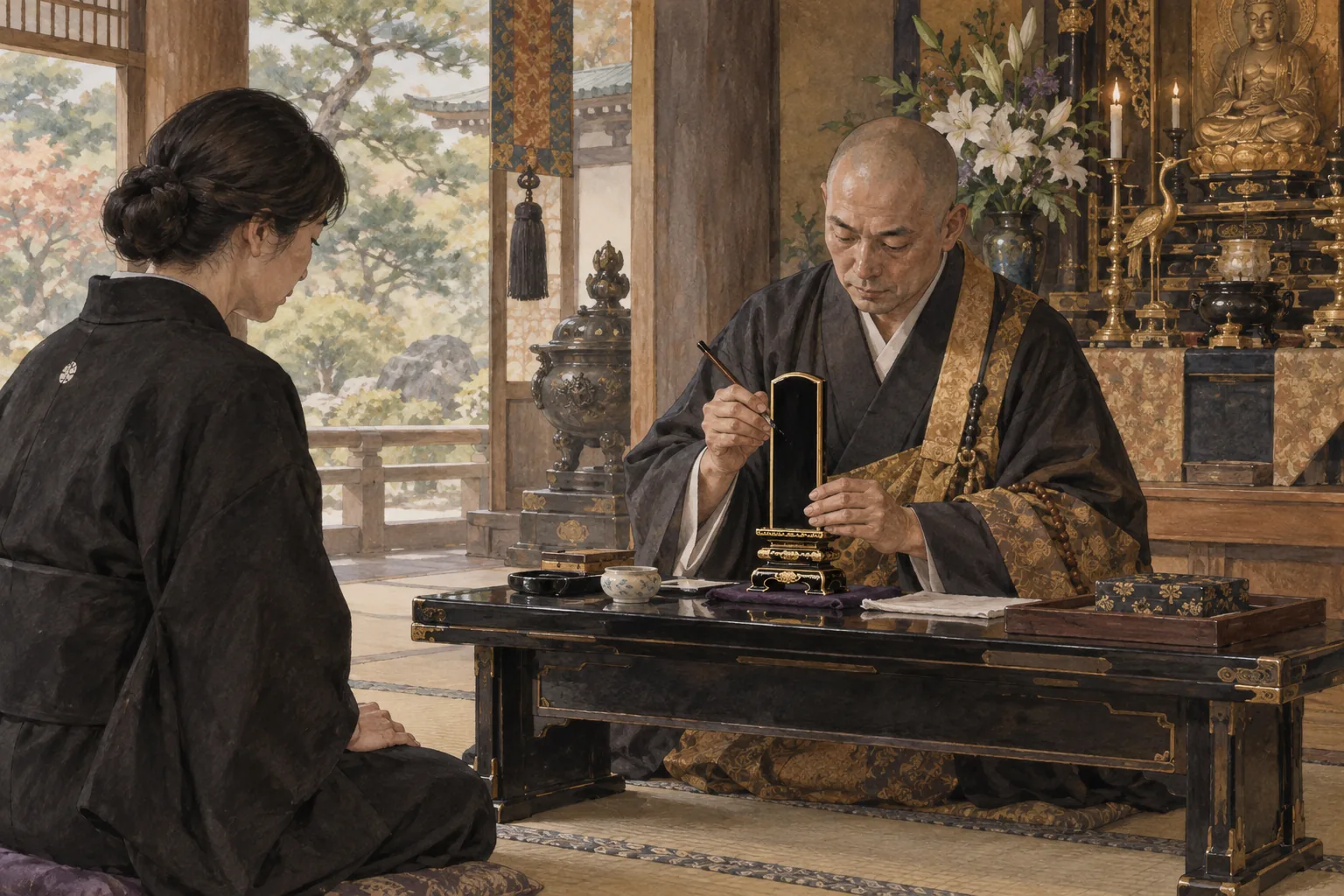
A kaimyo is the Buddhist name a person receives after death, at the funeral. Strictly it is the name given when one takes the precepts, which is why some people receive one while alive, but in practice most Japanese people are given one at their funeral and it is that name, not their living name, that appears on the memorial tablet and the gravestone.
The name is assembled from parts, and some of those parts are ranked: an honorific prefix marking exceptional contribution to the temple, characters indicating status, and a suffix that differs for men, women and children. Because the rank is reflected in what the family pays, the amounts involved can be substantial and they are not published as a price list, which makes the whole subject uncomfortable. Families who feel pressured can decline, and there is a slow move toward funerals with no kaimyo at all, though relatives may object strongly.
戒名とは、亡くなった人が葬儀の際に授かる仏教の名です。厳密には戒を受けるときに授かる名であり、だから生前に授かる人もいますが、実際には日本人の多くは葬儀で授かり、位牌や墓石に記されるのは生前の名ではなくその名です。
名はいくつかの部分から組み立てられ、そのうちいくつかには位があります。寺への特別な貢献を示す冠の号、格を表す文字、そして男性、女性、子どもで異なる末尾の語です。位が家の納める額に反映されるため、額が大きくなることもあり、しかも料金表として公表されるものではありません。
それがこの話題を居心地の悪いものにしています。求められることを負担に感じる家は断ることができますし、戒名を付けない葬儀へ向かうゆるやかな動きもあります。ただし、親族が強く反対することもあります。
Questions people actually ask
And how to answer them.
How much does it cost?
There is no fixed schedule, and it is framed as an offering rather than a price. Reported amounts vary widely by school, region and rank, from modest sums to figures that shock families. You may ask the temple directly what is customary.
定まった料金表はなく、代金ではなくお布施という形をとります。報じられる額は宗派、地域、位によって幅が広く、控えめなものから、遺族が驚く額までさまざまです。何が通例かを寺に直接尋ねてかまいません。
Can you refuse to have one?
You can, and some families do, particularly with non-religious funerals. The consequence to check is the grave: a temple cemetery may expect the temple's rites, so discuss it in advance rather than after the funeral.
断ることはできますし、無宗教の葬儀を選ぶ家などでは実際に断ります。確かめるべきは墓のことです。寺の墓地はその寺の儀礼を前提としていることがあるので、葬儀のあとではなく前に相談してください。
A common misunderstanding
MYTHA kaimyo is only ever given after death.
FACTIt is properly the name received on taking the Buddhist precepts, and people do receive one while alive. Most Japanese encounter it only at funerals, which is why it is read as a name for the dead.
Phrases you can use
- It's the name written on the grave.墓石に刻まれるのはこの名です。
- Parts of the name indicate rank.名の一部が位を表します。
- The temple receives an offering for it.寺にはお布施を納めます。
- You can ask what is customary.通例を尋ねてかまいません。
Words you need
- memorial tablet位牌
- gravestone墓石
- offering to a templeお布施
- precepts戒
Watch
From YouTubeBackground (Japanese)
戒名は宗派によって呼び方が異なり、浄土真宗では「法名」、日蓮宗では「法号」と言います。院号、道号、戒名、位号といった部分から成り、位号には信士・信女、居士・大姉などの段階があります。金額が明示されないことへの不満から、料金を公表する寺や、戒名を付けない葬儀を選ぶ人も出ています。生前に授かる戒名を「生前戒名」と呼び、あらかじめ決めておく人もいます。