ofuse
the money offered to a priest, with no stated price
お布施(おふせ)
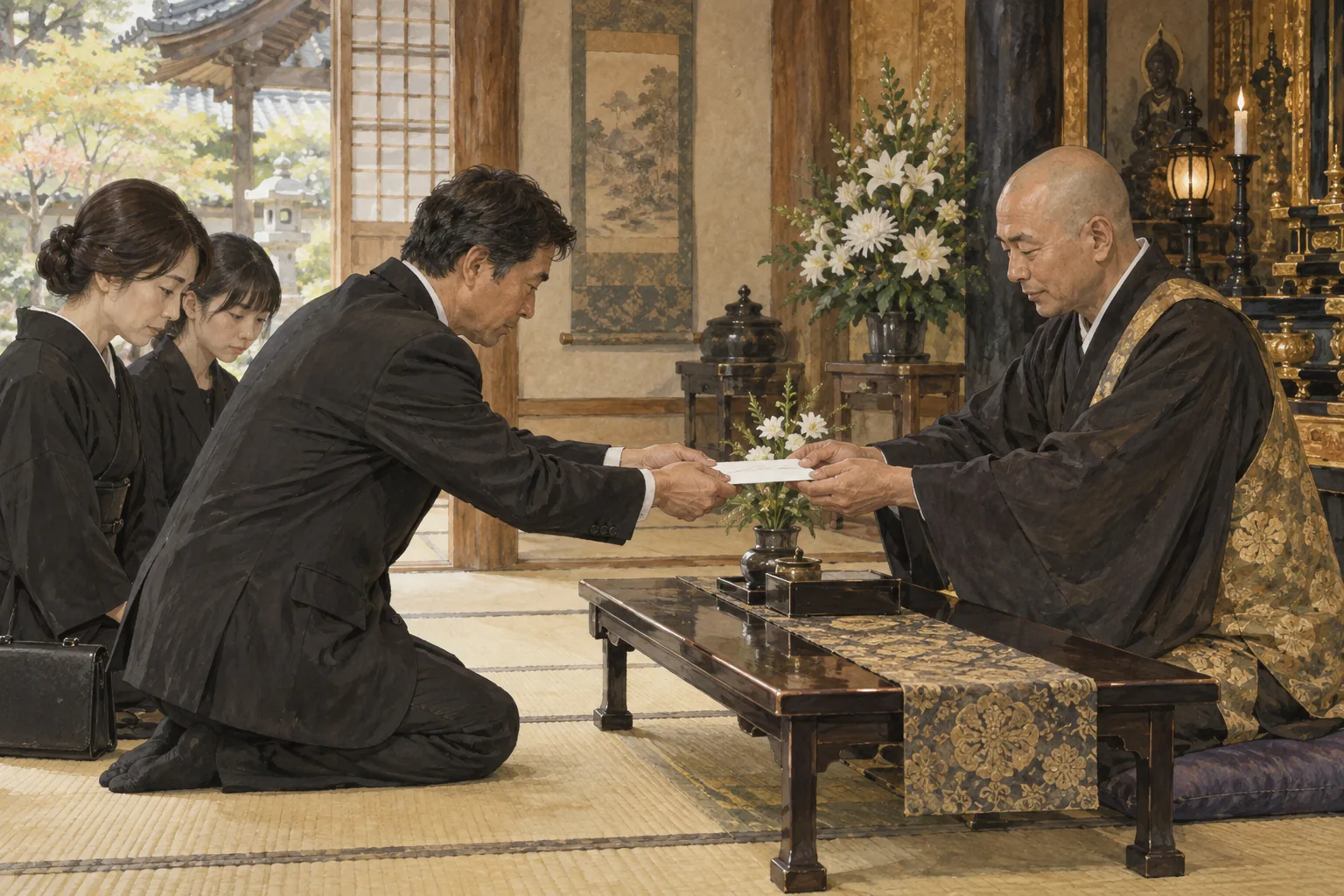
In one line
The shortest answer that works
Ofuse is money given to a temple for a ceremony, and it has no fixed price.
お布施とは、法要などの際に寺へ渡すお金のことで、決まった値段がありません。
In 30 seconds
The standard explanation
When a family holds a funeral or memorial service, they give the priest money in an envelope. This is ofuse. It is framed not as payment for a service but as an offering, so temples generally do not publish a price, and if you ask, the answer is often that it is up to you. In practice families ask relatives, funeral companies or the temple's parishioners what the local expectation is.
葬儀や法要を営むとき、家は僧侶に封筒に入れたお金を渡します。これがお布施です。役務への支払いではなく施しという位置づけなので、寺はふつう金額を示しません。尋ねても「お気持ちで」と返ってくることが多いです。実際には、親族や葬儀社、その寺の檀家に、その土地での相場を聞いて決めています。
As a short speech
A full paragraph you can read aloud
If a Japanese family holds a funeral, they hand the priest an envelope of money called ofuse. What confuses many people, Japanese included, is that there is no price. The doctrinal framing is that this is not a fee. A priest performing a rite is not selling a service, and the family is making an offering, so attaching a price would change what it is. The practical result is that families have to guess.
They ask relatives, they ask the funeral company, or they ask other families connected to the temple, and an unofficial local going rate exists that nobody states out loud. Some temples have begun publishing figures because people found the ambiguity stressful, and there is debate within the Buddhist world about whether stating prices turns a rite into a transaction.
There is a second layer: the envelope's wording, the type of envelope and how it is handed over all follow conventions. If you are ever in this position as a foreigner, ask the funeral company. That is a normal question and they answer it every day.
日本の家が葬儀を営むとき、僧侶にお布施という封筒を渡します。日本人も含めて多くの人が戸惑うのは、値段が無いことです。教えの上では、これは料金ではありません。僧侶が儀式を行うのは役務を売ることではなく、家は施しをしている、という位置づけなので、値段を付けると意味が変わってしまいます。
結果として、家は推測することになります。親族に聞き、葬儀社に聞き、その寺に関わる他の家に聞く。誰も口には出さない、土地ごとの相場が存在します。分からなくて苦しいという声を受けて、金額を示す寺も出てきましたが、金額を示すことが儀式を取引に変えてしまわないか、仏教界の中でも議論があります。
もう一段あって、封筒の表書き、封筒の種類、渡し方にも作法があります。もし外国の方がこの立場になったら、葬儀社に聞いてください。ごく普通の質問で、毎日答えていることです。
Questions people actually ask
And how to answer them.
So how much do people actually give?
It varies a great deal by region, by sect and by the scale of the ceremony, and there is no figure that is correct everywhere. The reliable move is to ask the funeral company or a relative who has done it locally.
地域、宗派、法要の規模で大きく変わり、どこでも正しいという金額はありません。確実なのは、葬儀社か、その土地で経験のある親族に聞くことです。
Is it a donation or a payment?
Formally it is an offering, and that is why no price is stated. In practice it functions as the temple's income, which is exactly the tension people feel about it.
形の上では施しで、だから金額が示されません。実際には寺の収入になっており、多くの人が感じる居心地の悪さはそこにあります。
Is there anything besides the ofuse?
Often yes. Money for the priest's transport and money in place of a meal may be given in separate envelopes, and the thanks for a posthumous Buddhist name may be included in the ofuse or given separately, depending on the temple. The funeral company will lay out what is customary.
あることが多いです。御車代や御膳料を別の封筒で渡すことがあり、戒名へのお礼は、お布施に含める場合も別に包む場合もあり、寺によって違います。何が慣例かは葬儀社が教えてくれます。
A common misunderstanding
MYTHTemples charge a set fee for funerals and Japanese people know what it is.
FACTNo price is stated, by design, and most families do not know the figure either. They ask relatives or the funeral company, and the amount varies by region and sect.
Phrases you can use
- There's no set price — it's framed as an offering.決まった値段はありません。施しという位置づけなので。
- If you ask, they'll usually say it's up to you.聞いても、たいてい「お気持ちで」と言われます。
- Families ask the funeral company what's customary locally.家は、その土地での慣例を葬儀社に聞きます。
- It goes in an envelope; you don't hand over bare cash.専用の封筒に入れて渡します。現金のままは渡しません。
- Japanese people find this awkward too, honestly.正直なところ、日本人もここは戸惑っています。
Words you need
- offering布施、施し
- priest僧侶、お坊さん
- memorial service法要、法事
- envelope (for money)封筒、不祝儀袋
- going rate相場
Watch
From YouTubeBackground (Japanese)
布施はもともと仏教における六波羅蜜のひとつで、財を施す財施、教えを説く法施、恐れを取り除く無畏施に分けられる。金額を示さないのは、見返りを求めない施しという位置づけによるが、近年は金額の目安を示す寺や、僧侶を手配する事業も現れ、仏教界で議論になっている。封筒の表書きは「御布施」とし、葬儀であっても薄墨は使わないとされるのが一般的である(薄墨は遺族への香典に用いる)。なお宗派や地域で作法が異なるため、迷ったら寺か葬儀社に直接尋ねるのが確実である。