jichinsai
the ceremony held before building on a piece of land
地鎮祭(じちんさい)
In one line
The shortest answer that works
Jichinsai is a Shinto ceremony held on an empty plot before construction begins.
地鎮祭とは、工事を始める前に、更地で行う神道の儀式です。
In 30 seconds
The standard explanation
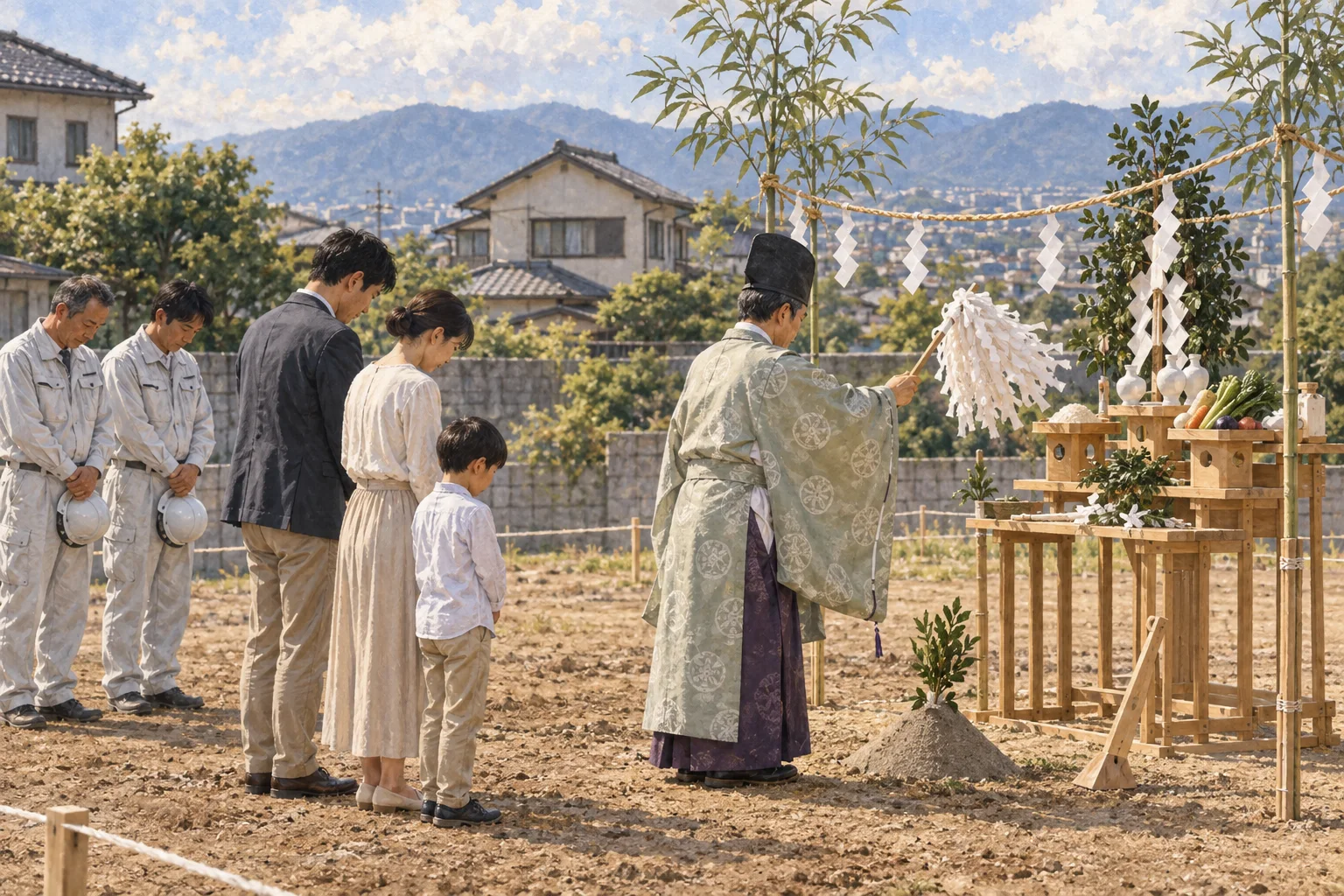
Before a house or a building goes up, a priest is often invited to the empty site. Four bamboo poles are set at the corners with a rope between them, offerings are laid out, prayers are read, and the owner and builder cut into a small mound of sand. The ceremony asks permission of the deity of the land and prays for safety during construction.
家や建物を建てる前に、更地へ神職を招くことがよくあります。四隅に竹を立てて縄を張り、供え物を並べ、祝詞をあげ、施主と施工者が盛り砂に鍬を入れます。土地の神に断りを入れ、工事の安全を願う儀式です。
As a short speech
A full paragraph you can read aloud
If you pass an empty building site in Japan and see four bamboo poles at the corners with a rope strung between them and a white tent in the middle, you are looking at a jichinsai. It is the ceremony held before construction starts. A Shinto priest is invited, an altar is set up with offerings of rice, salt, water, sake, fish and vegetables, prayers are read, and the people present offer a sprig of sacred evergreen.
The part everyone recognizes is a small mound of sand into which the owner, the architect and the builder cut in turn with a wooden implement, which symbolizes breaking ground. The purpose is to report the construction to the deity of the land, ask permission and pray that nobody is hurt during the work.
What is interesting is who takes part. Large construction companies hold these routinely, and engineers who describe themselves as having no religion attend without hesitation, because it functions as a marker of the start of work and a public commitment to safety as much as a religious rite.
日本で更地を通りかかり、四隅に竹が立って縄が張られ、真ん中に白いテントがあるのを見たら、それは地鎮祭です。工事を始める前に行う儀式です。神職を招き、祭壇に米・塩・水・酒・魚・野菜を供え、祝詞をあげ、参列した人が榊の枝を捧げます。
誰もが見て分かるのが、盛り砂に施主、設計者、施工者が順に鍬などを入れる場面で、これが着工を象徴しています。目的は、工事をすることを土地の神に報告し、許しを願い、作業中に誰もけがをしないよう祈ることです。
面白いのは、誰が参列するかです。大きな建設会社はこれを日常的に行い、自分は無宗教だと言う技術者も、ためらわずに参列します。宗教の儀式であると同時に、工事の始まりを示す区切りであり、安全を人前で約束する場でもあるからです。
Questions people actually ask
And how to answer them.
Is it compulsory?
No. It is customary rather than required, and some owners skip it to save cost or because they prefer not to. Large contractors usually propose it as a matter of course, and it is often included in the schedule.
義務ではありません。習慣であって必要な手続きではなく、費用のために、あるいは望まないために行わない施主もいます。大きな施工会社は当然のように提案し、日程に組み込まれていることが多いです。
What does it cost?
The offering to the priest is commonly in the range of twenty to fifty thousand yen, with the builder often preparing the bamboo, the altar and the offerings. Ask the contractor what is included before arranging anything.
神職への初穂料は二万円から五万円ほどが一般的で、竹や祭壇、供え物は施工会社が用意することが多いです。手配の前に、どこまで含まれているかを施工会社に確かめてください。
Do I have to be religious to hold one?
Most people who hold one do not describe themselves as religious. It is treated as a customary marker of starting work, and the same family may have a Christian-style wedding and a Buddhist funeral.
行う人の多くは、自分を信心深いとは考えていません。工事の始まりを示す習わしとして扱われており、同じ家族がキリスト教式で結婚し、仏式で葬儀を行うこともあります。
Phrases you can use
- We are holding the ground-breaking ceremony on Saturday.土曜に地鎮祭を行います。
- A priest will come to the site.現場に神職が来ます。
- It is to pray for safety during the work.工事の安全を願うためのものです。
- Does the builder arrange everything?準備は施工会社がしてくれますか。
- The owner cuts into the sand first.最初に施主が砂に鍬を入れます。
Words you need
- a construction site工事現場
- to break ground土に鍬を入れる
- an offeringお供え・初穂料
- a priest神職
- safety during work工事の安全
Watch
From YouTubeBackground (Japanese)
四隅に立てる竹に縄を張り、紙垂を下げて、その内側を清めた場とします。供え物は米・塩・水・酒に、海のもの、山のもの、野のものを添えるのが一般的です。盛り砂に鍬を入れる場面では、設計者が鎌、施主が鍬、施工者が鋤を用いる形が広く行われています。神式のほか、仏式やキリスト教式で行う例もあります。ビルの工事では、完成の前に上棟や竣工の儀式を行うこともあります。近年は簡略にしたり、行わない選択をする施主も増えています。