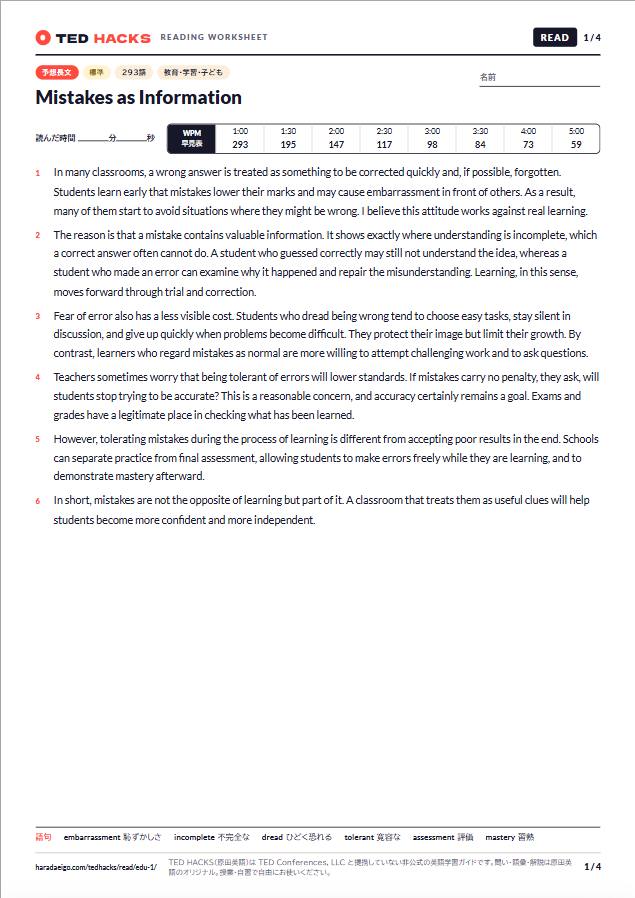
In many classrooms, a wrong answer is treated as something to be corrected quickly and, if possible, forgotten. Students learn early that mistakes lower their marks and may cause embarrassment in front of others. As a result, many of them start to avoid situations where they might be wrong. I believe this attitude works against real learning.
The reason is that a mistake contains valuable information. It shows exactly where understanding is incomplete, which a correct answer often cannot do. A student who guessed correctly may still not understand the idea, whereas a student who made an error can examine why it happened and repair the misunderstanding. Learning, in this sense, moves forward through trial and correction.
Fear of error also has a less visible cost. Students who dread being wrong tend to choose easy tasks, stay silent in discussion, and give up quickly when problems become difficult. They protect their image but limit their growth. By contrast, learners who regard mistakes as normal are more willing to attempt challenging work and to ask questions.
Teachers sometimes worry that being tolerant of errors will lower standards. If mistakes carry no penalty, they ask, will students stop trying to be accurate? This is a reasonable concern, and accuracy certainly remains a goal. Exams and grades have a legitimate place in checking what has been learned.
However, tolerating mistakes during the process of learning is different from accepting poor results in the end. Schools can separate practice from final assessment, allowing students to make errors freely while they are learning, and to demonstrate mastery afterward.
In short, mistakes are not the opposite of learning but part of it. A classroom that treats them as useful clues will help students become more confident and more independent.