

 ワークシート
 ぬりえ
 迷路
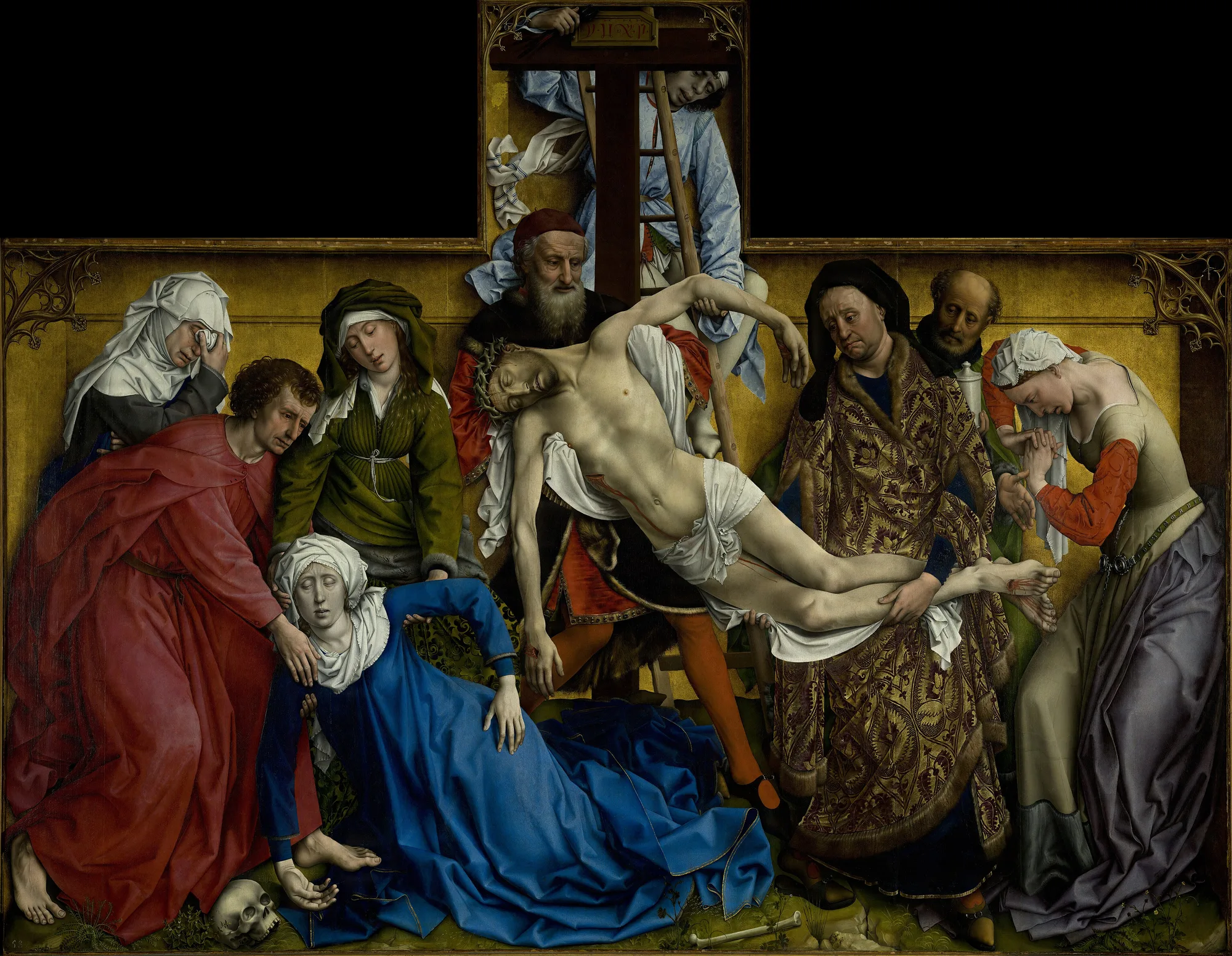
ガラス玉のような涙。600年前の、世界でいちばん悲しい場面。Tears like glass beads. Perhaps the saddest scene in art, 600 years old.
この作品のお話
Story十字架で亡くなったイエス・キリストのなきがらを、弟子たちが下ろす場面です。金色の浅い箱のような空間に、10人の人物が彫刻のようにぎっしり並んでいます。気を失ってくずれ落ちる聖母マリア、それをささえるヨハネ、右はしで手をよじって泣くマグダラのマリア。一人ひとりの悲しみ方がちがいます。
This scene shows Jesus's followers taking his body down from the cross. Ten figures fill a shallow golden space, like statues in a box. Mary, his mother, faints, and John holds her. On the far right, Mary Magdalene twists her hands and cries. Each person shows sorrow in a different way.
ベルギーの町ルーヴェンの「弓の射手の組合」が、自分たちの礼拝堂のために注文しました。画家は、当時ふつうだった木彫りの祭壇をまねて、背景を金色にし、人物を浮き彫りのように描きました。キリストとマリアの体が同じ形にかたむいているのは、母が子の苦しみを共にしていることを表しています。
The crossbowmen's guild of Leuven, in Belgium, ordered this painting for their chapel. Rogier copied the look of carved wooden altarpieces, which were common then. He made the background gold and painted the figures like sculptures. Christ's body and Mary's body lean in the same way. This shows that the mother shares her son's suffering.
評判は高く、16世紀にネーデルラント総督マリア(ハンガリー王妃)が、模写とパイプオルガンと引きかえに手に入れました。その後スペイン王フェリペ2世のものとなり、エル・エスコリアル修道院に置かれます。スペイン内戦のときには国外へ避難し、1939年にスペインへもどってからは、プラド美術館に置かれています。
It was very famous. In the 1500s, Mary of Hungary, the ruler of the Netherlands, got it in exchange for a copy and an organ. Later it belonged to King Philip II of Spain and was kept at El Escorial. During the Spanish Civil War, it was moved abroad for safety. Since it came back to Spain in 1939, it has been at the Prado.
イエスは十字架の上で亡くなりました。いま、仲間たちが彼の体を下ろしています。母マリアはたおれてしまいます。みんなとても悲しんでいます。顔を見てください。小さなガラス玉のような、透明な涙が見えます。
Jesus died on the cross. Now his friends take his body down. His mother Mary falls down. Everyone is very sad. Look at their faces. You can see clear tears, like little glass beads.
英語のレベルは上の「やさしい/ふつう」で切りかえられます。
えっ!?な裏ネタ
Secrets絵の上の左右のすみの、金色の飾り模様をよく見ると、小さな弓(クロスボウ)がぶら下がっています。注文主の「弓の射手の組合」のしるしです。キリストの体の曲線を弓の形に重ねる見方もあります。
Look closely at the golden decorations in the upper corners. Tiny crossbows hang there. They are the sign of the crossbowmen's guild that ordered the painting. Some people also see the curve of Christ's body as the shape of a bow.
マリアたちのほおには、透明な涙が描かれています。光をうけて、まるでガラス玉のよう。美術史家パノフスキーは、この涙を「強い感情から生まれた、輝く真珠」とたたえました。
Clear tears run down the women's cheeks. They catch the light like little glass beads. The art historian Erwin Panofsky praised them as shining pearls born of strong emotion.
16世紀、この絵をほしがったマリア(ハンガリー王妃)は、画家ミヒール・コクシーに描かせた模写と、パイプオルガンを礼拝堂に贈り、かわりに本物を手に入れました。それほどほしい絵だったのです。
In the 1500s, Mary of Hungary wanted this painting very much. She gave the chapel a copy by the painter Michiel Coxcie and a pipe organ, and took the original in return.
1990年代、古い板には割れそうなひびが入り、絵の具もはがれかけていました。プラド美術館は、アメリカのメトロポリタン美術館の板絵修復の専門家とともに修復し、作品を守りました。
By the 1990s, the old wooden panel had cracks that could split it, and some paint was coming off. The Prado repaired it with a panel expert from the Metropolitan Museum of Art in New York.
ここを見て!
Look Closer1気を失う聖母マリアMary fainting
青い服のマリアが気を失ってくずれ落ちます。体の形は、上のキリストとそっくり同じかたむきです。
Mary, in blue, faints and falls. Her body leans in the same way as Christ's body above her.
2手をよじるマグダラのマリアMary Magdalene twisting her hands
右はしで、体を折り曲げて手をよじり、悲しみにたえるマグダラのマリア。
On the far right, Mary Magdalene bends her body and twists her hands in grief.
3小さな弓A tiny crossbow
金の飾りの先に、小さな弓がぶら下がっています。注文した組合のしるしです。
A tiny crossbow hangs from the gold decoration. It is the sign of the guild that ordered the painting.
4ドクロThe skull
足もとのドクロは、最初の人間アダムのものとされます。キリストがアダムの罪をつぐなうという意味がこめられています。
The skull at their feet is said to be Adam's, the first man. It shows the idea that Christ saves people from Adam's sin.
英語で名画を語ろう
Talk about Art in EnglishMary falls in the same pose as her son.
マリアは息子と同じポーズでたおれています。
💡 2人の人物の姿勢をくらべるときに便利。pose は「ポーズ・姿勢」で、日本語のポーズと同じです。
英語で説明すると… Describe it
これは金色の背景の悲しい宗教画です。真ん中では、2人の男がイエスの体をささえています。左では、青い服の女性が気を失っています。右では、長いドレスの女性が泣いています。
This is a sad religious scene on a gold background. In the center, two men are holding the body of Jesus. On the left, a woman in blue is fainting. On the right, a woman in a long dress is crying.
考えてみよう Think & Talk
- あなたには、だれがいちばん悲しそうに見えますか?それはなぜ?Which person looks the saddest to you? Why?
- 画家はなぜ風景ではなく金色の背景にしたのだと思いますか?Why do you think the painter used a gold background instead of a landscape?
この作品の英単語
WordsMary faints with sorrow.
マリアは悲しみのあまり気を失います。
Clear tears run down her cheeks.
透明な涙が彼女のほおを流れています。
Each person shows grief in a different way.
一人ひとりがちがう形で深い悲しみを表しています。
A crossbowmen's guild ordered this painting.
弓の射手の組合がこの絵を注文しました。
ミニクイズ
QuizQ. この絵を注文したのは、どんな人たちの組合?What kind of guild ordered this painting?
ルーヴェンの弓の射手の組合です。すみに小さな弓が描かれています。
The crossbowmen's guild of Leuven. Tiny crossbows are painted in the corners.
ウソ?ホント? 気を失うマリアの体は、キリストの体と同じようにかたむいている。Mary's fainting body leans the same way as Christ's body.
母が子の苦しみを共にしていることを表しています。
It shows that the mother shares her son's suffering.
ウソ?ホント? 背景には、エルサレムの町と青空が描かれている。The background shows the city of Jerusalem and a blue sky.
背景は金色の平らな壁で、木彫りの祭壇のように見せています。
The background is flat gold, like a carved wooden altarpiece.
 画像の出典とライセンス / Image credit
- PDEl Descendimiento, by Rogier van der Weyden, from Prado in Google Earth.jpg(Wikimedia Commons)
ライセンス:Public domain(パブリックドメイン)/作者・撮影者の表記:Rogier van der Weyden/提供元:The Prado in Google Earth: Home page 7th level of zoom, JPEG compression quality: Photoshop 9.
この作品は、作者の死後長い年月がたち著作権の保護期間が終わった「パブリックドメイン」の作品です。画像は平面の作品を忠実に写したもので、新しい著作権は生じません(Wikimedia Commons の PD-Art の考え方)。 所蔵:プラド美術館(Museo del Prado)。画像は表示のために縮小・WebP 形式に変換しています。
