 ワークシート
 ぬりえ
 迷路
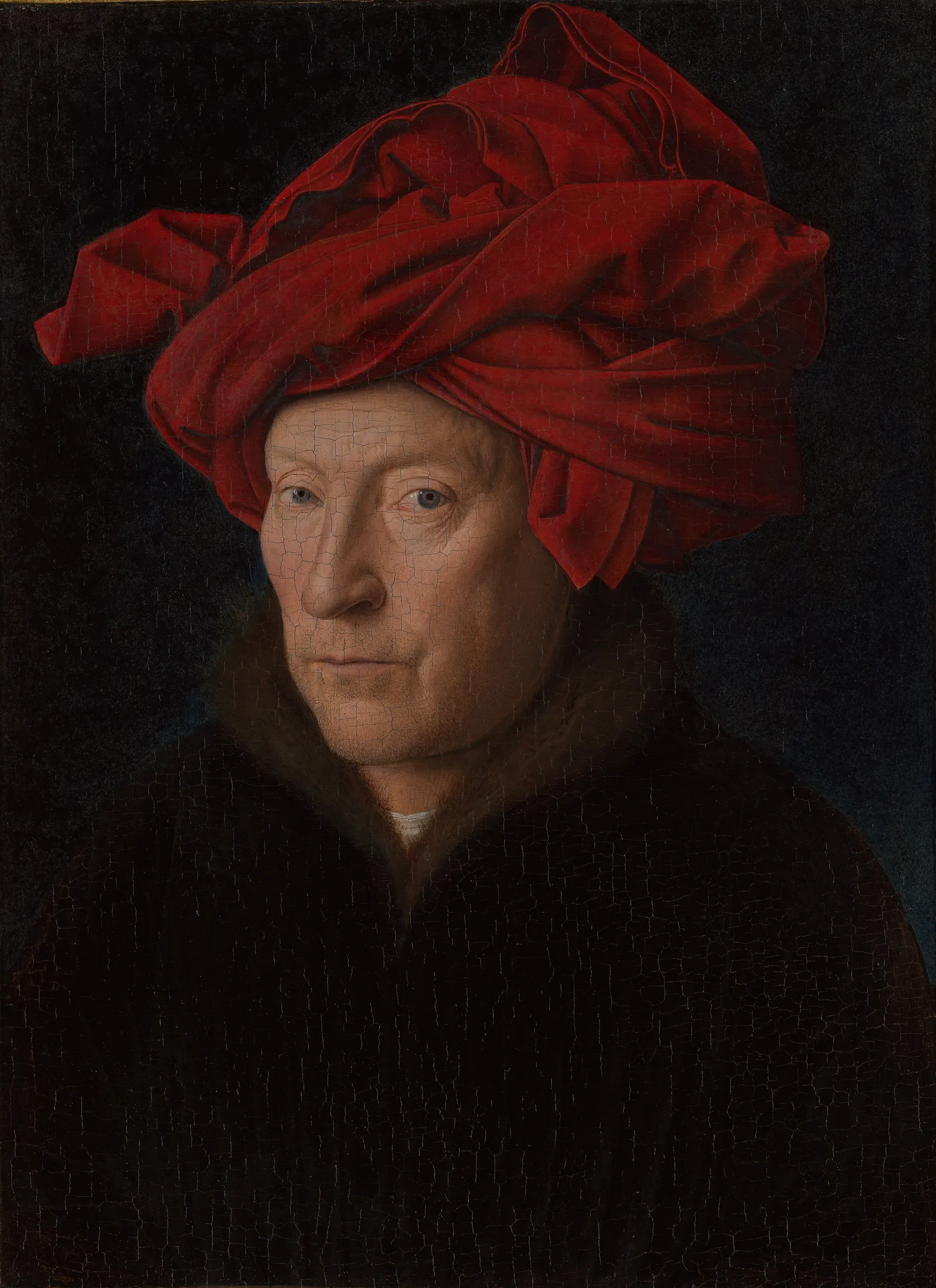
画家本人かもしれない男。額に書かれたなぞの言葉は「私にできるかぎり」。Is this the painter himself? His motto reads 'As I can.'
この作品のお話
Story赤い布を頭に巻いた男性が、少しななめからこちらを見ています。1433年、フランドル(今のベルギー)の画家ヤン・ファン・エイクが描いた肖像画で、今はロンドンのナショナル・ギャラリーにあります。縦26センチほどの小さな板の絵ですが、しわや無精ひげまで、虫めがねで見たように描かれています。
A man with a red cloth wrapped around his head looks at us from a slight angle. Jan van Eyck, a painter from Flanders (now Belgium), painted this portrait in 1433. It is now in the National Gallery in London. The panel is only about 26 cm tall, but every wrinkle and bit of stubble is painted as if seen through a magnifying glass.
ファン・エイクは油絵の具をたくみに使い、光や質感を本物そっくりに表した画家です。赤い布の深いひだ、毛皮のえりのやわらかさ、うるんだ目の光まで、細かな筆づかいで描き分けています。男性は見る人の目をまっすぐ見つめていて、こうした肖像画の早い例の一つとされます。
Van Eyck used oil paint skillfully to make light and textures look real. With fine brushwork, he painted the deep folds of the red cloth, the soft fur collar and the wet shine of the eyes. The man looks straight into our eyes, and this is thought to be one of the earliest portraits to do so.
もとの額には、画家の手で文字が書かれています。下には「ヤン・ファン・エイクが私を作った。1433年10月21日」、上には「ALS ICH CAN(私にできるかぎり)」。モデルの名前がどこにもないことから、画家の自画像ではないかと考えられています。この画像は絵の部分だけで、額は写っていません。
Words are written on the original frame. At the bottom it says, 'Jan van Eyck made me, 21 October 1433.' At the top it says 'ALS ICH CAN,' meaning 'As I can.' Since the sitter's name appears nowhere, many think it may be a self-portrait. This image shows only the painting, not the frame.
男の人が頭に大きな赤い布を巻いています。こちらを見ています。この絵はとても小さいです。でも顔の細かいしわまで見えます。もしかすると、画家が自分を描いたのかもしれません!
A man wears a big red cloth on his head. He looks at us. The picture is very small. But you can see tiny lines on his face. Maybe the painter painted himself!
英語のレベルは上の「やさしい/ふつう」で切りかえられます。
えっ!?な裏ネタ
Secrets「ALS ICH CAN」は「私にできるかぎり」という意味です。「ICH(私)」の音が画家の名前「エイク」に似ていることから、名前をかけただじゃれの合い言葉だと考えられています。ひかえめなようで、腕前への自信も感じられます。
'ALS ICH CAN' means 'As I can.' The word 'ICH' (I) sounds like the painter's name, Eyck, so the motto is thought to be a pun on his name. It sounds modest, but it also shows pride in his skill.
ファン・エイクは1439年に妻マルグリットの肖像も描いています。その額には「夫ヤンが私を完成させた」という言葉とともに、同じ合い言葉が、ギリシャ文字をまぜたつづりで書かれています。今はベルギーのブルッヘの美術館にあります。
In 1439, Van Eyck also painted his wife, Margaret. Her frame says that her husband Jan finished the portrait. It also has the same motto, spelled with some Greek letters. That portrait is now in a museum in Bruges, Belgium.
目に顔を近づけると、白目に細い赤い血管が描かれているのが分かります。そこまで描きこむ画家はめったにいません。自画像だとすれば、鏡を長く見つめていたせいでは、と想像する人もいます。
Look closely and you will see thin red veins in the whites of his eyes. Very few painters show such detail. If it is a self-portrait, some imagine his eyes were tired from staring into a mirror for a long time.
ターバンに見える赤い布は、当時のフランドルで流行した「シャプロン」という帽子です。輪の形のかぶりものに長い布のしっぽがついていて、ここではそのしっぽを頭に巻きつけています。画家はその複雑なひだを、まるで彫刻のように立体的に描き出しました。
The red cloth that looks like a turban is a chaperon, a fashionable hat in Flanders at that time. It had a ring-shaped headpiece with a long tail of cloth, and here the tail is wrapped around the head. Van Eyck painted its many folds so that they look almost like sculpture.
ここを見て!
Look Closer1赤いシャプロンThe red chaperon
頭に巻いた赤い布。深いひだに光と影がくっきりつけられています。
The red cloth wrapped around his head. Light and shadow show its deep folds clearly.
2血管まで描いた目Eyes with tiny veins
こちらを見つめる目。白目には細い赤い血管が描かれています。
His eyes look right at us. You can see thin red veins in the whites.
3無精ひげStubble
あごやほおに、のびかけのひげ。一本一本、細い筆で描かれています。
Short stubble on his chin and cheeks. Each hair is painted with a fine brush.
4毛皮のえりFur collar
暗い服のえりもとには、やわらかな毛皮がのぞいています。
Soft fur peeks out at the collar of his dark coat.
英語で名画を語ろう
Talk about Art in EnglishVan Eyck painted every detail as well as he could.
ファン・エイクは、一つ一つの細部をできるかぎりうまく描きました。
💡 as well as one can で「できるかぎりうまく」。額の ALS ICH CAN は「私にできるかぎり」。
英語で説明すると… Describe it
これは男性の肖像画です。頭に大きな赤い布を巻いています。真剣な目でこちらを見ています。背景がとても暗いので、顔が目立っています。
This is a portrait of a man. He is wearing a large red cloth around his head. He is looking at us with serious eyes. The background is very dark, so his face stands out.
考えてみよう Think & Talk
- これは自画像だと思いますか?それはなぜ?Do you think this is a self-portrait? Why or why not?
- もし自画像を描くなら、何を身につけますか?それはなぜ?If you painted yourself, what would you wear, and why?
この作品の英単語
WordsYou can see every wrinkle on his face.
顔のしわがひとつ残らず見えます。
He wraps a red cloth around his head.
彼は頭に赤い布を巻きつけています。
His motto was 'As I can.'
彼のモットーは「私にできるかぎり」でした。
He painted tiny details with a fine brush.
彼は細い筆でとても小さな部分まで描きました。
ミニクイズ
QuizQ. 額の言葉「ALS ICH CAN」の意味は?What does 'ALS ICH CAN' on the frame mean?
画家の合い言葉で、名前「エイク」とかけただじゃれとも考えられています。
It was the painter's motto, and it may be a pun on his name, Eyck.
ウソ?ホント? この絵は縦2メートルをこえる大きな絵だ。This painting is more than 2 meters tall.
縦26センチほどの小さな絵です。
It is a small painting, only about 26 cm tall.
ウソ?ホント? 額には、絵が描かれた日付まで書かれている。The frame even shows the date the painting was made.
「1433年10月21日」と書かれています。
It says '21 October 1433.'
 画像の出典とライセンス / Image credit
- PDJan van Eyck - Portrait of a Man (Self Portrait?) 1433.jpg(Wikimedia Commons)
ライセンス:Public domain(パブリックドメイン)/作者・撮影者の表記:Jan van Eyck
この作品は、作者の死後長い年月がたち著作権の保護期間が終わった「パブリックドメイン」の作品です。画像は平面の作品を忠実に写したもので、新しい著作権は生じません(Wikimedia Commons の PD-Art の考え方)。 所蔵:ナショナル・ギャラリー(ロンドン)(The National Gallery, London)。画像は表示のために縮小・WebP 形式に変換しています。