

 ワークシート
 ぬりえ
 迷路
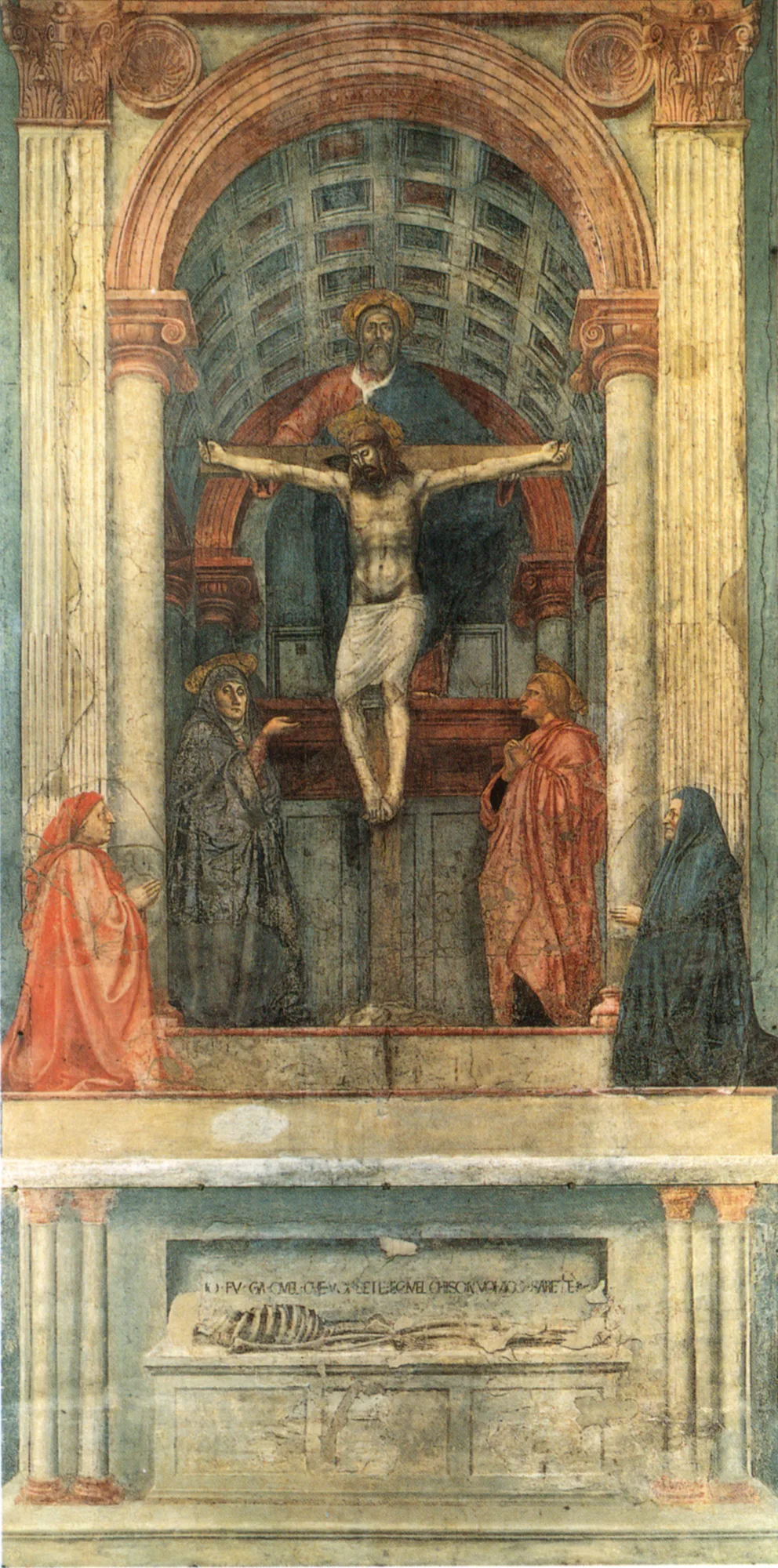
壁に穴が開いている!?遠近法で描いた、最初期のだまし絵。Is there a hole in the wall? One of the first paintings to use true perspective.
この作品のお話
Story平らな壁なのに、まるで奥に礼拝堂があるように見えるフレスコ画です。中央には十字架のイエス、その後ろに父なる神。左右には聖母マリアと聖ヨハネが立ち、さらに手前では、絵を注文した夫婦がひざまずいて祈っています。いちばん下には、石の棺の上に横たわるがいこつが描かれています。
This fresco is painted on a flat wall, but it looks as if a chapel opens up behind it. In the center is Jesus on the cross, with God the Father behind him. Mary and Saint John stand on either side, and in front, the couple who ordered the painting kneel and pray. At the very bottom, a skeleton lies on a stone tomb.
作者マザッチョは、建築家ブルネレスキが考え出した「線遠近法」を本格的に絵に使った、最初の画家の一人です。天井のアーチの格子模様では、奥へ向かう線が一つの点に集まり、その点は見る人の目の高さに置かれています。のちの画家・伝記作家ヴァザーリは、壁に穴が開いているように見えると、この遠近法をほめたたえました。
Masaccio was one of the first painters to use linear perspective, a method worked out by the architect Brunelleschi. The lines of the coffered ceiling that go back into space all meet at one point, and that point is at the viewer's eye level. Later, the artist and writer Vasari praised it, saying the vault looked like a hole in the wall.
1570年ごろ、画家ヴァザーリが聖堂を改装した際、この絵の前に新しい祭壇が作られ、絵は長いあいだ隠れてしまいました。1860年に再発見され、上の部分はいったん別の場所に移されましたが、下のがいこつの部分もやがて見つかり、1952年に元の場所でふたたび一つになりました。
Around 1570, when the artist Vasari redesigned the church, a new altar was built in front of the fresco, and it was hidden for a long time. It was rediscovered in 1860. The upper part was moved to another place in the church for a while. Later, the skeleton section was also found, and in 1952 the two parts were joined again in their original place.
この絵は平らな壁に描かれています。でも、奥深い部屋があるように見えるのです!マザッチョは「遠近法」という新しい描き方を使いました。いちばん下には、がいこつがいます。マザッチョはわずか26歳で亡くなりました。
This painting is on a flat wall. But it looks like a deep room! Masaccio used a new way of drawing called perspective. At the bottom, there is a skeleton. Masaccio died young, at only 26.
英語のレベルは上の「やさしい/ふつう」で切りかえられます。
えっ!?な裏ネタ
Secrets下のがいこつの上には「わたしはかつて、あなたと同じだった。そして今のわたしの姿に、あなたもいつかなる」という意味の言葉が書かれています。人はだれでもいつか死ぬのだから、よく生きなさい、というメッセージです。
Above the skeleton are words that mean, “I once was what you are, and what I am, you also will be.” Everyone will die someday, so live a good life — that is the message.
1570年ごろ、ヴァザーリが聖堂を改装したとき、この絵の前に石の祭壇と別の絵が置かれ、絵は見えなくなりました。それでも主な部分は壁に残り、1860年に再発見されます。隠されたことで多くが守られた一方、傷ついた部分もあります。
Around 1570, when Vasari redesigned the church, a stone altar and another painting were placed in front of the fresco, and it disappeared from view. But most of it stayed on the wall, and it was found again in 1860. Being hidden helped save much of the painting, although some parts were damaged.
マザッチョの本名はトンマーゾ。マザッチョは「ぶかっこうな(だらしない)トマソ」といった意味のあだ名です。ヴァザーリによると、絵に夢中で、身なりやお金のことにまったく無頓着だったからだそうです。
Masaccio's real name was Tommaso. “Masaccio” is a nickname that means something like “clumsy” or “messy Tom.” According to Vasari, he was so focused on painting that he did not care at all about his clothes or money.
マザッチョは1428年、ローマで亡くなりました。まだ26歳でした。活動した期間はわずか数年なのに、遠近法や、重さを感じさせる人物の表現で、ルネサンス絵画の流れを大きく変えました。
Masaccio died in Rome in 1428. He was only 26. He worked for just a few years, but with perspective and solid, weighty figures, he changed the course of Renaissance painting.
ここを見て!
Look Closer1アーチの天井The arched ceiling
四角い格子が奥へ向かって小さくなる天井。遠近法で、本当にくぼんでいるように見えます。
The square panels of the ceiling get smaller as they go back. Thanks to perspective, it looks truly deep.
2父なる神God the Father
十字架のうしろに立ち、両手で十字架をささえる神。その下に、聖霊を表す白い鳩が小さく描かれています。
God stands behind the cross and holds it up with both hands. Below him, a small white dove stands for the Holy Spirit.
3注文主の夫婦The donors
左右の手前でひざまずく男女は、この絵を注文した夫婦です。聖人たちと同じ大きさで描かれています。
The man and woman kneeling at the front on each side are the couple who paid for the painting. They are shown the same size as the saints.
4がいこつThe skeleton
石の棺の上に横たわるがいこつ。上には、見る人へのメッセージが書かれています。
A skeleton lies on a stone tomb. Above it is a message for everyone who looks.
英語で名画を語ろう
Talk about Art in EnglishThe wall looks as if it has a deep chapel inside.
その壁は、まるで中に奥深い礼拝堂があるかのように見えます。
💡 だまし絵や立体感を説明するのにぴったり。as if のあとには文が続きます。
英語で説明すると… Describe it
これは教会の壁に描かれた背の高い絵です。真ん中では、大きなアーチの下でイエスが十字架にかけられています。両側では、男性と女性がひざまずいて祈っています。いちばん下には、石の箱の上に横たわるがいこつがあります。
This is a tall painting on a church wall. In the center, Jesus is on the cross under a big arch. On both sides, a man and a woman are kneeling and praying. At the bottom, there is a skeleton lying on a stone box.
考えてみよう Think & Talk
- がいこつは「わたしはかつて、あなたと同じだった」と言います。このメッセージはどんな意味だと思いますか?The skeleton says, “I once was what you are.” What do you think this message means?
- 1400年代の人々は、なぜ遠近法にそんなに驚いたのだと思いますか?Why do you think people in the 1400s were so amazed by perspective?
この作品の英単語
WordsA skeleton lies at the bottom of the painting.
絵のいちばん下にがいこつが横たわっている。
The painting creates an illusion of a deep chapel.
その絵は、奥深い礼拝堂があるような錯覚を生む。
The fresco was discovered again in 1860.
そのフレスコ画は1860年に再発見された。
It is painted on a flat wall.
それは平らな壁に描かれている。
ミニクイズ
QuizQ. 奥へ向かう遠近法の線が集まる点は、どこに置かれている?Where is the point where the lines going back into the picture meet?
線が集まる点を見る人の目の高さに置いたので、本当に奥行きがあるように見えます。
The point is at the viewer's eye level, so the space looks truly deep.
ウソ?ホント? この絵は、長いあいだ祭壇のうしろに隠れていた。This painting was hidden behind an altar for a long time.
ホント。1570年ごろから1860年まで、祭壇の裏にありました。
True. It was behind an altar from around 1570 until 1860.
ウソ?ホント? マザッチョは、60歳を過ぎてからこの絵を描いた。Masaccio painted this when he was over 60.
ウソ。マザッチョは26歳で亡くなりました。この絵は20代半ばの作品です。
False. Masaccio died at 26. He painted this in his mid-twenties.
 画像の出典とライセンス / Image credit
- PDMasaccio, trinità.jpg(Wikimedia Commons)
ライセンス:Public domain(パブリックドメイン)/作者・撮影者の表記:Masaccio/提供元:book: John T. Spike, Masaccio, Rizzoli libri illustrati, Milano 2002
この作品は、作者の死後長い年月がたち著作権の保護期間が終わった「パブリックドメイン」の作品です。画像は平面の作品を忠実に写したもので、新しい著作権は生じません(Wikimedia Commons の PD-Art の考え方)。 所蔵:サンタ・マリア・ノヴェッラ聖堂(Santa Maria Novella)。画像は表示のために縮小・WebP 形式に変換しています。
