 ワークシート
 ぬりえ
 迷路
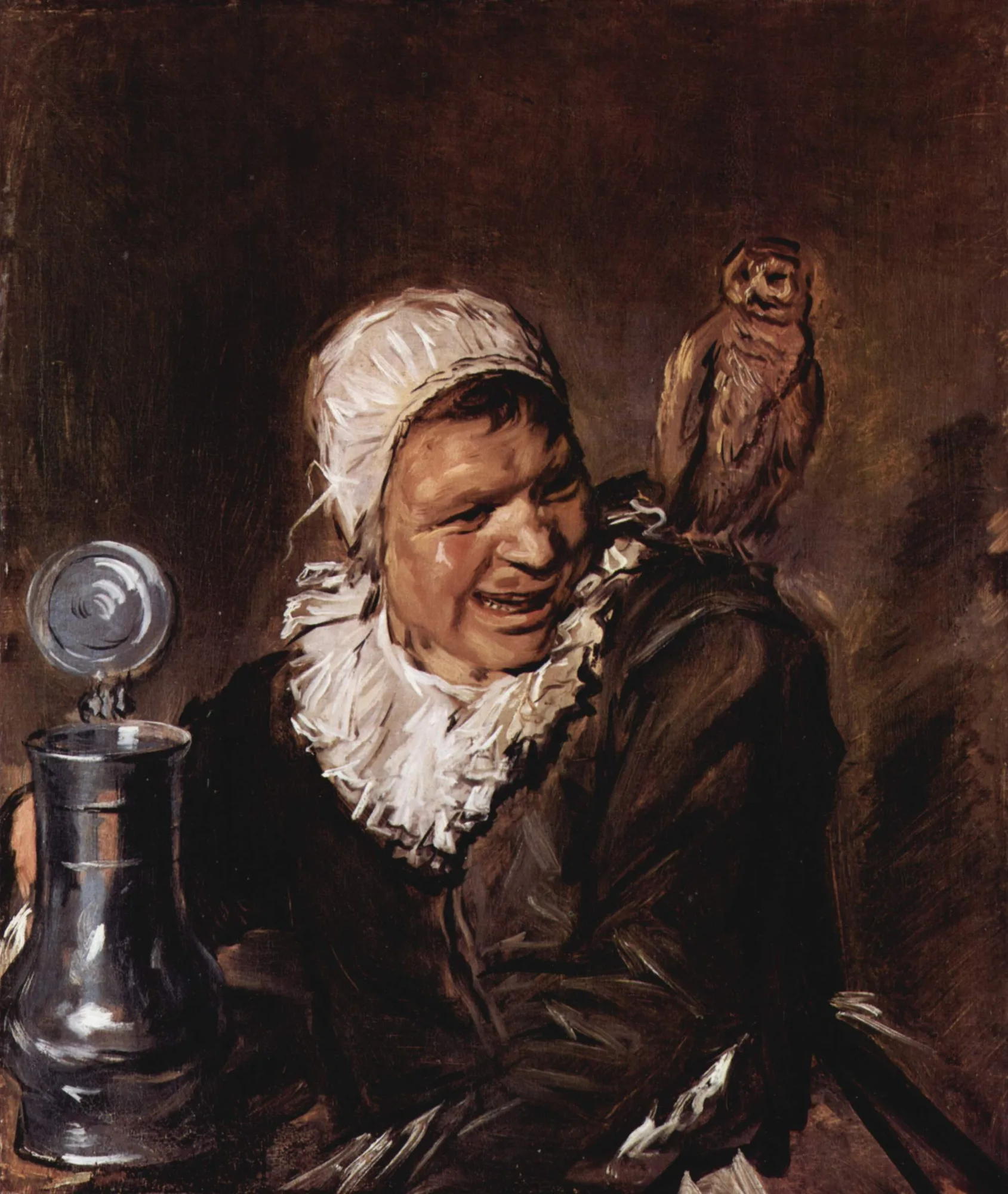
肩にフクロウ、大笑いの顔。ハールレムの町に本当にいた女性の肖像。An owl on her shoulder and a big laugh. A portrait of a real woman from Haarlem.
この作品のお話
Story白い頭巾の女性が、横を向いて大きな口を開けて笑っています。肩には一羽のフクロウ、手もとには大きなジョッキ。オランダのハールレムの画家フランス・ハルスが1640〜46年ごろに描いた作品です。今はドイツのベルリン絵画館にあります。題名の「マレ・バッベ」は、モデルの女性のあだ名です。
A woman in a white cap turns to the side and laughs with her mouth wide open. An owl sits on her shoulder, and a big tankard stands next to her. Frans Hals, a painter from Haarlem in the Netherlands, made this around 1640 to 1646. It is now in the Gemäldegalerie in Berlin, Germany. The title, 'Malle Babbe', was the nickname of the woman who posed for it.
ハルスは、すばやく大胆な筆づかいで知られる画家です。この絵でも、えりのひだや服は、筆をさっさっと走らせたあとがそのまま見えます。笑い声が聞こえてきそうな一瞬の表情を、細かく描きこまずにとらえているのです。当時の多くの画家が、絵の具のあとが見えないようなめらかに仕上げたのとは正反対でした。
Hals is known for his quick, bold brushwork. In this painting, too, you can see each fast stroke in the folds of her collar and clothes. He caught a laughing face in an instant without adding fine details. This was the opposite of many painters of his time, who made their surfaces smooth so that no brushstrokes showed.
調査で、モデルはハールレムに実在した女性バルバラ・クラースだと考えられています。彼女は町の外にあった施設で暮らし、1663年に亡くなりました。ハルスの大胆な筆づかいは、200年以上あとのフランスの画家クールベやマネたちに大きな刺激をあたえました。
Research suggests the model was a real woman in Haarlem named Barbara Claes. She lived in a care home just outside the town, and she died in 1663. Hals's bold brushwork greatly inspired French painters more than 200 years later, such as Courbet and Manet.
女の人が大きな声で笑っています。白い頭巾をかぶっています。肩にはフクロウがのっています!画家はとてもすばやい筆づかいで描きました。彼女はオランダの町に本当にいた女性です。
A woman laughs out loud. She wears a white cap. An owl sits on her shoulder! The painter used very quick brushstrokes. She was a real woman in a Dutch town.
英語のレベルは上の「やさしい/ふつう」で切りかえられます。
えっ!?な裏ネタ
Secretsハールレムの記録の調査から、モデルはバルバラ・クラースという女性だとわかってきました。彼女は町の施設で暮らしていました。のちにハルスの息子ピーテルも同じ施設に入れられたことがありますが、2人が知り合いだったかどうかはわかりません。
By studying records in Haarlem, researchers found that the model was probably a woman named Barbara Claes. She lived in a care home in the town. Later, Hals's son Pieter was also sent to the same place, but we do not know whether the two knew each other.
この絵は昔「ハールレムの魔女」とも呼ばれ、フクロウは魔女のお供だと思われていました。でもオランダには「フクロウのように酔っぱらう」という言い回しがあります。手もとの大きなジョッキと合わせて、フクロウは「酔い」を表しているという見方が有力です。
This painting was once called 'The Witch of Haarlem,' and people thought the owl was a witch's helper. But there is an old Dutch saying, 'as drunk as an owl.' Together with the big tankard, the owl is now usually seen as a sign of drunkenness.
1869年、この絵がドイツのミュンヘンで展示されたとき、フランスの写実主義の画家クールベがこれを模写しました。ハルスの自由な筆づかいは、19世紀の画家たちにとって「新しい絵」のお手本だったのです。
In 1869, when this painting was shown in Munich, Germany, the French Realist painter Gustave Courbet made a copy of it. To 19th-century painters, Hals's free brushwork was a model for a new kind of painting.
ハールレムの町には、1978年に作られたマレ・バッベの銅像が立っています。さらにオランダには『マレ・バッベ』という歌もあり、歌手ロブ・デ・ナイスが1973年にアルバムに入れ、1975年にはシングルがヒットしました。380年ほど前の絵の女性が、今も町の人気者なのです。
In Haarlem, there is a bronze statue of Malle Babbe made in 1978. There is even a Dutch song called 'Malle Babbe.' The singer Rob de Nijs recorded it on a 1973 album, and it became a hit single in 1975. The woman in a painting from the 1640s is still a local star.
ここを見て!
Look Closer1大笑いの顔The laughing face
横を向いて大きな口を開ける女性。だれかに呼びかけているようにも見えます。
She turns to the side with her mouth wide open. She may be calling out to someone.
2肩のフクロウThe owl on her shoulder
茶色いフクロウが、こちらをじっと見ています。数筆でさっと描かれています。
A brown owl stares at us. It is painted with just a few quick strokes.
3大きなジョッキThe big tankard
ふたつきの金属のジョッキ。白い筆あとで、金属の光を表しています。
A metal tankard with a lid. White strokes show the shine of the metal.
4えりの筆あとBrushstrokes on the collar
白いえりのひだは、すばやい筆の動きがそのまま見えます。近づくと抽象画のようです。
You can see every quick stroke in the white collar. Up close, it looks almost like an abstract painting.
英語で名画を語ろう
Talk about Art in EnglishAn owl is sitting on her shoulder.
フクロウが彼女の肩の上に座っています。
💡 肩に「のっている」は on。look over one's shoulder なら「肩ごしにふり返る」です。
英語で説明すると… Describe it
白い頭巾の女性が笑っています。顔を右に向けています。肩の上には、茶色いフクロウがいます。左には、大きな金属のジョッキがあります。
A woman in a white cap is laughing. She turns her head to the right. On her shoulder, there is a brown owl. On the left, there is a big metal tankard.
考えてみよう Think & Talk
- 彼女は何を見て笑っていると思いますか?What do you think made her laugh?
- すばやいざっくりした筆あとと、なめらかな絵。あなたはどちらが好きですか?それはなぜ?Do you like quick, rough brushstrokes or smooth paintings better? Why?
この作品の英単語
WordsAn owl sits on her shoulder.
フクロウが彼女の肩にとまっています。
'Malle Babbe' was her nickname.
「マレ・バッベ」は彼女のあだ名でした。
Hals used rough, quick strokes.
ハルスはざっくりとすばやい筆あとを使いました。
Courbet copied this painting in 1869.
クールベは1869年にこの絵を模写しました。
ミニクイズ
QuizQ. この絵を1869年に模写したフランスの画家は?Which French painter copied this work in 1869?
写実主義の画家クールベが、ミュンヘンで展示されていたこの絵を模写しました。
The Realist painter Courbet copied it when it was shown in Munich.
ウソ?ホント? ハルスは、筆あとが見えないように、なめらかに描いた。Hals painted smoothly so that no brushstrokes showed.
その反対で、すばやく大胆な筆あとをわざと残しています。
The opposite. He left quick, bold brushstrokes on purpose.
ウソ?ホント? モデルは、ハールレムに実在した女性だと考えられている。The model is thought to be a real woman from Haarlem.
記録の調査から、バルバラ・クラースという女性だと考えられています。
Records suggest she was a woman named Barbara Claes.
 画像の出典とライセンス / Image credit
- PDFrans Hals 021.jpg(Wikimedia Commons)
ライセンス:Public domain(パブリックドメイン)/作者・撮影者の表記:Frans Hals
この作品は、作者の死後長い年月がたち著作権の保護期間が終わった「パブリックドメイン」の作品です。画像は平面の作品を忠実に写したもので、新しい著作権は生じません(Wikimedia Commons の PD-Art の考え方)。 所蔵:ベルリン絵画館(Gemäldegalerie, Berlin)。画像は表示のために縮小・WebP 形式に変換しています。