

 ワークシート
 ぬりえ
 迷路
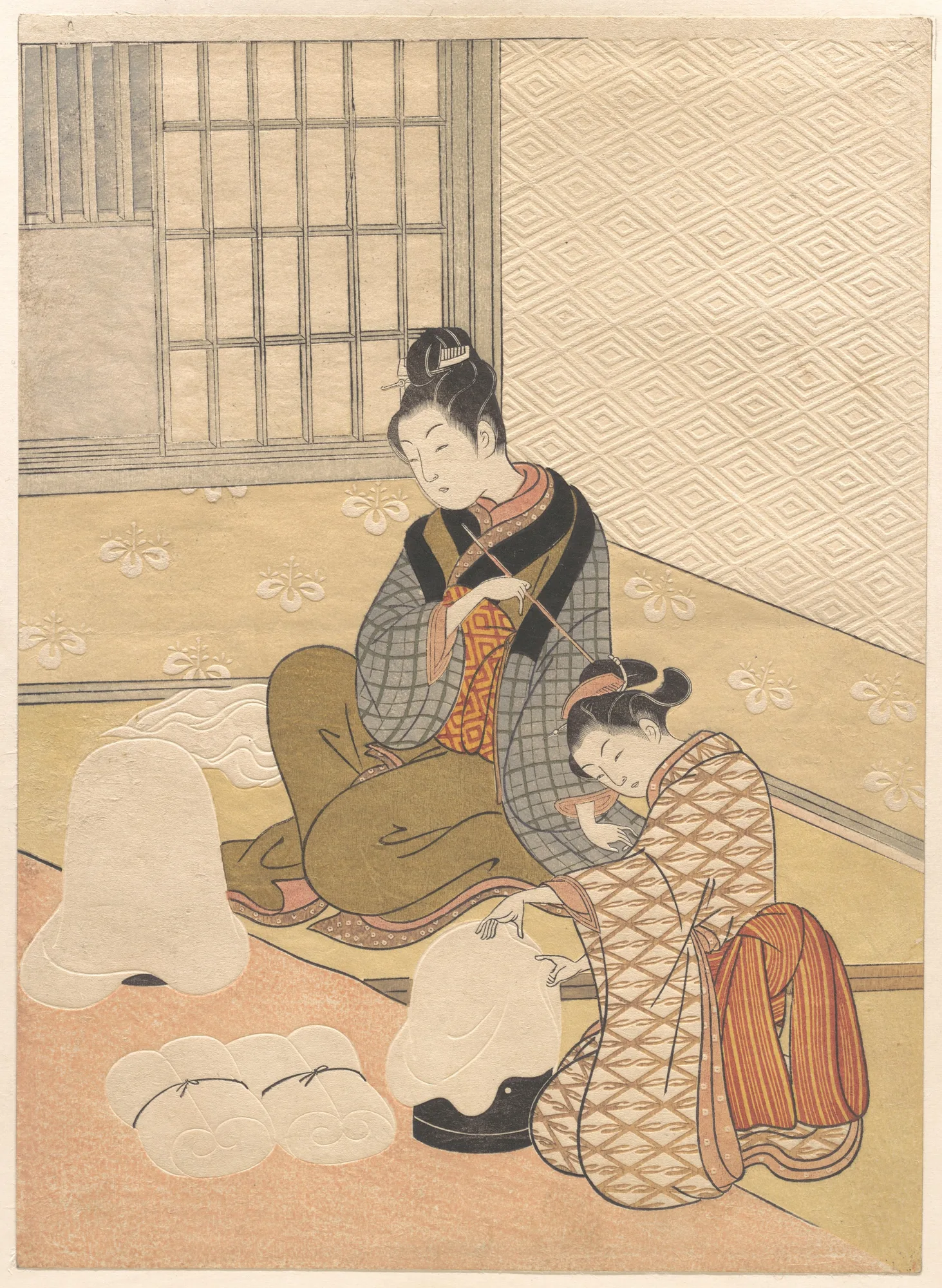
部屋の中に雪山!?じつは綿。中国の名所絵を部屋に持ちこんだ、春信のしゃれ。Snowy mountains indoors!? They're silk floss. Harunobu's witty joke on famous Chinese views.
この作品のお話
Story鈴木春信の「坐鋪八景(ざしきはっけい)」という8枚シリーズの1枚です。部屋の中で、一人の女性がきせるを持って座り、もう一人が真綿(まわた)をのばしています。黒い塗り物の道具(塗桶)にかぶせた白い真綿が、雪をかぶった山のように見えます。画像の摺りはニューヨークのメトロポリタン美術館の所蔵で、初摺りではない後の摺りとされています。同じ図柄の摺りはほかの美術館にもあります。
This print is from Suzuki Harunobu's series of eight, called Eight Parlor Views. In the room, one woman sits holding a pipe, while the other stretches silk floss over a black lacquered form. The floss looks like mountains covered with snow. This impression, in The Metropolitan Museum of Art, is a later printing, not a first edition, and other museums have prints of the same design.
題名は、中国の有名な風景の組み合わせ「瀟湘八景(しょうしょうはっけい)」のパロディです。その一つ「江天暮雪(夕方の川の雪景色)」を、家の中の「塗桶の暮雪」に見立てました。白い真綿や右上の壁の模様は、色をつけずに版木を強く押しあてる「空摺(からずり)」で、紙がでこぼこに浮き上がっています。
The title makes fun of the 'Eight Views of the Xiao and Xiang Rivers', famous Chinese landscapes. One of them is 'Evening Snow on the River'. Harunobu turned it into 'evening snow' on a floss shaper, inside a house. The white floss and the wall pattern are embossed. The printer pressed the paper on the block without ink, so the shapes rise up from the paper.
春信は1765年ごろ、たくさんの色を重ねて摺る「錦絵(にしきえ)」を生み出した中心人物です。趣味人たちが、しゃれた絵暦(えごよみ)を作って交換したのがきっかけでした。その後、この多色摺りの技術が浮世絵の標準になり、歌麿や北斎、広重の名作へとつながっていきます。
Around 1765, Harunobu was the leading artist in creating full-color prints called nishiki-e, or 'brocade pictures'. It began when wealthy hobbyists made stylish picture calendars to trade with each other. Soon this many-color printing became the standard for ukiyo-e. It led to the great works of Utamaro, Hokusai and Hiroshige.
部屋に二人の女性がいます。白い形を見てください。雪の山のように見えますね。でも雪ではありません!やわらかい絹の綿なのです。本物の版画では、白いところが「空摺」で浮き上がって、でこぼこして見えます!
Two women are in a room. Look at the white shapes. They look like snowy mountains. But they are not snow! They are soft silk. In the real print, the white parts are raised, so they look bumpy!
英語のレベルは上の「やさしい/ふつう」で切りかえられます。
えっ!?な裏ネタ
Secrets白い山の正体は真綿。蚕のまゆをのばして作るふわふわの綿で、冬の着物の中綿などに使われました。黒い塗桶にかぶせてのばすと、まさに雪山。春信の見立ての腕が光ります。
The white mountains are silk floss. It is soft fluff made by stretching silkworm cocoons, used to pad winter clothes. Over the black forms, it looks just like snowy peaks. This is Harunobu's clever wit.
真綿や壁の菱形の模様は、インクをつけない版木を強く押しあてる「空摺」という技。光にかざすと、紙が浮き彫りのように盛り上がって見えます。春信は、この空摺をとても上手に使った絵師として知られます。
The floss and the diamond pattern on the wall use karazuri, or blind printing. The printer pressed an uninked block hard into the paper. In the light, the shapes stand up like a relief. Harunobu is known for using this technique beautifully.
春信が亡くなった後、のちに洋風画で有名になる司馬江漢が、春信の名で版画を描いたと自分で書き残しています。それほど春信の絵は人気だったのです。江漢は晩年の随筆で、春信風の絵に「春信」と署名したことを打ち明けています。
After Harunobu died, Shiba Kōkan, who later became famous for Western-style painting, wrote that he made prints under Harunobu's name. That is how popular Harunobu was. In an essay late in life, Kōkan admitted signing 'Harunobu' on prints in his style.
江戸時代の暦では、毎年「大の月」と「小の月」が変わりました。趣味人たちは、その月の並びを絵の中に隠した「絵暦」を作って競いあい、それが錦絵の誕生につながりました。
In the Edo calendar, the long and short months changed every year. Hobbyists competed to make picture calendars that hid the months inside the design. This contest helped give birth to full-color prints.
ここを見て!
Look Closer1雪山のような真綿Floss like snowy mountains
塗桶にかぶせた白い真綿。空摺で浮き上がり、雪山のように見えます。
White floss over a lacquered form. It is embossed and looks like a snowy mountain.
2きせるを持つ女性Woman with a pipe
細長いきせるを持って、くつろぐ女性。春信の描く人物は、ほっそりして人形のようです。
A woman relaxes with a long, thin pipe. Harunobu's people are slim and doll-like.
3空摺の壁Embossed wall
右上の壁の菱形模様は、色をのせずに凹凸だけで表されています。
The diamond pattern on the wall is shown only by raised lines, with no color.
4黒い塗桶Black lacquered form
もう一人の女性が、塗桶の上の真綿をととのえています。
The other woman smooths the floss on a black lacquered form.
英語で名画を語ろう
Talk about Art in EnglishThis print is a parody of a famous Chinese landscape.
この版画は、有名な中国の風景のパロディです。
💡 見立て・もじりの説明に。parody of のあとに元ネタを置きます。
英語で説明すると… Describe it
これは部屋の中の二人の女性の絵です。左には、白い真綿の山があります。真ん中では、女性が長いきせるを持って座っています。右では、もう一人の女性が真綿の仕事をしています。うしろには窓があります。
This is a picture of two women in a room. On the left, there are white mounds of silk floss. In the middle, a woman is sitting with a long pipe. On the right, another woman is working on the floss. Behind them, there is a window.
考えてみよう Think & Talk
- 身のまわりで、有名な景色に見立てられそうなものは何ですか?What everyday things around you look like a famous place?
- 摺師はなぜ「雪」に色をつけなかったと思いますか?Why do you think the printer left the 'snow' without color?
この作品の英単語
WordsThis woodblock print uses many colors.
この木版画はたくさんの色を使っている。
The white floss is embossed.
白い真綿は浮き彫りになっている。
The title is a parody of famous Chinese views.
題名は中国の名所のパロディだ。
Silk floss is made from silkworm cocoons.
真綿は蚕のまゆから作られる。
ミニクイズ
QuizQ. この絵の「雪」の正体は?What is the 'snow' in this picture?
塗桶にかぶせた真綿を、雪山に見立てています。
Silk floss on lacquered forms is shown as snowy mountains.
ウソ?ホント? 春信は多色摺りの錦絵を生み出した中心人物だ。Harunobu was a leading creator of full-color nishiki-e prints.
1765年ごろ、絵暦をきっかけに錦絵が誕生しました。
Around 1765, full-color prints grew out of picture calendars.
ウソ?ホント? 白い部分は、白い絵の具をたっぷり重ねて盛り上げている。The white parts are raised with thick white paint.
絵の具ではなく、色をつけない版木で紙を押し上げる「空摺」です。
No paint is used. An uninked block pushes up the paper. This is blind printing.
 画像の出典とライセンス / Image credit
- PDSuzuki Harunobu - Evening Snow on the Heater.jpg(Wikimedia Commons)
ライセンス:Public domain(パブリックドメイン)/作者・撮影者の表記:Suzuki Harunobu/提供元:This file was donated to Wikimedia Commons as part of a project by the Metropolitan Museum of Art. See the Image and Data Resources Open Access Policy
この作品は、作者の死後長い年月がたち著作権の保護期間が終わった「パブリックドメイン」の作品です。画像は平面の作品を忠実に写したもので、新しい著作権は生じません(Wikimedia Commons の PD-Art の考え方)。 所蔵:メトロポリタン美術館(The Metropolitan Museum of Art)。画像は表示のために縮小・WebP 形式に変換しています。
