

 ワークシート
 ぬりえ
 迷路
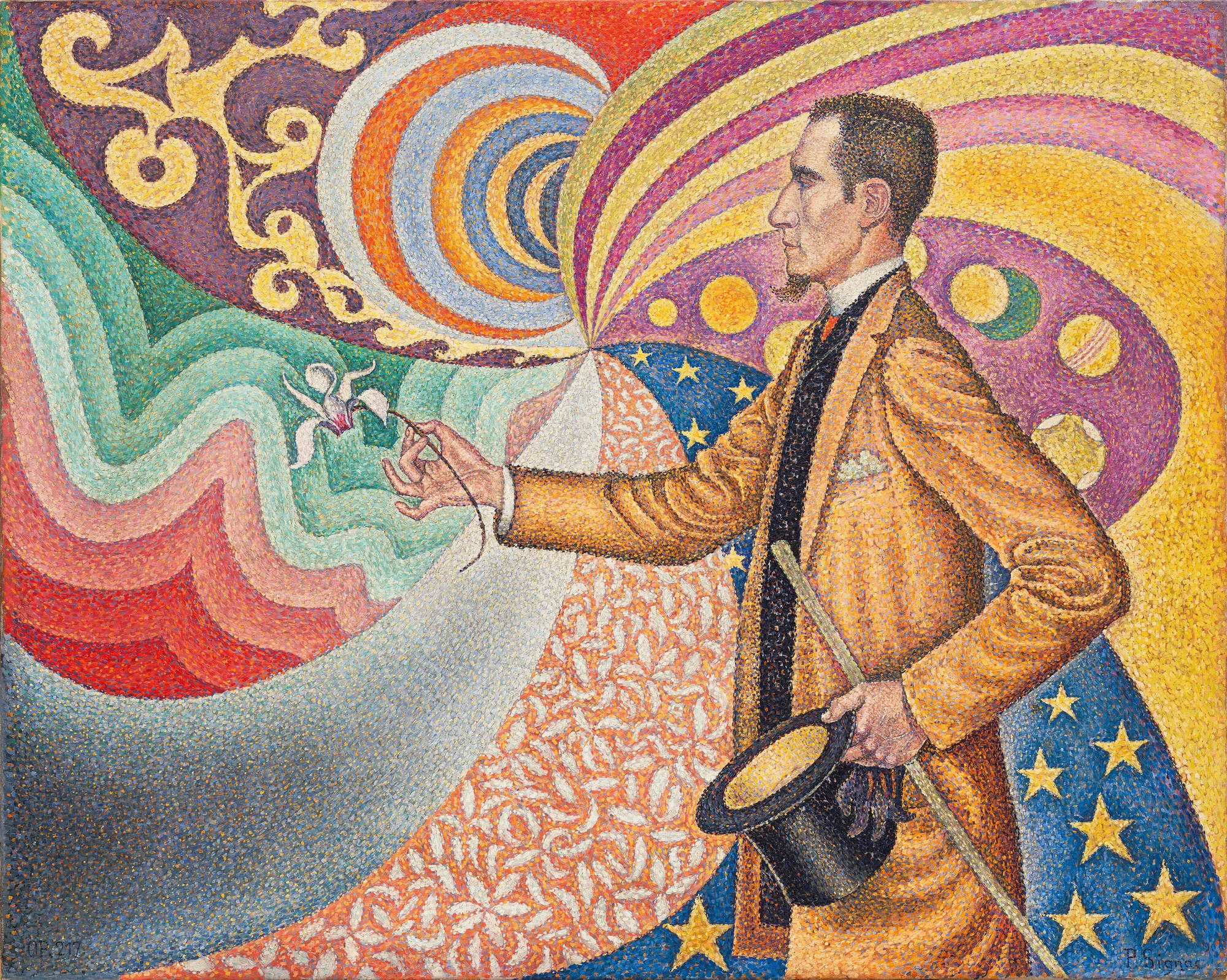
題名がとにかく長い!渦巻きと星を背に立つ、ナゾの批評家。The longest title ever? A mysterious critic before swirls and stars.
 美術館アンテナ:ポール・シニャックの作品に会える展覧会
この作品のお話
Story点描の画家シニャックが、親友の美術批評家フェリックス・フェネオンを描いた肖像画です。フェネオンは横向きに立ち、左手にシルクハットとステッキ、のばした右手に小さなシクラメンの花を持っています。背景は、渦巻き・星・波・円がぐるぐる回る、まるで万華鏡のようなもようです。
Paul Signac painted this portrait of his friend, the art critic Félix Fénéon. Fénéon stands in profile. In his left hand, he holds a top hat and a cane. In his outstretched right hand, he holds a small cyclamen flower. The background is full of spirals, stars, waves and circles, like a kaleidoscope.
フェネオンは、スーラやシニャックの点描の絵に「新印象派」という名前をつけ、世に広めた人物です。シニャックはそのお礼としてこの肖像を描きました。背景のもようは、科学者シャルル・アンリの「色と線のリズム」の理論を表したもの。シニャックが集めていた日本の着物の柄の木版画集がもとになったとも考えられています。
Fénéon gave the name "Neo-Impressionism" to the dot paintings of Seurat and Signac, and he helped make them known. Signac painted this portrait to thank him. The background shows Charles Henry's theory about the rhythm of colors and lines. It may also come from an album of Japanese kimono patterns that Signac owned.
1891年に展示されると、「ふしぎ」「背景が人物を食ってしまう」と評価は分かれ、フェネオン本人もあまり喜ばなかったと言われます。今ではシニャックの代表作として、ニューヨーク近代美術館(MoMA)に飾られています。1991年にデイヴィッド・ロックフェラー夫妻から寄贈されました。
When it was shown in 1891, people disagreed about it. Some called it strange and said the background was too strong. Fénéon himself was not very pleased, it is said. Today it is one of Signac's most famous works. It is in The Museum of Modern Art (MoMA) in New York, a gift from Mr. and Mrs. David Rockefeller in 1991.
この男性はフェリックス・フェネオンです。美術について書く人でした。彼は点で描く絵のスタイルに名前をつけました。友だちのシニャックが、お礼に彼を描きました。この絵の題名は、とても、とても長いのです!
This man is Félix Fénéon. He was a writer about art. He gave a name to the dot style of painting. His friend Signac painted him to say thank you. The title is very, very long!
英語のレベルは上の「やさしい/ふつう」で切りかえられます。
えっ!?な裏ネタ
Secrets正式な題は「作品217番。拍子と角度、色調と色合いのリズミカルな背景のエナメルの上に、1890年のF・フェネオン氏の肖像」。左下に「OP. 217」と書かれているのが見えます。
The full title is "Opus 217. Against the Enamel of a Background Rhythmic with Beats and Angles, Tones, and Tints, Portrait of M. Félix Fénéon in 1890." You can see "OP. 217" at the bottom left.
シニャックはこのころ、自分の絵に作曲家のように「オーパス(作品番号)」をつけていました。絵を音楽のリズムのように考えていたからです。同じころの海辺の風景画にも番号がついています。
Around this time, Signac gave his paintings opus numbers, as composers do. He thought of painting like the rhythm of music. His seaside landscapes from the same years have numbers too.
フェネオンは陸軍省で働く役人でしたが、無政府主義(アナキズム)に共鳴し、1894年に大きな裁判にかけられました。結果は無罪。法廷での皮肉たっぷりの受け答えが評判になりました。
Fénéon worked as a clerk at the Ministry of War. But he supported anarchism, and in 1894 he was put on trial. He was found not guilty. His witty answers in court became famous.
フェネオンは1906年、新聞に短い事件記事を毎日のように書きました。わずか3行ほどの文章にユーモアと皮肉をこめたもので、のちに『3行ニュース』として本にまとめられ、文学として評価されています。
In 1906, Fénéon wrote very short news items for a newspaper. Each was only about three lines long, full of humor and irony. They were later collected as Novels in Three Lines and are now seen as literature.
ここを見て!
Look Closer1フェネオンの横顔Fénéon's profile
とがったあごひげの横顔。あごひげの上向きのカーブは、手の花のカーブとひびき合っています。
His profile with a pointed goatee. The upward curve of his beard echoes the curve of the flower.
2シクラメンの花Cyclamen flower
まるで手品師のように、小さな花を差し出しています。何を意味するのかは、はっきりしていません。
Like a magician, he holds out a small flower. Its meaning is not clear.
3渦巻くうずまきThe spiral
色の帯がぐるぐると中心へ吸いこまれます。色と線にリズムがあるという理論を形にしたものです。
Bands of color spin into the center. It shows the idea that colors and lines have rhythm.
4シルクハットとステッキTop hat and cane
おしゃれなパリの紳士の持ち物。左下には「OP. 217」の文字も見えます。
These belong to a stylish Paris gentleman. Look for "OP. 217" at the bottom left too.
英語で名画を語ろう
Talk about Art in EnglishFénéon holds out a small flower in his right hand.
フェネオンは右手で小さな花を差し出しています。
💡 手や物を前にのばして出す動き。hold up(かかげる)との違いに注意。
英語で説明すると… Describe it
右に、茶色いコートの男性がいます。シルクハットとステッキを持っています。小さな白い花を差し出しています。うしろには、色とりどりのうずまき、波、星があります。
On the right, there is a man in a brown coat. He is holding a top hat and a cane. He is holding out a small white flower. Behind him, there are colorful spirals, waves and stars.
考えてみよう Think & Talk
- フェネオンはなぜ花を持っているのだと思いますか?Why do you think Fénéon is holding a flower?
- 背景は、この人の性格について何か教えてくれていますか?どんなふうに?Does the background tell us about the man's personality? How?
この作品の英単語
WordsFénéon is shown in profile.
フェネオンは横顔で描かれている。
Fénéon was an art critic.
フェネオンは美術批評家だった。
A colorful spiral fills the background.
色あざやかなうずまきが背景をうめている。
His witty answers made people laugh.
彼の気のきいた答えは人々を笑わせた。
ミニクイズ
QuizQ. フェネオンが名づけた、スーラやシニャックの画風の名前は?What name did Fénéon give to the style of Seurat and Signac?
フェネオンは1886年ごろから「新印象派」という呼び名を使い、点描の画家たちを支えました。
Fénéon used the name "Neo-Impressionism" from around 1886 and supported the dot painters.
ウソ?ホント? この絵の左下には「OP. 217」と書かれている。"OP. 217" is written at the bottom left of the painting.
シニャックが音楽のようにつけた作品番号です。
It is Signac's opus number, like in music.
ウソ?ホント? フェネオンはこの肖像画を見て大喜びし、一生自慢した。Fénéon loved this portrait and showed it off all his life.
本人はあまり喜ばなかったと伝えられています。
It is said he was not very pleased with it.
 画像の出典とライセンス / Image credit
- PDSignac - Portrait de Félix Fénéon.jpg(Wikimedia Commons)
ライセンス:Public domain(パブリックドメイン)/作者・撮影者の表記:Paul Signac/提供元:First uploaded to de.wikipedia by de:Benutzer:Hans Bug. See MoMA
この作品は、作者の死後長い年月がたち著作権の保護期間が終わった「パブリックドメイン」の作品です。画像は平面の作品を忠実に写したもので、新しい著作権は生じません(Wikimedia Commons の PD-Art の考え方)。 所蔵:ニューヨーク近代美術館(MoMA)(The Museum of Modern Art (MoMA))。画像は表示のために縮小・WebP 形式に変換しています。
