wasan
the mathematics developed in Edo-period Japan
和算(わさん)
In one line
The shortest answer that works
Wasan was Japan's own mathematics, developed in isolation and sometimes dedicated to shrines as votive tablets.
和算は日本で独自に発展した数学で、解いた問題を絵馬にして神社に奉納することもありました。
In 30 seconds
The standard explanation
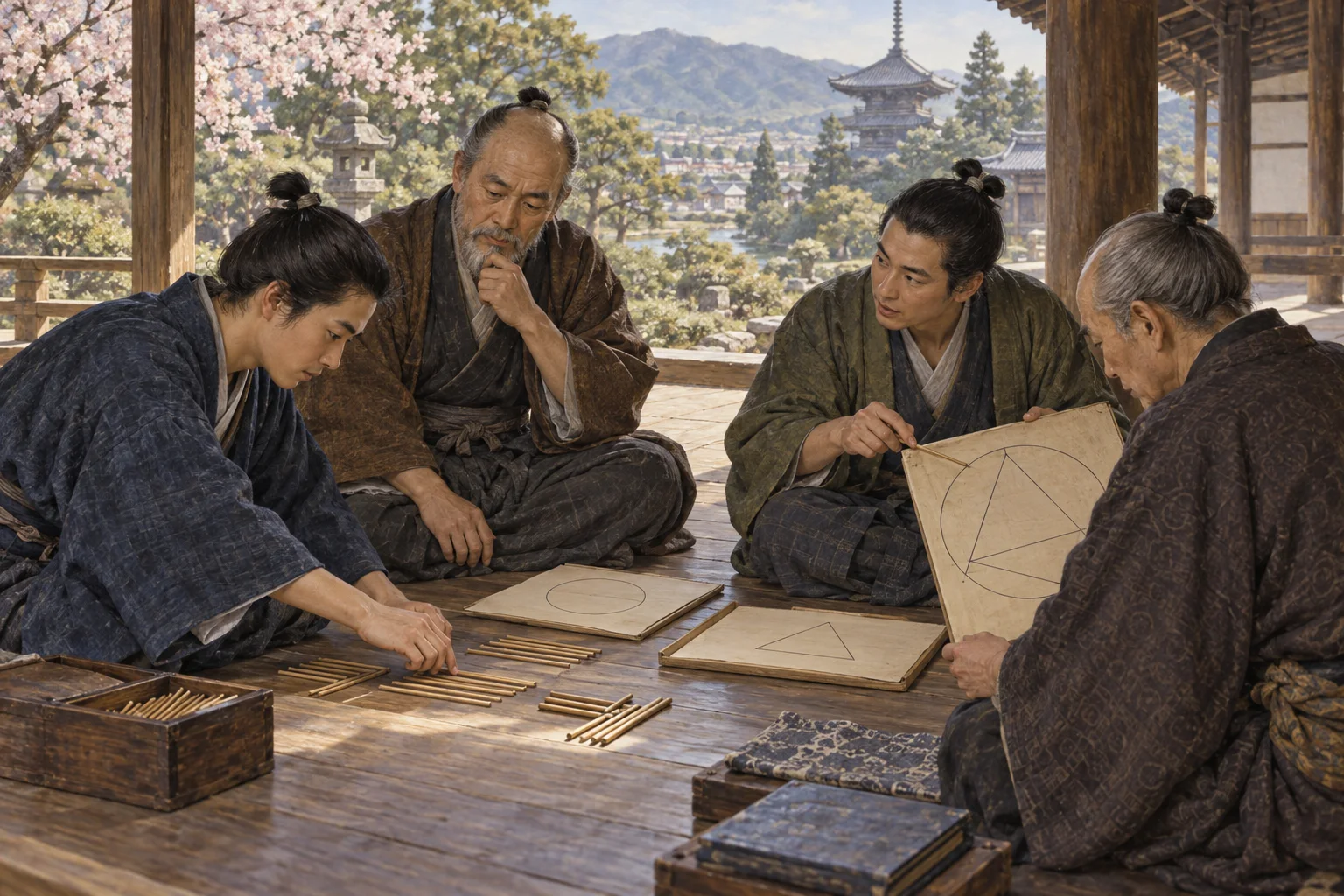
Cut off from European mathematics, Edo-period Japan developed its own, working on equations, series and geometry with the abacus and with written notation. It was practiced by samurai, merchants and farmers alike as a pursuit. Solvers sometimes recorded a problem and its answer on a painted wooden tablet and hung it at a shrine, where hundreds still survive.
ヨーロッパの数学から切り離された江戸時代の日本は、独自の数学を育てました。そろばんと記号を使い、方程式や級数、図形を扱います。武士も商人も農民も、趣味としてこれに取り組みました。解いた人は、問題と答えを板に描いて神社に掲げることがあり、その板が今も各地に残っています。
As a short speech
A full paragraph you can read aloud
One of the more surprising things about the closed country period is that Japan did serious mathematics without Europe. It is called wasan. Working from Chinese texts and then far beyond them, scholars developed notation for equations, methods for series, and a great deal of geometry involving circles inscribed in triangles and other shapes.
The outstanding figure, Seki Takakazu, who died in 1708, worked on determinants and on approximating pi at roughly the same period as Newton and Leibniz, without contact with them. What makes wasan unlike mathematics anywhere else is the sangaku.
When someone solved a difficult problem, they might have it painted on a wooden tablet, with the figure in color and the answer given, and hang it at a shrine or temple as an offering and as a challenge to other solvers. Hundreds survive. After the Meiji period Japan adopted Western mathematics for schools, and wasan stopped being taught.
鎖国の時代について意外に思われることの一つは、日本がヨーロッパ抜きで本格的な数学をしていたことです。和算と呼びます。中国の書物から出発し、やがてそれをはるかに越えて、方程式の記法、級数の扱い、三角形に内接する円などの図形の問題を発展させました。
傑出した人物である関孝和は1708年に没していますが、行列式や円周率の近似に取り組んだ時期は、ニュートンやライプニッツとおおむね重なります。もちろん、互いに接点はありません。和算をほかの国の数学と違うものにしているのが算額です。
難しい問題を解いた人が、図を彩色し答えを添えて板に描き、神社や寺に奉納する。感謝であると同時に、ほかの解き手への挑戦でもありました。今も各地に残っています。明治以降、学校は西洋の数学を採用し、和算は教えられなくなりました。
Questions people actually ask
And how to answer them.
What is a sangaku exactly?
A wooden tablet, like the votive plaques people write wishes on, but carrying a geometry problem with a colored diagram and usually its answer. They were hung at shrines and temples from the seventeenth century onward.
願いごとを書く絵馬と同じような木の板ですが、そこに彩色した図と幾何の問題、たいていは答えが書かれています。十七世紀以降、神社や寺に掲げられました。
Why dedicate mathematics to a shrine?
Partly as thanks for the insight, partly as publication. A shrine was a place people passed through, so hanging a solved problem there announced it, and the format invited someone else to post a harder one.
解けたことへの感謝であり、同時に発表でもありました。神社は人が行き交う場所なので、そこに掲げれば知らせたことになります。形式そのものが、より難しい問題を掲げる人を呼び込みました。
Can I see one?
Yes. Shrines and temples in many prefectures keep them, and some museums display them with modern explanations. They are easiest to appreciate as objects; the problems are often hard even for a mathematician.
見られます。各地の神社や寺が所蔵しており、現代の解説を添えて展示している博物館もあります。まずは物として眺めるのがよいでしょう。問題は数学者にも難しいものが少なくありません。
Phrases you can use
- They did this without European books.西洋の書物なしにこれをやっていました。
- The tablet shows a geometry problem.この板には幾何の問題が描かれています。
- It was hung at a shrine as an offering.神社に奉納されたものです。
- Farmers and merchants studied it too.農民や商人もこれを学びました。
- Schools switched to Western mathematics.学校は西洋の数学に切り替わりました。
Words you need
- Japanese mathematics和算
- votive mathematics tablet算額
- geometry幾何
- abacusそろばん
- to dedicate an offering奉納する
Watch
From YouTubeBackground (Japanese)
和算は、江戸時代の日本で独自に発展した数学です。1627年刊行の塵劫記は、そろばんの使い方から実用の計算までを扱った入門書として広く読まれ、庶民に数学の趣味を広げました。関孝和は方程式や行列式に相当する方法を扱い、円周率の近似でも成果を残しています。解いた問題を彩色した板に描いて神社や寺に掲げる算額の習慣は世界でも例が少なく、全国に九百面ほどが現存するとされます。明治以降、学校教育が西洋数学に移り、和算は継承されなくなりました。