Monday, October 19 (archive)
Today in Japan
What day is it?
-
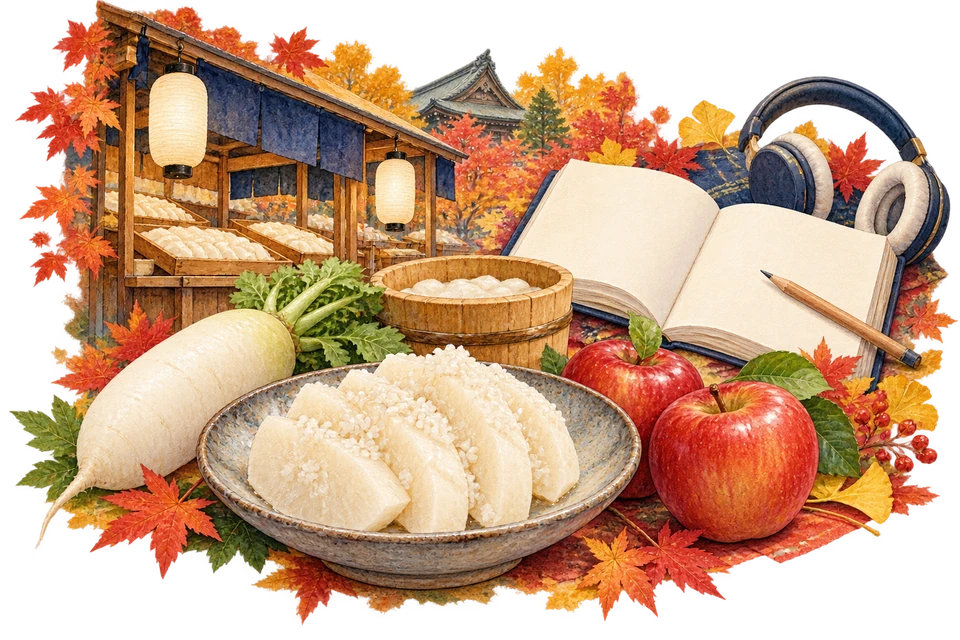
Bettara Market in Nihonbashi日本橋べったら市(10月19日・20日)
Every year on October 19th and 20th, hundreds of stalls fill the streets around Takarada Ebisu Shrine in Nihonbashi, Tokyo. It is said to go back to the Edo period, when merchants came here to buy supplies the day before Ebisu-ko, a festival for the god of business. The star is bettarazuke, daikon radish pickled sweet with rice koji.
Read more › -
TOEIC DayTOEICの日
In Japanese, the numbers 10 and 19 can be read as "to-i-ku," which sounds like TOEIC. The Institute for International Business Communication, which runs the test in Japan, picked this date for that reason. In Japan, TOEIC scores are often written on job applications and used by companies, which is why so many students and office workers take it.
Read more › -
1952年Bansui-ki, the memorial day for poet Doi Bansui晩翠忌
The poet Doi Bansui died on October 19th, 1952. He wrote the words of "Kojo no Tsuki," or "The Moon over the Ruined Castle," with music by Taki Rentaro, first published in a 1901 songbook for middle schools. He spent most of his life in his hometown of Sendai, and every year on this day, people sing the song in front of a monument at the Sendai Castle ruins.
Read more ›
If someone asks you
Why do so many Japanese people take the TOEIC?
Mostly because of jobs. A lot of Japanese companies look at TOEIC scores when they hire people, and some use them when they decide who gets promoted or sent abroad. It's also an easy number to put on a resume. The common TOEIC test only checks listening and reading, though, so a high score doesn't always mean someone is comfortable speaking English.
Phrase of the day
I'm taking the TOEIC next month.
Sentence of the day
October 19th is the first day of the Bettara Market in Tokyo, where people buy sweet pickled daikon before a festival for the god of business. It's also TOEIC Day, thanks to a number pun, so it's a good day to practice your English.
Related topics
- Annual EventsAdvanced ebisu koえびす講the merchants' festival for the god of business
- FolkloreAdvanced shichifukujin七福神the seven lucky gods
- Food & DrinkStandard tsukemono漬物Japanese pickles served alongside rice
- School LifeStandard nihon no eigo kyoiku日本の英語教育why Japanese people study English for years and still cannot speak it
- PlacesStandard nihonbashi日本橋the bridge in central Tokyo where Japan's main roads begin
- Food & DrinkAdvanced bettarazukeべったら漬けdaikon radish pickled sweet in rice koji