Shirakawago
the mountain village of steep thatched farmhouses
白川郷(しらかわごう)
In one line
The shortest answer that works
Shirakawago is a mountain village of farmhouses with steep thatched roofs built to shed heavy snow.
白川郷とは、大雪を落とすための急な茅葺き屋根を持つ民家が並ぶ、山あいの集落です。
In 30 seconds
The standard explanation
Shirakawago is a village in the mountains of Gifu, in one of the snowiest inhabited regions on earth. Its farmhouses have enormous thatched roofs pitched at about sixty degrees so that snow slides off. The style is called gassho-zukuri, meaning hands joined in prayer, after the shape. The village was listed as World Heritage in 1995 together with Gokayama.
白川郷は岐阜県の山中にあり、人が住む地域としては世界でも有数の豪雪地帯です。民家は大きな茅葺き屋根を持ち、雪が滑り落ちるよう約60度の急勾配になっています。その形から、手を合わせた合掌に見立てて合掌造りと呼ばれます。1995年に五箇山とともに世界文化遺産に登録されました。
As a short speech
A full paragraph you can read aloud
Shirakawago is a village of thatched farmhouses in the mountains of Gifu, in a region that gets some of the heaviest snow anywhere people live. The roofs are pitched at around sixty degrees so the snow slides off rather than crushing the house, and the shape gives the style its name, gassho-zukuri, hands joined in prayer.
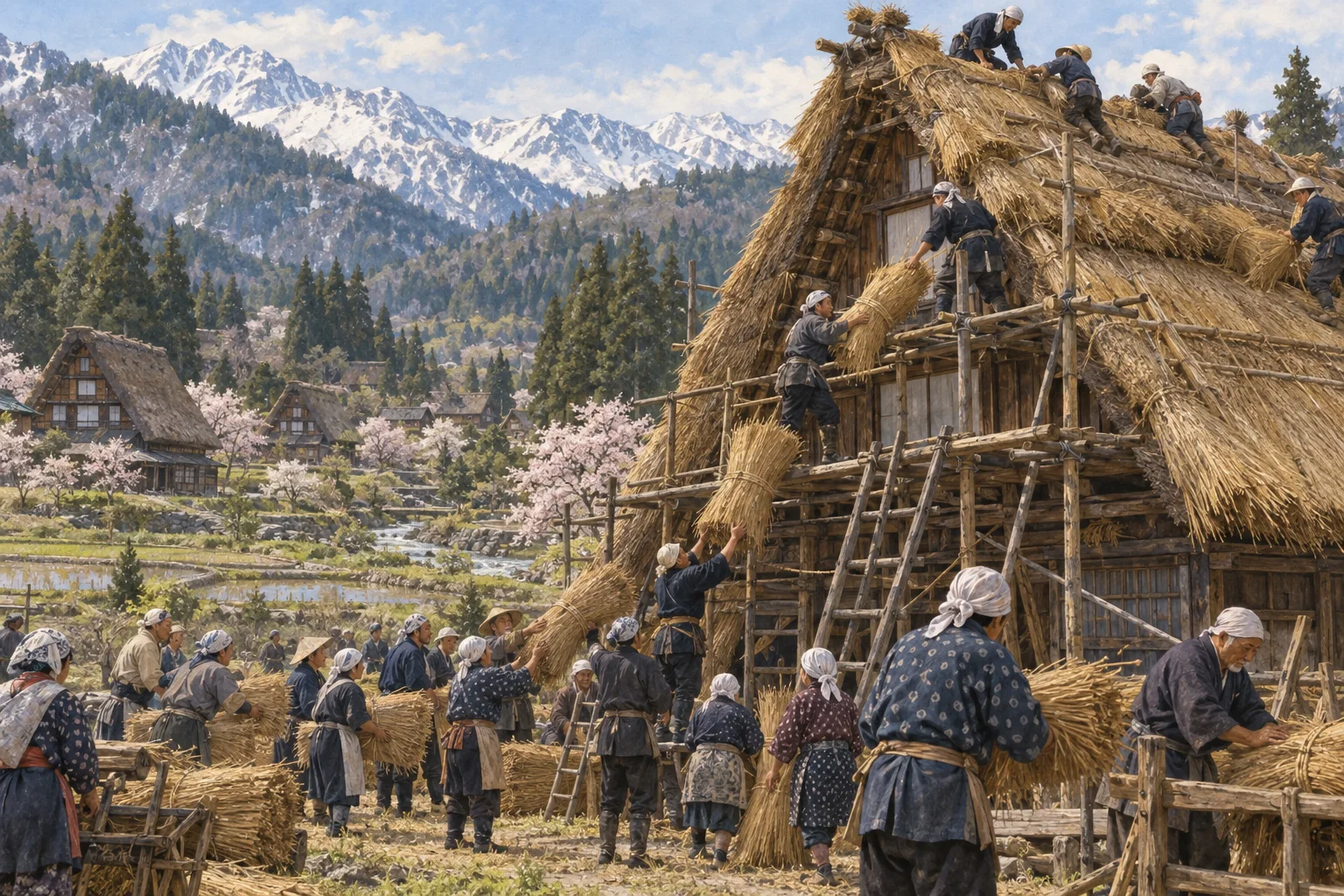
The upper floors under those roofs were used for raising silkworms, so the buildings were workshops as much as homes. When UNESCO listed the area in 1995, what is often stressed is that it was not only the architecture but the system that keeps it standing. A thatched roof has to be replaced every thirty to forty years, which no single family can do.
The village does it collectively, under an arrangement called yui, and a large house can draw two hundred people who finish the roof in a single day. That is the part worth explaining. The buildings are beautiful, but what is really being preserved is an obligation between neighbors, and that is much harder to maintain as the population ages.
白川郷は岐阜の山中にある茅葺きの民家の集落で、人が住む地域としては世界でも有数の雪深い土地です。屋根はおよそ60度の急勾配で、雪が家を潰さずに滑り落ちるようにしてあります。その形から、手を合わせた合掌に見立てて合掌造りと呼ばれます。
屋根の下の上階は蚕を飼うのに使われていたので、家であると同時に仕事場でもありました。1995年のユネスコの登録でよく強調されるのは、評価されたのが建物だけではなく、それを保たせている仕組みでもあったという点です。茅葺きの屋根は30年から40年に一度、葺き替えなければならず、一軒の家族にできることではありません。
村は「結」と呼ばれる取り決めで共同で行い、大きな家なら200人が集まって一日で葺き上げます。説明する値打ちがあるのはそこです。建物は美しいのですが、本当に守られているのは近所どうしの義務のほうで、人が減って高齢化するほど、こちらのほうが保つのが難しいのです。
Questions people actually ask
And how to answer them.
Do people still live there?
Yes. These are lived-in houses, not a museum village, which is why signs ask visitors not to enter gardens or photograph through windows. A few houses are open to visitors and some operate as guesthouses.
住んでいます。博物館の村ではなく生活している家なので、庭に入らない、窓から撮影しない、という掲示があります。見学できる家が何軒かあり、民宿になっている家もあります。
Why are the roofs so steep?
Snow. The region gets several meters in winter, and a shallow roof would collapse under the weight. The steep pitch sheds it. The thatch also insulates, and the smoke from the hearth below helps keep insects out of it.
雪です。冬には数メートル積もる土地で、勾配がゆるい屋根では重みで潰れます。急にすることで落とします。茅は断熱にもなり、下の囲炉裏の煙が虫を寄せつけない働きもします。
When should I go?
Winter is the famous view but roads and buses are affected by snow, and the light-up evenings need reservations well in advance. Autumn and early summer are far easier and much less crowded.
有名なのは冬の景色ですが、雪で道路とバスに影響が出ますし、ライトアップの夜はかなり前から予約が要ります。秋と初夏のほうがずっと行きやすく、空いています。
A common misunderstanding
MYTHShirakawago is a preserved open-air museum.
FACTIt is a working village where people live. The listing is often explained as honoring the living system of communal roof replacement, called yui, as well as the buildings themselves.
Phrases you can use
- The roofs are that steep so the snow slides off.屋根が急なのは、雪を滑り落とすためです。
- Gassho means hands joined in prayer — that's the shape.合掌は手を合わせることで、あの形から来ています。
- People still live in these houses.これらの家には、いまも人が住んでいます。
- The whole village rethatches a roof together, in one day.屋根の葺き替えは村総出で、一日で終わらせます。
- The upper floors were used for raising silkworms.上の階は、蚕を飼うのに使われていました。
Words you need
- thatched roof茅葺き屋根
- pitch, slope勾配
- silkworm蚕
- mutual aid相互扶助、結
- hearth囲炉裏
Watch
From YouTubeBackground (Japanese)
白川郷と五箇山の合掌造り集落は1995年に世界文化遺産に登録された。屋根の勾配はおよそ60度で、豪雪を滑り落とすための形である。小屋裏の広い空間は養蚕に使われ、床を張って二層、三層にした家もある。茅葺きの葺き替えは30〜40年に一度必要で、「結」と呼ばれる相互扶助の仕組みで村人が総出で行う。大きな家では200人規模が集まり、一日で葺き上げることもある。建物だけでなく、この結の仕組みが評価されたことが登録の理由のひとつとされる。なお過疎と高齢化により、結の維持そのものが課題になっている。