sashisuseso
the order in which the five basic seasonings go into a Japanese dish
さしすせそ(さしすせそ)
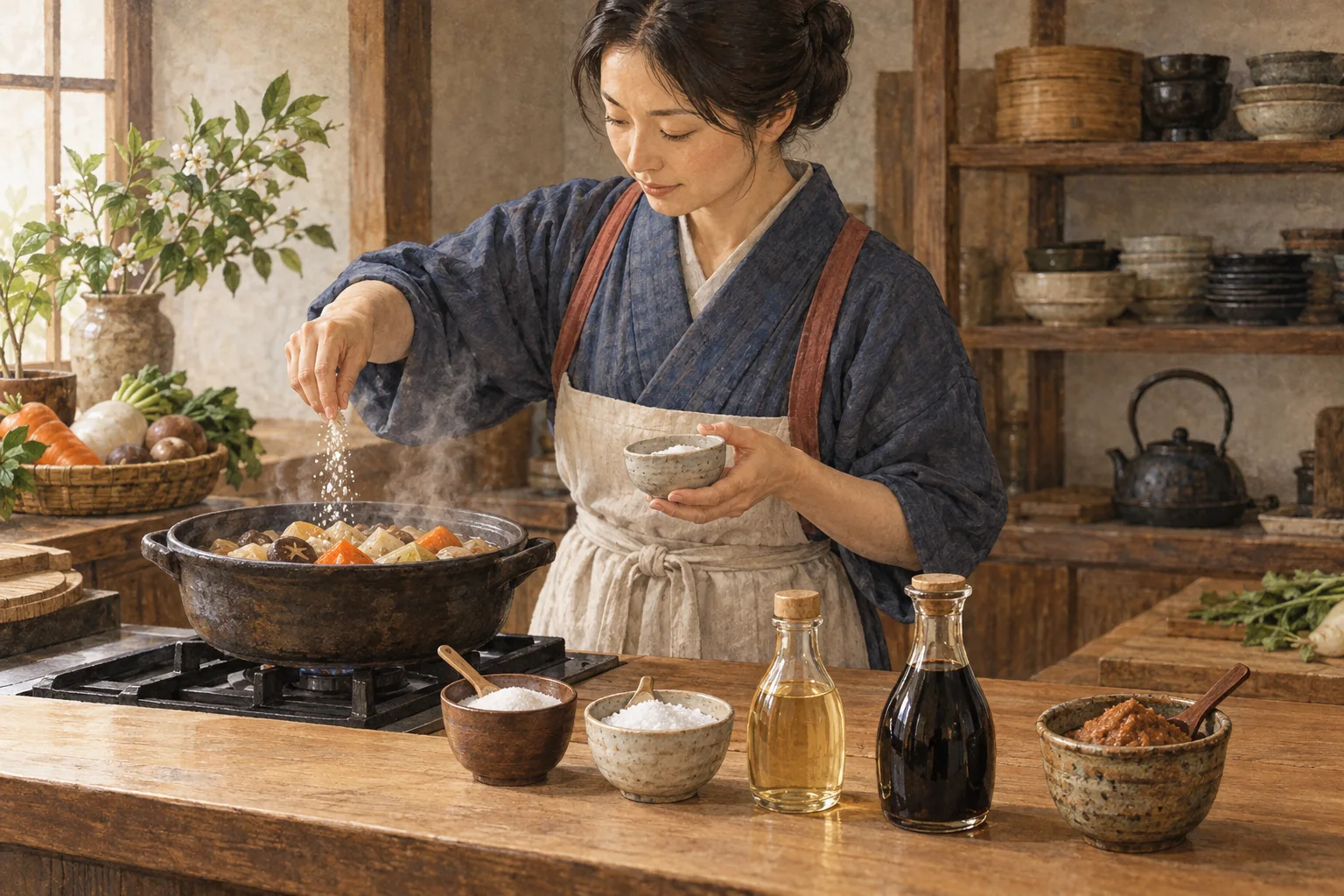
In one line
The shortest answer that works
Sashisuseso is a mnemonic for the five basic seasonings and the order they go in.
さしすせそは、五つの基本の調味料と、入れる順番の覚え方です。
In 30 seconds
The standard explanation
The five kana sa-shi-su-se-so stand for sugar, salt, vinegar, soy sauce and miso, and the phrase records the order in which they are added to a simmered dish. Sugar goes first because its molecules are large and slow to penetrate; salt would tighten the ingredients and block it. Vinegar, soy sauce and miso go last because heat drives off their aroma.
さ・し・す・せ・そは、砂糖、塩、酢、醤油、味噌を表し、煮物に入れる順番を記したものです。砂糖を先にするのは、分子が大きくしみ込むのが遅いから。塩が先だと材料が締まって、砂糖が入りません。酢と醤油と味噌が最後なのは、熱で香りが飛ぶからです。
As a short speech
A full paragraph you can read aloud
Sashisuseso is how Japanese cooks remember the order of seasonings, using the first five sounds of one row of the kana syllabary. Sa is sato, sugar. Shi is shio, salt. Su is su, vinegar. Se is seuyu, an old spelling of shoyu, soy sauce. So is miso.
The order is not arbitrary. Sugar is added first because sugar molecules are much larger than salt molecules and take longer to move into the ingredient; if salt goes in first, it draws out water and firms the surface, and the sugar never gets in.
Vinegar, soy sauce and miso come last because what they contribute is aroma, and simmering them for long drives it off, which is why miso is usually stirred into soup after the heat is turned down. It is a mnemonic, not a law, and cooks break it constantly. But it captures something real about how flavor enters food.
さしすせそは、日本の料理人が調味料の順番を覚えるための言い方で、かなの「さ行」の五つの音を使います。さは砂糖。しは塩。すは酢。せは「せうゆ」、醤油の古い書き方。そは味噌です。
順番には理由があります。砂糖を先に入れるのは、砂糖の分子が塩よりずっと大きく、材料にしみ込むのに時間がかかるから。塩が先に入ると水分が引き出されて表面が締まり、砂糖はもう入りません。
酢と醤油と味噌が最後なのは、それらが加えるのが香りだからで、長く煮ると飛んでしまいます。味噌を火を弱めてから溶くのは、そのためです。法則ではなく覚え方なので、料理人はしょっちゅう破ります。ただ、味がどう入るかについて、本当のことを言い当ててはいます。
Questions people actually ask
And how to answer them.
Is the science behind it real?
Partly. The size difference between sugar and salt molecules is real, and salt does draw out moisture and firm the surface. Whether it makes a noticeable difference in a home kitchen is debated among cooks.
一部は本当です。砂糖と塩の分子の大きさの違いは事実で、塩が水分を引き出して表面を締めるのも本当です。家庭の台所で違いが分かるほどかは、料理人のあいだでも意見が分かれます。
Why is soy sauce se?
Because of historical spelling. Shoyu was once written seuyu, which begins with the kana se. The mnemonic preserves a spelling that was abolished in 1946.
昔の書き方によります。醤油はかつて「せうゆ」と書き、「せ」で始まりました。この覚え方は、1946年に廃された表記を残しているのです。
What if a recipe uses sake or mirin?
They often go in at the very start, before the five, because alcohol helps soften ingredients and its harshness needs to cook off. The mnemonic only covers the five it names.
多くの場合、五つより前、いちばん初めに入れます。アルコールが材料を柔らかくし、角を飛ばす必要があるからです。この覚え方は、名前のある五つだけを扱っています。
Phrases you can use
- Sugar, salt, vinegar, soy sauce, miso — in that order.砂糖、塩、酢、醤油、味噌の順です。
- Sugar first because it's slow to soak in.砂糖が先なのは、しみ込むのが遅いからです。
- Salt firms the surface, so it comes after.塩は表面を締めるので、あとにします。
- Miso goes in at the end, off the boil.味噌は最後に、火を弱めてから溶きます。
- It's a mnemonic, not a rule.法則ではなく、覚え方です。
Words you need
- seasoning調味料
- to soak in, to penetrateしみ込む
- simmered dish煮物
- aroma香り
- sweet cooking wineみりん
Watch
From YouTubeBackground (Japanese)
さしすせその「せ」は、醤油の歴史的仮名遣い「せうゆ」による。現代仮名遣いは昭和21年(1946年)に定められ、「しょうゆ」となったが、この覚え方には古い表記が残っている。砂糖のショ糖の分子量は約342、塩の塩化ナトリウムは約58で、大きいほど拡散が遅い。味噌汁で味噌を最後に溶くのは、加熱で香りの成分が飛ぶためで、煮立てないのが基本とされる。酒とみりんは五つに含まれず、下処理として最初に加えることが多い。