hari kuyo
a memorial service for broken needles
針供養(はりくよう)
In one line
The shortest answer that works
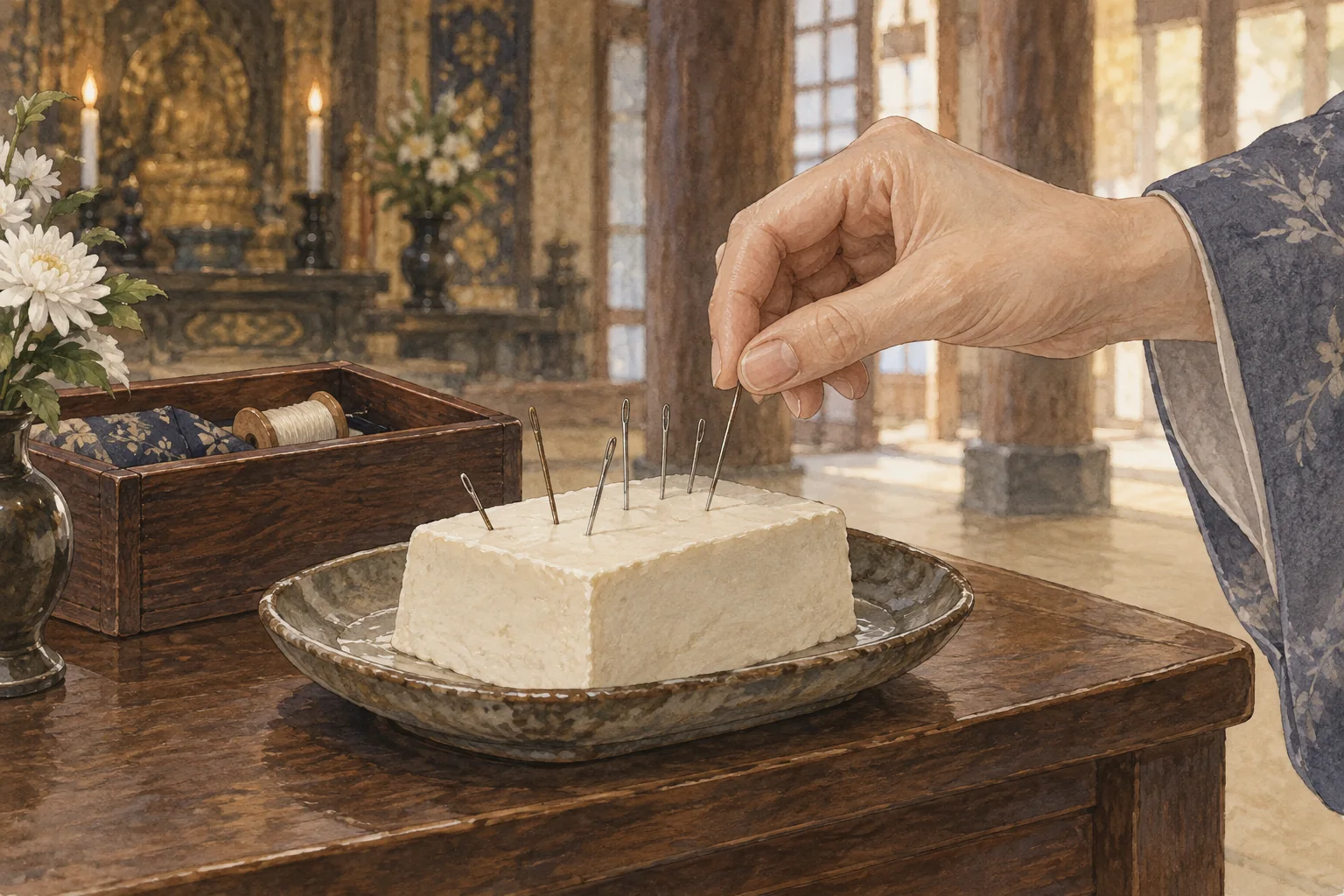
Hari kuyo is a service where broken sewing needles are laid to rest in tofu and thanked for their work.
針供養とは、折れた縫い針を豆腐に刺して休ませ、その働きに感謝する行事です。
In 30 seconds
The standard explanation
On a set day in February or December, depending on the region, people bring bent and broken sewing needles to a shrine or temple and push them into a block of tofu or konnyaku. The soft material is meant to give the needles a gentle final rest after a working life in tough cloth. Sewing is set aside for the day. The custom is kept by kimono makers, tailoring schools and anyone who sews.
地域によって二月か十二月の決まった日に、人は曲がったり折れたりした縫い針を神社や寺に持ち寄り、豆腐やこんにゃくに刺します。硬い布で働いた針に、やわらかいものの中で最後の休息を与えるという意味です。その日は針仕事を休みます。和裁の職人や洋裁の学校、針を使う人たちが続けている習わしです。
As a short speech
A full paragraph you can read aloud
Hari kuyo is a memorial service for needles, and it tells you something about how tools are regarded here. On the eighth of February in eastern Japan, or the eighth of December in much of the west, people who sew bring their bent and broken needles to a shrine or temple.
There, a large block of tofu or konnyaku is set out, and each needle is pushed gently into it. The idea is that a needle has spent its working life being forced through tough cloth, so its last resting place should be soft. A priest reads a service, people thank the needles for their work, and sewing is put aside for the day.
The custom is old, associated with a deity of crafts, and it is kept up by kimono tailors, dressmaking schools and ordinary people who sew at home. It sits alongside the idea that long-used objects can acquire a spirit, and alongside memorial services held for dolls, brushes, scissors and even chopsticks. Visitors often find it one of the most surprising things about Japanese attitudes to objects.
針供養は針のための法要で、ここで道具がどう見られているかを教えてくれます。東日本では二月八日、西日本の多くでは十二月八日に、針を使う人が曲がった針や折れた針を神社や寺に持っていきます。
そこには大きな豆腐かこんにゃくが据えられていて、一本ずつそっと刺していきます。針は働くあいだずっと硬い布を通されてきたのだから、最後に休む場所はやわらかくあるべきだ、という考えです。僧や神職が供養を行い、人は針の働きに感謝し、その日は針仕事を休みます。
古い習わしで、技芸の神と結びついて語られ、和裁の職人、洋裁の学校、家で縫い物をする人たちが続けています。長く使われた物には魂が宿るという考えとも、人形や筆や鋏、箸のための供養とも地続きです。外国から来た人は、物に対する日本人の態度の中でも、とくに驚くことの一つだとよく言います。
Questions people actually ask
And how to answer them.
Why tofu?
Because it is soft. A needle's work is to be pushed through resistant material, so the offering gives it the opposite experience at the end. Konnyaku, a firm jelly, is used in some places for the same reason. Neither is eaten afterward; the block is disposed of by the shrine.
やわらかいからです。針の仕事は抵抗のある物を貫くことなので、最後にその反対を与えるという意味です。同じ理由で、固いゼリー状のこんにゃくを使う地域もあります。どちらも後で食べることはなく、社寺が始末します。
Are there memorial services for other objects?
Yes, and they are not rare. Dolls, writing brushes, scissors, eyeglasses, tea whisks and even chopsticks have their own services at particular temples and shrines, usually for items that can no longer be used but feel wrong to throw away. Companies sometimes hold them for retired machinery.
あります。珍しいことではありません。人形、筆、鋏、眼鏡、茶筅、箸にも、特定の寺社で供養が行われます。もう使えないけれど捨てるのが忍びない物のためです。企業が役目を終えた機械のために行うこともあります。
Can a visitor take part?
At shrines and temples that hold public services, yes. Bring any broken needles or pins you have, or simply watch. Check the date, because eastern and western Japan use different days, and confirm in advance whether the service is open to the public.
一般に公開している社寺なら参加できます。折れた針やピンがあれば持っていき、見学だけでも構いません。東日本と西日本で日が違うので日付を確かめ、公開されているかを事前に確認してください。
Phrases you can use
- The needles are laid to rest in tofu.針は豆腐に刺して休ませます。
- It's a thank-you to the tool for its work.道具の働きへの感謝です。
- Nobody sews on that day.その日は針仕事をしません。
- There are services for dolls and brushes too.人形や筆の供養もあります。
- The date differs between east and west Japan.東日本と西日本で日が違います。
Words you need
- memorial service供養
- sewing needle縫い針
- tofu豆腐
- lay to rest休ませる・納める
- craft / handiwork手仕事
Watch
From YouTubeBackground (Japanese)
針供養は、折れたり曲がったりして使えなくなった針を寺社に納め、豆腐やこんにゃくに刺して供養する行事です。日取りは関東を中心に二月八日、関西を中心に十二月八日が多く、この二日は「事八日」と呼ばれて物忌みの日とされてきました。裁縫の上達を願う信仰とも結びつき、和裁・洋裁の学校や職人が参加します。東京の浅草寺の淡島堂や、和歌山の淡嶋神社の針供養が知られています。針だけでなく、人形供養、筆供養、鋏供養、箸供養など、道具に感謝して納める行事は各地にあり、長く使われた道具に霊が宿るという付喪神の考えと地続きに語られます。供養に使われた豆腐は食べず、社寺が処分します。