geto boru
the team game invented in Japan for children, now played mostly by older people
ゲートボール(げーとぼーる)
In one line
The shortest answer that works
Geto boru, or gateball, is a mallet-and-gate team game devised in Japan in 1947, now played mainly by older people.
ゲートボールとは、1947年に日本で考案された、スティックとゲートを使う団体競技で、いまは主に高齢者が親しんでいるものです。
In 30 seconds
The standard explanation
Two teams of five hit balls through three gates and onto a center pole within thirty minutes, on a small rectangular court. It was devised in Hokkaido in 1947, when equipment for children was scarce after the war, and later spread through local welfare programs for the elderly. It is a strategy game with turn order and knocking opponents' balls away, not a gentle pastime.
五人ずつの二組が、小さな長方形のコートで、三十分のあいだに三つのゲートを通し、中央のポールに当てることを競います。戦後の1947年、子どもの遊び道具が乏しかった北海道で考案され、のちに高齢者向けの地域の取り組みを通じて広まりました。打順があり、相手の球をはじき出す駆け引きがあり、のどかな遊びではありません。
As a short speech
A full paragraph you can read aloud
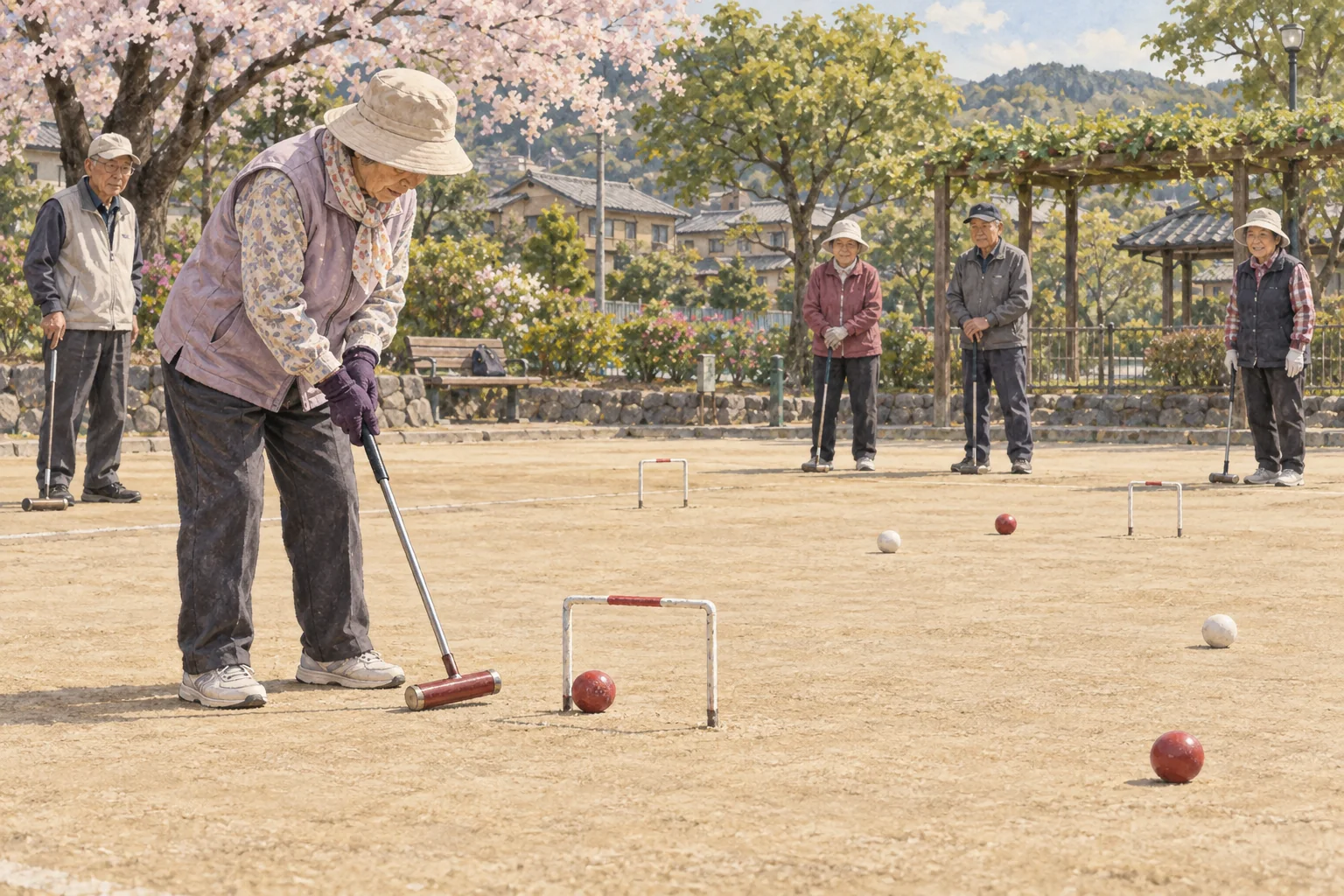
If you see a group of older people on a gravel court, each holding a wooden mallet and watching a stopwatch with serious faces, that is gateball, and its history is the interesting part. It was devised in Hokkaido in 1947 to give children something to play with when there was almost no sporting equipment after the war, borrowing the shape of croquet and simplifying it.
It did not take hold with children. What happened instead is that from the 1970s onward local governments promoted it for the elderly, because it needed little space, no running and no expensive gear, and it spread through community associations until it became the emblem of a Japanese retirement. The game itself is not gentle.
Two teams of five alternate strictly by number, there is a thirty-minute clock, a captain directs play, and a central tactic is to strike an opponent's ball and send it out of position, so a good team plays several turns ahead. It is played competitively, with national tournaments and a governing body, and it has spread to other countries, notably in South America and East Asia.
砂のコートで、年配の人たちが木槌のようなスティックを持ち、真剣な顔で時計を見ている。それがゲートボールで、面白いのはその歴史です。1947年、戦後で運動の道具がほとんどなかったころ、子どもに遊ぶものを与えたいと考えた人が北海道で考案しました。
クロッケーの形を借りて簡単にしたものです。ところが子どもには定着しませんでした。かわりに起きたのは、1970年代以降、自治体が高齢者向けに広めたことです。広い場所も、走ることも、高い道具も要らない。町内会を通して広がり、やがて日本の老後を象徴するものになりました。
競技そのものはのどかではありません。五人ずつの二組が番号どおりに交互に打ち、三十分の時計があり、主将が指示を出します。中心の戦術は、相手の球を打って位置から追い出すこと。強い組は何手も先を読みます。全国大会も統括団体もある競技で、南米や東アジアを中心に海外にも広がりました。
Questions people actually ask
And how to answer them.
Is it the same as croquet?
It borrowed the idea but is a different game: five-a-side teams, a strict turn order by number, a thirty-minute limit and its own scoring.
発想は借りていますが別の競技です。五人ずつの団体戦で、番号どおりの打順があり、三十分の制限があり、独自の得点法を持ちます。
Why is it associated with old people?
Local governments and welfare programs promoted it from the 1970s because it is cheap, needs no running and suits a small ground. It was never adopted by children as intended.
安く、走る必要がなく、狭い場所でできるため、1970年代から自治体や福祉の取り組みが広めたからです。本来の狙いだった子どもには定着しませんでした。
Can a visitor try it?
Local clubs generally welcome anyone who turns up, and equipment is lent. The rules take about an hour to learn; the tactics take much longer.
地域の会はたいてい誰でも迎えてくれますし、道具は貸してもらえます。規則は一時間ほどで覚えられますが、駆け引きはそう簡単ではありません。
A common misunderstanding
MYTHGateball is a slow game for people who can no longer do sport.
FACTIt is a timed team strategy game in which knocking opponents' balls out of position is a core tactic, and competitive play is intense.
Phrases you can use
- It was invented in Japan in 1947.1947年に日本で生まれました。
- It was made for children, but now it's mostly older people who play it.子どものために作られ、いまは高齢者が打ちます。
- Five players a side, thirty minutes.五人ずつ、三十分です。
- You knock the other team's ball away.相手の球をはじき出します。
- It's more tactical than it looks.見た目より駆け引きの多い競技です。
Words you need
- mallet, stickスティック
- gateゲート
- turn order打順
- community association町内会
- knocking outタッチ・スパーク
Watch
From YouTubeBackground (Japanese)
ゲートボールは1947年(昭和22年)に北海道の芽室町で考案されたとされ、戦後の物資不足のなかで子ども向けの遊びとして作られた。1970年代以降、高齢者の健康づくりとして各地の自治体が普及を進めた。公益財団法人日本ゲートボール連合が競技を統括し、世界大会も開かれている。ブラジルや中国、台湾など海外にも競技人口がある。