

 ワークシート
 ぬりえ
 迷路
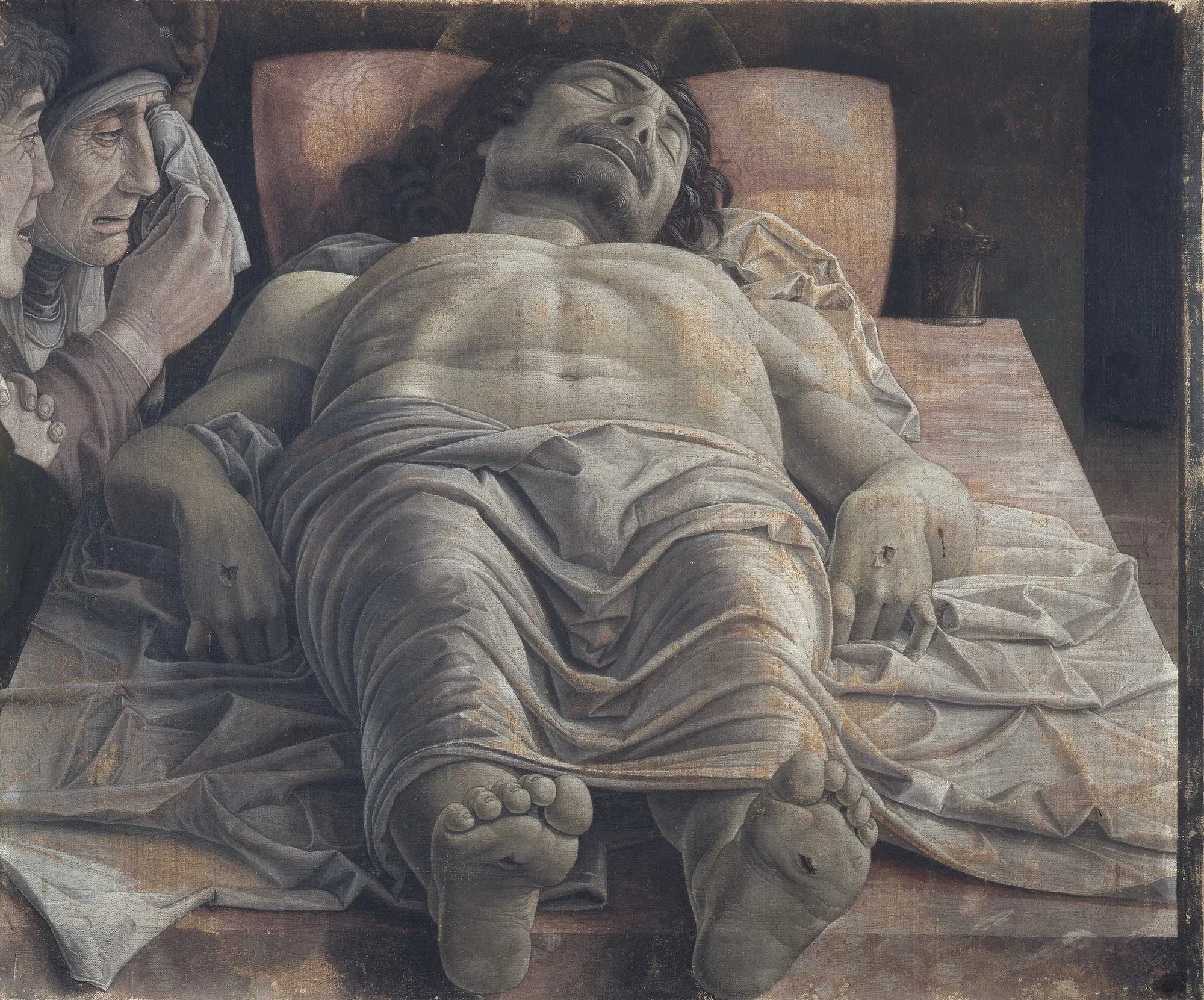
足の裏から見たキリスト!大胆すぎるアングルの名画。Christ seen from the soles of his feet — a painting with a shockingly bold angle.
この作品のお話
Story十字架からおろされたイエス・キリストが、石の台の上に横たわっています。私たちは、その足もとに立って見下ろすような位置に置かれます。左はしで涙をぬぐうのは母マリアと弟子のヨハネ、その奥にもうひとりの人物がのぞいています。北イタリアの画家マンテーニャが描いた、15世紀でもっとも大胆な構図の一つです。
Jesus Christ, taken down from the cross, lies on a stone slab. We stand at his feet and look along his body. On the far left, his mother Mary and his follower John wipe away tears, and another mourner can be seen behind them. The north Italian painter Mantegna made this, one of the boldest compositions of the 15th century.
体を手前から奥へ向かって縮めて描く方法を「短縮法」といいます。遠近法の名人だったマンテーニャは、この絵であえてルールを少し破りました。正確に描くと足が大きくなりすぎて体をかくしてしまうため、足を小さめにしたのです。色をほとんど使わない、石の彫刻のような灰色の画面が、深い静けさを生んでいます。
Drawing a body so that it seems to go back into space is called foreshortening. Mantegna was a master of perspective, but here he broke the rules a little. If he had drawn the feet at their true size, they would hide the body. So he made them smaller. The gray colors, almost like a stone carving, create a deep silence.
マンテーニャが1506年に亡くなったとき、工房には「短縮法で描かれたキリスト」があったと記録されています。それがこの絵だった可能性は高いのですが、同じ題材の作品はほかにもあったため、確かではありません。その後いくつもの持ち主を経て、1824年にミラノのブレラ美術館へ。大胆な構図は、のちの画家や写真家にまで影響をあたえています。
When Mantegna died in 1506, a “foreshortened Christ” was recorded in his studio. It was very likely this painting, but there were other versions of the subject, so we cannot be sure. After passing through several owners, it came to the Brera Gallery in Milan in 1824. Its bold angle has influenced later painters and even photographers.
男の人を足のほうから見ています。彼は石の台の上に横たわっています。当時の絵としては、とてもめずらしい角度です。マンテーニャはわざと足を小さく描きました。足が大きいと、顔が見えなくなってしまうからです!
We see a man from the feet up. He is lying on a stone table. This angle was very unusual in his time. Mantegna made the feet small on purpose. With big feet, we can't see the face!
英語のレベルは上の「やさしい/ふつう」で切りかえられます。
えっ!?な裏ネタ
Secrets本当の遠近法どおりに描くと、手前の足はもっと大きくなり、顔はほとんど見えなくなってしまいます。マンテーニャはわざと足を小さく描き、顔も胸もしっかり見えるようにしました。正確さよりも、伝えたいことを優先したのです。
With true perspective, the feet in front would be much bigger, and you could hardly see the face. Mantegna made the feet smaller on purpose, so we can see the face and chest clearly. He chose meaning over exact accuracy.
この絵の前で左右に動くと、キリストの体と顔がこちらの動きについてくるように感じられると言われます。極端な角度で描かれているために起きる、ふしぎな目の錯覚です。美術館でぜひ試してみたくなる話です。
It is said that if you walk from side to side in front of this painting, the body and face seem to follow you. This strange optical illusion comes from the extreme angle. It is something you will want to try in the museum.
マンテーニャが1506年に亡くなったあと、工房で「短縮法で描かれたキリスト」が記録されました。この絵である可能性が高いとされますが、同じ題材の作品もあったため確かではありません。画家が自分の祈りのために描いた絵だったのかもしれません。
After Mantegna died in 1506, a “foreshortened Christ” was recorded in his studio. It is probably this painting, but there were other versions of the subject, so no one can be sure. He may have painted it for his own private prayers.
1967年、亡くなった革命家チェ・ゲバラの写真が世界に報じられたとき、イギリスの美術評論家ジョン・バージャーは、この絵の構図とよく似ていると指摘しました。500年前の絵の形が、現代の報道写真の中によみがえったのです。
In 1967, photos of the revolutionary Che Guevara after his death were shown around the world. The British art critic John Berger pointed out that one looked very much like this painting. A 500-year-old composition had appeared again in a modern news photo.
ここを見て!
Look Closer1手前の足The feet in front
画面のいちばん手前にある足。十字架の傷あとが見えます。本当の大きさより小さめに描かれています。
The feet are closest to us, and we can see the wounds from the cross. They are painted smaller than their true size.
2キリストの顔Christ's face
まくらにのせた頭が、少しこちらに傾いています。静かで、眠っているようにも見えます。
His head rests on a pillow and tilts a little toward us. It is calm, almost as if he were asleep.
3泣く人々The mourners
左はしで、マリアとヨハネが涙をぬぐっています。画面からはみ出しそうな位置に、ぎゅっと押しこめられています。
On the far left, Mary and John wipe their tears. They are squeezed in at the very edge of the picture.
4香油のつぼThe ointment jar
右奥の小さなつぼ。体にぬるための、よい香りの油が入っていると考えられています。
A small jar sits in the back on the right. It probably holds sweet-smelling oil for the body.
英語で名画を語ろう
Talk about Art in EnglishMantegna painted the body from an unusual angle.
マンテーニャは体をめずらしい角度から描きました。
💡 from a low angle(下から)、from above(上から)なども同じ形で使えます。
英語で説明すると… Describe it
この絵は、ほとんど灰色と茶色です。男性が石の台の上にあおむけに横たわっています。手前には、私たちのすぐ近くに彼の足があります。左には3人の悲しんでいる人がいます。
This painting is mostly gray and brown. A man is lying on his back on a stone table. His feet are in the foreground, close to us. On the left, there are three sad people.
考えてみよう Think & Talk
- 私たちは人物の足もとに立っています。この角度から見ると、どんな気持ちになりますか?We stand at the feet of the figure. How does this angle make you feel?
- マンテーニャは足の本当の大きさを変えました。画家はルールを破ってもいいと思いますか?それはなぜですか?Mantegna changed the true size of the feet. Is it OK for artists to break the rules? Why?
この作品の英単語
WordsThe painter chose a very unusual angle.
画家はとてもめずらしい角度を選んだ。
Three people mourn on the left.
左で3人が悲しんでいる。
Christ lies on a stone slab.
キリストは石の台の上に横たわっている。
It is one of the boldest paintings of its time.
それは当時もっとも大胆な絵の一つだ。
ミニクイズ
QuizQ. マンテーニャが足を小さめに描いたのはなぜ?Why did Mantegna paint the feet smaller?
遠近法どおりだと足が大きすぎて、体や顔をかくしてしまうためです。
With true perspective, the feet would be so big that they would hide the body and face.
ウソ?ホント? この絵は、あざやかな赤や青をたくさん使っている。This painting uses a lot of bright red and blue.
ウソ。ほとんど灰色と茶色だけで、石の彫刻のように描かれています。
False. It uses mostly gray and brown, like a stone carving.
ウソ?ホント? この絵は、木の板ではなく布(カンヴァス)に描かれている。This picture is painted on canvas, not on a wooden panel.
ホント。テンペラという絵の具で、カンヴァスに描かれています。
True. It is painted in tempera on canvas.
 画像の出典とライセンス / Image credit
- PDThe dead Christ and three mourners, by Andrea Mantegna.jpg(Wikimedia Commons)
ライセンス:Public domain(パブリックドメイン)/作者・撮影者の表記:Andrea Mantegna/提供元:Pinacoteca di Brera
この作品は、作者の死後長い年月がたち著作権の保護期間が終わった「パブリックドメイン」の作品です。画像は平面の作品を忠実に写したもので、新しい著作権は生じません(Wikimedia Commons の PD-Art の考え方)。 所蔵:ブレラ美術館(Pinacoteca di Brera)。画像は表示のために縮小・WebP 形式に変換しています。
