

 ワークシート
 ぬりえ
 迷路
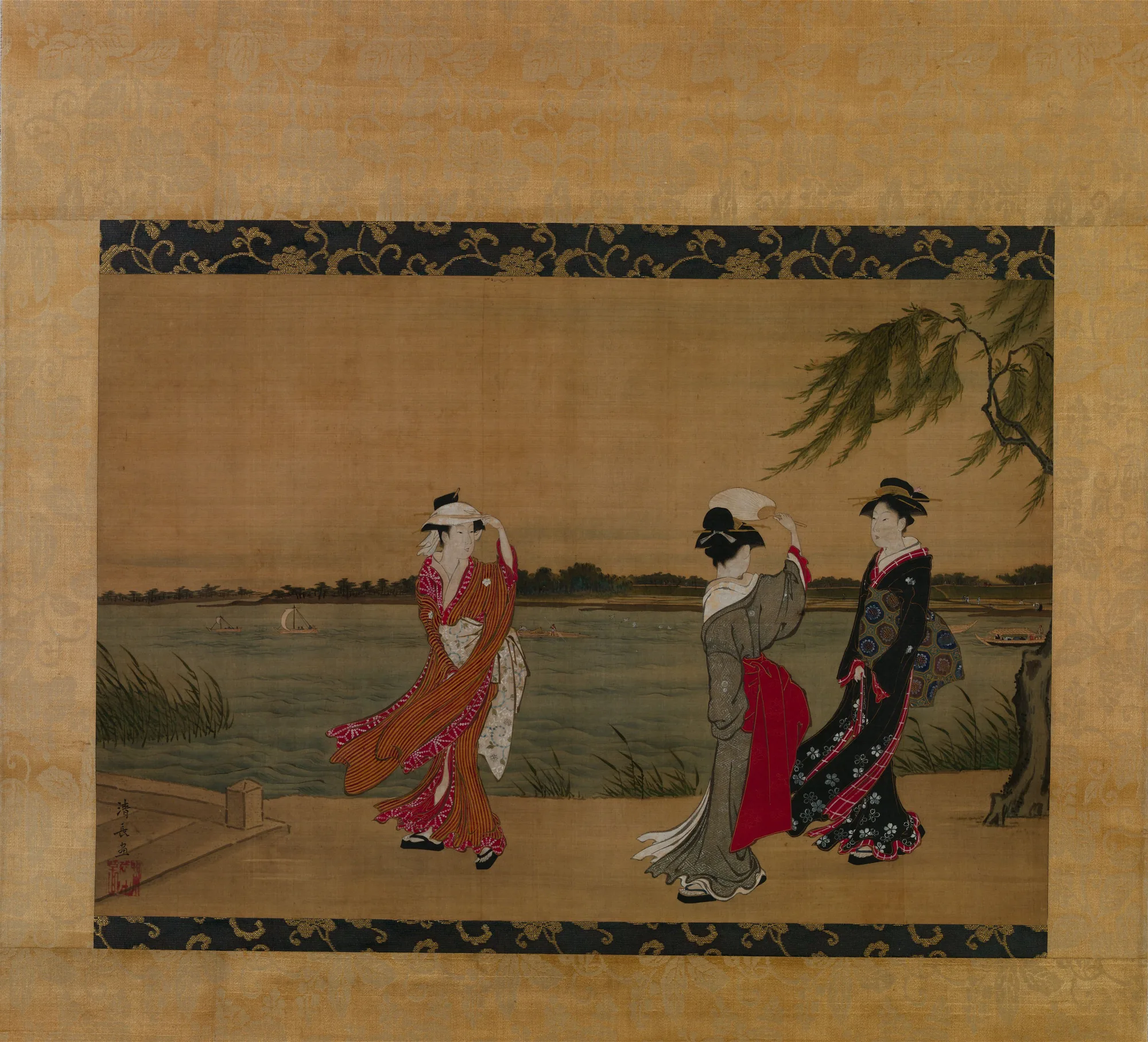
川風がビュー!着物も柳もなびく一瞬を描いた、すらりと背の高い美人たち。Whoosh! The river wind blows their kimonos and the willow. Three tall, graceful women.
 美術館アンテナ:鳥居清長の作品に会える展覧会
この作品のお話
Story川ぞいの道を、三人の女性が歩いています。強い風が吹いて、着物のすそやそでがはためき、左の女性は頭の手ぬぐいをおさえ、中央の女性はうちわを頭の上にかざしています。右では柳の枝が大きくなびき、川には帆かけ舟。描いたのは、すらりとした美人画で知られる浮世絵師・鳥居清長です。版画ではなく、絹に筆で直接描いた一点ものの絵です。
Three women walk along a path by a river. A strong wind makes their kimono hems and sleeves flap. The woman on the left holds down the cloth on her head, while the woman in the center raises a fan above her head. On the right, a willow tree bends in the wind, and sailboats float on the river. The artist is Torii Kiyonaga, famous for tall, slender beauties. This is not a print but a one-of-a-kind painting, brushed directly onto silk.
清長は1780年代、背が高くのびやかな女性たちを、実際の江戸の風景の中に描いて大人気になりました。その美人像は、のちの喜多川歌麿にも影響をあたえたと言われます。清長は歌舞伎の看板などを手がける鳥居派の四代目を継いだあと、版画の仕事を減らしていきました。この掛け軸は、晩年の19世紀初めごろの作品とされます。
In the 1780s, Kiyonaga became very popular for painting tall, graceful women in recognizable Edo settings. His ideal of female beauty is said to have influenced Kitagawa Utamaro. Later, Kiyonaga became the fourth head of the Torii school, known for kabuki signboards, and he made fewer prints. This hanging scroll is thought to be from his late years, in the early 19th century.
風に吹かれる一瞬の動きを、細やかな筆づかいでいきいきととらえています。着物の模様や柳の葉の一枚一枚まで、ていねいに描きこまれています。まわりの金色の模様の布は、掛け軸に仕立てるための表具です。1936年にメトロポリタン美術館に入り、今もニューヨークで大切にされています。
The fine brushwork captures a single moment of movement in the wind. Even the kimono patterns and each willow leaf are painted with care. The gold-patterned cloth around the picture is the mounting that turns it into a hanging scroll. The painting entered the Metropolitan Museum of Art in 1936 and is still kept in New York today.
三人の女性が川辺を歩いています。風がとても強いです。着物が風で動いています。一人の女性は頭の布をおさえています。もう一人はうちわをかざしています。これは版画ではありません。画家が絹に手で描いた絵です。
Three women walk by a river. The wind is very strong. Their kimonos move in the wind. One woman holds down a cloth on her head. Another woman raises a fan. This is not a print. The artist painted it by hand on silk.
英語のレベルは上の「やさしい/ふつう」で切りかえられます。
えっ!?な裏ネタ
Secrets浮世絵というと木版画を思いうかべますが、絵師が筆で直接描いた「肉筆浮世絵」もあります。版画とちがって世界に一つしかない作品で、お金持ちの注文で描かれることが多かったと考えられています。
When we hear 'ukiyo-e', we think of woodblock prints. But artists also painted pictures by hand, called nikuhitsu ukiyo-e. Unlike prints, each one is unique. They were often made for rich customers.
清長が継いだ鳥居派は、江戸時代から歌舞伎の看板や番付を描いてきた絵師の家です。その伝統は九代目の鳥居清光(1938〜2021)まで300年以上受けつがれ、清光も歌舞伎座の絵看板を手がけました。
Kiyonaga led the Torii school, a family of artists who painted kabuki signboards and programs from the Edo period on. The tradition lasted more than 300 years, down to Torii Kiyomitsu IX (1938–2021), who also painted signboards for the Kabukiza Theatre.
清長の描く女性は、背がすらりと高く、頭が小さいのが特徴です。今でいう「8頭身」に近いスタイルだとよく言われます。この絵の三人も、のびやかな体つきで、清長らしさがよく出ています。
Kiyonaga's women are tall with small heads. People often say they are close to 'eight heads tall', like modern fashion models. The three women here also have long, graceful bodies typical of his style.
この絵は、メトロポリタン美術館が1936年に購入したハワード・マンスフィールドの日本美術コレクションの一つです。同じコレクションには、広重の「深川洲崎十万坪」(ワシの絵)の摺りも入っています。
This painting came to the Met in 1936 as part of Howard Mansfield's collection of Japanese art. The same collection also includes a print of Hiroshige's eagle over Fukagawa Susaki.
ここを見て!
Look Closer1風に吹かれる女性Woman in the wind
しま模様の着物がはためき、手ぬぐいを手でおさえる女性。風の強さが伝わってきます。
Her striped kimono flaps as she holds her head cloth. You can feel how strong the wind is.
2うしろ姿の女性Woman seen from behind
赤い帯のうしろ姿。着物のすそが風で大きくうしろへ流れています。
We see her back and her red sash. Her kimono hem blows far behind her.
3なびく柳Willow in the wind
柳の枝が大きくしなっています。風が右から左へ吹いているのがわかります。
The willow branches bend a lot. They show the wind blowing from right to left.
4帆かけ舟A sailboat
川の向こうに小さな帆かけ舟。遠くの景色まで、ていねいに描かれています。
A small sailboat on the far side of the river. Even the distant view is carefully painted.
英語で名画を語ろう
Talk about Art in EnglishThe woman's kimono is blown by the wind.
女性の着物が風に吹かれています。
💡 blow(吹く)の受け身。過去分詞は blown。髪や旗、木の葉の説明にも使えます。
英語で説明すると… Describe it
これは川辺の三人の女性の絵です。強い風が吹いています。左の女性は、オレンジ色のしま模様の着物を着ています。左の女性は頭の布をおさえています。中央の女性はうちわをかざしています。右には柳の木があります。
This is a painting of three women by a river. A strong wind is blowing. The woman on the left is wearing an orange striped kimono. The woman on the left is holding down a cloth on her head. The woman in the center is raising a fan. On the right, there is a willow tree.
考えてみよう Think & Talk
- 目に見えない風を、画家はどうやって描くことができるのでしょう?How can a painter show wind, which we cannot see?
- 三人の女性は、何を話していると思いますか?What do you think the three women are talking about?
この作品の英単語
WordsA strong wind blows by the river.
川辺に強い風が吹いています。
The willow bends in the wind.
柳が風でしなっています。
Kiyonaga painted tall, slender women.
清長は背が高くすらりとした女性を描きました。
Their sleeves flap in the wind.
彼女たちのそでが風ではためいています。
ミニクイズ
QuizQ. この作品はどうやって作られた?How was this work made?
絵師が筆で描いた「肉筆浮世絵」で、世界に一つしかありません。
It is a hand-painted ukiyo-e, and only one exists.
ウソ?ホント? 鳥居清長は、背の高いすらりとした美人画で人気になった。Kiyonaga became popular for pictures of tall, slender women.
1780年代、のびやかな美人画で大人気になりました。
He was very popular in the 1780s for his graceful women.
ウソ?ホント? 絵の中の柳は、風がなくまっすぐにたれている。The willow hangs straight down because there is no wind.
柳の枝は風で大きくしなっています。
The willow branches bend a lot in the wind.
 画像の出典とライセンス / Image credit
- PDTorii Kiyonaga - Three Girls on a Riverbank - 36.100.46 - Metropolitan Museum of Art.jpg(Wikimedia Commons)
ライセンス:Public domain(パブリックドメイン)/作者・撮影者の表記:Torii Kiyonaga
この作品は、作者の死後長い年月がたち著作権の保護期間が終わった「パブリックドメイン」の作品です。画像は平面の作品を忠実に写したもので、新しい著作権は生じません(Wikimedia Commons の PD-Art の考え方)。 所蔵:メトロポリタン美術館(The Metropolitan Museum of Art)。画像は表示のために縮小・WebP 形式に変換しています。
