

 ワークシート
 ぬりえ
 迷路
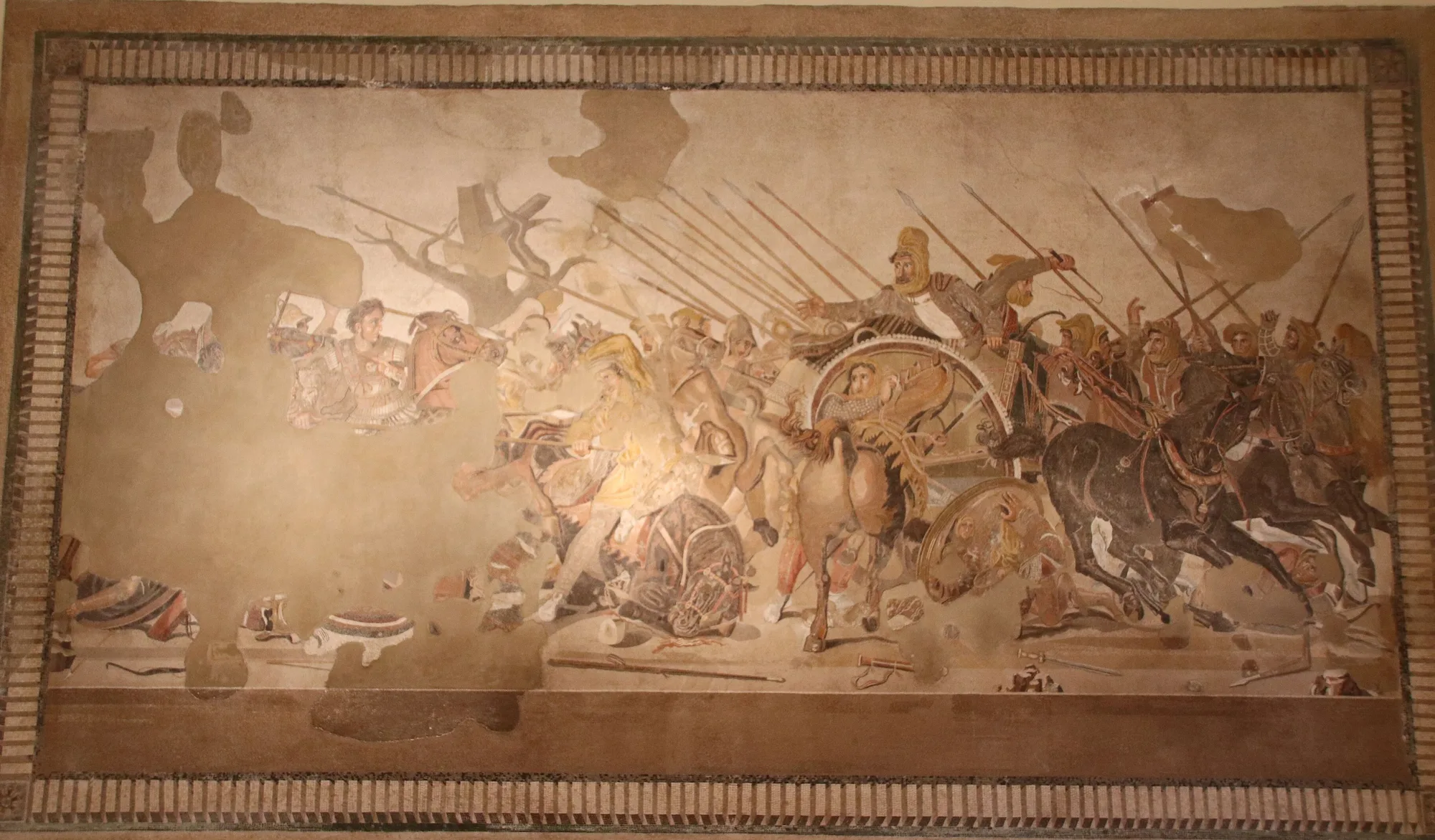
100万個をこえる小石でえがいた大決戦!アレクサンドロス大王vsペルシャ王。A great battle made of over a million tiny stones! Alexander the Great vs. the King of Persia.
この作品のお話
Story左から馬で突進してくる若い武将が、マケドニアのアレクサンドロス大王。右の戦車の上で、おびえた顔で手をのばしているのがペルシャ王ダレイオス3世です。紀元前333年のイッソスの戦いを表したものと伝えられてきました。小さな石のかけらを床に敷きつめた「モザイク」で、大きさは横5メートルをこえます。
The young commander charging on horseback from the left is Alexander the Great of Macedon. On the right, Darius III, King of Persia, stretches out his hand from his chariot with a frightened face. It has long been said to show the Battle of Issus in 333 BC. It is a mosaic, made of small pieces of stone set into a floor, and it is more than five meters wide.
このモザイクは、ポンペイの大邸宅「ファウヌスの家」の床をかざっていました。作られたのは紀元前100年ごろですが、もとになったのは紀元前300年ごろのギリシャの有名な絵だと考えられています。元の絵は失われましたが、職人たちは限られた色の石で、影や立体感、遠近まで見事に表しました。
This mosaic decorated a floor in a large house in Pompeii called the House of the Faun. It was made around 100 BC, but it is thought to copy a famous Greek painting from around 300 BC. The original painting is lost. With stones of only a few colors, the craftsmen still showed shadows, depth and distance.
紀元79年、ヴェスヴィオ火山の噴火でポンペイは灰にうもれました。このモザイクが掘り出されたのは1831年。1844年11月にナポリの博物館へ運ばれ、今のファウヌスの家の床には、2005年に作られた複製が置かれています。古代の戦いの絵として、教科書や本にくり返しのってきました。
In AD 79, the eruption of Mount Vesuvius buried Pompeii in ash. This mosaic was dug up in 1831. In November 1844, it was moved to the museum in Naples, and a copy made in 2005 now lies on the floor of the House of the Faun. It has appeared again and again in history books as a picture of an ancient battle.
これは戦いの大きな絵です。とても小さな石でできています。アレクサンドロス大王が左で馬に乗っています。ペルシャ王は右にいます。こわそうな顔で、にげようとしています。
This is a big picture of a battle. It is made of very small stones. Alexander the Great rides a horse on the left. The King of Persia is on the right. He looks scared and wants to run away.
英語のレベルは上の「やさしい/ふつう」で切りかえられます。
えっ!?な裏ネタ
Secretsこのモザイクに使われた石のかけらは、約150万個と見つもられています(400万個をこえるという計算もあります)。1つ1つは数ミリほどの大きさ。それを床の上に1つずつはめこんでいったのです。
This mosaic is estimated to have about 1.5 million pieces of stone, and some counts say over 4 million. Each piece is only a few millimeters wide. They were set into the floor one by one.
画面の中央下、倒れたペルシャ兵の顔が、ぴかぴかの盾に映りこんでいます。石のかけらだけで「映りこみ」まで表したこの部分は、職人の腕前を見せつける名場面です。実物の前では、思わず顔を近づけたくなります。
Near the bottom center, the face of a fallen Persian soldier is reflected in a shiny shield. Showing a reflection with only pieces of stone was a way for the craftsmen to show off their skill.
この絵で一番大きく、表情豊かに描かれているのは、実は負けて逃げようとするダレイオス王です。御者は馬にむちを入れて退却しようとし、王は振り返って手をのばしています。勝者よりも敗者のドラマが目を引く構図です。
The largest and most expressive figure is actually Darius, the king who is losing. His driver whips the horses to escape, while the king turns and reaches out. The drama of the loser catches our eye more than the winner.
元になったギリシャの絵の作者は、エレトリアのフィロクセノスという画家だという説がよく知られています。ほかにアペレスなどの名前も挙がっていますが、決め手はなく、今もなぞのままです。
A well-known theory says the original Greek painting was by Philoxenus of Eretria. Other names, such as Apelles, have also been suggested. There is no proof, so it is still a mystery.
ここを見て!
Look Closer1アレクサンドロス大王Alexander the Great
かぶとをかぶらず、目を大きく見開いて突き進む若き王。モザイクの左側は大きくはがれていますが、王の顔はしっかり残っています。
The young king charges forward without a helmet, his eyes wide open. Much of the left side is lost, but his face survives.
2ペルシャ王ダレイオス3世Darius III, King of Persia
戦車の上から手をのばす王。おどろきと恐れが入りまじった表情です。
The king reaches out from his chariot. His face shows shock and fear.
3盾に映った顔Face in the shield
倒れた兵士の顔が、ぴかぴかの盾に映っています。
The face of a fallen soldier is reflected in a shiny shield.
4空に向かう長い槍Long spears
ななめに並ぶ何本もの長い槍。大軍がひしめく様子と、戦いの勢いを表しています。
Many long spears point up at an angle. They show a crowded army and the force of the battle.
英語で名画を語ろう
Talk about Art in EnglishAlexander comes face to face with the Persian king.
アレクサンドロスはペルシャ王と真正面から向き合います。
💡 face to face は「顔と顔をつきあわせて」。対決や出会いの場面にぴったりです。
英語で説明すると… Describe it
これはこみあった戦いの場面です。左では、若い男が馬に乗って戦いに飛びこんでいます。右では、王が戦車に乗って手をのばしています。まん中には、たくさんの兵士と馬、長い槍があります。
This is a busy battle scene. On the left, a young man is riding a horse into the fight. On the right, a king is standing in a chariot and reaching out his hand. There are many soldiers, horses and long spears in the middle.
考えてみよう Think & Talk
- 作者はなぜ、負けている王をこんなに大きくはっきりと表したのだと思いますか?Why do you think the artist made the losing king so large and clear?
- この絵が自分の家の床にあったらうれしいですか?それはなぜですか?Would you like to have this picture on the floor of your house? Why or why not?
この作品の英単語
WordsThis mosaic shows a famous battle.
このモザイクは有名な戦いを表しています。
Alexander charges toward the enemy.
アレクサンドロスは敵に向かって突進します。
The king stands in his chariot.
王は戦車に乗っています。
Darius looks frightened.
ダレイオスはおびえているように見えます。
ミニクイズ
QuizQ. このモザイクは、もともとどこにあった?Where was this mosaic first?
ポンペイの「ファウヌスの家」の床にありました。
It was on a floor in the House of the Faun in Pompeii.
ウソ?ホント? このモザイクは、紀元79年の火山の噴火で灰にうもれた町から見つかった。This mosaic was found in a town buried by a volcano in AD 79.
ヴェスヴィオ火山の噴火でうもれたポンペイで、1831年に見つかりました。
It was found in 1831 in Pompeii, which was buried by Mount Vesuvius.
ウソ?ホント? このモザイクは、戦いを見ていた兵士がその場で作った。This mosaic was made by a soldier who watched the battle.
戦いから200年以上あとに、ギリシャの絵をもとに作られたと考えられています。
It was made over 200 years after the battle, probably copying a Greek painting.
 画像の出典とライセンス / Image credit
- PDBattle of Issus in 333 BC, between Alexander the Great & Darius III, from House of the Faun, Pompeii (48452831836).jpg(Wikimedia Commons)
ライセンス:Public domain(パブリックドメイン)/作者・撮影者の表記:Gary Todd from Xinzheng, China
この作品は、作者の死後長い年月がたち著作権の保護期間が終わった「パブリックドメイン」の作品です。画像は平面の作品を忠実に写したもので、新しい著作権は生じません(Wikimedia Commons の PD-Art の考え方)。 所蔵:ナポリ国立考古学博物館(National Archaeological Museum of Naples)。画像は表示のために縮小・WebP 形式に変換しています。
