teppo denrai
the arrival of the matchlock gun in 1543 and how fast Japan copied it
鉄砲伝来(てっぽうでんらい)
In one line
The shortest answer that works
Teppo denrai, the arrival of firearms, is the 1543 introduction of guns, which Japanese smiths copied within about a year.
鉄砲伝来とは、1543年に鉄砲が日本へ伝わったことで、一年ほどで国内での製作が始まりました。
In 30 seconds
The standard explanation
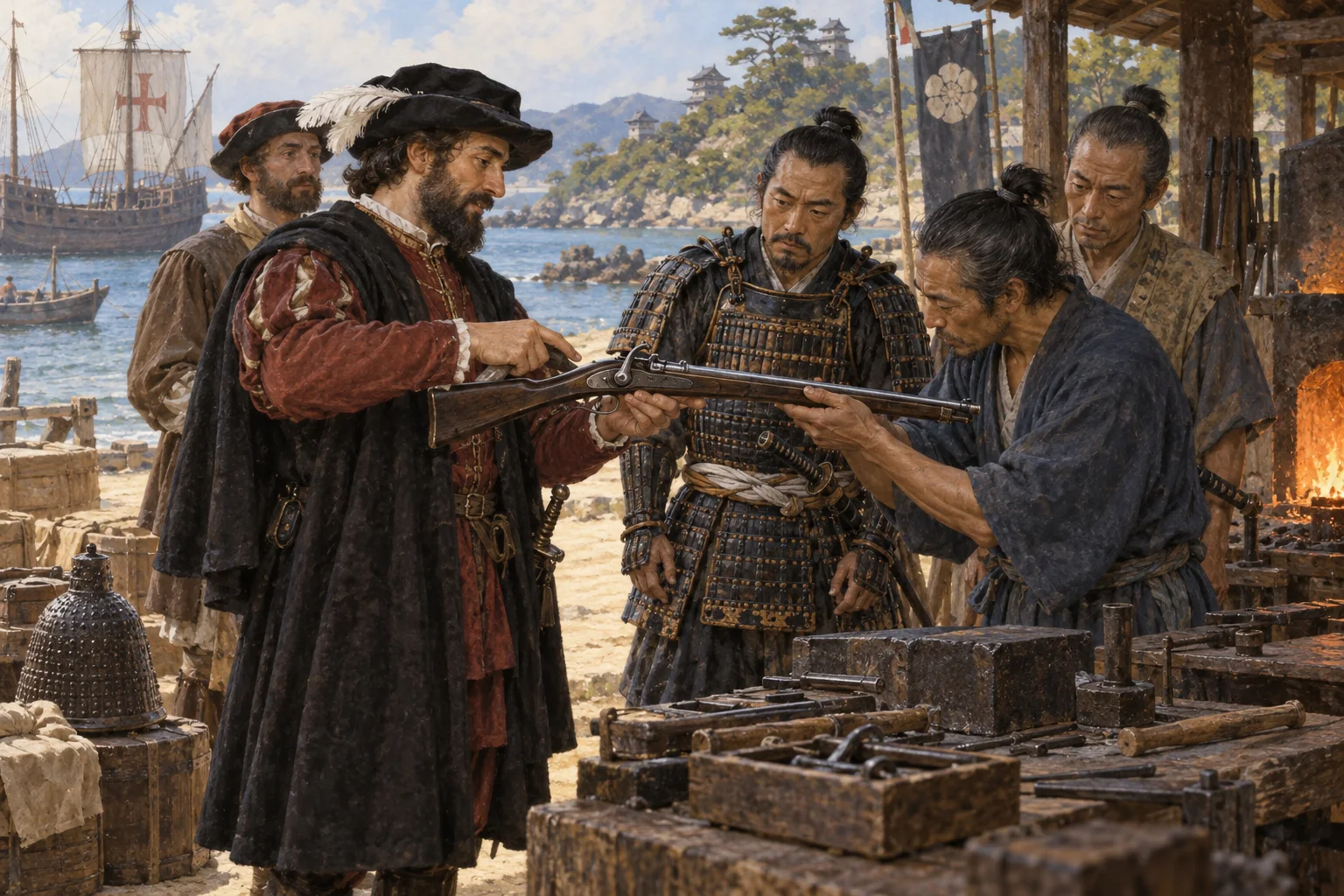
In 1543 a ship carrying Portuguese traders came ashore on Tanegashima, an island south of Kyushu, with matchlock guns aboard. The island's lord bought two and had his swordsmiths copy them. Within decades guns were being made in quantity at Sakai and other centers, and they changed how wars were fought during the century of civil war.
1543年、ポルトガル人を乗せた船が九州の南の島、種子島に漂着し、火縄銃を持っていました。島主は2挺を買い、刀鍛冶に写させます。数十年のうちに堺などで量産されるようになり、戦国の戦い方を変えました。
As a short speech
A full paragraph you can read aloud
The usual story is that firearms arrived in Japan in 1543, when a ship carrying Portuguese traders came ashore on Tanegashima, a small island south of Kyushu. The lord of the island bought two matchlocks and ordered his swordsmiths to reproduce them.
The interesting part is what happened next. Within about a year the island was making its own, and the knowledge spread to Sakai near Osaka and to Kunitomo near Lake Biwa, which became gun-making towns. By the 1570s Japanese armies were using firearms in very large numbers.
The reason is that the country already had a large population of highly skilled metalworkers making swords and armor, and a civil war creating demand. Two caveats are worth adding. The date rests mainly on a chronicle written more than sixty years later, and Portuguese records suggest 1542. And the hardest part to copy is said to have been not the barrel but the screw at its base.
よく語られる話はこうです。1543年、ポルトガル人の商人を乗せた船が、九州の南の小さな島、種子島に漂着した。島主は火縄銃2挺を買い、刀鍛冶に写すよう命じた。面白いのはその先です。
一年ほどで島は自前の銃を作り始め、技術は大阪に近い堺、琵琶湖のそばの国友へ広がり、そこが鉄砲の町になります。1570年代には、日本の軍勢は大量の鉄砲を使っていました。理由は、刀と甲冑を作る腕のいい金属職人がもともと大勢いたこと、そして需要を生む内戦があったことです。
ただし二つ断っておきます。この年号は、六十年以上あとに書かれた記録に主に拠っています。ポルトガル側の記録では1542年です。そして写すのに最も難しかったのは、銃身ではなく、その底に切るねじだったといわれます。
Questions people actually ask
And how to answer them.
Is 1543 certain?
Not entirely. The date comes from a chronicle written in 1606, and some Portuguese accounts point to 1542. Japanese textbooks use 1543, but historians note that the sources disagree.
完全には確かではありません。この年号は1606年に書かれた記録によるもので、ポルトガル側の記録には1542年とするものがあります。日本の教科書は1543年としていますが、史料によって食い違いがあることを研究者は指摘しています。
What was hard about copying it?
The screw plug that seals the base of the barrel. Japanese smiths had no tradition of cutting screw threads, and the story goes that the problem was solved with help from a Portuguese smith who stayed on the island.
銃身の底をふさぐねじです。日本の職人にはねじを切る伝統がなく、島に残ったポルトガルの職人の助けで解決した、と伝えられています。
Did guns end the samurai?
No. Samurai commanded the gun units and used firearms themselves. What guns changed was tactics and the value of trained infantry, not who held power.
終わらせていません。鉄砲隊を率いたのは武士ですし、自ら撃ちもしました。鉄砲が変えたのは戦術と、訓練した足軽の価値であって、誰が権力を持つかではありません。
A common misunderstanding
MYTHJapan later banned guns because samurai valued the sword.
FACTThe Tokugawa government controlled gun production and possession as part of keeping the peace, as it controlled other weapons. There was no ban driven by devotion to the sword, and guns continued to be made.
Phrases you can use
- Firearms reached Japan in 1543, on Tanegashima.鉄砲は1543年、種子島に伝わりました。
- Local smiths were copying them within about a year.一年ほどで、地元の職人が写し始めました。
- The hardest part was the screw at the base of the barrel.いちばん難しかったのは、銃身の底のねじでした。
- Sakai and Kunitomo became gun-making towns.堺と国友が鉄砲の町になりました。
- Sources disagree on the exact year.正確な年については、記録によって食い違いがあります。
Words you need
- matchlock gun火縄銃
- to be washed ashore漂着する
- to reproduce, to copy複製する
- screw threadねじ
- civil war period戦国時代
Watch
From YouTubeBackground (Japanese)
天文12年(1543年)、種子島に漂着した船のポルトガル人が火縄銃を伝えたとされる。島主・種子島時堯が2挺を買い求め、刀鍛冶の八板金兵衛に複製を命じたと『鉄砲記』にある。この書は伝来から六十年以上のちの慶長11年(1606年)に南浦文之が著したもので、年代には1542年とする説もある。技術は紀州の根来、泉州の堺、近江の国友へ広がった。火縄銃そのものを「種子島」と呼ぶ言い方も生まれた。