kokkuri-san
a coin-and-paper fortune-telling game often compared to a Japanese Ouija board
こっくりさん(こっくりさん)
In one line
The shortest answer that works
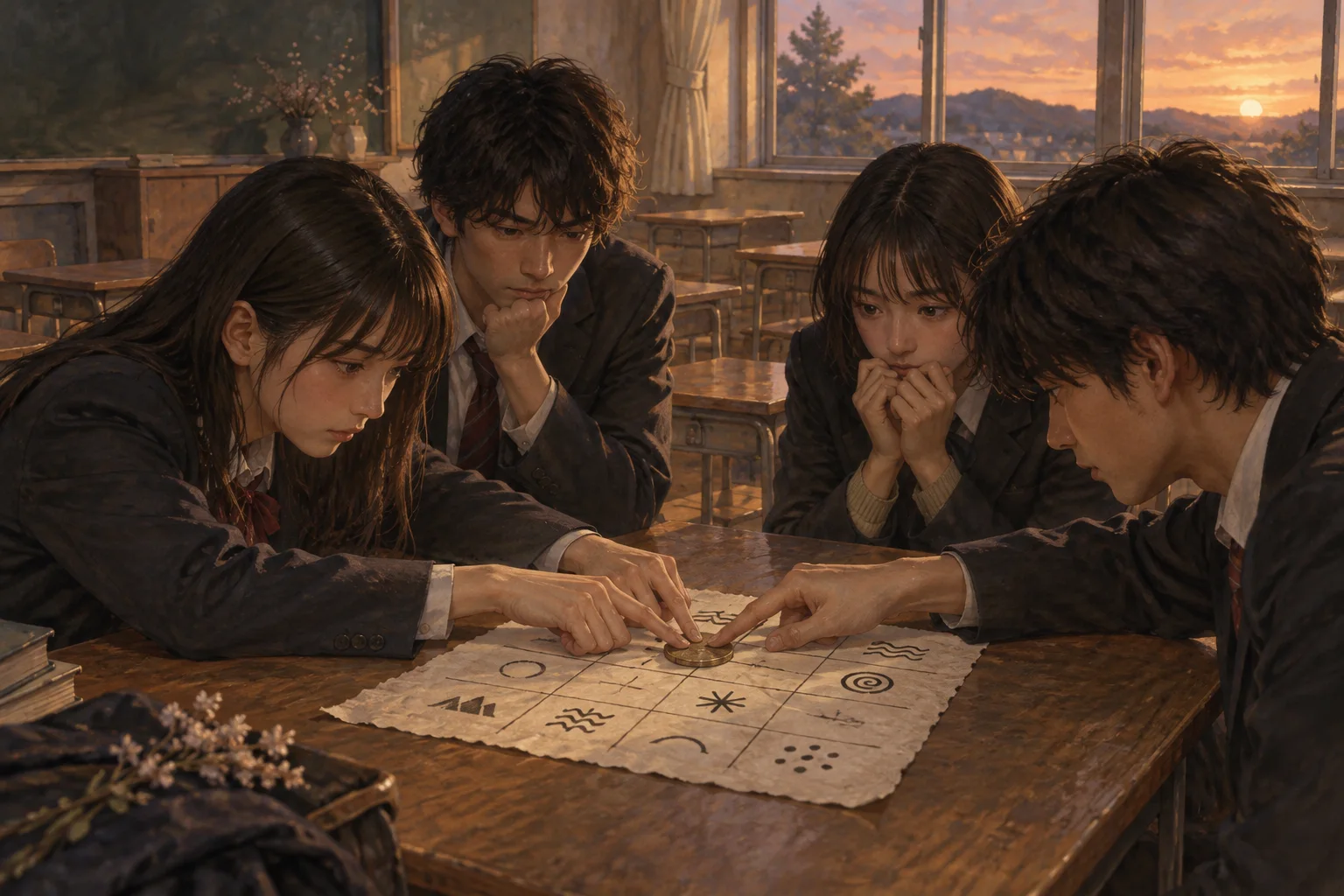
Kokkuri-san is a coin-and-paper fortune-telling game, often compared to a Japanese Ouija board.
こっくりさんとは、コインと紙を使う占いの遊びで、日本版ウィジャボードとよく比較されます。
In 30 seconds
The standard explanation
Kokkuri-san is a game where a few people rest their fingers lightly on a coin placed on a sheet of paper marked with yes, no, numbers and letters, and ask a spirit questions. The coin is said to drift toward answers on its own. It's mostly a schoolyard and sleepover game today, treated half as a scary ritual and half as a party trick, and schools sometimes discourage it because of how genuinely unsettled some children become.
こっくりさんとは、何人かで指をコインに軽く添え、はい・いいえ・数字・文字を書いた紙の上でそのコインに霊への質問をする遊びです。コインは勝手に答えの方へ動くとされます。今では主に学校や泊まりの場で行われる遊びで、怖い儀式であると同時に余興でもあり、本気で怖がって不安定になる子どもがいるため、学校が控えるよう伝えることもあります。
As a short speech
A full paragraph you can read aloud
Calling kokkuri-san a Japanese Ouija board isn't wrong, but it undersells how directly the two are related. The game is said to trace back to Western table-turning, a form of spiritualism that foreign sailors reportedly practiced at Japanese port towns during the Meiji era, and which Japanese onlookers copied and adapted using coins and paper instead of a full table. Players write yes, no, the fifty-sound syllabary and numbers on a sheet of paper, rest their fingers lightly on a coin, and ask a question aloud; the coin is said to creep toward an answer on its own.
What actually moves the coin is almost certainly the ideomotor effect, tiny unconscious muscle movements shared among the players, not a spirit, but the shared belief and the tension of the moment make it feel otherwise. Because of that tension, and rules like properly saying goodbye to the spirit before stopping, some Japanese schools quietly discourage the game, worried less about anything supernatural and more about how genuinely frightened some children become.
こっくりさんを「日本版ウィジャボード」と呼ぶのは間違いではありませんが、両者がどれほど直接つながっているかを言い足りていません。この遊びは、明治時代に日本の港町を訪れた外国人船員が行っていたとされる、テーブルターニングという西洋の降霊術に由来すると言われ、それを見た日本人が、テーブルの代わりにコインと紙を使って真似たのが始まりとされます。
参加者は紙に「はい」「いいえ」、五十音、数字を書き、コインに指を軽く添えて質問を声に出します。すると、コインが勝手に答えのほうへ動いていくとされます。実際にコインを動かしているのは、ほぼ間違いなく参加者全員のごくわずかな無意識の筋肉の動き、いわゆる観念運動効果であり、霊ではありません。
しかし、皆で信じ込む雰囲気とその場の緊張が、そうではないように感じさせます。この緊張、そして終える前に霊にきちんと別れを告げるといった決まりごとのために、一部の学校はこの遊びを控えるよう伝えています。何か超自然的なことよりも、本気で怖がって不安定になる子どもが実際にいることを心配してのことです。
Questions people actually ask
And how to answer them.
Is it really a spirit that moves the coin?
Almost certainly not; the widely accepted explanation is the ideomotor effect, tiny unconscious muscle movements shared by everyone touching the coin, but the belief and the tense atmosphere make it feel like something else is moving it.
ほぼ間違いなく違います。広く受け入れられている説明は観念運動効果で、コインに触れている全員のごくわずかな無意識の筋肉の動きです。ただ、皆が信じ込む緊張した雰囲気のせいで、何か別のものが動かしているように感じられます。
Why do schools sometimes discourage it?
Not because of anything supernatural, but because some children take it very seriously and become genuinely frightened or upset afterward, and rumors can spread quickly once one class starts playing it.
超自然的な理由からではなく、本気で怖がってその後動揺してしまう子どもが実際にいるからです。一つのクラスで流行り出すと噂が急に広まってしまうこともあります。
Is it exactly the same thing as a Western Ouija board?
They share the same underlying idea and even a similar origin story involving Western spiritualism, but the format is different: paper and a coin instead of a printed board and a planchette, and Japanese versions often include specific rules for ending the session safely.
根本の発想も、西洋の降霊術に関わる由来も似ていますが、形は違います。印刷された盤と指し示す道具の代わりに紙とコインを使い、日本版には遊びを安全に終えるための独自の決まりごとが付いていることが多くあります。
A common misunderstanding
MYTHKokkuri-san is an ancient Japanese spirit-summoning ritual.
FACTIt's said to derive from Western table-turning, brought to Japan by foreign sailors during the Meiji era and adapted into today's coin-and-paper form, making it a relatively modern, foreign-influenced game rather than an ancient Shinto or Buddhist practice.
Phrases you can use
- Have you ever played kokkuri-san?こっくりさんをやったことがありますか。
- It's basically a Japanese version of the Ouija board.基本的には日本版のウィジャボードのようなものです。
- The coin is said to move on its own.コインは勝手に動くとされています。
- You're supposed to say goodbye to the spirit before you stop.終わる前に霊にきちんとお別れを言わないといけないとされています。
- Some schools discourage students from playing it.学校によっては、生徒がやらないよう伝えています。
Words you need
- table-turningテーブルターニング
- ideomotor effect観念運動効果
- Japanese syllabary五十音
- fortune-telling占い
- to properly say goodbye (to a spirit)きちんとお別れを言う
Watch
From YouTubeBackground (Japanese)
こっくりさんは、明治時代に外国人船員が日本の港町で行っていたとされる、西洋の降霊術テーブルターニングが元になったとされる。当初は、三本の竹を組んだ上にお櫃のふたなどを載せ、数人で手を添えて行われていたが、後にコインと紙を使う今の形が定着したとされる。名前は、机やコインが「こっくりこっくり」と揺れ動く様子から付けられたという。コインを動かしているのは無意識の筋肉の動きとされるが、遊び終える際に霊へきちんと別れを告げないと祟りがあるという言い伝えも広まり、学校が指導の対象にすることもある。