hamaya
the arrow you buy at New Year
破魔矢(はまや)
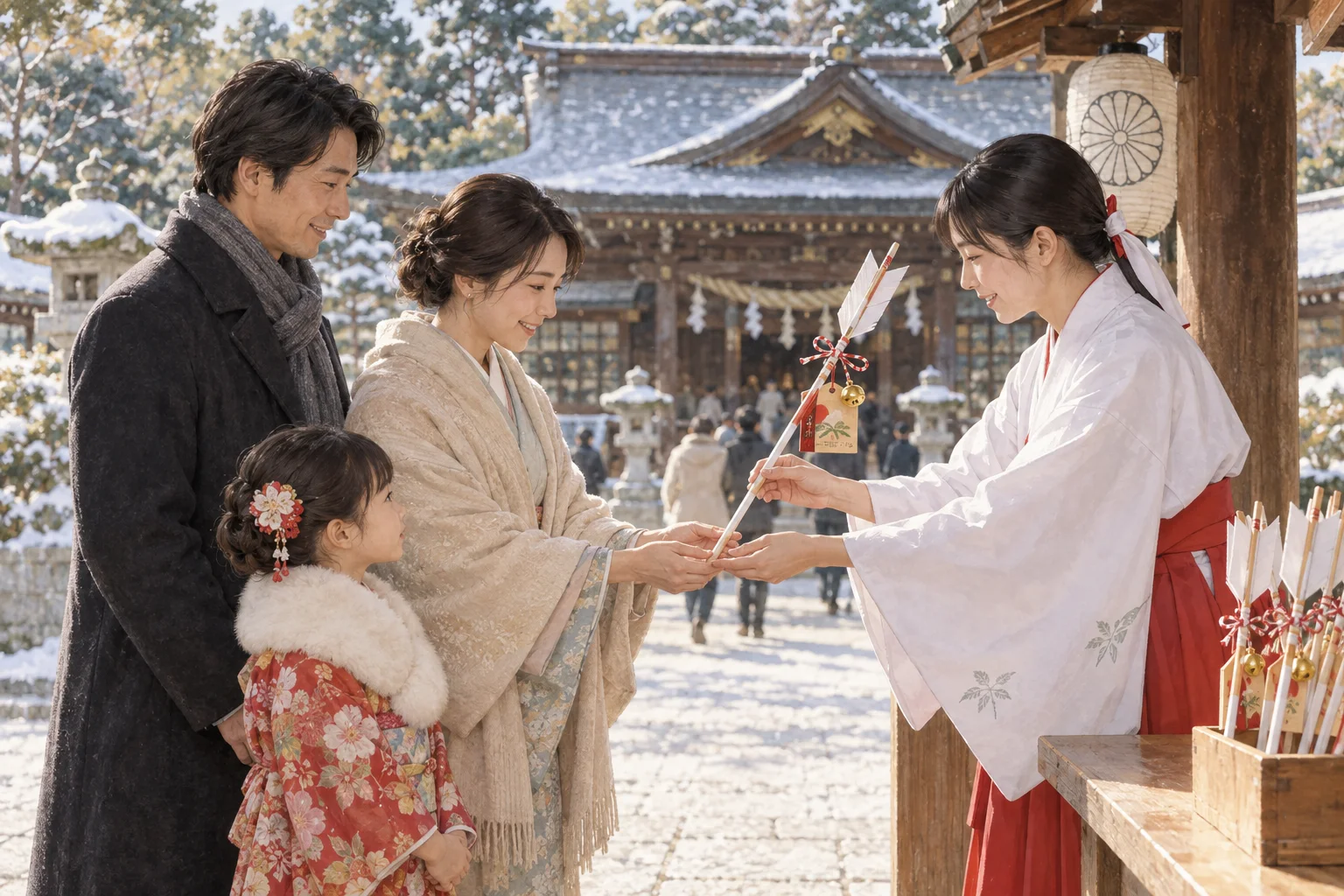
In one line
The shortest answer that works
A hamaya is a blunt decorative arrow bought at New Year to ward off misfortune for the year.
破魔矢とは、その年の災いを避けるために正月に受ける、鏃のない飾りの矢です。
In 30 seconds
The standard explanation
Hamaya are white-feathered arrows sold at shrines and temples at New Year. They have no point, because they are not weapons but protective objects, set up at home for the year and returned to be burned the following New Year. Some come with a small bell, a paper talisman or a zodiac plaque for the year.
破魔矢は、正月に寺社で授与される白い羽根のついた矢です。鏃はありません。武器ではなく守りの品だからです。一年のあいだ家に飾り、翌年の正月に納めて焚き上げてもらいます。鈴や御札、その年の干支の絵馬が添えられているものもあります。
As a short speech
A full paragraph you can read aloud
A hamaya is an arrow you buy at a shrine or temple over the New Year period, and the name means an arrow that breaks evil. It is white-feathered, usually well under a meter long, and it has no point, because it is not meant to be shot; it is a protective object with a direction.
You take it home and stand it somewhere high, often above a doorway or beside the household shrine, and it stays there for the year. The following New Year you bring it back and it is burned with the other old talismans and decorations in a ceremonial fire.
Some say to point it toward an unlucky direction and others toward the lucky one, though plenty of households simply put it where there is space. It often comes with a plaque showing the animal of the coming year, which makes it a small, cheap and genuinely Japanese souvenir, as long as you understand that returning it is part of the arrangement.
破魔矢は正月の時期に寺社で受ける矢で、名は魔を破る矢という意味です。白い羽根がつき、長さはたいてい1メートル足らずで、鏃はありません。射るためのものではないからです。これは向きを持った守りの品です。持ち帰って高い場所に立てます。
戸口の上や神棚のそばが多く、そのまま一年そこに置きます。翌年の正月に寺社へ納めると、他の古い御札や飾りとともに焚き上げの火で焼かれます。凶の方角へ向けるという説も、恵方へ向けるという説もありますが、空いている場所に置くだけの家も多くあります。
その年の干支の絵が入った板が添えられていることが多く、小さく安価で、本当に日本的な土産になります。ただし、返しに行くところまでが一組だと理解しておく必要があります。
Questions people actually ask
And how to answer them.
Do I have to return it after a year?
That is the convention, and shrines set out a box for old talismans each New Year. If you are taking one abroad, treat it as a keepsake instead; nobody expects a visitor to fly back with it, and there is no penalty attached.
それが習わしで、神社は正月に古い御札を納める箱を出します。海外へ持ち帰るなら記念品として扱ってください。旅行者が返しに飛んでくることを期待する人はいませんし、罰があるわけでもありません。
Why does it have no arrowhead?
Because it was never a weapon. The point would make it a hazard in a house and is unnecessary for what it does, which is to face a direction. The name refers to breaking misfortune, not to hitting anything.
もともと武器ではないからです。家の中で鏃は危険ですし、この品の役目である方角を向くことに鏃は要りません。名は災いを破ることを指しており、何かに当てることではありません。
Phrases you can use
- It wards off misfortune for the year.一年の災いを避けるものです。
- There's no arrowhead on it.鏃はついていません。
- Stand it somewhere high in the house.家の高い場所に立てます。
- You return it the following New Year.翌年の正月に納めます。
Words you need
- to ward off避ける
- talisman御札
- ritual fire焚き上げ
- zodiac animal干支
Watch
From YouTubeBackground (Japanese)
破魔矢は、正月に的を射て年占いをした「破魔打」という行事に由来するとされ、的を「ハマ」と呼んだことから名が来たという説があります。多くは初詣の期間に授与され、鈴や干支の絵馬が添えられます。古い破魔矢や御札は、1月中旬に各地で行われるどんど焼きなどの火で焼かれます。神社のものと寺のものがあり、寺では矢に加えて護符が付くこともあります。建物の上棟式でも破魔矢を用いる習慣があります。