
原田英語の多読ベストジュニア このサイトについてはじめて

How the Whale Got his Throat

クジラののどがせまいわけ
★★★★☆7分1380語朗読 Phil Chenevert原文そのまま一致率 79.3%

海の魚を食べつくした食いしんぼうのクジラが、ちえとくふういっぱいの船乗りをのみこんでしまいます。すると……。クジラののどがせまくなったわけのお話。

PDFで印刷(A4 10まい)

In the sea, once upon a time, O my Best Beloved, there was a Whale, and he ate fishes.むかしむかし、海に、いとしい子よ、1頭のクジラがいて、魚を食べていました。 He ate the starfish and the garfish, and the crab and the dab, and the plaice and the dace, and the skate and his mate, and the mackereel and the pickereel, and the really truly twirly-whirly eel.ヒトデも、ダツも、カニも、カレイも、ツノガレイも、ウグイも、エイとその友だちも、サバも、カワカマスも、くねくねくねったウナギも、ぜんぶ食べました。 All the fishes he could find in all the sea he ate with his mouth—so!海じゅうで見つけた魚を、みんな口で食べてしまったのです――こんなふうに! Till at last there was only one small fish left in all the sea, and he was a small 'Stute Fish, and he swam a little behind the Whale's right ear, so as to be out of harm's way.とうとう海には、小さな魚が1ぴきしかのこっていませんでした。それはかしこい小魚で、食べられないように、クジラの右耳の少しうしろを泳いでいました。 Then the Whale stood up on his tail and said, 'I'm hungry.'するとクジラは、しっぽで立ち上がって言いました。「はらがへった」 And the small 'Stute Fish said in a small 'stute voice, 'Noble and generous Cetacean, have you ever tasted Man?'かしこい小魚は、小さなかしこい声で言いました。「りっぱで気前のいいクジラさま、人間というものを食べたことはありますか?」

'No,' said the Whale.「ない」とクジラは言いました。 'What is it like?'「どんな味だ?」

'Nice,' said the small 'Stute Fish.「おいしいですよ」とかしこい小魚は言いました。 'Nice but nubbly.'「おいしいけれど、ごつごつしています」

'Then fetch me some,' said the Whale, and he made the sea froth up with his tail.「では、少しとってこい」とクジラは言って、しっぽで海をあわだたせました。

'One at a time is enough,' said the 'Stute Fish.「1回に1人で十分ですよ」とかしこい小魚は言いました。 'If you swim to latitude Fifty North, longitude Forty West (that is magic), you will find, sitting on a raft, in the middle of the sea, with nothing on but a pair of blue canvas breeches, a pair of suspenders (you must not forget the suspenders, Best Beloved), and a jack-knife, one shipwrecked Mariner, who, it is only fair to tell you, is a man of infinite-resource-and-sagacity.'「ほくい50度、せいけい40度のところ(これはまほうです)まで泳いでいけば、海のまん中で、いかだにすわっている船乗りが1人見つかります。船がしずんでしまった人で、着ているものといえば、青いズック地のズボンと、ズボンつり(ズボンつりをわすれてはいけませんよ、いとしい子よ)だけ、それにナイフを1本持っています。それから、言っておくのがフェアですが、その人は、ちえとくふうがどこまでもある人なのです」

So the Whale swam and swam to latitude Fifty North, longitude Forty West, as fast as he could swim, and on a raft, in the middle of the sea, with nothing to wear except a pair of blue canvas breeches, a pair of suspenders (you must particularly remember the suspenders, Best Beloved), and a jack-knife, he found one single, solitary shipwrecked Mariner, trailing his toes in the water.そこでクジラは、ほくい50度、せいけい40度のところまで、できるだけ速く泳いで泳いで行きました。すると、海のまん中のいかだの上に、青いズック地のズボンとズボンつり(ズボンつりをとくにおぼえておいてね、いとしい子よ)のほかは何も着ていない、ナイフを持った、たったひとりぼっちの船乗りが、足の指を水にひたしていました。 (He had his mummy's leave to paddle, or else he would never have done it, because he was a man of infinite-resource-and-sagacity.)(船乗りはお母さんから、水遊びをしてもいいと言われていたのです。そうでなければ、そんなことはしなかったでしょう。だって、ちえとくふうがどこまでもある人だったのですから)

Then the Whale opened his mouth back and back and back till it nearly touched his tail, and he swallowed the shipwrecked Mariner, and the raft he was sitting on, and his blue canvas breeches, and the suspenders (which you must not forget), and the jack-knife—He swallowed them all down into his warm, dark, inside cupboards, and then he smacked his lips—so, and turned round three times on his tail.するとクジラは、口をうしろへうしろへうしろへと、しっぽにとどきそうなくらい大きくあけて、船乗りをのみこみました。すわっていたいかだも、青いズック地のズボンも、ズボンつり(わすれちゃだめですよ)も、ナイフも――みんなまとめて、あたたかくてくらい、おなかの中の戸だなへのみこんでしまいました。そして、こんなふうにしたつづみを打って、しっぽで3回くるくる回りました。

But as soon as the Mariner, who was a man of infinite-resource-and-sagacity, found himself truly inside the Whale's warm, dark, inside cupboards, he stumped and he jumped and he thumped and he bumped, and he pranced and he danced, and he banged and he clanged, and he hit and he bit, and he leaped and he creeped, and he prowled and he howled, and he hopped and he dropped, and he cried and he sighed, and he crawled and he bawled, and he stepped and he lepped, and he danced hornpipes where he shouldn't, and the Whale felt most unhappy indeed.ところが、ちえとくふうがどこまでもある船乗りは、自分が本当にクジラのあたたかくてくらいおなかの中の戸だなにいるとわかったとたん、ドスンドスンとふみならし、ぴょんぴょんはね、ドンドンたたき、ゴツンゴツンぶつかり、はねまわり、おどりまわり、ガンガン、ガランガラン、たたいたりかみついたり、とんだりはったり、うろつきまわって大声でほえ、ぴょんととんではドスンと落ち、さけんではため息をつき、はいまわってはわめき、歩いてはとびはね、おどってはいけないところで船乗りおどりをおどりました。クジラはとても、とてもいやな気持ちになりました。 (Have you forgotten the suspenders?)(ズボンつりのこと、わすれていませんか?)
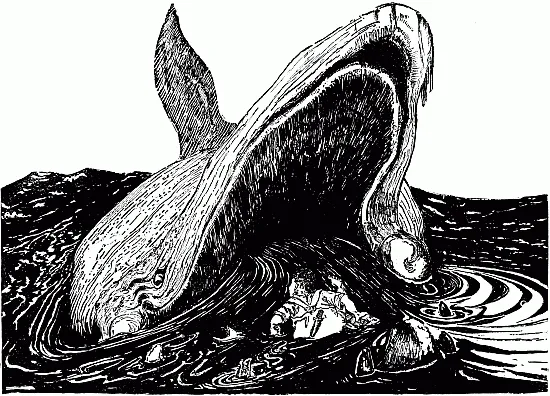
How the Whale Got his Throat の挿絵(Rudyard Kipling / Joseph M. Gleeson)

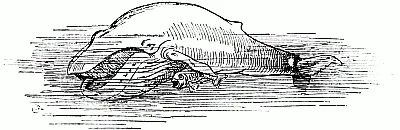
This is the picture of the Whale swallowing the Mariner with his infinite-resource-and-sagacity, and the raft and the jack-knife and his suspenders, which you must not forget.これは、クジラが、ちえとくふうがどこまでもある船乗りを、いかだもナイフもズボンつりもいっしょにのみこんでいるところの絵です。ズボンつりをわすれてはいけませんよ。 The buttony-things are the Mariner's suspenders, and you can see the knife close by them.ボタンのついたものが船乗りのズボンつりで、そのそばにナイフが見えますね。 He is sitting on the raft, but it has tilted up sideways, so you don't see much of it.船乗りはいかだにすわっていますが、いかだがよこにかたむいているので、あまりよく見えません。 The whity thing by the Mariner's left hand is a piece of wood that he was trying to row the raft with when the Whale came along.船乗りの左手のそばにある白っぽいものは、クジラがやってきたとき、船乗りがいかだをこごうとしていた木のきれはしです。 The piece of wood is called the jaws-of-a-gaff.その木のきれはしは、ガフのあごとよばれています。 The Mariner left it outside when he went in.船乗りは、クジラの中に入るとき、それを外においていきました。 The Whale's name was Smiler, and the Mariner was called Mr. Henry Albert Bivvens, A.B.クジラの名前はスマイラー、船乗りの名前はヘンリー・アルバート・ビヴェンスさん、一とう水へいです。 The little 'Stute Fish is hiding under the Whale's tummy, or else I would have drawn him.かしこい小魚はクジラのおなかの下にかくれています。そうでなければ、かいてあげたのですけれど。 The reason that the sea looks so ooshy-skooshy is because the Whale is sucking it all into his mouth so as to suck in Mr. Henry Albert Bivvens and the raft and the jack-knife and the suspenders.海がザブザブ、ゴボゴボしているのは、クジラが、ヘンリー・アルバート・ビヴェンスさんと、いかだと、ナイフと、ズボンつりをすいこもうとして、海の水をみんな口にすいこんでいるからです。 You must never forget the suspenders.ズボンつりのことは、ぜったいにわすれてはいけませんよ。

So he said to the 'Stute Fish, 'This man is very nubbly, and besides he is making me hiccough.そこでクジラは、かしこい小魚に言いました。「この人間はとてもごつごつしているし、そのうえ、こいつのせいでしゃっくりが出る。 What shall I do?'どうしたらいい?」

'Tell him to come out,' said the 'Stute Fish.「出てくるように言いなさい」とかしこい小魚は言いました。

So the Whale called down his own throat to the shipwrecked Mariner, 'Come out and behave yourself.そこでクジラは、自分ののどの下にいる船乗りによびかけました。「出てきて、おとなしくしろ。 I've got the hiccoughs.'しゃっくりが止まらないんだ」

'Nay, nay!' said the Mariner.「いやだ、いやだ!」と船乗りは言いました。 'Not so, but far otherwise.「そうはいかない、まったく反対だ。 Take me to my natal-shore and the white-cliffs-of-Albion, and I'll think about it.'ぼくが生まれた国の岸、アルビオンの白いがけまでつれていってくれたら、考えてやってもいい」 And he began to dance more than ever.そして、前よりもっとおどりはじめました。

'You had better take him home,' said the 'Stute Fish to the Whale.「その人を家へつれて帰ったほうがいいですよ」と、かしこい小魚はクジラに言いました。 'I ought to have warned you that he is a man of infinite-resource-and-sagacity.'「言っておけばよかったのですが、その人はちえとくふうがどこまでもある人なのです」

How the Whale Got his Throat の挿絵(Rudyard Kipling / Joseph M. Gleeson)

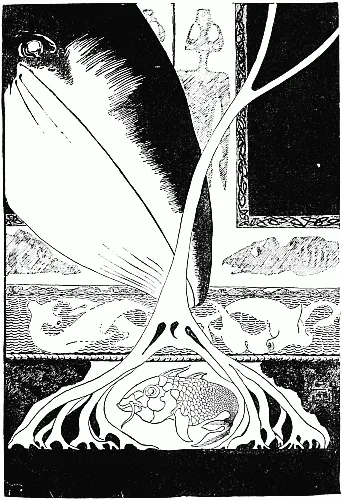
Here is the Whale looking for the little 'Stute Fish, who is hiding under the Door-sills of the Equator.これは、クジラが、赤道のドアのしきいの下にかくれているかしこい小魚をさがしているところです。 The little 'Stute Fish's name was Pingle.かしこい小魚の名前はピングルといいました。 He is hiding among the roots of the big seaweed that grows in front of the Doors of the Equator.赤道のドアの前に生えている大きな海草の根っこのあいだにかくれています。 I have drawn the Doors of the Equator.赤道のドアをかいておきました。 They are shut.ドアはしまっています。 They are always kept shut, because a door ought always to be kept shut.ドアはいつもしめてあります。ドアというものは、いつもしめておくべきものだからです。 The ropy-thing right across is the Equator itself; and the things that look like rocks are the two giants Moar and Koar, that keep the Equator in order.まん中をよこぎっているロープのようなものが赤道そのものです。岩のように見えるのは、赤道をちゃんとしておく2人の大男、モアとコアです。 They drew the shadow-pictures on the doors of the Equator, and they carved all those twisty fishes under the Doors.2人は赤道のドアにかげ絵をかき、ドアの下のくねくねした魚たちをほりました。 The beaky-fish are called beaked Dolphins, and the other fish with the queer heads are called Hammer-headed Sharks.くちばしのある魚はクチバシイルカ、へんな頭をしたほかの魚はシュモクザメといいます。 The Whale never found the little 'Stute Fish till he got over his temper, and then they became good friends again.クジラは、きげんが直るまで、かしこい小魚を見つけられませんでした。それから2ひきは、またなかよしになりました。

So the Whale swam and swam and swam, with both flippers and his tail, as hard as he could for the hiccoughs; and at last he saw the Mariner's natal-shore and the white-cliffs-of-Albion, and he rushed half-way up the beach, and opened his mouth wide and wide and wide, and said, 'Change here for Winchester, Ashuelot, Nashua, Keene, and stations on the Fitchburg Road;' and just as he said 'Fitch' the Mariner walked out of his mouth.そこでクジラは、しゃっくりをしながら、両方のひれとしっぽを使って、力いっぱい泳いで泳いで泳ぎました。そしてとうとう、船乗りの生まれた国の岸と、アルビオンの白いがけが見えてきました。クジラははまべのとちゅうまでかけのぼると、口を大きく大きく大きくあけて言いました。「ウィンチェスター、アシュエロット、ナシュア、キーン、フィッチバーグ線の駅へ行く方は、こちらでお乗りかえください」。そしてクジラが「フィッチ」と言ったちょうどそのとき、船乗りは口から歩いて出てきました。 But while the Whale had been swimming, the Mariner, who was indeed a person of infinite-resource-and-sagacity, had taken his jack-knife and cut up the raft into a little square grating all running criss-cross, and he had tied it firm with his suspenders (now you know why you were not to forget the suspenders!), and he dragged that grating good and tight into the Whale's throat, and there it stuck!ところが、クジラが泳いでいるあいだに、本当にちえとくふうがどこまでもある船乗りは、ナイフでいかだを切って、たてよこに組んだ小さな四角いこうしを作り、それをズボンつりでしっかりしばっていたのです(これで、ズボンつりをわすれてはいけないわけがわかったでしょう!)。そして、そのこうしをクジラののどにぐいっとしっかり引っぱりこんだので、こうしはそこにつっかえてしまいました! Then he recited the following Sloka, which, as you have not heard it, I will now proceed to relate—それから船乗りは、つぎのような詩をとなえました。あなたはまだ聞いたことがないでしょうから、これからお話ししましょう――

By means of a gratingこうしをはめてやったから、I have stopped your ating.もうおまえは食べられないぞ。

For the Mariner he was also an Hi-ber-ni-an.というのも、船乗りはアイルランドの人でもあったのです。 And he stepped out on the shingle, and went home to his mother, who had given him leave to trail his toes in the water; and he married and lived happily ever afterward.そして船乗りは、じゃりのはまべにおり立ち、水に足の指をひたしてもいいと言ってくれたお母さんのところへ帰っていきました。それからけっこんして、いつまでもしあわせにくらしました。 So did the Whale.クジラも同じです。 But from that day on, the grating in his throat, which he could neither cough up nor swallow down, prevented him eating anything except very, very small fish; and that is the reason why whales nowadays never eat men or boys or little girls.でもその日から、のどにはまったこうしは、せきをしても出てこないし、のみこむこともできないので、クジラはとてもとても小さな魚しか食べられなくなりました。だから今のクジラは、人間も、男の子も、小さな女の子も、けっして食べないのです。

The small 'Stute Fish went and hid himself in the mud under the Door-sills of the Equator.かしこい小魚は、赤道のドアのしきいの下のどろの中に行って、かくれてしまいました。 He was afraid that the Whale might be angry with him.クジラがおこっているかもしれないと、こわかったのです。

The Sailor took the jack-knife home.船乗りは、ナイフを家に持って帰りました。 He was wearing the blue canvas breeches when he walked out on the shingle.じゃりのはまべに歩いて出てきたとき、船乗りは青いズック地のズボンをはいていました。 The suspenders were left behind, you see, to tie the grating with; and that is the end of that tale.ズボンつりは、ほら、こうしをしばるのに使って、のこしてきたのです。これでこのお話はおしまい。

How the Whale Got his Throat の挿絵(Rudyard Kipling / Joseph M. Gleeson)
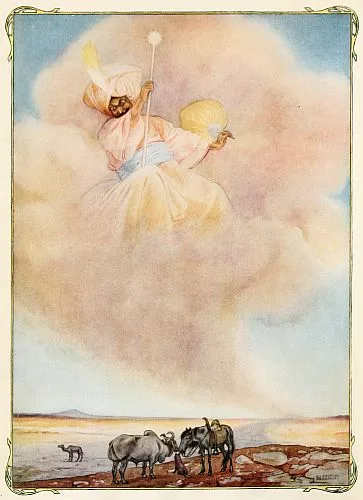
When the cabin port-holes are dark and green船室のまるいまどが、くらいみどり色になるとき、Because of the seas outside;外の海の水のせいで。When the ship goes wop (with a wiggle between)船がぐらりとゆれて(あいだにぐらぐらがあって)、And the steward falls into the soup-tureen,きゅうじさんがスープのうつわにころげこみ、And the trunks begin to slide;トランクがすべりだすとき。When Nursey lies on the floor in a heap,ばあやがゆかの上にぐったりたおれて、And Mummy tells you to let her sleep,ママが「ねかせておいてあげなさい」と言うとき、And you aren't waked or washed or dressed,そしてあなたが起こしてもらえず、顔もあらってもらえず、服も着せてもらえないとき、Why, then you will know (if you haven't guessed)そう、そのときわかるでしょう(まだ気づいていなければね)、You're 'Fifty North and Forty West!'あなたは「ほくい50度、せいけい40度」にいるのだと!
How the Whale Got his Throat の挿絵(Rudyard Kipling / Joseph M. Gleeson)

さいごまで よめたね!

「よめた!」をおすと、スタンプがもらえて おはなしの森 に木や動物がふえるよ。

PDFで印刷(A4 10まい)

おうちの方・大人の学習者へ
「ズボンつりをわすれないで」のくり返しが、さいごに大きな意味を持ちます。親子で予想しながらどうぞ。

出典台帳 — このページの「本物」の証明

英文
原文そのまま(1語も書きかえていません)。Project Gutenberg 電子書籍 #32488(Rudyard Kipling、1902年の本)
挿絵
Rudyard Kipling / Joseph M. Gleeson(同じ本の初版の挿絵。パブリックドメイン)
朗読
Phil Chenevert(LibriVox のボランティア。Just So Stories (version 5)「01 - HOW THE WHALE GOT HIS THROAT 」)。録音はパブリックドメインで、元のファイルをそのまま使っています(音質を落とす加工なし)。
照合
朗読を音声認識(Whisper)で文字起こしし、原文と1語ずつ照らし合わせました。一致率 79.3%
文が光るタイミングはこの照合で決めています。
聞き比べ
LibriVox にある 4 本の録音を自動で聞き比べて選びました(原文との一致・雑音の少なさ・話す速さ)。
朗読者点数一致速さ
Phil Chenevert ← 採用92.0692%148語/分
Reynard T. Fox91.4191%153語/分
Tim Bulkeley (1948-2019)00%-語/分
Betsy Walker00%-語/分
和訳
和訳はAIと人が作成。AIは3重チェック。人の目でも順次確認しています。英文には一切手を入れていません。