 9分
 朗読 Michele Fry
 原文そのまま

 PDFで印刷(A4 10まい)
[This chapter, one of the most wonderful in Fabre’s books, is included in a simplified form in this volume, on account of its interest to such younger readers as have studied geometry.][この章はファーブルの本の中でもとりわけすばらしい章の一つで、幾何学を学んだことのある年少の読者にも興味深いので、この本ではやさしくした形でのせています。]
When we look at the webs of the Garden Spiders, especially those of the Silky Spider and the Banded Spider, we notice first that the spokes or radii are equally spaced; the angles formed by each consecutive pair are of the same value; and this in spite of their number, which in the webs of the Silky Spider sometimes exceeds forty.オニグモのなかま、とくにシロカネグモやナガコガネグモのあみを見ると、まず気がつくのは、「や」つまり半径が等しい間かくでならんでいることです。となり合う二本がつくる角はどれも同じ大きさです。しかも、シロカネグモのあみでは「や」が四十本をこえることもあるのに、そうなのです。 We know in what a strange way the Spider weaves her web and divides the area of the web into a large number of equal parts or sectors, a number which is almost always the same in the work of each species of Spider.クモがどんなに変わったやり方であみを織り、あみの面をたくさんの等しい部分、つまりおうぎ形に分けるかは、もう知っていますね。その数は、それぞれの種類のクモの作品ではほとんどいつも同じです。 The Spider darts here and there when laying her spokes as if she had no plan, and this irresponsible way of working produces a beautiful web like the rose-window in a church, a web which no designer could have drawn better with compasses.クモは「や」を張るとき、まるで何の計画もないように、あちこちにとび回ります。それなのに、このでたらめな働き方から、教会のバラ窓のような美しいあみができるのです。どんな設計者がコンパスを使っても、これ以上うまくはかけなかったでしょう。
We shall also notice that, in each sector, the various chords, parts of the angular spiral, are parallel to one another and gradually draw closer together as they near the center.また、それぞれのおうぎ形の中で、角ばったうずまきの一部である弦(二点を結ぶ直線)がおたがいに平行で、まん中に近づくにつれて、だんだん間がつまっていくことにも気がつくでしょう。 With the two radiating lines that frame them they form obtuse angles on one side and acute angles on the other; and these angles remain constant in the same sector, because the chords are parallel.弦は、それをはさむ二本の「や」と、片側では鈍角(直角より大きい角)を、反対側では鋭角(直角より小さい角)をつくります。弦は平行なので、同じおうぎ形の中ではこれらの角は変わりません。
There is more than this: these same angles, the obtuse as well as the acute, do not alter in value, from one sector to another, as far as the eye can judge.それだけではありません。この同じ角は、鈍角も鋭角も、目で見てわかるかぎり、おうぎ形がかわっても大きさが変わらないのです。 Taken as a whole, therefore, the spiral consists of a series of cross-bars intersecting the several radiating lines obliquely at angles of equal value.TN: added periodですから、全体として見ると、うずまきは、何本もの「や」と同じ大きさの角でななめに交わる、横木の連なりでできているのです。
By this characteristic we recognize what geometricians have named the “logarithmic spiral.”このとくちょうから、幾何学者が「対数らせん」と名づけたものだとわかります。 It is famous in science.これは科学の世界では有名な線です。 The logarithmic spiral describes an endless number of circuits around its pole, to which it constantly draws nearer without ever being able to reach it.対数らせんは、その中心(極)のまわりを数かぎりなく回り、いつまでも中心に近づいていきますが、決してたどり着くことはありません。 We could not see such a line, the whole of it, even with our best philosophical instruments.そんな線の全体は、最高の科学の器具を使っても見ることはできません。 It exists only in the imagination of scientists.それは科学者の頭の中にだけあるのです。 But the Spider knows it, and winds her spiral in the same way, and very accurately at that.ところがクモはそれを知っていて、同じようにうずまきをまいていきます。しかも、とても正確にです。
Another property of this spiral is that if one in imagination winds a flexible thread around it, then unwinds the thread, keeping it taut the while, its free end will describe a spiral similar at all points to the original.このらせんには、もう一つの性質があります。頭の中で、しなやかな糸をらせんにまきつけ、それをぴんと張ったままほどいていくと、糸のはしは、どの点でももとのらせんと同じ形のらせんをえがくのです。 The curve will merely have changed places.曲線は、ただ場所が変わっただけなのです。 Jacques Bernouilli, the professor of mathematics who discovered this magnificent theorem, had engraved on his tomb, as one of his proudest titles to fame, the spiral and its double, made by the unwinding of the thread.このすばらしい定理を発見した数学の教授ヤコブ・ベルヌーイは、自分のいちばんのほこりとして、そのらせんと、糸をほどいてできるもう一つのらせんを、自分の墓にほらせました。 Written underneath it was the sentence: Eadem mutata resurgo.その下には、「エアデム・ムタタ・レスルゴ」という言葉が書かれていました。 “I rise again like unto myself.”「わたしは変わっても、同じすがたでよみがえる」という意味です。 It was a splendid flight of fancy which showed his belief in immortality.それは、永遠の命を信じる心をあらわした、すばらしい想像のつばさでした。
Now is this logarithmic spiral, with its curious properties, merely an idea of the geometricians?では、この不思議な性質を持つ対数らせんは、幾何学者の頭の中の考えにすぎないのでしょうか? Is it a mere dream, an abstract riddle?ただの夢、目に見えないなぞなぞなのでしょうか?
No, it is a reality in the service of life, a method of construction often employed by animals in their architecture.いいえ、それは生き物の役に立っている本物です。動物が家を建てるときによく使う、組み立ての方法なのです。 The Mollusk never makes its shell without reference to the scientific curve.軟体動物は、かならずこの科学的な曲線にしたがって貝がらを作ります。 The first-born of the species knew it and put it into practice; it was as perfect in the dawn of creation as it can be to-day.その種類の最初に生まれたものも、これを知っていて実行していました。この世のはじまりのころにも、今と同じくらい完全だったのです。
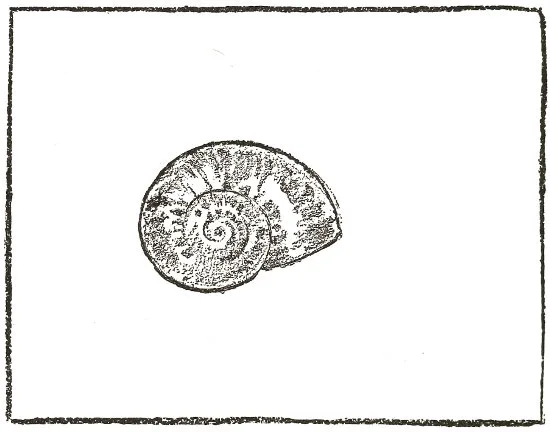
There are perfect examples of this spiral found in the shells of fossils.化石の貝がらにも、このらせんのみごとな例が見られます。 To this day, the last representative of an ancient tribe, the Nautilus of the Southern Seas, remains faithful to the old design, and still whirls its spiral logarithmically, as did its ancestors in the earliest ages of the world’s existence.今でも、古い一族の最後の生き残りである南の海のオウムガイは、昔の設計を守りつづけ、この世のいちばんはじめの時代の先祖と同じように、今も対数らせんの形にからをまいています。 Even in the stagnant waters of our grassy ditches, a tiny Shellfish, no bigger than a duckweed, rolls its shell in the same manner.わたしたちの近くの草の生えたみぞの、よどんだ水の中でも、ウキクサほどの大きさしかない小さな貝が、同じやり方でからをまいています。 The common snail-shell is constructed according to logarithmic laws.ふつうのカタツムリのからも、対数の法則にしたがってできています。