
原田英語の多読ベストジュニア このサイトについてはじめて

the Cotton-Bees and Resin-Bees

ワタハナバチとヤニハナバチ
★★★★☆8分1541語朗読 shibe原文そのまま一致率 95.9%

ほかの虫が作った穴やカタツムリのからを借りて住むハチたち。わたでふくろをあむワタハナバチと、やにで家をふさぐヤニハナバチのくらしをのぞきます。

PDFで印刷(A4 10まい)

There are many Bees who, like the Leaf-cutters, do not make their own dwellings, but use shelters made by the work of others.ハキリバチのように、自分で住まいを作らずに、ほかのものが作った住まいを使うハチは、たくさんいます。 Many of the Osmia-bees seize the old homes of the Masons; other honey-gatherers use earthworm galleries, snail-shells, dry brambles which have been made into hollow tubes by the mining Bees, and even the homes of the Digger Wasps burrowed in the sand.ツツハナバチのなかまの多くは、ヌリハナバチの古い家をうばいます。ほかのみつを集めるハチたちは、ミミズのトンネルや、カタツムリのからや、穴をほるハチがくりぬいてつつにした、かれたキイチゴのくきを使います。砂の中にほられたアナバチの家まで使うのです。 Among these borrowers are the Cotton-bees, who fill the reeds with cottony satchels, and the Resin-bees, who plug up snail-shells with gum and resin.こうした借り住まいのハチの中に、アシのつつをわたのふくろでいっぱいにするワタハナバチと、カタツムリのからをねばねばしたやにでふさぐヤニハナバチがいます。

There is a reason for such arrangement.こうなっているのには、わけがあります。 The Bees who work hard to make their homes, such as the Mason-bee, who scrapes hard clay and makes a large cement mansion, the Carpenter-bee, who bores dead wood to a depth of nine inches, and the Anthophora, who digs corridors and cells in the banks hardened by the sun, have no time left to spend in furnishing their cells elaborately.住まいを作るのに一生けんめいはたらくハチたち、たとえば、かたいねん土をけずって大きなセメントのやしきを作るヌリハナバチや、かれた木に二十三センチもの深さの穴をあけるクマバチや、日に照らされてかたくなったがけに通路と部屋をほるケブカハナバチには、部屋の中を手間をかけてかざる時間が、もう残っていないのです。 On the other hand, the Bees who take possession of ready-made homes, are artists in interior decorations.その反対に、できあがった家を自分のものにするハチたちは、部屋の中をかざる芸術家なのです。 There is the Leaf-cutting Bee, who makes her leafy baskets with such skill; the Upholsterer-bee, who hangs her cells with poppy-petals, and the Cotton-bee, who makes the most beautiful purses of cotton.とても上手に葉のかごを作るハキリバチがいますし、ケシの花びらを部屋のかべにはりめぐらす「かべかざりバチ」もいますし、わたでいちばん美しいきんちゃくぶくろを作るワタハナバチもいます。

We have only to look at the Cotton-bee’s nests, to realize that the insect who makes these could not be a digger, too.ワタハナバチの巣を見れば、それを作る虫が、穴ほりまでするはずはないとわかります。 When newly-felted, and not yet sticky with honey, the wadded purse is very elegant, of a dazzling white.作ったばかりで、まだはちみつでべたべたしていないとき、このわたのふくろは、まぶしいほど白く、とても上品です。 No bird’s-nest can compare with it in fineness of material or in gracefulness of form.材料の細かさでも形の美しさでも、これにかなう鳥の巣はありません。 How, with the little bales of cotton brought up one by one in her mouth, can the Bee manage to mat all together into one material and then to work this into a thimble-shaped wallet?ハチは、口にくわえて一つずつ運んでくる小さなわたのたばを、どうやってみんなからみ合わせて一まいの布にし、それを指ぬきの形のふくろに仕上げるのでしょう? She has no other tools to work with than those owned by the Mason-bees and the Leaf-cutting Bees; namely, her jaws and her feet.ハチが仕事に使える道具は、ヌリハナバチやハキリバチが持っているものと同じ、あごと足だけです。 Yet what very different results are obtained!それなのに、できあがるものの、なんとちがうことでしょう!

It is hard to see the Cotton-bees in action, since they work inside the reeds when making the nests.ワタハナバチは、アシのつつの中で巣を作るので、はたらいているところを見るのはむずかしいのです。 However, I will describe the little that I saw.でも、わたしが見たわずかなことをお話ししましょう。 The Bee procures her cotton from many different kinds of plants, such as thistles, mulleins, the woolly sage and everlastings.ハチは、アザミ、モウズイカ、毛におおわれたサルビア、かわいても色のあせない花(エバーラスティング)など、いろいろな種類の植物からわたを手に入れます。 She uses only the plants that are dead and dry, however, never fresh ones.TN: added period In this way she avoids mildew, which would make its appearance in her nests in the mass of hairs still filled with sap.でも使うのは、かれてかわいた植物だけで、生のものはけっして使いません。こうして、カビをさけているのです。まだしるをふくんだ毛のかたまりでは、巣の中にカビがはえてしまうからです。
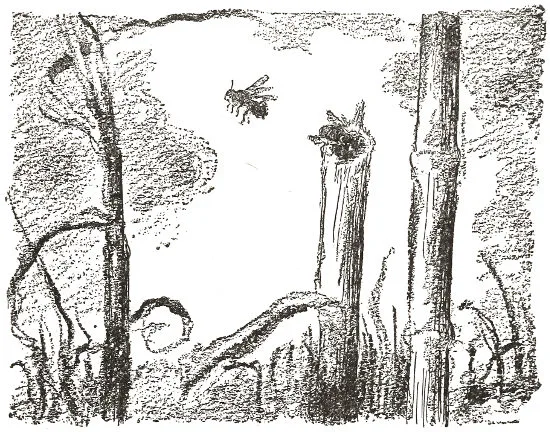
the Cotton-Bees and Resin-Bees の挿絵((1919 edition))

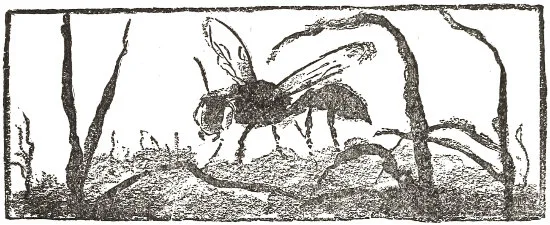
She alights on the plant she wishes to use, scrapes it with her mouth, and then passes the tiny flake to her hind-legs, which hold it pressed against the chest, mixes with it still more down, and makes the whole into a little ball.ハチは、使いたい植物にとまって、口でこすり取り、その小さな毛のかたまりを後ろ足にわたします。後ろ足はそれを胸におしつけて持ち、さらに毛をまぜて、ぜんぶを小さな玉にします。 When this is the size of a pea, it goes back to the mouth, and the insect flies off, with her bale of cotton in her mouth.玉がエンドウ豆くらいの大きさになると、また口にもどされ、ハチはわたのたばを口にくわえて飛んでいきます。 If we have the patience to wait, we shall see her coming back again and again to the same plant, until her bags are all made.しんぼう強く待っていれば、ハチがふくろをぜんぶ作り終えるまで、何度も何度も同じ植物にもどってくるのが見られるでしょう。

The Cotton-bee uses different grades of cotton for the different parts of her work.ワタハナバチは、仕事の場所によって、ちがう品質のわたを使い分けます。 She is like the bird, who furnishes the inside of her nest with wool to make it soft for the little birds, and strengthens the outside with sticks.ハチは鳥に似ています。鳥は、ひなのために巣の内がわを毛でやわらかくし、外がわは小枝で強くしますね。 The Bee makes her cells, the grubs’ nurseries, of the very finest down, the cotton gathered from a thistle; she makes the barrier plug at the entrance of stiff, prickly hairs, such as the coarse bristles scraped from a mullein-leaf.ハチは、幼虫の子ども部屋である部屋を、いちばん細かいわた、つまりアザミから集めたわたで作ります。入り口をふさぐせんは、モウズイカの葉からこすり取ったあらい毛のような、かたくてちくちくする毛で作ります。

I do not see her making the cells inside the bramble, but I catch her preparing the plug for the top.キイチゴのくきの中で部屋を作るところは見られませんが、いちばん上のせんを用意しているところは見つけられます。 With her fore-legs she tears the cotton apart and spreads it out; with her jaws she loosens the hard lumps; with her forehead she presses each new layer of the plug upon the one below.ハチは、前足でわたを引きさいて広げ、あごでかたいかたまりをほぐし、ひたいで、せんの新しい層を一つずつ、下の層の上におしつけます。 This is a rough task; but probably her general way of working is the same for the finer cells.これはあらっぽい仕事ですが、たぶん、もっと細かい部屋を作るときも、だいたい同じやり方をしているのでしょう。

Some Cotton-bees after making the plug go even further and fill up the empty space at the end of the bramble with any kind of rubbish that they can find: little pieces of gravel, bits of earth, grains of sawdust, mortar, cypress-catkins, or broken leaves.ワタハナバチの中には、せんを作ったあと、さらにキイチゴのくきの先の空いた所を、見つけられるかぎりのがらくたでうめるものもいます。小さなじゃり、土のかけら、おがくず、しっくい、イトスギの花、くずれた葉などです。 The pile is a real barricade, and will keep any foe from breaking in.この山は、本物のバリケードで、どんな敵も入りこめません。

The honey with which the Cotton-bee whose nest I examined filled the cells was pale-yellow, all of the same kind and only partly liquefied, so that it would not trickle through the cotton bag.わたしが調べた巣のワタハナバチが部屋にためていたはちみつは、うすい黄色で、すべて同じ種類のものでした。そして、わたのふくろからしみ出さないように、一部分しかとろとろになっていませんでした。 On this honey the egg is laid.このはちみつの上に、たまごが産みつけられます。 After a while the grub is hatched and finds its food all ready.しばらくすると幼虫がかえって、食べ物がすっかり用意されているのを見つけます。 It plunges its head in the honey, drinks long draughts, and grows fat.幼虫は、頭をはちみつにつっこんで、ごくごくと長いこと飲み、まるまると太ります。 We will leave it there, knowing that after a while it will build a cocoon and turn into a Cotton-bee.やがて幼虫はまゆを作って、ワタハナバチになるのですから、ここでそっとしておきましょう。

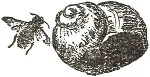
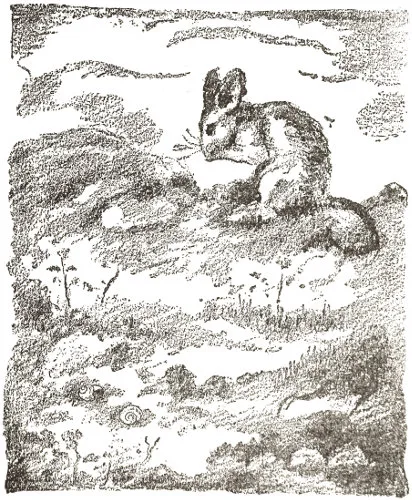
Another interesting Bee who uses a ready-made home is the Resin-bee.できあがった家を使う、もう一つのおもしろいハチが、ヤニハナバチです。 In the stone-heaps which have been left from the quarries, we often find the Field-mouse sitting on a grass mattress, nibbling acorns, almonds, olive-stones, apricot-stones, and snail-shells.石切り場に残された石の山では、草のしきぶとんの上にすわったノネズミが、ドングリやアーモンド、オリーブのたね、アンズのたね、カタツムリのからなどをかじっているのを、よく見かけます。 When he is gone, he has left behind him, under the overhanging stones, a heap of empty shells.ノネズミがいなくなると、つき出た石の下に、からっぽの貝がらの山が残されています。 Among these, there is always a hope of finding a few plugged up with resin, the nests of this sort of Bee.その中には、やにでふさがれたものがいくつか見つかる見こみが、いつもあります。それが、このハチの巣なのです。 The Osmia-bees also use snail-shells, but they plug them up with clay.ツツハナバチもカタツムリのからを使いますが、ツツハナバチはねん土でふさぎます。

the Cotton-Bees and Resin-Bees の挿絵((1919 edition))

It is hard to tell the Resin-bees’ nests, because the insect often makes its home at the very inside of the spiral, a long way from the mouth.ヤニハナバチの巣は見分けるのがむずかしいのです。このハチは、からのうずまきのいちばんおく、入り口からずっとはなれた所に家を作ることが多いからです。 I hold up a shell to the light.わたしは、からを光にかざしてみます。 If it is quite transparent, I know that it is empty and I put it back to be used for future nests.すっかりすき通っていれば、からっぽだとわかるので、これから巣に使われるように、もとにもどしておきます。 If the second whorl is opaque, does not let the light through, the spiral contains something.二つ目のうずまきがすき通っていなくて、光を通さなければ、うずの中に何かが入っています。 What?何でしょう? Earth washed in by the rain?雨で流れこんだ土でしょうか? Remnants of the dead Snail?死んだカタツムリの残りでしょうか? That remains to be seen.それは、調べてみないとわかりません。 With a little pocket-trowel I make a wide window in the middle of the final whorl.小さなポケット用のこてで、いちばん外がわのうずまきのまん中に、大きな窓をあけます。 If I see a gleaming resin floor, with incrustations of gravel, the thing is settled: I have a Resin-bee’s nest.じゃりのうめこまれた、つやつやしたやにのゆかが見えたら、決まりです。ヤニハナバチの巣を手に入れたのです。

the Cotton-Bees and Resin-Bees の挿絵((1919 edition))

The Bee picks out the particular whorl of the shell which is the right size for her nest.ハチは、からのうずまきの中から、巣にちょうどいい太さのところをえらびます。 In large shells, the nest is near the back; in smaller shells, at the very front, where the passage is widest.大きなからでは、巣はおくのほうにあり、小さなからでは、通路がいちばん広い、いちばん前のほうにあります。 She always makes a partition of a mosaic formed of bits of gravel set in gum.ハチはいつも、じゃりのつぶをやにでうめこんだ、モザイクのしきりを作ります。 I did not know at first what this gum was.はじめのうちは、このやにが何なのかわかりませんでした。 It is amber-colored, semi-transparent, brittle, soluble in spirits of wine, and burns with a sooty flame and a strong smell of resin.それはこはく色で、半分すき通っていて、もろく、アルコールにとけ、すすの出るほのおをあげて、やにの強いにおいをさせてもえます。 These characteristics told me that the Bee uses the resinous drops that ooze from the trunks of various cone-bearing trees.こうした性質から、ハチは、いろいろな、まつかさのような実をつける木(針葉樹)のみきからにじみ出る、やにのしずくを使っているのだとわかりました。 There are plenty of junipers in the neighborhood, and I think that these form the main part of this Bee’s materials.近くにはネズの木がたくさんあるので、このハチの材料は、おもにネズのやにだろうと思います。 If there were pines, cypresses, and other cone-bearing trees near, she would probably use those.もし近くにマツやイトスギや、ほかのまつかさをつける木があれば、たぶんそれを使うでしょう。

After the lid of resin and gravel, the Bee stops up the shell still further with bits of gravel, catkins and needles of the juniper, and other odds and ends, including a few rare little land-shells.やにとじゃりのふたのあと、ハチはさらに、じゃりのつぶや、ネズの花のふさや針のような葉、そのほかのこまごました物で、からをふさぎます。その中には、めずらしい小さな陸の貝がらがまじっていることもあります。 This is the secondary barrier, to make the shell still safer for her nest.これは、巣をもっと安全にするための、二つ目のバリケードです。 The Cotton-bee uses the same sort of barrier in the bramble.ワタハナバチも、キイチゴのくきの中に同じようなバリケードを作ります。 The Resin-bee uses it only in the larger shells, where there is much vacant space; in the smaller ones, where her nest reaches nearly to the entrance, she does without it.ヤニハナバチがこのバリケードを使うのは、空いた所の多い大きなからのときだけです。巣が入り口近くまでとどく小さなからでは、バリケードなしですませます。

The cells come next, farther back in the spiral.部屋は、その次の、うずまきのもっとおくにあります。 There are usually only two.部屋はたいてい二つだけです。 The front room, which is the larger, contains a male, which in this kind of Bee is larger than the female; the smaller back room houses a female.大きいほうの手前の部屋にはオスが入っていて、このハチでは、オスのほうがメスより大きいのです。小さいほうのおくの部屋にはメスが入っています。 It is extraordinary how the mother Bee knows the sex of the egg she is laying.お母さんバチが、自分の産むたまごがオスかメスかを知っているのは、おどろくべきことです。 This matter has never been explained to the satisfaction of scientists.このことは、科学者たちがなっとくできるようには、まだ説明されていません。

The Resin-bee makes a mistake in choosing large shells and not filling them up to the very entrance.ヤニハナバチは、大きなからをえらんで、入り口までいっぱいにしないという、まちがいをおかします。 The Osmia-bee also makes her nest in snail-shells; she often seizes upon the empty rooms in the Resin-bee’s house and fills them with her mass of cells.ツツハナバチもカタツムリのからに巣を作ります。ツツハナバチは、よくヤニハナバチの家の空いた部屋を横取りして、自分の部屋のかたまりでいっぱいにしてしまいます。 She then stops up the entrance with a thick clay stopper.それから、厚いねん土のせんで入り口をふさぎます。 When July comes, this house with the two families of tenants becomes the scene of a tragic conflict.七月になると、二つの家族が住むこの家は、悲しいあらそいの場になります。 The Resin-bees, in the back rooms, on attaining the adult state, burst their swaddling bands, bore their way through the resin partitions, pass through the gravel barricade and try to release themselves.おくの部屋のヤニハナバチは、おとなになると、自分をくるんでいたまゆをやぶり、やにのしきりに穴をあけ、じゃりのバリケードを通りぬけて、外へ出ようとします。 Alas, the strange family ahead blocks the way!ああ、ところが、前にいるよその家族が道をふさいでいるのです! The Osmia inmates are still in the grub stage; they mean to stay in their cells till the next spring.ツツハナバチの住人たちは、まだ幼虫のままです。次の春まで、部屋にとどまるつもりなのです。 The Resin-bees cannot get out through this second row of clay-stoppered cells; they give up all hope and perish behind the wall of earth.ヤニハナバチは、このねん土でふさがれた二列目の部屋を通りぬけることができません。すっかりあきらめて、土のかべの後ろで死んでしまいます。 If their mother had only foreseen this danger, the disaster would never have happened; but instinct has failed her for once.もしお母さんがこの危険を前もってわかっていたら、こんな不幸は起こらなかったでしょう。でも、このときばかりは、本能がうまくはたらかなかったのです。 Misfortune has not taught the Resin-bees anything through all the generations; and this contradicts the theory of those scientists who say that animals learn through experience.ヤニハナバチは、何代たっても、この不幸から何も学んでいません。このことは、動物は経験から学ぶと言う科学者たちの説に反しているのです。

the Cotton-Bees and Resin-Bees の挿絵((1919 edition))

さいごまで よめたね!

「よめた!」をおすと、スタンプがもらえて おはなしの森 に木や動物がふえるよ。

PDFで印刷(A4 10まい)

おうちの方・大人の学習者へ
家を「作る」ハチと、借りた家を「かざる」ハチがいるという見方がおもしろい。64〜65の「たまごのオス・メス」のなぞは、今では母バチが受精させるかどうかで決めていることがわかっています。

出典台帳 — このページの「本物」の証明

英文
原文そのまま(1語も書きかえていません)。Project Gutenberg 電子書籍 #45812(J. Henri Fabre (adapted by Louise Seymour Hasbrouck)、1919年の本)
挿絵
(1919 edition)(同じ本の初版の挿絵。パブリックドメイン)
朗読
shibe(LibriVox のボランティア。Insect Adventures「The Cotton-Bees and Resin-Bees」)。録音はパブリックドメインで、元のファイルをそのまま使っています(音質を落とす加工なし)。
照合
朗読を音声認識(Whisper)で文字起こしし、原文と1語ずつ照らし合わせました。一致率 95.9%
文が光るタイミングはこの照合で決めています。
和訳
和訳はAIと人が作成。AIは3重チェック。人の目でも順次確認しています。英文には一切手を入れていません。