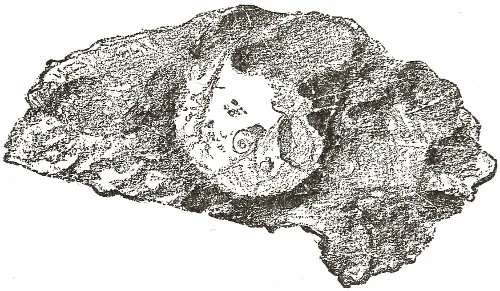
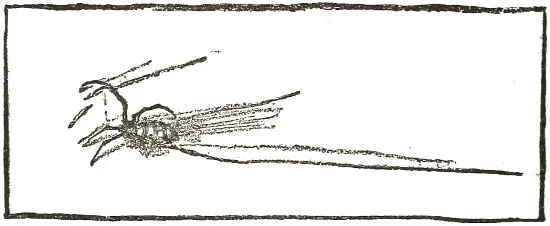
The edge of the dome is scalloped into a dozen pointed scallops, the points of which spread and are fixed to the stone.丸屋根のふちは、十二ほどのとがった波形に切れこんでいて、そのとがった先が広がって、石にとめつけられています。 A flat roof closes the top of the dwelling.すみかのてっぺんは、平らな屋根でふさがれています。
Where is the entrance?入り口はどこでしょう? All the arches of the edge open upon the roof; not one leads inside.ふちのアーチはどれも屋根のほうに開いていて、中に通じているものは一つもありません。 Yet the owner of the house must go out from time to time, if only in search of food; on returning from her expedition, she must go in again.それでも、家の主は、えさをさがすためだけでも、ときどき外に出なければなりません。そして遠出から帰ったら、また中に入らなければなりません。 How does she make her exits and her entrances?どうやって出たり入ったりするのでしょう? A straw will tell us the secret.1本のわらが、そのひみつを教えてくれます。
Pass it over the threshold of the various arches.いろいろなアーチの入り口に、わらを当ててみましょう。 It finds them all carefully closed, apparently.どれも、しっかりとじているように見えます。 But one of the scallops, if cleverly coaxed, opens at the edge into two lips and stands slightly ajar.でも、波形のうちの一つは、うまくつついてやると、ふちのところで二まいのくちびるのように開いて、少しすきまができます。 This is the door, which at once shuts again of its own elasticity.これが戸なのです。戸は、自分のばねの力で、すぐにまたしまります。 Nor is this all: the Spider, when she returns home, often bolts herself in; that is to say, she joins and fastens the two leaves of the door with a little silk.それだけではありません。クモは家に帰ると、よくかんぬきをかけます。つまり、二まいの戸を少しの糸でつなぎあわせて、とめてしまうのです。
The Clotho, when in danger, runs quickly home; she opens the chink with a touch of her claw, enters and disappears.クロトーグモは、危険がせまると、急いで家へかけもどります。つめでちょっとさわってすきまを開け、中に入って見えなくなります。 The door closes of itself and is supplied, in case of need, with a lock consisting of a few threads.戸はひとりでにしまり、いざというときには、何本かの糸でできたかぎもかけられます。 No burglar, on the outside of so many arches, one and all alike, will ever discover under which one the fugitive vanished so suddenly.どれもこれもそっくりなアーチがたくさんあるのですから、外にいるどろぼうには、にげた者がどのアーチの下へさっと消えたのか、決してわからないでしょう。
Let us open the Spider’s cabin.クモの小屋を開けてみましょう。 What luxury!なんというぜいたくでしょう! We have read how the Princess in the fairy-tale was unable to rest, if there was a crumpled rose-leaf in her bed.おとぎ話のおひめさまは、ベッドにしわくちゃのバラの花びらが一まいあるだけで、ねむれなかったと読んだことがありますね。 The Clotho is quite as fastidious.クロトーグモも、それに負けないくらい、ねどこには気をつかうのです。 Her couch is more delicate than swan’s-down and whiter than the fleece of clouds where brood the summer storms.そのしとねは、白鳥の羽毛よりもやわらかく、夏のあらしをはらんだ雲のふわふわよりも白いのです。 It is the ideal blanket.理想の毛布です。 Above is a canopy or tester of equal softness.上には、同じくらいやわらかい天がいがあります。 Between the two nestles the Spider, short-legged, clad in somber garments, with five yellow favors on her back.その二つのあいだに、クモがおさまっています。あしは短く、地味な服を着て、せなかには黄色いかざりもようが五つあります。
Rest in this exquisite retreat demands that it be perfectly steady, especially on gusty days, when sharp draughts creep under the stone dwelling.このすばらしいかくれがで休むには、すみかがしっかりしていて、ぐらつかないことが大事です。とくに風のつよい日には、すきま風が石のすみかの下にしのびこんでくるからです。 By taking a careful look at her we can see how the Spider manages this.よく見てみると、クモがどうやってそうしているのかがわかります。 The arches that bear the weight of the building are fastened to the stone at each end.建物の重さをささえるアーチは、両はしが石にとめつけられています。 Moreover, where they touch, you may see a cluster of diverging threads that creep along the stone and cling to it throughout their length, which spreads afar.そのうえ、アーチが石にふれている所には、四方に広がる糸のたばが見えます。糸は石の上をはっていき、ずっと遠くまで、その長さぜんたいで石にくっついているのです。 I have measured some that were fully nine feet long.長さがたっぷり9フィート(約2.7メートル)もあるのを、はかったことがあります。 These are so many cables; they are like the ropes and pegs that hold the Arab’s tent in position.これらはみんな、ロープのようなものです。アラビアの人のテントを立てておく、つなやくいのようなものなのです。
Another detail attracts our attention: whereas the inside of the house is exquisitely clean, the outside is covered with dirt, bits of earth, chips of rotten wood, little pieces of gravel.もうひとつ、目につくことがあります。家の中はすばらしくきれいなのに、外がわはごみや、土のかけらや、くさった木のくずや、小さなじゃりでおおわれているのです。 Often there are worse things still: hung up or embedded are the dry carcasses of Beetles that favor under-rock shelters; parts of Thousand-legged Worms, bleached by the sun; snail-shells, chosen from among the smallest.もっとひどいものがあることもよくあります。石の下のかくれがをこのむこうちゅうのひからびたなきがらや、日にさらされて白くなったヤスデの体の一部や、いちばん小さいのをえらんだカタツムリのからが、ぶら下げられたり、うめこまれたりしているのです。
These relics are plainly, for the most part, table-leavings, broken victuals.こうしたのこりものは、ほとんどが、どう見ても、食べのこし、食事のあとのくずです。 Unskilled in laying traps, the Clotho lives upon the insects who wander from one stone to another.わなをしかけるのが得意でないクロトーグモは、石から石へとさまよい歩く虫を食べてくらしています。 Whoever ventures under the slab at night is strangled by the hostess; and the dried-up carcass, instead of being flung to a distance, is hung to the silken wall, as though the Spider wished to make a bogey-house of her home.夜に石の下へ入りこんだものは、だれでも、この家の主人にしめ殺されてしまいます。そして、ひからびたなきがらは、遠くへ投げすてられるのではなく、絹のかべにぶら下げられるのです。まるでクモが、自分の家をおばけやしきにしたがっているかのようです。 But this cannot be her aim.でも、これがねらいであるはずはありません。 To act like the ogre who hangs his victim from the castle battlements is the worst way to disarm suspicion in the passers-by whom you are lying in wait to capture.つかまえようと待ちぶせしている通りがかりの者に、あやしまれないようにするには、えじきをお城のかべにつるす人食いおにのようなまねをするのは、いちばんまずいやり方です。
There are other reasons which increase our doubts.うたがいをいっそう深める理由が、ほかにもあります。 The shells hung up are most often empty; but there are also some occupied by the Snail, alive and untouched.ぶら下げてある貝がらは、たいていはからっぽですが、中にカタツムリが生きたまま、手つかずで入っているものもあるのです。 What can the Spider do with these snail-shells wherein the animal retreats so far that she cannot reach it?カタツムリがずっとおくまで引っこんでしまって、クモがとどかないようなからを、クモはどうするのでしょう? The Spider cannot break the hard shell or get at the hermit through the opening.クモには、かたいからをわることも、口から中の住人にとどくこともできません。 Then why should she collect these prizes, whose slimy flesh is probably not to her taste?では、そのぬるぬるした肉は、たぶんクモの口に合わないのに、どうしてこんなえものを集めるのでしょう? We begin to suspect a simple question of ballast and balance.わたしたちは、これは、ただの「おもし」と「つりあい」の問題なのではないかと考えはじめます。 The House Spider prevents her web, spun in a corner of the wall, from losing its shape at the least breath of air, by loading it with crumbling plaster and allowing tiny fragments of mortar to accumulate.イエグモは、かべのすみにはったあみが、ほんの少しの風で形がくずれないように、ぼろぼろのしっくいをのせ、小さなモルタルのかけらがたまるままにしておきます。 The Clotho Spider dumps down on her abode any more or less heavy object, mainly corpses of insects, because she need not look for these and finds them ready to hand after each meal.クロトーグモは、多かれ少なかれ重いものなら何でも、自分のすみかにどさっとのせます。おもに虫のなきがらです。わざわざさがさなくても、食事のたびに手もとにあるからです。 They are weights, not trophies; they take the place of materials that must otherwise be collected from a distance and lifted to the top.それらはおもしであって、記念品ではありません。そうでなければ遠くから集めてきて、てっぺんまで持ち上げなければならない材料のかわりになっているのです。 In this way, a breastwork is obtained that strengthens and steadies the house.こうして、すみかを強くし、しっかりさせる、むねかべができあがるのです。 Further balance is often given by tiny shells and other objects hanging a long way down.小さな貝がらなどが、ずっと下のほうにぶら下がっていて、さらにつりあいをとっていることもよくあります。 The Clotho knows the laws of balancing; by means of additional weights, she is able to lower the center of gravity and thus to give her dwelling the proper equilibrium and roominess.クロトーグモは、つりあいの法則を知っているのです。おもしをつけたして重心を下げ、それによって、すみかがちょうどよくつりあい、広さもたもてるようにしているのです。
Now what does she do in her softly-wadded home?さて、このやわらかなわたをしきつめた家の中で、クモは何をしているのでしょう? Nothing, that I know of.わたしの知るかぎり、何もしていません。 With a full stomach, her legs luxuriously stretched over the down carpet, she does nothing, thinks of nothing; she listens to the sound of the earth revolving on its axis.おなかいっぱいで、羽毛のじゅうたんの上にあしをのびのびと広げて、何もせず、何も考えずに、地球がじくのまわりを回る音に耳をすましています。 It is not sleep, still less is it waking; it is a middle state where the Spider is conscious of nothing except that she is happy.それはねむりではなく、目ざめているのでもなおさらありません。そのあいだの状態で、クモは、自分がしあわせだということのほかは、何も感じていないのです。 We ourselves, when comfortably in bed, enjoy, just before we fall asleep, a few moments of bliss, when we neither think nor worry; and those moments are among the sweetest in our lives.わたしたちも、ベッドでぬくぬくしているとき、ねむりにおちるちょっと前に、何も考えず、何も心配しない、しあわせなひとときを味わいます。そのひとときは、人生でいちばんあまいときのひとつです。 The Clotho Spider seems to know similar moments and to make the most of them.クロトーグモも、同じようなひとときを知っていて、それを思いきり楽しんでいるようです。

 8分
 朗読 K.F. Armstrong
 原文そのまま

 PDFで印刷(A4 9まい)