 16分
 朗読 Bob Neufeld
 原文そのまま
 PDFで印刷(A4 12まい)
Some men are born to good luck: all they do or try to do comes right—all that falls to them is so much gain—all their geese are swans—all their cards are trumps—toss them which way you will, they will always, like poor puss, alight upon their legs, and only move on so much the faster.世の中には、運よく生まれついた人がいるものです。何をしても、何をしようとしても、うまくいきます。手に入るものは何でももうけになり、ガチョウはみんな白鳥に見え、カードはみんな切り札です。どんなふうにほうり投げても、まるでネコのように、いつも足から着地して、そのぶんかえって元気に進んでいくのです。 The world may very likely not always think of them as they think of themselves, but what care they for the world? what can it know about the matter?世間の人は、本人が思っているようには思ってくれないかもしれません。でも、そんな人たちは世間のことなど気にしません。世間に何がわかるというのでしょう?
One of these lucky beings was neighbour Hans.そんな運のいい人の一人が、となりのハンスでした。 Seven long years he had worked hard for his master.ハンスは長い7年のあいだ、主人のもとでいっしょうけんめいはたらきました。 At last he said, ‘Master, my time is up; I must go home and see my poor mother once more: so pray pay me my wages and let me go.’とうとうハンスは言いました。「ご主人さま、約束の年月が終わりました。家に帰って、かわいそうな母にもう一度会わなければなりません。どうかお給金をはらって、帰らせてください。」 And the master said, ‘You have been a faithful and good servant, Hans, so your pay shall be handsome.’すると主人は言いました。「ハンス、おまえは正直でよくはたらいてくれた。だから、たっぷりはらってやろう。」 Then he gave him a lump of silver as big as his head.そして主人は、ハンスの頭ほどもある大きな銀のかたまりをくれました。
Hans took out his pocket-handkerchief, put the piece of silver into it, threw it over his shoulder, and jogged off on his road homewards.ハンスはポケットからハンカチを取り出し、銀のかたまりをつつんで肩にかつぎ、家に向かってのんびり歩きだしました。 As he went lazily on, dragging one foot after another, a man came in sight, trotting gaily along on a capital horse.ハンスが足を引きずるようにして、だらだら歩いていると、立派な馬に乗って楽しそうにかけてくる男が見えました。 ‘Ah!’ said Hans aloud, ‘what a fine thing it is to ride on horseback!「ああ!」とハンスは声に出して言いました。「馬に乗るのはなんてすてきなんだろう! There he sits as easy and happy as if he was at home, in the chair by his fireside; he trips against no stones, saves shoe-leather, and gets on he hardly knows how.’あの人は、まるで家のだんろのそばのいすにすわっているみたいに、楽ちんで幸せそうだ。石につまずくこともないし、くつもへらないし、いつのまにか先へ進んでいる。」 Hans did not speak so softly but the horseman heard it all, and said, ‘Well, friend, why do you go on foot then?’ハンスの声は小さくなかったので、馬に乗った男にはすっかり聞こえていました。男は言いました。「やあ、それなら、どうして歩いているんだい?」 ‘Ah!’ said he, ‘I have this load to carry: to be sure it is silver, but it is so heavy that I can’t hold up my head, and you must know it hurts my shoulder sadly.’「ああ!」とハンスは言いました。「この荷物を運ばなきゃならないんです。たしかに銀なんですけど、重くて頭も上げられないし、肩がひどくいたくなるんですよ。」 ‘What do you say of making an exchange?’ said the horseman.「とりかえっこをするのはどうだい?」と馬に乗った男は言いました。 ‘I will give you my horse, and you shall give me the silver; which will save you a great deal of trouble in carrying such a heavy load about with you.’「わたしの馬をあげるから、きみはその銀をくれないか。そうすれば、そんな重い荷物を持ち歩く苦労がずいぶんへるよ。」 ‘With all my heart,’ said Hans: ‘but as you are so kind to me, I must tell you one thing—you will have a weary task to draw that silver about with you.’「喜んで。」とハンスは言いました。「でも、あなたがとても親切だから、一つだけ言っておきます。その銀を運んで歩くのは、くたびれる仕事ですよ。」 However, the horseman got off, took the silver, helped Hans up, gave him the bridle into one hand and the whip into the other, and said, ‘When you want to go very fast, smack your lips loudly together, and cry “Jip!”’それでも男は馬からおりて銀を受け取り、ハンスを馬に乗せてやりました。そして片手にたづなを、もう片方の手にむちをにぎらせて言いました。「うんと速く走らせたいときは、舌を大きく鳴らして『ジップ!』とさけぶんだよ。」
Hans was delighted as he sat on the horse, drew himself up, squared his elbows, turned out his toes, cracked his whip, and rode merrily off, one minute whistling a merry tune, and another singing,ハンスは馬に乗って大喜びでした。せすじをのばし、ひじをはり、つま先を外に向け、むちをピシッと鳴らして、楽しそうに進んでいきました。楽しい曲を口ぶえでふいたかと思うと、こんな歌を歌いました。
After a time he thought he should like to go a little faster, so he smacked his lips and cried ‘Jip!’しばらくすると、ハンスはもう少し速く走ってみたくなったので、舌を鳴らして「ジップ!」とさけびました。 Away went the horse full gallop; and before Hans knew what he was about, he was thrown off, and lay on his back by the road-side.馬は全速力でかけだしました。そしてハンスが何がなんだかわからないうちに、ふり落とされて、道ばたにあお向けにたおれていました。 His horse would have ran off, if a shepherd who was coming by, driving a cow, had not stopped it.ちょうど牛を追って通りかかったひつじかいが馬を止めてくれなかったら、馬はにげていってしまったことでしょう。 Hans soon came to himself, and got upon his legs again, sadly vexed, and said to the shepherd, ‘This riding is no joke, when a man has the luck to get upon a beast like this that stumbles and flings him off as if it would break his neck.ハンスはすぐに気がついて立ちあがりましたが、すっかりふきげんになって、ひつじかいに言いました。「馬に乗るなんて、とんでもないことだ。こんなけものに乗ったら、つまずいて、首が折れそうなほどふり落とされるんだから。 However, I’m off now once for all: I like your cow now a great deal better than this smart beast that played me this trick, and has spoiled my best coat, you see, in this puddle; which, by the by, smells not very like a nosegay.もうこれっきり、二度とごめんだ。こんな意地悪をして、ほら、わたしのいちばんいい上着をこの水たまりでよごしてしまった気取ったけものより、あなたの牛のほうがずっと好きですよ。それにしても、この水たまりはあまり花たばのようなにおいはしませんね。 One can walk along at one’s leisure behind that cow—keep good company, and have milk, butter, and cheese, every day, into the bargain.あの牛のうしろなら、のんびり歩いていけるし、話し相手にもなるし、おまけに毎日ミルクもバターもチーズも手に入る。 What would I give to have such a prize!’あんな宝物が手に入るなら、何をあげてもいいのになあ!」 ‘Well,’ said the shepherd, ‘if you are so fond of her, I will change my cow for your horse; I like to do good to my neighbours, even though I lose by it myself.’「それなら」とひつじかいは言いました。「そんなに気に入ったのなら、わたしの牛をきみの馬ととりかえてあげよう。自分が損をしても、となりの人によくしてあげるのが好きなんでね。」 ‘Done!’ said Hans, merrily.「決まり!」とハンスはうきうきして言いました。 ‘What a noble heart that good man has!’ thought he.「あの人は、なんて心のやさしい人なんだろう!」とハンスは思いました。 Then the shepherd jumped upon the horse, wished Hans and the cow good morning, and away he rode.それからひつじかいは馬にとび乗り、ハンスと牛に「ごきげんよう。」と言って、走りさりました。
Hans brushed his coat, wiped his face and hands, rested a while, and then drove off his cow quietly, and thought his bargain a very lucky one.ハンスは上着のよごれをはらい、顔と手をふいて、しばらく休みました。それから牛をのんびり追っていきながら、なんて運のいいとりかえっこだったんだろうと思いました。 ‘If I have only a piece of bread (and I certainly shall always be able to get that), I can, whenever I like, eat my butter and cheese with it; and when I am thirsty I can milk my cow and drink the milk: and what can I wish for more?’「パンが一切れありさえすれば(そのくらいはいつだって手に入るさ)、好きなときにバターとチーズをつけて食べられる。のどがかわいたら、牛の乳をしぼって飲めばいい。これ以上、何を望むことがあるだろう?」 When he came to an inn, he halted, ate up all his bread, and gave away his last penny for a glass of beer.宿屋に着くと、ハンスはひと休みして、パンをのこらず食べてしまい、最後の1ペニーでビールを一ぱい飲みました。 When he had rested himself he set off again, driving his cow towards his mother’s village.休みおわると、ハンスはまた牛を追って、お母さんのいる村へ向かいました。 But the heat grew greater as soon as noon came on, till at last, as he found himself on a wide heath that would take him more than an hour to cross, he began to be so hot and parched that his tongue clave to the roof of his mouth.ところが、お昼になるとどんどん暑くなりました。とうとう、わたるのに1時間以上かかる広いあれ野に出たときには、あまりの暑さとのどのかわきで、舌が上あごにはりついてしまうほどでした。 ‘I can find a cure for this,’ thought he; ‘now I will milk my cow and quench my thirst’: so he tied her to the stump of a tree, and held his leathern cap to milk into; but not a drop was to be had.「これなら、なおせるぞ。」とハンスは思いました。「牛の乳をしぼって、のどのかわきをいやそう。」そこでハンスは牛を木の切りかぶにつなぎ、革のぼうしを受けにして乳をしぼろうとしましたが、一てきも出ませんでした。 Who would have thought that this cow, which was to bring him milk and butter and cheese, was all that time utterly dry?ミルクやバターやチーズをくれるはずのこの牛が、じつはずっと乳の出ない牛だったなんて、だれが思ったでしょう? Hans had not thought of looking to that.ハンスはそこまで気がつかなかったのです。
While he was trying his luck in milking, and managing the matter very clumsily, the uneasy beast began to think him very troublesome; and at last gave him such a kick on the head as knocked him down; and there he lay a long while senseless.ハンスがへたな手つきで、なんとか乳をしぼろうとしていると、牛はいやがって、ハンスをうるさく思いはじめました。そしてとうとう、ハンスの頭をけとばしてたおしてしまいました。ハンスは長いあいだ気をうしなって、そこにたおれていました。 Luckily a butcher soon came by, driving a pig in a wheelbarrow.運よく、まもなく肉屋が、手おし車にブタをのせて通りかかりました。 ‘What is the matter with you, my man?’ said the butcher, as he helped him up.「おい、どうしたんだね?」と肉屋は言って、ハンスを助け起こしました。 Hans told him what had happened, how he was dry, and wanted to milk his cow, but found the cow was dry too.ハンスは、何があったかを話しました。のどがかわいたので牛の乳をしぼろうとしたら、牛も乳が出なかったというのです。 Then the butcher gave him a flask of ale, saying, ‘There, drink and refresh yourself; your cow will give you no milk: don’t you see she is an old beast, good for nothing but the slaughter-house?’すると肉屋はビールの入った水とうをわたして言いました。「ほら、これを飲んで元気を出しなさい。その牛は乳なんか出さないよ。年とった牛で、肉にするほかには何の役にも立たないのがわからないのかい?」 ‘Alas, alas!’ said Hans, ‘who would have thought it?「ああ、なんてことだ!」とハンスは言いました。「だれがそんなことを思うもんか。 What a shame to take my horse, and give me only a dry cow!わたしの馬を取って、乳の出ない牛をよこすなんて、ひどいじゃないか! If I kill her, what will she be good for?この牛を肉にしたって、何の役に立つだろう? I hate cow-beef; it is not tender enough for me.牛の肉はきらいなんだ。わたしにはかたすぎる。 If it were a pig now—like that fat gentleman you are driving along at his ease—one could do something with it; it would at any rate make sausages.’でも、ブタだったら――あなたがのんびり運んでいる、その太ったおかたのようなブタなら――何かに使えるだろうに。少なくともソーセージにはなる。」 ‘Well,’ said the butcher, ‘I don’t like to say no, when one is asked to do a kind, neighbourly thing.「それなら」と肉屋は言いました。「親切なことをたのまれて、いやとは言いたくないね。 To please you I will change, and give you my fine fat pig for the cow.’きみのために、とりかえてあげよう。この立派な太ったブタを、その牛とかえてやるよ。」 ‘Heaven reward you for your kindness and self-denial!’ said Hans, as he gave the butcher the cow; and taking the pig off the wheel-barrow, drove it away, holding it by the string that was tied to its leg.「あなたの親切と、自分を後回しにするお心に、神さまのごほうびがありますように!」とハンスは言って、肉屋に牛をわたしました。そして手おし車からブタをおろし、足に結んであるひもを持って、ブタを追っていきました。
So on he jogged, and all seemed now to go right with him: he had met with some misfortunes, to be sure; but he was now well repaid for all.こうしてハンスはのんびり進んでいきました。今度は何もかもうまくいきそうでした。たしかに、いくつか運の悪いこともありましたが、それも今ではすっかりうめあわせがついたのです。 How could it be otherwise with such a travelling companion as he had at last got?とうとうこんな旅の道づれができたのだから、うまくいかないはずがあるでしょうか?
The next man he met was a countryman carrying a fine white goose.つぎに会ったのは、立派な白いガチョウをかかえたいなかの男でした。 The countryman stopped to ask what was o’clock; this led to further chat; and Hans told him all his luck, how he had so many good bargains, and how all the world went gay and smiling with him.男は立ち止まって何時かとたずねました。それがきっかけでおしゃべりになり、ハンスは自分の運のよさを残らず話しました。とりかえっこでどんなにうまくやったか、世の中がどんなに楽しくにこにこしてくれるか、を話したのです。 The countryman then began to tell his tale, and said he was going to take the goose to a christening.それから男も自分の話をはじめ、このガチョウを赤ちゃんの洗礼のおいわいに持っていくところだと言いました。 ‘Feel,’ said he, ‘how heavy it is, and yet it is only eight weeks old.「持ってごらん。」と男は言いました。「こんなに重いのに、まだ生まれて8週間なんだ。 Whoever roasts and eats it will find plenty of fat upon it, it has lived so well!’これを焼いて食べる人は、あぶらがたっぷりのっているのがわかるよ。それだけいいものを食べて育ったんだからね!」 ‘You’re right,’ said Hans, as he weighed it in his hand; ‘but if you talk of fat, my pig is no trifle.’「そのとおりですね。」とハンスは、ガチョウを手で持って重さをはかりながら言いました。「でも、あぶらのことを言うなら、わたしのブタだって負けていませんよ。」 Meantime the countryman began to look grave, and shook his head.そのうちに、男はむずかしい顔をして、首をふりはじめました。 ‘Hark ye!’ said he, ‘my worthy friend, you seem a good sort of fellow, so I can’t help doing you a kind turn.「いいかい!」と男は言いました。「きみはいい人みたいだから、ちょっと親切にしてあげずにはいられないよ。 Your pig may get you into a scrape.そのブタのせいで、きみはこまったことになるかもしれない。 In the village I just came from, the squire has had a pig stolen out of his sty.わたしが今通ってきた村で、地主さんのブタが小屋からぬすまれたんだ。 I was dreadfully afraid when I saw you that you had got the squire’s pig.きみを見たとき、そのブタが地主さんのブタじゃないかと、すごく心配になったんだよ。 If you have, and they catch you, it will be a bad job for you.もしそうで、つかまったら、ひどいことになるぞ。 The least they will do will be to throw you into the horse-pond.少なくとも、馬の水あび池にほうりこまれるだろうね。 Can you swim?’きみ、泳げるかい?」
Poor Hans was sadly frightened.かわいそうに、ハンスはすっかりこわくなりました。 ‘Good man,’ cried he, ‘pray get me out of this scrape.「親切なおかた、どうかこのこまったことから助けてください。」とハンスはさけびました。 I know nothing of where the pig was either bred or born; but he may have been the squire’s for aught I can tell: you know this country better than I do, take my pig and give me the goose.’「このブタがどこで生まれ育ったのか、わたしはちっとも知りません。でも、ひょっとしたら地主さんのブタかもしれません。あなたはわたしよりこのあたりにくわしいでしょうから、どうかブタを引き取って、ガチョウをください。」 ‘I ought to have something into the bargain,’ said the countryman; ‘give a fat goose for a pig, indeed!「おまけをもらってもいいくらいだね。」と男は言いました。「太ったガチョウをブタとかえるなんて、まったく! ‘Tis not everyone would do so much for you as that.だれもがきみのために、ここまでしてくれるわけじゃないんだよ。 However, I will not be hard upon you, as you are in trouble.’でも、きみはこまっているんだから、きびしいことは言わないでおこう。」 Then he took the string in his hand, and drove off the pig by a side path; while Hans went on the way homewards free from care.それから男はひもを手に取り、わき道からブタを追っていってしまいました。ハンスのほうは心配もなく家に向かって歩いていきました。 ‘After all,’ thought he, ‘that chap is pretty well taken in.「けっきょく、あいつはすっかりだまされたってわけだ。」とハンスは思いました。 I don’t care whose pig it is, but wherever it came from it has been a very good friend to me.「だれのブタだってかまわないけど、どこから来たにしても、ぼくにはずいぶんいい友だちだったなあ。 I have much the best of the bargain.このとりかえっこは、ぼくのほうがずっと得をしたぞ。 First there will be a capital roast; then the fat will find me in goose-grease for six months; and then there are all the beautiful white feathers.まずはおいしい焼き肉になるし、それからあぶらは半年分のガチョウのあぶらになる。そのうえ、美しい白い羽がどっさりある。 I will put them into my pillow, and then I am sure I shall sleep soundly without rocking.それをまくらに入れたら、ゆりかごでゆらさなくたって、ぐっすりねむれるに決まってる。 How happy my mother will be!お母さんはどんなに喜ぶだろう! Talk of a pig, indeed!ブタだなんて、とんでもない! Give me a fine fat goose.’立派な太ったガチョウがいちばんさ。」
As he came to the next village, he saw a scissor-grinder with his wheel, working and singing,つぎの村に来ると、はさみとぎ屋が、と石の車を回しながら、はたらいて歌っていました。
Hans stood looking on for a while, and at last said, ‘You must be well off, master grinder! you seem so happy at your work.’ハンスはしばらくながめていましたが、とうとう言いました。「とぎ屋のおじさん、ずいぶんもうかっているんでしょうね! とても楽しそうにはたらいているから。」 ‘Yes,’ said the other, ‘mine is a golden trade; a good grinder never puts his hand into his pocket without finding money in it—but where did you get that beautiful goose?’「そうさ。」ととぎ屋は言いました。「わたしの仕事は金のなる仕事でね。いいとぎ屋は、ポケットに手を入れればいつでもお金があるもんだ。ところで、その立派なガチョウはどこで手に入れたんだい?」 ‘I did not buy it, I gave a pig for it.’「買ったんじゃありません。ブタととりかえたんです。」 ‘And where did you get the pig?’「じゃあ、ブタはどこで?」 ‘I gave a cow for it.’「牛ととりかえました。」 ‘And the cow?’「じゃあ、牛は?」 ‘I gave a horse for it.’「馬ととりかえました。」 ‘And the horse?’「じゃあ、馬は?」 ‘I gave a lump of silver as big as my head for it.’「頭ほどもある銀のかたまりととりかえました。」 ‘And the silver?’「じゃあ、銀は?」 ‘Oh!「ああ! I worked hard for that seven long years.’それは7年のあいだ、いっしょうけんめいはたらいてもらったんです。」 ‘You have thriven well in the world hitherto,’ said the grinder, ‘now if you could find money in your pocket whenever you put your hand in it, your fortune would be made.’「今までずいぶんうまくやってきたね。」ととぎ屋は言いました。「このうえ、ポケットに手を入れるたびにお金が出てくるようになれば、きみは大金持ちだよ。」 ‘Very true: but how is that to be managed?’「ほんとうにそうですね。でも、どうしたらそうなれるんですか?」 ‘How?「どうしたらって? Why, you must turn grinder like myself,’ said the other; ‘you only want a grindstone; the rest will come of itself.なに、わたしみたいにとぎ屋になればいいのさ。」ととぎ屋は言いました。「と石さえあればいい。あとは自然にうまくいくよ。 Here is one that is but little the worse for wear: I would not ask more than the value of your goose for it—will you buy?’ここに、ほとんどすりへっていないと石があるよ。そのガチョウの値打ちぶんだけもらえばいい。買うかい?」 ‘How can you ask?’ said Hans; ‘I should be the happiest man in the world, if I could have money whenever I put my hand in my pocket: what could I want more? there’s the goose.’「聞くまでもありませんよ。」とハンスは言いました。「ポケットに手を入れるたびにお金が手に入るなら、ぼくは世界一の幸せ者です。これ以上、何がほしいでしょう? さあ、ガチョウをどうぞ。」 ‘Now,’ said the grinder, as he gave him a common rough stone that lay by his side, ‘this is a most capital stone; do but work it well enough, and you can make an old nail cut with it.’「さあ」ととぎ屋は、そばにころがっていたありふれたざらざらの石をわたしながら言いました。「これはとびきり上等の石だよ。うまく使いさえすれば、古いくぎだってよく切れるようにとげるさ。」
Hans took the stone, and went his way with a light heart: his eyes sparkled for joy, and he said to himself, ‘Surely I must have been born in a lucky hour; everything I could want or wish for comes of itself.ハンスは石を受け取って、うきうきした気分で歩いていきました。目は喜びでかがやき、ハンスはひとりごとを言いました。「ぼくはきっと、運のいい時に生まれたにちがいない。ほしいもの、願うものが、何でも向こうからやってくるんだもの。 People are so kind; they seem really to think I do them a favour in letting them make me rich, and giving me good bargains.’みんな、なんて親切なんだろう。ぼくをお金持ちにさせて、得なとりかえっこをさせてくれるのを、まるでぼくがみんなにしてあげている親切みたいに思っているんだから。」
Meantime he began to be tired, and hungry too, for he had given away his last penny in his joy at getting the cow.そのうちに、ハンスはくたびれてきて、おなかもすいてきました。牛を手に入れてうれしくなったときに、最後の1ペニーを使ってしまったからです。
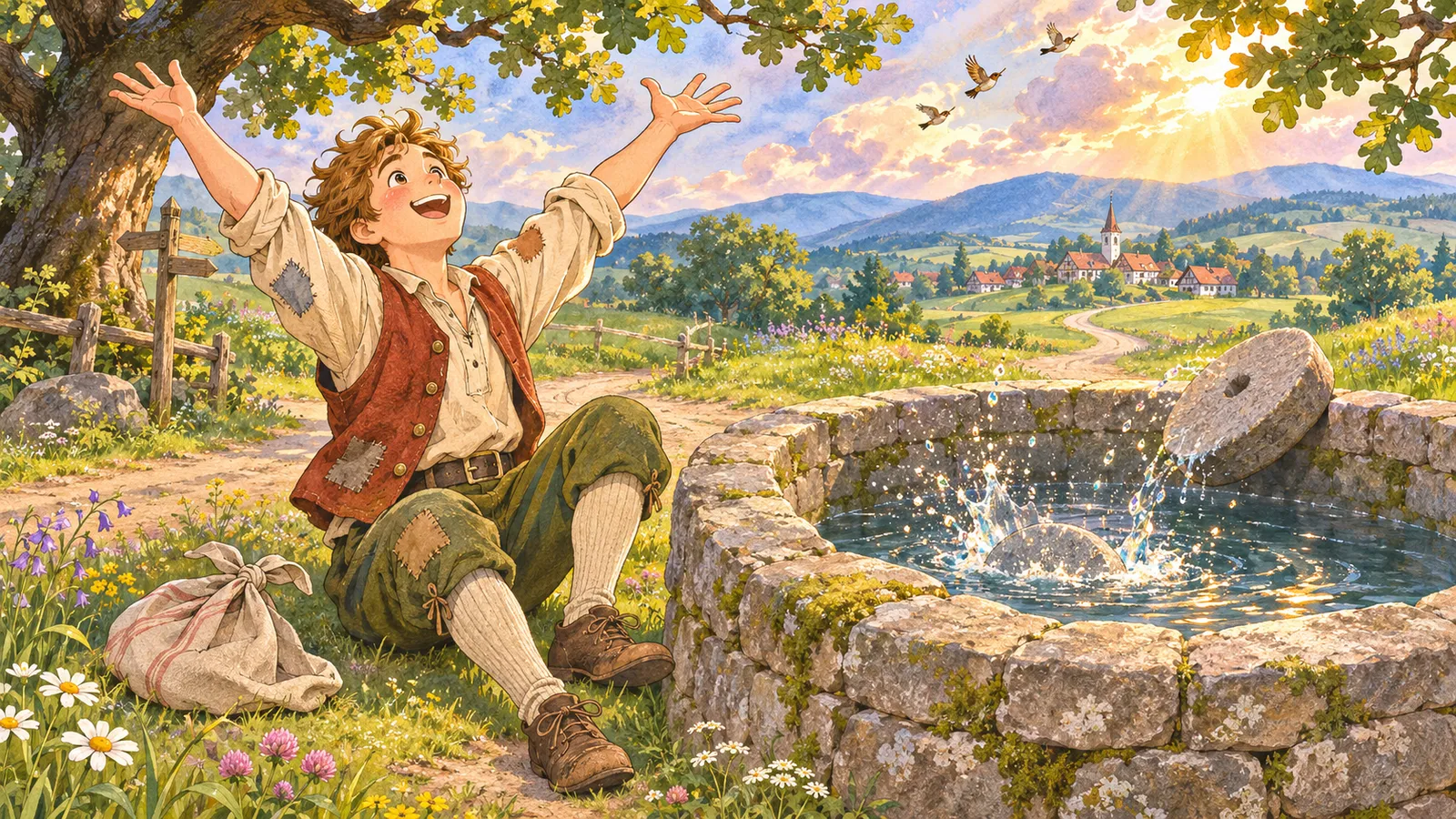
At last he could go no farther, for the stone tired him sadly: and he dragged himself to the side of a river, that he might take a drink of water, and rest a while.とうとうハンスはそれ以上歩けなくなりました。石が重くて、ひどくくたびれてしまったのです。そこで水を飲んで少し休もうと、やっとのことで川のそばまで行きました。 So he laid the stone carefully by his side on the bank: but, as he stooped down to drink, he forgot it, pushed it a little, and down it rolled, plump into the stream.ハンスは石をそっと岸の自分のそばに置きました。けれども、水を飲もうとかがんだとき、石のことをわすれて少しおしてしまったので、石はころころころがって、ドボンと川に落ちてしまいました。
For a while he watched it sinking in the deep clear water; then sprang up and danced for joy, and again fell upon his knees and thanked Heaven, with tears in his eyes, for its kindness in taking away his only plague, the ugly heavy stone.しばらくハンスは、石が深くすんだ水の中にしずんでいくのを見ていました。それからとびあがって喜びのあまりおどりだし、また地面にひざをついて、目になみだをうかべて神さまに感謝しました。たった一つのやっかいもの、あのみにくい重い石を取りさってくださったからです。
‘How happy am I!’ cried he; ‘nobody was ever so lucky as I.’「ぼくはなんて幸せなんだろう!」とハンスはさけびました。「ぼくほど運のいい者は、今までだれもいなかったぞ。」 Then up he got with a light heart, free from all his troubles, and walked on till he reached his mother’s house, and told her how very easy the road to good luck was.それからハンスは、すべての心配ごとからときはなたれて、かろやかな気持ちで立ちあがり、お母さんの家まで歩いていきました。そして、幸運への道はなんてかんたんなんだろうと、お母さんに話したのでした。