 10分
 朗読 Ruth Golding
 原文そのまま

 PDFで印刷(A4 9まい)
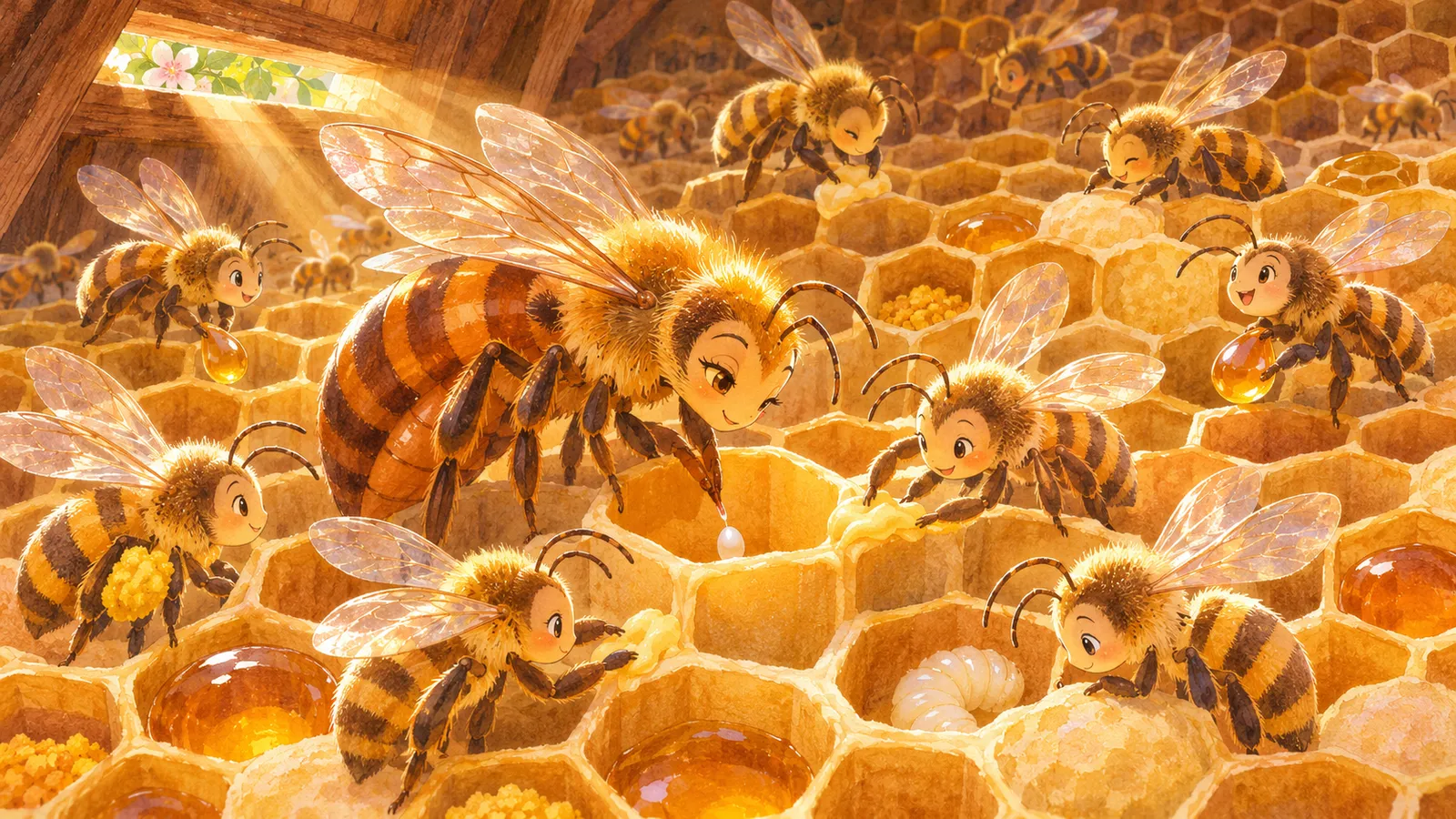
And now, as soon as a rough lump of wax is ready, another set of bees come to do their work.さて、ろうのおおまかなかたまりができるとすぐに、別のグループのハチたちがやって来て、自分たちの仕事をします。 These are called the nursing bees, because they prepare the cells and feed the young ones.このハチたちは「子もりバチ」とよばれます。へやを用意し、子どもたちに食べ物をあたえるからです。 One of these bees, standing on the roof of the hive, begins to force her head into the wax, biting with her jaws and moving her head to and fro.子もりバチの一ぴきが巣箱の天井に立って、あごでかみながら頭を前後に動かし、ろうの中に頭をぐいぐいおしこみはじめます。 Soon she has made the beginning of a round hollow, and then she passes on to make another, while a second bee takes her place and enlarges the first one.すぐに丸いくぼみのでき始めができると、そのハチは次のくぼみを作りに移り、2ひき目のハチが代わりに来て、最初のくぼみを広げます。 As many as twenty bees will be employed in this way, one after another, upon each hole before it is large enough for the base of a cell.1つのあなが、へやの底になるほど大きくなるまでに、20ぴきものハチが次々にこうしてはたらくのです。
Meanwhile another set of nursing bees have been working just in the same way on the other side of the wax, and so a series of hollows are made back to back all over the comb.そのあいだに、別の子もりバチのグループが、ろうの反対側でまったく同じようにはたらいています。こうして、くぼみが背中合わせにずらりと、巣全体に作られていきます。 Then the bees form the walls of the cells and soon a number of six-sided tubes, about half an inch deep, stand all along each side of the comb ready to receive honey or bee-eggs.それからハチたちはへやのかべを作り、やがて、深さ半インチ(約1.3センチ)ほどの六角形の管がたくさん、巣の両側にずらりと並んで、みつやハチの卵を受け入れる用意ができます。
You can see the shape of these cells in c,d, Fig.このへやの形は、図 56, and notice how closely they fit into each other.56のc、dで見ることができます。どんなにぴったりとくっつき合っているか、見てください。 Even the ends are so shaped that, as they lie back to back, the bottom of one cell (B, Fig.へやのはしでさえ、背中合わせに並んだとき、1つのへやの底(図 56) fits into the space between the ends of three cells meeting it from the opposite side (A, Fig.56のB)が、反対側から来る3つのへやのはしのあいだのすき間(図 56), while they fit into the spaces around it.56のA)にぴったりはまり、その3つのへやも、まわりのすき間にぴったりはまるような形になっているのです。 Upon this plan the clever little bees fill every atom of space, use the least possible quantity of wax, and make the cells lie so closely together that the whole comb is kept warm when the young bees are in it.このやり方で、かしこい小さなミツバチは、すき間をほんの少しも残さずにうめ、ろうをできるだけ少ししか使わず、へやをぎっしりくっつけて並べるので、子どものハチが中にいるとき、巣全体があたたかく保たれるのです。
There are some kinds of bees who do not live in hives, but each one builds a home of its own.ミツバチのなかには、巣箱に住まず、一ぴき一ぴきが自分だけの家を作る種類もいます。 These bees - such as the upholsterer bee, which digs a hole in the earth and lines it with flowers and leaves, and the mason bee, which builds in walls - do not make six-sided cells, but round ones, for room is no object to them.こうしたハチ――たとえば、土にあなをほって花や葉をしきつめる「いす張り屋バチ」や、かべの中に巣を作る「石工(いしく)バチ」――は、六角形ではなく、丸いへやを作ります。場所のことを気にする必要がないからです。 But nature has gradually taught the little hive-bee to build its cells more and more closely, till they fit perfectly within each other.けれども自然は、小さなミツバチに、へやをだんだんぴったりとくっつけて作ることを教えてきて、とうとう、へやがおたがいに完全にはまり合うまでになったのです。 If you make a number of round holes close together in a soft substance, and then squeeze the substance evenly from all sides, the rounds will gradually take a six-sided form, showing that this is the closest shape into which they can be compressed.やわらかい物に丸いあなをたくさん並べてあけ、それからまわりじゅうから同じようにおしつけると、丸いあなはだんだん六角形になっていきます。これが、いちばんぎっしりとおしこめられる形だということを表しているのです。 Although the bee does not know this, yet as gnaws away every bit of wax that can be spared she brings the holes into this shape.ミツバチはこのことを知っているわけではありませんが、けずりとれるろうを少しでもかじりとっていくうちに、あなをこの形にしていくのです。
As soon as one comb is finished, the bees begin another by the side of it, leaving a narrow lane between, just broad enough for two bees to pass back to back as they crawl along, and so the work goes on till the hive is full of combs.1つの巣ができ上がるとすぐ、ハチたちはそのとなりに次の巣を作りはじめます。あいだには、2ひきのハチが背中合わせにはってすれちがえるだけのはばの、せまい通り道を残しておきます。こうして、巣箱が巣でいっぱいになるまで仕事はつづいていきます。
As soon, however, as a length of about five or six inches of the first comb has been made into cells, the bees which are bringing home honey no longer hang to make it into wax, but begin to store it in the cells.でも、最初の巣の5〜6インチほどの長さにへやができると、すぐに、みつを持ち帰ったハチたちは、もうぶら下がってみつをろうに変えることはせず、へやにみつをたくわえはじめます。 We all know where the bees go to fetch their honey, and how, when a bee settles on a flower, she thrusts into it her small tongue-like proboscis, which is really a lengthened under-lip, and sucks out the drop of honey.ミツバチがみつをどこへとりに行くかは、みんな知っていますね。ハチは花にとまると、小さなしたのような口のくだ――じつは下くちびるがのびたもの――を花の中へさしこんで、みつのしずくをすい出すのです。 This she swallows, passing it down her throat into a honey-bag or first stomach, which lies between her throat and her real stomach, and when she gets back to the hive she can empty this bag and pass honey back through her mouth again into the honey-cells.ハチはこれを飲みこみ、のどを通して「みつぶくろ」、つまり第一の胃に送ります。みつぶくろは、のどと本当の胃のあいだにあります。そして巣箱にもどると、このふくろをからにして、みつをまた口からはき出し、みつのへやに入れることができるのです。
But if you watch bees carefully, especially in the spring-time, you will find that they carry off something else besides honey.でも、ミツバチを注意深く見ていると、とくに春には、みつのほかにも何かを運んでいることに気づくでしょう。 Early in the morning, when the dew is on the ground, or later in the day, in moist shady places, you may see a bee rubbing itself against a flower, or biting those bags of yellow dust or pollen which we mentioned in Lecture VII.朝早く、地面につゆがおりているときや、もっとおそい時間でもしめった日かげのところで、ハチが花に体をこすりつけていたり、第7回のお話で話した、黄色い粉、つまり花粉の入ったふくろをかんでいたりするのが見られます。 When she has covered herself with pollen, she will brush it off with her feet, and, bringing it to her mouth, she will moisten and roll it into a little ball, and then pass it back from the first pair of legs to the second and so to the third or hinder pair.体じゅう花粉だらけになると、ハチはそれをあしではらい落とし、口へ持っていってしめらせ、小さな玉に丸めます。そして、それを1番目のあしから2番目のあしへ、そして3番目、つまり後ろのあしへと、送っていくのです。 Here she will pack it into a little hairy groove called a "basket" in the joint of one of the hind legs, where you may see it, looking like a swelled joint, as she hovers among the flowers.後ろあしでは、片方の後ろあしの関節にある、毛の生えた小さなみぞ――「花粉かご」とよばれます――に、花粉をつめこみます。花のあいだを飛びまわっているハチを見ると、関節がふくらんでいるように見えるのがそれです。 She often fills both hind legs in this way, and when she arrives back at the hive the nursing bees take the lumps form her, and eat it themselves, or mix it with honey to feed the young bees; or, when they have any to spare, store it away in old honey-cells to be used by-and-by.ハチはよく、こうして両方の後ろあしをいっぱいにします。巣箱にもどると、子もりバチたちがそのかたまりを受けとって、自分で食べたり、みつとまぜて子どものハチにあたえたりします。また、余ったときは、古いみつのへやにしまっておいて、あとで使います。 This is the dark, bitter stuff called "bee- bread" which you often find in a honeycomb, especially in a comb which has been filled late in the summer.これが、はちみつの巣の中によく見られる「ハチパン」とよばれる、黒っぽくて苦いものです。とくに、夏の終わりにみつをつめた巣によく見られます。
When the bee has been relieved of the bee-bread she goes off to one of the clean cells in the new comb, and, standing on the edge, throws up the honey from the honey-bag into the cell.ハチパンをわたして身軽になったハチは、新しい巣のきれいなへやの一つへ行き、へやのふちに立って、みつぶくろのみつをへやの中へはき出します。 One cell will hold the contents of many honey-bags, and so the busy little workers have to work all day filling cell after cell, in which the honey lies uncovered, being too thick and sticky to flow out, and is used for daily food - unless there is any to spare, and then they close up the cells with wax to keep for the winter.1つのへやには、たくさんのみつぶくろの分が入ります。ですから、はたらき者の小さなハチたちは、1日じゅうはたらいて、へやを次々にいっぱいにしていかなければなりません。みつはこくてねばねばしているので流れ出さず、へやにふたをしないまま毎日の食べ物に使われます。でも余った分があれば、冬のためにとっておくよう、へやをろうでふさぐのです。
Meanwhile, a day or two after the bees have settled in the hive, the queen-bee begins to get very restless.そのあいだに、ハチたちが巣箱に落ち着いてから1日か2日たつと、女王バチがとてもそわそわしはじめます。 She goes outside the hive and hovers about a little while, and then comes in again, and though generally the bees all look very closely after her to keep her indoors, yet now they let her do as she likes.女王は巣箱の外へ出て、しばらくあたりを飛びまわり、また中へもどってきます。ふだんはハチたちがみな、女王を巣の中にいさせようと、しっかり見張っているのですが、このときばかりは好きなようにさせておきます。 Again she goes out, and again back, and then, at last, she soars up into the air and flies away.女王はまた出ていき、またもどってきます。そして、ついに空高くまい上がって、飛び去っていきます。 But she is not allowed to go alone.でも、ひとりで行くことは許されません。 All the drones of the hive rise up after her, forming a guard of honour to follow her wherever she goes.巣箱のおすバチがみな女王のあとから飛び上がり、どこへでもついていく、名よの護衛隊になるのです。
In about half-an-hour she comes back again, and then the working bees all gather round her, knowing that now she will remain quietly in the hive and spend all her time in laying eggs; for it is the queen-bee who lays all the eggs in the hive.30分ほどすると女王はもどってきます。すると、はたらきバチたちがみな女王のまわりに集まります。これからは女王が巣箱の中で静かに過ごし、すべての時間を卵を産むことに使うのだと知っているからです。巣箱の卵を全部産むのは、女王バチなのです。 This she begins to do about two days after her flight.女王は、飛んだ日から2日ほどたつと、卵を産みはじめます。 There are now many cells ready besides those filled with honey; and, escorted by several bees, the queen-bee goes to one of these, and, putting her head into it remains there a second as if she were examining whether it would make a good home for the young bee.今では、みつでいっぱいのへやのほかにも、用意のできたへやがたくさんあります。女王バチは何びきかのハチにつきそわれてその一つへ行き、中に頭を入れて、まるで子どものハチのよい家になるかどうか調べているかのように、少しのあいだじっとしています。 Then, coming out, she turns round and lays a small, oval, bluish-white egg in the cell.それから出てきて、くるりと向きを変え、へやの中に、小さなだ円形の、青みがかった白い卵を1つ産みます。 After this she takes no more notice of it, but goes on to the next cell and the next, doing the same thing, and laying eggs in all the empty cells equally on both sides of the comb.そのあとは、もうその卵には見向きもせず、次のへや、また次のへやへと進んで同じことをし、巣の両側の、空いているへやすべてに、かたよりなく卵を産んでいきます。 She goes on so quickly that she sometimes lays as many as 200 eggs in one day.女王はとてもすばやく進むので、1日に200個もの卵を産むことがあります。
Then the work of the nursing bees begins.そこから、子もりバチの仕事が始まります。 In two or three days each egg has become a tiny maggot or larva, and the nursing bees put into its cell a mixture of pollen and honey which they have prepared in their own mouths, thus making a kind of sweet bath in which the larva lies.2〜3日で、卵はそれぞれ小さなうじ、つまり幼虫になります。子もりバチたちは、自分の口の中で用意した花粉とみつをまぜたものを幼虫のへやに入れ、幼虫がその中に横たわる、あまいおふろのようなものを作ってやるのです。 In five or six days the larva grows so fat upon this that it nearly fills the cell, and then the bees seal up the mouth of the cell with a thin cover of wax, made of little rings and with a tiny hole in the centre.5〜6日たつと、幼虫はこれを食べてとても太り、へやがほとんどいっぱいになります。すると子もりバチたちは、小さな輪でできていて、まん中に小さなあなのあいた、ろうのうすいふたで、へやの口をふさぎます。
As soon as the larva is covered in, it begins to give out from its under-lip a whitish, silken film, made of two threads of silk glued together, and with this it spins a covering or cocoon all round itself, and so it remains for about ten days more.ふたをされるとすぐ、幼虫は下くちびるから、2本の絹の糸をはり合わせた白っぽい絹のまくを出しはじめ、それで自分のまわりにおおい、つまりまゆをつむぎます。そしてそのまま、さらに10日ほど過ごすのです。 At last, just twenty-one days after the egg was laid, the young bee is quite perfect, lying in the cell as in Fig.そしてついに、卵が産まれてからちょうど21日目に、若いハチはすっかりでき上がって、図 57, and she begins to eat her way through the cocoon and through the waxen lid, and scrambles out of her cell.57のようにへやの中に横たわっています。そして、まゆとろうのふたをかじってあなをあけ、へやからはい出してくるのです。 Then the nurses come again to her, stroke her wings and feed her for twenty-four hours, and after that she is quite ready to begin work, and flies out to gather honey and pollen like the rest of the workers.すると、子もりバチたちがまたやって来て、羽をなでてやり、24時間食べ物をあたえます。そのあとは、もうすっかり仕事を始める用意ができて、ほかのはたらきバチと同じように、みつや花粉を集めに飛び立っていくのです。