
 15分
 朗読 Ruth Golding
 原文そのまま

 PDFで印刷(A4 12まい)
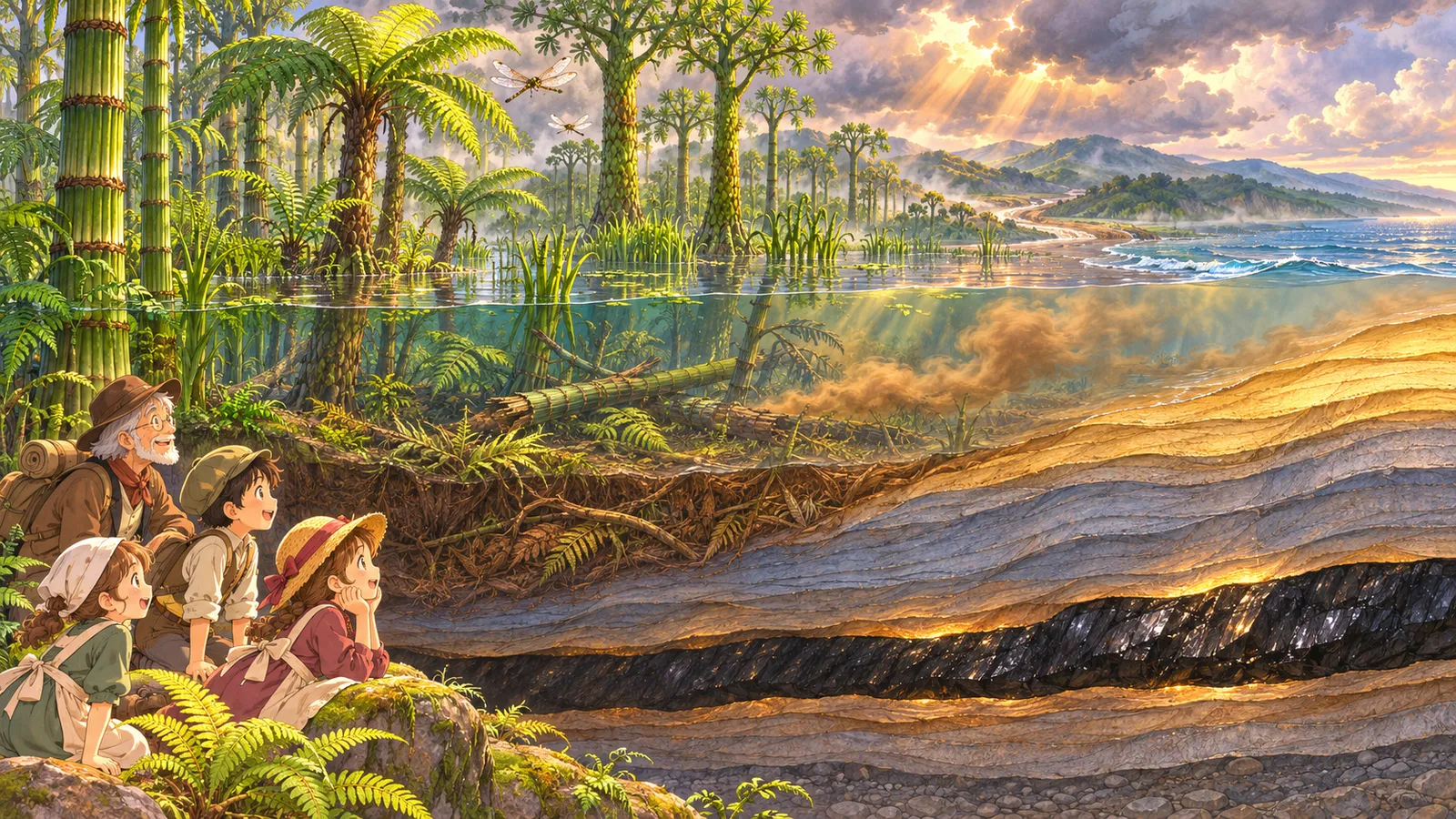
Now we know that there were plenty of ferns and of large Calamites growing thickly together in the coal-forests, for we find their remains everywhere in the clay, so we can easily picture to ourselves how the dense jungle formed by these plants would fringe the coal-swamp, as the present plants do the Great Dismal Swamp, and would keep out all earthy matter, so that year after year the plants would die and form a thick bed of peat, afterwards to become coal.石炭の森にはシダや大きなカラミテスがたくさん、びっしりとしげっていたことがわかっています。ねん土の中のいたるところに、そのなごりが見つかるからです。ですから、今の植物がグレート・ディズマル・スワンプのまわりをかこんでいるように、こうした植物が作る深いしげみが石炭のぬま地のまわりをかこみ、土をすべて入れないようにしていた様子は、かんたんに思いうかべられます。こうして毎年毎年、植物はかれて厚いピートの層を作り、それがのちに石炭になったのです。
The next thing we have to account for is the bed of shale or hardened clay covering over the coal.次に説明しなければならないのは、石炭をおおっている、けつ岩、つまりかたまったねん土の層です。 Now we know that from time to time land has gone slowly up and down on our globe so as in some places to carry the dry ground under the sea, and in others to raise the sea-bed above the water.地球では、ときどき土地がゆっくりとしずんだり持ち上がったりして、ある場所ではかわいた地面が海の下に入り、別の場所では海の底が水の上に持ち上げられてきたことがわかっています。 Let us suppose, then, that the great Dismal Swamp was gradually to sink down so that the sea washed over it and killed the reeds and shrubs.では、グレート・ディズマル・スワンプがだんだんしずんでいって、海の水がその上をあらい、アシや低い木を死なせてしまったとしましょう。 Then the streams from the west would not be sifted any longer but would bring down mud, and leave it, as in the delta of the Nile or Mississippi, to make a layer over the dead plants.すると、西からの小川はもうこし分けられず、どろを運んできて、ナイル川やミシシッピ川の河口の三角州のように、かれた植物の上にどろの層を作るでしょう。 You will easily understand that this mud would have many pieces of dead trees and plants in it, which were stifled and died as it covered them over; and thus the remains would be preserved like those which we find now in the roof of the coal-galleries.このどろの中には、木や草のかけらがたくさんまざっていたことが、かんたんにわかるでしょう。木や草は、どろにおおわれて息ができなくなり、かれてしまったのです。こうして、今わたしたちが石炭のこう道のてんじょうで見つけるような植物のなごりが、のこされたのです。
But still there are the thick sandstones in the coal-mine to be explained.でも、炭こうの中には、まだ説明しなければならない厚い砂岩があります。 How did they come there?砂岩はどうやってそこにできたのでしょう? To explain them, we must suppose that the ground went on sinking till the sea covered the whole place where once the swamp had been, and then sea-sand would be thrown down over the clay and gradually pressed down by the weight of new sand above, till it formed solid sandstone and our coal-bed became buried deeper and deeper in the earth.それを説明するには、地面がしずみつづけて、かつてぬま地だったところ全体を海がおおい、海の砂がねん土の上につもって、上につもる新しい砂の重みでだんだんおし固められ、かたい砂岩になった、と考えなければなりません。こうして、石炭の層は、地中のどんどん深くへうめられていったのです。
At last, after long ages, when the thick mass of sandstones above the bed b (Fig.そしてついに、長い長い年月がたって、層b(図 46) had been laid down, the sinking must have stopped and the land have risen a little, so that the sea was driven back; and then the rivers would bring down earth again and make another clay-bed.46)の上に厚い砂岩のかたまりができたころ、しずむのが止まり、土地が少し持ち上がって、海がおし返されたにちがいありません。すると川はまた土を運んできて、新しいねん土の層を作ったでしょう。 Then a new forest would spring up, the ferns, Calamites, Lepidodendrons, and Sigillarias would gradually form another jungle, and many hundred of feet above the buried coal-bed b, a second bed of peat and vegetable matter would begin to accumulate to form the coal-bed a.そこへ新しい森が生えて、シダやカラミテスやレピドデンドロンやシギラリアが、だんだんまた深いしげみを作ったでしょう。そして、うまった石炭層bの何百フィートも上で、2つ目のピートと植物の層がつもりはじめ、石炭層aになっていったのです。
Such is the history of how the coal which we now dig out of the depths of the earth once grew as beautiful plants on the surface.これが、今わたしたちが地の底からほり出している石炭が、かつては地上で美しい植物として育っていたという歴史です。 We cannot tell exactly all the ground over which these forests grew in England, because some of the coal they made has been carried away since by rivers and cut down by the waves of the sea, but we can say that wherever there is coal now, there they must have been then.イングランドで、こうした森が生えていた土地がどこからどこまでだったか、正確に言うことはできません。森がつくった石炭の一部は、その後、川に運び去られたり、海の波にけずられたりしているからです。でも、今、石炭があるところには、そのころかならず森があったと言うことはできます。
Try and picture to yourselves that on the east coast of Northumberland and Durham, where all is now black with coal- dust, and grimy with the smoke of furnaces; and where the noise of hammers and steam-engines, and of carts and trucks hurrying to and fro, makes the country re-echo with the sound of labour; there ages ago in the silent swamp shaded with monster trees, one thin layer of plants after another was formed, year after year, to become the coal we now value so much.思いうかべてみてください。ノーサンバーランドやダラムの東の海岸、今では石炭の粉でまっ黒になり、かまのけむりですすけ、ハンマーや蒸気機関、行ったり来たりする荷車やトロッコの音で、土地じゅうがはたらく音にひびいているところ。そこでははるかむかし、とてつもない大木がかげを落とす静かなぬま地で、毎年毎年、植物のうすい層が一まいまた一まいとつもり、今わたしたちがこんなに大切にしている石炭になっていったのです。 In Lancashire, busy Lancashire, the same thing was happening, and even in the middle of Yorkshire and Derbyshire the sea must have come up and washed a silent shore where a vast forest spread out over at least 700 or 800 square miles.ランカシャー、いそがしいランカシャーでも同じことが起きていました。ヨークシャーやダービーシャーのまん中でさえ、海がやって来て静かな岸をあらっていたにちがいありません。そこには、少なくとも700か800平方マイルにわたって、広大な森が広がっていたのです。 In Stafford-shire, too, which is now almost the middle of England, another small coal-field tells the same story, while in South Wales the deep coal-mines and number of coal-seams remind us how for centuries and centuries forests must have flourished and have disappeared over and over again under the sand of the sea.今ではイングランドのほぼまん中にあたるスタッフォードシャーでも、小さな炭田が同じ物語を語っています。そして南ウェールズでは、深い炭こうと、何まいもの石炭の層が、何百年も何百年ものあいだ、森がさかえては海の砂の下に消えていくことが、何度も何度もくり返されたにちがいないことを教えてくれます。
But what is it that has changed these beds of dead plants into hard, stony coal?でも、このかれた植物の層を、かたい石のような石炭に変えたものは何なのでしょう? In the first place you must remember they have been pressed down under an enormous weight of rocks above them.まず第一に、その層は、上にのったとてつもない重さの岩でおしつけられてきたことを、思い出さなければなりません。 We can learn something about this even from our common lead pencils.このことは、ふつうのえんぴつからさえ、少し学ぶことができます。 At one time the graphite or pure carbon, of which the blacklead (as we wrongly call it) of our pencils is made, was dug solid out of the earth. but so much has now been used that they are obliged to collect the graphite dust, and press it under a heavy weight, and this makes such solid pieces that they can cut them into leads for ordinary cedar pencils.むかしは、えんぴつのしん(まちがって「こくえん」とよばれていますが)を作るグラファイト、つまり純すいな炭素は、かたまりのまま地中からほり出されていました。でも今ではたくさん使われてしまったので、グラファイトの粉を集めて重いおもしでおしつけなければならなくなりました。そうするととてもかたいかたまりになるので、それを切って、ふつうのシーダー(スギの仲間)のえんぴつのしんにできるのです。
Now the pressure which we can exert by machinery is absolutely nothing compared to the weight of all those hundreds of feet of solid rock which lie over the coal-beds, and which has pressed them down for thousands and perhaps millions of years; and besides this, we know that parts of the inside of the earth are very hot, and many of the rocks in which coal is found are altered by heat.でも、機械でかけられる力など、石炭の層の上にのって、何千年、もしかすると何百万年ものあいだそれをおしつけてきた、何百フィートものかたい岩の重さにくらべれば、まったく何でもありません。そのうえ、地球の内部にはとても熱いところがあり、石炭が見つかる岩の多くは、熱によって変化していることもわかっています。 So we can picture to ourselves that the coal was not only squeezed into a solid mass, but often much of the oil and gas which were in the leaves of the plants was driven out by heat, and the whole baked, as it were, into one substance.ですから、石炭はかたいかたまりにおしつぶされただけでなく、植物の葉にふくまれていた油や気体の多くが熱で追い出され、全体がいわばむし焼きにされて、一つの物質になったのだと考えられます。 The difference between coal which flames and coal which burns only with a red heat, is chiefly that one has been baked and crushed more than the other.ほのおを上げてもえる石炭と、赤く光るだけでもえる石炭のちがいは、おもに、一方がもう一方よりもよけいにむし焼きにされ、おしつぶされたということです。 Coal which flames has still got in it the tar and the gas and the oils which the plant stored up in its leaves, and these when they escape again give back the sunbeams in a bright flame.ほのおを上げてもえる石炭には、植物が葉にたくわえたタールや気体や油がまだ残っていて、それが外へ出てくるとき、明るいほのおになって日の光を返してくれるのです。 The hard stone coal, on the contrary, has lost a great part of these oils, and only carbon remains, which seizes hold of the oxygen of the air and burns without flame.反対に、かたい石のような石炭は、こうした油の大部分を失っていて、炭素しか残っていません。炭素は空気中の酸素をつかまえて、ほのおを上げずにもえるのです。 Coke is pure carbon, which we make artificially by driving out the oils and gases from coal, and the gas we burn is part of what is driven out.コークスは純すいな炭素で、石炭から油や気体を追い出して、人の手で作ります。わたしたちがもやしているガスは、そのとき追い出されたものの一部なのです。
We can easily make coal-gas here in this room.この部屋で、かんたんに石炭ガスを作ることができます。 I have brought a tobacco-pipe, the bowl of which is filled with a little powdered coal, and the broad end cemented up with Stourbridge clay.ここに、たばこのパイプを持ってきました。火皿には石炭の粉が少しつめてあり、広い口はスタウアブリッジのねん土でふさいであります。 When we place this bowl over a spirit-lamp and make it very hot, the gas is driven out at the narrow end of the pipe and lights easily (see Fig.この火皿をアルコールランプの上にかざしてうんと熱くすると、パイプの細いはしからガスが追い出されてきて、かんたんに火がつきます(図 53).53を見てください)。 This is the way all our gas is made, only that furnaces are used to bake the coal in, and the gas is passed into large reservoirs till it is wanted for use.わたしたちのガスはみな、このようにして作られています。ただ、石炭をむし焼きにするのにはかまが使われ、ガスは使うときまで大きなタンクにためられているのです。
You will find it difficult at first to understand how coal can be so full of oil and tar and gases, until you have tried to think over how much of all these there is in plants, and especially in seeds - think of the oils of almonds, of lavender, of cloves, and of caraways; and the oils of turpentine which we get from the pines, and out of which tar is made.はじめは、石炭がどうしてこんなに油やタールや気体をたっぷりふくんでいるのか、わかりにくいでしょう。でも、植物、とくにたねに、そうしたものがどれだけたくさんふくまれているかを考えてみればわかります。アーモンドやラベンダーやチョウジやキャラウェイの油、マツからとれるテレピン油、そして同じくマツから作られるタールのことを考えてみてください。 When you remember these and many more, and also how the seeds of the club-moss now are largely charged with oil, you will easily imagine that the large masses of coal-plants which have been pressed together and broken and crushed, would give out a great deal of oil which, when made very hot, rises up as gas.こうしたものや、もっとたくさんのものを思い出し、さらに今のヒカゲノカズラのたねにも油がたっぷりふくまれていることを思い出せば、石炭の植物の大きなかたまりがおしつけられ、くだかれ、つぶされて、たくさんの油を出し、それがうんと熱くなると気体になってのぼっていく、ということがかんたんに想像できるでしょう。 You may often yourself see tar oozing out of the lumps of coal in a fire, and making little black bubbles which burst and burn.火の中の石炭のかたまりから、タールがにじみ出て、小さな黒いあわを作り、それがはじけてもえるのを、自分でもよく見かけるでしょう。 It is from this tar that James Young first made the paraffin oil we burn in our lamps, and the spirit benzoline comes from the same source.このタールから、ジェームズ・ヤングが、わたしたちがランプでもやすパラフィン油をはじめて作りました。ベンゾリンという液体も、同じものからできています。
From benzoline, again, we get a liquid called aniline, from which are made so many of our beautiful dyes - mauve, magenta, and violet; and what is still more curious, the bitter almonds, pear- drops, and many other sweets which children like to well, are actually flavoured by essences which come out of coal-tar.さらにベンゾリンからは、アニリンという液体がとれます。そこから、モーブやマゼンタやバイオレットといった、美しい染料がたくさん作られています。そして、もっとふしぎなことに、子どもたちが大好きなアーモンド味のあめや、ナシ味のドロップなど、たくさんのおかしの味つけにも、じつは石炭タールからとれるエッセンスが使われているのです。 Thus from coal we get not only nearly all our heat and our light, but beautiful colours and pleasant flavours.このように、石炭からは、わたしたちの熱と明かりのほとんどだけでなく、美しい色やおいしい味まで手に入るのです。 We spoke just now of the plants of the coal as being without beautiful flowers, and yet we see that long, long after their death they give us lovely colours and tints as beautiful as any in flower-world now.さっき、石炭の植物には美しい花がなかったと話しましたね。それなのに、死んでから長い長い時がたって、今の花の世界のどんな色にも負けない、すてきな色合いをわたしたちにあたえてくれているのです。
Think, then, how much we owe to these plants which lived and died so long ago!そう考えると、はるかむかしに生きて死んでいったこの植物たちに、わたしたちはどれほどお世話になっていることでしょう! If they had been able to reason, perhaps they might have said that they did not seem of much use in the world.もし植物たちが考えることができたら、自分たちは世の中であまり役に立っていないようだ、と言ったかもしれません。 They had no pretty flowers, and there was no one to admire their beautiful green foliage except a few croaking reptiles, and little crickets and grasshoppers; and they lived and died all on one spot, generation after generation, without seeming to do much good to anything or anybody.かわいい花もなく、美しい緑の葉をほめてくれるのは、ゲロゲロ鳴く少しのは虫類と、小さなコオロギやバッタだけでした。そして、何代も何代も同じ場所で生きては死に、何にもだれにも、あまり役に立っていないように見えたのです。 Then they were covered up and put out of sight, and down in the dark earth they were pressed all out of shape and lost their beauty and became only black, hard coal.それからうめられて見えなくなり、暗い地中でおしつぶされて形をすっかり失い、美しさもなくして、ただの黒くてかたい石炭になってしまいました。 There they lay for centuries and centuries, and thousands and thousands of years, and still no one seemed to want them.そこで何百年も何百年も、何千年も何千年も横たわっていましたが、それでもだれもほしがる人はいないようでした。
At last, one day, long, long after man had been living on the earth, and had been burning wood for fires, and so gradually using up the trees in the forests, it was discovered that this black stone would burn, and from that time coal has been becoming every day more and more useful.ついにある日、人間が地球に住むようになってからずっとずっとあと、人間がたき火に木をもやして森の木をだんだん使いはたしていったころ、この黒い石がもえることが発見されました。そのときから、石炭は日に日にますます役に立つものになってきたのです。 Without it not only should we have been without warmth in our houses, or light in our streets when the stock of forest-wood was used up; but we could never have melted large quantities of iron-stone and extracted the iron.石炭がなかったら、森の木を使いはたしたとき、家はあたたかくなく、通りに明かりもなかったでしょう。それだけでなく、大量の鉄鉱石をとかして鉄をとり出すことも、けっしてできなかったでしょう。 We have proof of this in Sussex.そのしょうこがサセックスにあります。 The whole country is full of iron-stone, and the railings of St. Paul's churchyard are made of Sussex iron.この地方全体に鉄鉱石がたくさんあり、セント・ポール大聖堂の墓地のさくも、サセックスの鉄で作られています。 Iron-foundries were at work there as long as there was wood enough to supply them, but gradually the works fell into disuse, and the last furnace was put out in the year 1809.そこでは、まかなえるだけの木があるあいだは鉄工場が動いていましたが、だんだん使われなくなり、1809年に最後のかまの火が消されました。 So now, because there is no coal in Sussex, the iron lies idle, while in the North, where the iron-stone is near the coal- mines, hundreds of tons are melted out every day.ですから今、サセックスには石炭がないので鉄はねむったままですが、北のほうの、鉄鉱石が炭こうの近くにあるところでは、毎日何百トンもの鉄がとかし出されています。
Again, without coal we could have had no engines of any kind, and consequently no large manufactories of cotton goods, linen goods, or cutlery.また、石炭がなかったら、どんな種類の機関もなかったでしょう。ですから、もめん製品やあさの製品やはものを作る大きな工場もなかったはずです。 In fact, almost everything we use could only have been made with difficulty and in small quantities; and even if we could have made them it would have been impossible to have sent them so quickly all over the world without coal, for we could have had no railways or steamships, but must have carried all goods along canals, and by slow sailing vessels.じっさい、わたしたちが使うほとんどすべてのものは、苦労して少しずつしか作れなかったでしょう。たとえ作れたとしても、石炭がなければ、それを世界じゅうにすばやく送ることはできなかったでしょう。鉄道も蒸気船もなく、すべての品物を運河にそって運んだり、のろいほかけ船で運んだりしなければならなかったはずです。 We ourselves must have taken days to perform journeys now made in a few hours, and months to reach our colonies.わたしたち自身も、今なら数時間ですむ旅に何日もかかり、植民地に着くには何か月もかかったでしょう。
In consequence of this we should have remained a very poor people.そのため、わたしたちはとてもまずしい国民のままだったでしょう。 Without manufactories and industries we should have had to live chiefly by tilling the ground, and everyone being obliged to toil for daily bread, there would have been much less time or opportunity for anyone to study science, or literature, or history, or to provide themselves with comforts and refinements of life.工場や産業がなければ、おもに畑をたがやして生きていかなければならず、だれもが毎日のパンのためにあくせくはたらかなければならないので、科学や文学や歴史を学んだり、生活を快適で上品なものにしたりする時間や機会は、ずっと少なかったでしょう。
All this then, those plants and trees of the far-off ages, which seemed to lead such useless lives, have done and are doing for us.こうしたことをすべて、あんなに役に立たない一生を送ったように見えた、はるかむかしの草や木が、わたしたちのためにしてくれたのであり、今もしてくれているのです。 There are many people in the world who complain that life is dull, that they do not see the use of it, and that there seems no work specially for them to do.世の中には、生きるのはたいくつだ、生きることに何の意味があるのかわからない、自分のためにある仕事はなさそうだ、となげく人がたくさんいます。 I would advise such people, whether they are grown up or little children, to read the story of the plants which form the coal.そういう人には、大人でも小さな子どもでも、石炭になった植物の物語を読むようにすすめたいと思います。 These saw no results during their own short existences, they only lived and enjoyed the bright sunshine, and did their work, and were content.この植物たちは、自分の短い一生のあいだには何の結果も見ませんでした。ただ生きて、明るい日の光を楽しみ、自分の仕事をして、満足していたのです。 And now thousands, probably millions, of years after they lived and died, England owes her greatness, and we much of our happiness and comfort, to the sunbeams which those plants wove into their lives.そして今、植物たちが生きて死んでから何千年、おそらく何百万年もたって、イングランドはそのいだいさを、わたしたちは幸せと心地よさの多くを、あの植物たちが自分の命におりこんだ日の光のおかげで手に入れているのです。
They burst forth again in our fires, in our brilliant lights, and in our engines, and do the greater part of our work; teaching usその日の光は、わたしたちの火や、かがやく明かりや、機関の中でふたたびほとばしり出て、わたしたちの仕事の大部分をしてくれています。そして、わたしたちに教えてくれるのです――
In Memoriam(テニスン『イン・メモリアム』より)