 16分
 朗読 Patricia Oakley
 原文そのまま

 PDFで印刷(A4 11まい)
When you can really picture this power to yourself it will help you very much to understand what you read and observe about nature.この力をほんとうに心にえがけるようになれば、自然について読んだり観察したりすることを理解するのに、とても役に立つでしょう。
Next, as plants grow around you on every side, and are of so much importance in the world, you must also learn something of the names of the different parts of a flower, so that you may understand those books which explain how a plant grows and lives and forms its seeds.次に、植物はみなさんのまわりのどこにでも生えていて、世界でとても大切なものですから、花のいろいろな部分の名前も少しは学ばなければなりません。そうすれば、植物がどのように育ち、生き、種をつくるのかを説明している本がわかるようになります。 You must also know the common names of the parts of an animal, and of your own body, so that you may be interested in understanding the use of the different organs; how you breathe, and how your blood flows; how one animal walks, another flies, and another swims.また、動物の体の部分や、自分の体の部分のふつうの名前も知っておかなければなりません。そうすれば、いろいろな器官のはたらき――どうやって息をするのか、血がどう流れるのか、ある動物はどう歩き、べつの動物はどう飛び、またべつの動物はどう泳ぐのか――を知ることに、きょうみがわくでしょう。 Then you must learn something of the various parts of the world, so that you may know what is meant by a river, a plain, a valley, or a delta.それから、世界のいろいろな所についても少し学ばなければなりません。そうすれば、川や平野や谷や三角州(デルタ)とは何のことかがわかるようになります。 All these things are not difficult, you can learn them pleasantly from simple books on physics, chemistry, botany, physiology, and physical geography; and when you understand a few plain scientific terms, then all by yourself, if you will open your eyes and ears, you may wander happily in the fairy-land of science.こういうことは少しもむずかしくありません。物理学、化学、植物学、生理学(体のはたらきの学問)、自然地理学のやさしい本から、楽しく学べます。そして、かんたんな科学のことばをいくつか理解すれば、あとは目と耳を開きさえすれば、ひとりで科学のおとぎの国を楽しく歩きまわれるのです。 Then wherever you go you will findそうすれば、どこへ行っても、こんなものが見つかるでしょう。
And now we come to the last part of our subject.さて、いよいよこのお話の最後の部分になりました。 When you have reached and entered the gates of science, how are you to use and enjoy this new and beautiful land?科学の門にたどりついて中に入ったら、この新しい美しい国を、どう使い、どう楽しめばよいのでしょう。
This is a very important question for you may make a twofold use of it.これはとても大切な問題です。なぜなら、この国には二通りの使い方があるからです。 If you are only ambitious to shine in the world, you may use it chiefly to get prizes, to be at the top of your class, or to pass in examinations; but if you also enjoy discovering its secrets, and desire to learn more and more of nature and to revel in dreams of its beauty, then you will study science for its own sake as well.もし世の中で目立つことだけをのぞむなら、おもにほうびをもらったり、クラスで一番になったり、試験に受かったりするために使うかもしれません。でも、そのひみつを見つけるのを楽しみ、自然のことをもっともっと知りたいと思い、その美しさの夢にひたりたいと思うなら、科学そのもののためにも科学を学ぶことになるでしょう。 Now it is a good thing to win prizes and be at the top of your class, for it shows that you are industrious; it is a good thing to pass well in examinations , for it show that you are accurate; but if you study science for this reason only, do not complain if you find it full, and dry, and hard to master.ほうびをもらったり、クラスで一番になったりするのはよいことです。勉強熱心なしるしですから。試験によい成績で受かるのもよいことです。正確なしるしですから。でも、そのためだけに科学を学ぶのなら、科学がつまらなくて、味気なくて、身につけるのがむずかしいとわかっても、文句を言ってはいけません。 You may learn a great deal that is useful, and nature will answer you truthfully if you ask you questions accurately, but she will give you dry facts, just such as you ask for.役に立つことはたくさん学べるでしょうし、正確に質問すれば、自然は正直に答えてくれるでしょう。でも自然は、たずねられたとおりの、味気ない事実しかくれないのです。 If you do not love her for herself she will never take you to her heart.自然そのものを愛さなければ、自然はけっしてその胸にだきよせてはくれません。
This is the reason why so many complain that science is dry and uninteresting.これが、科学は味気なくてつまらないと、たくさんの人がこぼす理由です。 They forget that though it is necessary to learn accurately, for so only we can arrive at truth, it is equally necessary to love knowledge and make it lovely to those who learn, and to do this we must get at the spirit which lies under the facts.そういう人たちはわすれているのです。正確に学ぶことは必要です。そうしてこそ真実にたどりつけるのですから。でも同じように、知ることを愛し、学ぶ人にとって知ることを愛すべきものにすることも必要です。そのためには、事実の下にひそむ心をつかまなければなりません。 What child which loves its mother's face is content to know only that she has brown eyes, a straight nose, a small mouth, and hair arranged in such and such a manner?お母さんの顔が大好きな子どもが、お母さんの目は茶色で、鼻はまっすぐで、口は小さくて、かみの毛はこれこれこういうふうにゆってある、と知っているだけでまんぞくするでしょうか。 No, it knows that its mother has the sweetest smile of any woman living; that her eyes are loving, her kiss is sweet, and that when she looks grave, then something is wrong which must be put right.いいえ、その子は知っています。お母さんのほほえみは世界じゅうのどの女の人よりもやさしく、目はあたたかく、キスはあまく、お母さんがまじめな顔をしているときは、何かよくないことがあって、それを直さなければならないのだ、ということを。 And it is in this way that those who wish to enjoy the fairy-land of science must love nature.科学のおとぎの国を楽しみたい人は、まさにこのように自然を愛さなければならないのです。
It is well to know that when a piece of potassium is thrown on water the change which takes place is expressed by the formula K + H2O = KHO + H. But it is better still to have a mental picture of the tiny atoms clasping each other, and mingling so as to make a new substance, and to feel how wonderful are the many changing forms of nature.カリウムのかけらを水に投げこむと起こる変化が、K + H2O = KHO + H という式であらわされると知るのはよいことです。でも、それよりもっとよいのは、小さな原子たちがだき合い、まじり合って新しい物質をつくる様子を心にえがき、自然がさまざまに形を変えていくのはなんとすばらしいことかと感じることです。 It is useful to be able to classify a flower and to know that the buttercup belongs to the Family Ranunculaceae, with petals free and definite, stamens hypogynous and indefinite, pistil apocarpous.花を分類できて、キンポウゲがキンポウゲ科に入り、花びらははなれていて数が決まっており、おしべはめしべの根もとより下について数が決まっておらず、めしべは一本一本はなれている、と知っているのは役に立ちます。 But it is far sweeter to learn about the life of the little plant, to understand why its peculiar flower is useful to it, and how it feeds itself, and makes its seed.でも、その小さな植物のくらしを知り、そのかわった花がなぜその植物の役に立つのか、どうやって栄養をとり、種をつくるのかを理解するほうが、ずっとすてきです。 No one can love dry facts; we must clothe them with real meaning and love the truths they tell, if we wish to enjoy science.味気ない事実を愛せる人はいません。科学を楽しみたいなら、事実にほんとうの意味という服を着せて、事実が語る真実を愛さなければならないのです。
Let us take an example to show this.このことを、例をあげて見てみましょう。 I have here a branch of white coral, a beautiful, delicate piece of nature's work.ここに白いサンゴの枝があります。自然がつくった、美しく、こまやかな作品です。 We will begin by copying a description of it from one of those class-books which suppose children to learn words like parrots, and to repeat them with just as little understanding.まず、子どもがことばをオウムのようにおぼえて、オウムと同じくらい何もわからずにくり返すものと思っているような教科書から、サンゴの説明をうつしてみましょう。
"Coral is formed by an animal belonging to the kingdom of Radiates, sub-kingdom Polypes.「サンゴは、放射相しょう動物界、ポリプ類に属する動物によってつくられる。 The soft body of the animal is attached to a support, the mouth opening upwards in a row of tentacles.その動物のやわらかい体は土台にくっついており、口は上向きに開いて、まわりに一列のしょく手がある。 The coral is secreted in the body of the polyp out of the carbonate of lime in the sea.サンゴは、海の中の炭酸石灰から、ポリプの体の中で分ぴつされる。 Thus the coral animalcule rears its polypidom or rocky structure in warm latitudes, and constructs reefs or barriers round islands.こうしてサンゴ虫は、あたたかい地方にポリプの群体、すなわち岩のようなつくりをきずき上げ、島々のまわりにさんごしょうや、島をかこむ岩のかべ(ほしょう)をつくる。 It is limited in rage of depth from 25 to 30 fathoms.生きられる深さは25ひろから30ひろまでにかぎられる。 Chemically considered, coral is carbonate of like; physiologically, it is the skeleton of an animal; geographically, it is characteristic of warm latitudes, especially of the Pacific Ocean."化学的に見ればサンゴは炭酸石灰であり、生理学的に見れば動物の骨格であり、地理学的に見ればあたたかい地方、とくに太平洋の特ちょうである。」 This description is correct, and even fairly complete, if you know enough of the subject to understand it.この説明は正しく、そのことについて理解できるだけの知識があれば、かなりよくまとまってさえいます。 But tell me, does it lead you to love my piece of coral?でも教えてください。これを読んで、わたしのサンゴのかけらが好きになりますか。 Have you any picture in your mind of the coral animal, its home, or its manner of working?サンゴの動物や、そのすみかや、そのはたらき方が、何か心にうかびますか。
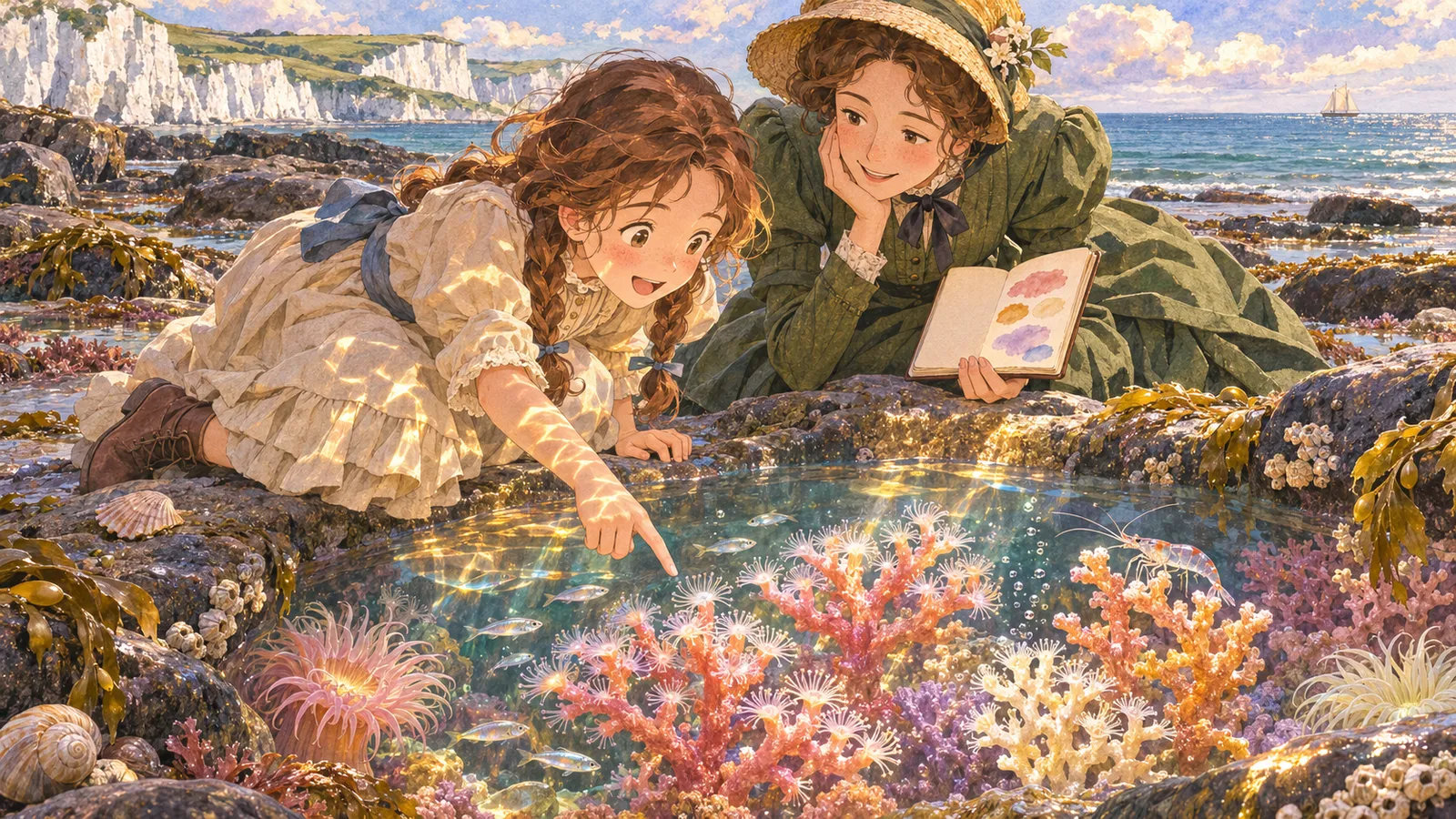
But now, instead of trying to master this dry, hard passage, take Mr. Huxley's penny lecture on 'Coral and Coral Reefs,' and with the piece of coral in your hand try really to learn its history.では、このかたくて味気ない文章をおぼえこもうとするかわりに、ハクスリーさんの1ペニーの講演『サンゴとさんごしょう』を手に取り、サンゴのかけらを手に持って、その歴史をほんとうに学んでみましょう。 You will then be able to picture to yourself the coral animal as a kind of sea-anemone, something like those which you have often seen, like red, blue, or green flowers, putting out feelers in sea-water on our coasts, and drawing in the tiny sea-animals to digest them in that bag of fluid which serves the sea-anemone as a stomach.そうすれば、サンゴの動物を、イソギンチャクの仲間のようなものとして心にえがけるようになるでしょう。イソギンチャクは、この国の海岸の海水の中で、赤や青や緑の花のようにしょく手をのばして、小さな海の生き物を引きこみ、胃のかわりになっている液体の入ったふくろの中で消化しているのを、みなさんもよく見たことがあるでしょう。 You will learn how this curious jelly animal can split itself in two, and so form two polyps, or send a bud out of its side and so grow up into a kind of "tree or bush of polyps," or how it can hatch little eggs inside it and throw out young ones from its mouth, provided with little hairs, by means of which they swim to new resting-places.このふしぎなゼリーのような動物が、自分を二つに分けて二ひきのポリプになったり、体のわきから芽を出して、いわば「ポリプの木やしげみ」のように育ったり、体の中で小さなたまごをかえして、小さな毛のはえた子どもを口からはき出し、子どもたちがその毛を使って泳いで新しいすみかへ行ったりすることを学ぶでしょう。 You will learn the difference between the animal which builds up the red coral as its skeleton, and the group of animals which build up the white; and you will look with new interest on our piece of white coral, as you read that each of those little sups on its stem with delicate divisions like the spokes of a wheel has been the home of a separate polyp, and that from the sea-water each little jelly animal has drunk in carbonate of lime as you drink in sugar dissolved in water, and then has used it grain by grain to build that delicate cup and add to the coral tree.赤いサンゴを自分の骨格としてつくる動物と、白いサンゴをつくる動物の集まりとのちがいも学ぶでしょう。そして、わたしたちの白いサンゴのかけらを、新しいきょうみをもってながめるようになるでしょう。そのくきにある、車輪のスポークのような細かいしきりのついた小さなカップのひとつひとつが、べつべつのポリプのすみかだったこと、そして小さなゼリーの動物がそれぞれ、みなさんがさとう水を飲むように、海水から炭酸石灰を飲みこみ、それをひとつぶずつ使って、あのこまやかなカップをつくり、サンゴの木を大きくしてきたことを読むのですから。
We cannot stop to examine all about coral now, we are only learning how to learn, but surely our specimen is already beginning to grow interesting; and when you have followed it out into the great Pacific Ocean, where the wild waves dash restlessly against the coral trees, and have seen these tiny drops of jelly conquering the sea and building huge walls of stone against the rough breakers, you will hardly rest till you know all their history.今はサンゴのことをすべて調べるために立ち止まることはできません。わたしたちは、学び方を学んでいるだけなのですから。でも、わたしたちの標本は、もうおもしろくなりはじめているはずです。そして、あれくるう波がサンゴの木にたえまなくぶつかる広い太平洋までサンゴを追いかけていき、この小さなゼリーのしずくたちが海に打ち勝ち、あらい大波をふせぐ大きな石のかべをきずいているのを見たら、そのすべての歴史を知るまで、とても落ち着いてはいられないでしょう。 Look at that curious circular island in the picture, covered with palm trees; it has a large smooth lake in the middle, and the bottom of this lake is covered with blue, red, and green jelly animals, spreading out their feelers in the water and looking like beautiful flowers, and all round the outside of the island similar animals are to be seen washed by the sea waves.絵の中の、ヤシの木におおわれた、あのふしぎな輪の形の島を見てごらんなさい。まん中に大きな静かな湖があり、その湖の底は、青や赤や緑のゼリーの動物でおおわれています。動物たちは水の中にしょく手を広げて、美しい花のように見えます。そして島の外側のまわりにも、海の波にあらわれている同じような動物たちが見られるのです。 Such islands as this have been build entirely by the coral animals, and the history of the way in which the reefs have sunk gradually down, as the tiny creatures added to them inch by inch, is as fascinating as the story of the building of any fairy palace in the days of old.このような島は、すっかりサンゴの動物がつくったものです。小さな生き物たちが1インチずつつけ足していくあいだに、さんごしょうがだんだんしずんでいったいきさつは、大昔のようせいのきゅうでんがつくられたお話と同じくらい、心をひきつけるものなのです。 Read all this, and then if you have no coral of your own to examine, go to the British Museum and see the beautiful specimens in the glass cases there, and think that they have been built up under the rolling surf by the tiny jelly animals; and then coral will become a real living thing to you, and you will love the thoughts it awakens.こういうことをみな読んで、もし自分で調べるサンゴがなかったら、大英博物館へ行って、ガラスのケースの中の美しい標本を見てごらんなさい。そして、それがうねる波の下で、小さなゼリーの動物たちによってつくられたのだと考えてごらんなさい。そうすれば、サンゴはみなさんにとってほんとうに生きたものになり、サンゴが目ざめさせてくれる考えを愛するようになるでしょう。
But people often ask, what is the use of learning all this?でも、こんなことをみな学んで何の役に立つのか、とよく聞かれます。 If you do not feel by this time how delightful it is to fill your mind with beautiful pictures of nature, perhaps it would be useless to say more.もし今ごろになっても、心を自然の美しい絵でいっぱいにすることがどんなに楽しいか感じないのなら、これ以上言ってもむだかもしれません。 But in this age of ours, when restlessness and love of excitement pervade so many lives, is it nothing to be taken out of ourselves and made to look at the wonders of nature going on around us?でも、落ち着きのなさや、しげきを求める気持ちが、たくさんの人のくらしにしみわたっているこの時代に、自分のことからはなれて、まわりで起こっている自然のふしぎを見せてもらうことが、何でもないことでしょうか。 Do you never feel tired and "out of sorts," and want to creep away from your companions, because they are merry and you are not?つかれて「なんだか調子が悪い」と感じ、友だちはみんな楽しそうなのに自分はそうでないので、そっとひとりになりたくなることはありませんか。 Then is the time to read about the starts, and how quietly they keep their course from age to age; or to visit some little flower, and ask what story it has to tell; or to watch the clouds, and try to imagine how the winds drive them across the sky.そんなときこそ、星のことを読むときです。星たちが、何年も何年も、どんなに静かに自分の道を進んでいるかを。あるいは、小さな花をたずねて、どんなお話があるのか聞いてみたり、雲をながめて、風がどうやって雲を空の向こうへ追いやるのか想像してみたりするときです。 No person is so independent as he who can find interest in a bare rock, a drop of water, the foam of the sea, the spider on the wall, the flower underfoot or the starts overhead.むき出しの岩や、ひとしずくの水や、海のあわや、かべのクモや、足もとの花や、頭の上の星にきょうみを見つけられる人ほど、ひとりで立っていられる人はいません。 And these interests are open to everyone who enters the fairy-land of science.そして、こうしたきょうみは、科学のおとぎの国に入るだれにでも開かれているのです。
Moreover, we learn from this study to see that there is a law and purpose in everything in the Universe, and it makes us patient when we recognize the quiet noiseless working of nature all around us.そのうえ、この学びから、宇宙のすべてのものに法則と目的があることがわかるようになります。そして、まわりのいたる所で静かに音もなくはたらく自然に気づくと、わたしたちはしんぼう強くなれるのです。 Study light, and learn how all colour, beauty, and life depend on the sun's rays; note the winds and currents of the air, regular even in their apparent irregularity, as they carry heat and moisture all over the world.光を学んで、すべての色も、美しさも、生命も、太陽の光線しだいだということを知りましょう。風や空気の流れに目をとめましょう。それは、ふきそくに見えても実は規則正しく、熱としめりけを世界じゅうに運んでいるのです。 Watch the water flowing in deep quiet streams, or forming the vast ocean; and then reflect that every drop is guided by invisible forces working according to fixed laws.深く静かな流れになって流れたり、広い大洋をつくったりする水をながめてごらんなさい。そして、そのひとしずくひとしずくが、決まった法則にしたがってはたらく目に見えない力にみちびかれていることを、よく考えてごらんなさい。 See plants springing up under the sunlight, learn the secrets of plant life, and how their scents and colours attract the insects.日の光の下で植物が芽を出すのを見て、植物のくらしのひみつを知り、そのかおりや色がどのように虫を引きよせるのかを学びましょう。 Read how insects cannot live without plants, nor plants without the flitting butterfly or the busy bee.虫は植物がなければ生きられず、植物もひらひら飛ぶチョウやいそがしいミツバチがいなければ生きられないことを読んでごらんなさい。 Realize that all this is worked by fixed laws, and that out of it (even if sometimes in suffering and pain) springs the wonderful universe around us.これがみな、決まった法則によって動いていること、そしてそこから(ときには苦しみやいたみをともなうことがあっても)わたしたちのまわりのすばらしい宇宙が生まれていることを、しっかり感じとってください。 And then say, can you fear for your own little life, even though it may have its troubles?そうしたら、考えてみてください。自分の小さな人生に、たとえなやみごとがあっても、その行く先をこわがるでしょうか。 Can you help feeling a part of this guided and governed nature? or doubt that the power which fixed the laws of the stars and of the tiniest drop of water - that made the plant draw power from the sun, the tine coral animal its food from the dashing waves; that adapted the flower to the insect and the insect to the flower - is also moulding your life as part of the great machinery of the universe, so that you have only to work, and to wait, and to love?このみちびかれ、おさめられている自然の一部だと感じずにいられるでしょうか。星の法則も、いちばん小さな水のしずくの法則も決め、植物が太陽から力を引き出し、小さなサンゴの動物がくだける波から食べ物をとるようにし、花を虫に、虫を花に合うようにつくった力が、宇宙の大きなしかけの一部として、みなさんの人生をもかたちづくっているのだということを、うたがえるでしょうか。だから、わたしたちはただはたらき、待ち、愛すればよいのです。
We are all groping dimly for the Unseen Power, but no one who loves nature and studies it can ever feel alone or unloved in the world.わたしたちはみな、目に見えない力を、ぼんやりと手さぐりでさがしています。でも、自然を愛して学ぶ人は、この世界でけっして、ひとりぼっちだとか、愛されていないとか感じることはないのです。 Facts, as mere facts, are dry and barren, but nature is full of life and love, and her calm unswerving rule is tending to some great though hidden purpose.ただの事実としての事実は、味気なく実りのないものです。でも自然は生命と愛に満ちていて、そのおだやかでゆるがないきまりは、かくれてはいても何か大きな目的へと向かっているのです。 You may call this Unseen Power what you will - may lean on it in loving, trusting faith, or bend in reverent and silent awe; but even the little child who lives with nature and gazes on her with open eye, must rise in some sense or other through nature to nature's God.この目に見えない力を、何とよんでもかまいません。愛と信じる心でそれにたよってもよいし、つつしみぶかく、だまってうやうやしく頭を下げてもよいでしょう。でも、自然とともにくらし、目を開いて自然を見つめる小さな子どもでさえ、なんらかの意味で、自然を通して、自然をつくった神さまのところまで、きっとのぼっていくにちがいないのです。