
 12分
 朗読 Ashwin Jain
 原文そのまま

 PDFで印刷(A4 9まい)
We have reached to-day the middle point of our course, and here we will make a new start.今日で、この講義はちょうど半分まで来ました。ここで新しいスタートを切りましょう。 All the wonderful histories which we have been studying in the last five lectures have had little or nothing to do with living creatures.これまでの5回の講義で学んできたすばらしいお話は、どれも生き物とはほとんど、あるいはまったく関係がありませんでした。 The sunbeams would strike on our earth, the air would move restlessly to and fro, the water-drops would rise and fall, the valleys and ravines would still be cut out by rivers , if there were no such thing as life upon the earth.たとえ地球に命というものがなくても、日光は地球にさしこみ、空気はじっとせずに行き来し、水のしずくは上ったり下りたりし、谷やきょう谷は川によってけずられつづけるでしょう。 But without living things there could be none of the beauty which these changes bring about.でも、生き物がいなければ、こうした変化がもたらす美しさは何もありません。 Without plants, the sunbeams, the air and the water would be quite unable to clothe the bare rocks, and without animals and man they could not produce light, or sound, or feeling of any kind.植物がなければ、日光も空気も水も、むき出しの岩に緑の衣を着せることはまったくできませんし、動物や人間がいなければ、光も音も、どんな感覚も生み出すことはできないのです。
In the next five lectures, however, we are going to learn something of the use living creatures make of the earth; and to- day we will begin by studying one of the ways in which we are affected by the changes of nature, and hear her voice.でも、次の5回の講義では、生き物が地球をどう使っているかについて学んでいきます。そして今日は、わたしたちが自然の変化から受けとるものの一つ、つまり自然の声を聞くしくみを学ぶことから始めましょう。
We are all so accustomed to trust to our sight to guide us in most of our actions, and to think of things as we see them, that we often forget how very much we owe to sound.でも、次の5回のお話では、生き物が地球をどう使っているかについて学んでいきます。そして今日は、しぜんのうつりかわりがわたしたちにどのようにえいきょうするのか、その一つを学び、しぜんの声を聞いてみましょう。 And yet Nature speaks to us so much by her gentle, her touching, or her awful sounds, that the life of a deaf person is even more hard to bear than that of a blind one.それでも、自然はやさしい音、心にしみる音、おそろしい音で、わたしたちにとても多くのことを語りかけています。ですから、耳が聞こえないことは、目が見えないこと以上に大きな苦労をともなう、と言われるほどなのです。
Have you ever amused yourself with trying how many different sounds you can distinguish if you listen at an open window in a busy street?それでも、しぜんはやさしい音、心にしみる音、おそろしい音で、わたしたちにとても多くのことを語りかけています。そのため、この本では、耳が聞こえない人のくらしは、目が見えない人のくらしよりもさらにたいへんだ、と考えています。 You will probably be able to recognize easily the jolting of the heavy wagon or dray, the rumble of the omnibus, the smooth roll of the private carriage and the rattle of the light butcher's cart; and even while you are listening for these, the crack of the carter's whip, the cry of the costermonger at his stall, and the voices of the passers-by will strike upon you ear.重い荷馬車や荷車のガタゴトいう音、乗合馬車のゴロゴロいう音、自家用の馬車のなめらかに走る音、肉屋の軽い荷車のガラガラいう音は、きっとかんたんに聞き分けられるでしょう。そして、それらに耳をすましているあいだにも、荷車引きのむちのピシッという音、屋台の物売りのよび声、通りすぎる人々の声が耳にとびこんでくるはずです。 Then if you give still more close attention you will hear the doors open and shut along the street, the footsteps of the passengers, the scraping of the shovel of the mud-carts; nay, if he happen to stand near, you may even hear the jingling of the shoeblack's pence as he plays pitch and toss upon the pavement.さらによく注意すれば、通りにそってドアが開いたりしまったりする音、通行人の足音、どろを運ぶ車のシャベルがこすれる音が聞こえるでしょう。それどころか、もし近くにいれば、くつみがきの少年が歩道で銭投げ遊びをしているときの、小銭のチャリンという音まで聞こえるかもしれません。 If you think for a moment, does it not seem wonderful that you should hear all these sounds so that you can recognize each one distinctly while all the rest are going on around you?ちょっと考えてみてください。まわりでほかの音がみな鳴っているのに、こうした音をみな、一つ一つはっきり聞き分けられるなんて、ふしぎだと思いませんか。
But suppose you go into the quiet country.では、静かないなかへ行ったとしましょう。 Surely there will be silence there.そこならきっと静かでしょう。 Try some day and prove it for yourself, lie down on the grass in a sheltered nook and listen attentively.いつか、自分でためしてみてください。風のこない静かな所で草の上にねころんで、じっと耳をすますのです。 If there be ever so little wind stirring you will hear it rustling gently through the trees; or even if there is not this, it will be strange if you do not hear some wandering gnat buzzing, or some busy bee humming as it moves from flower to flower.ほんの少しでも風がふいていれば、木々のあいだをそっとサラサラと通っていく音が聞こえるでしょう。風がなくても、どこかでさまよう小さな虫のブーンという羽音や、花から花へといそがしく飛びまわるハチのブンブンいう音が聞こえないとしたら、そのほうがふしぎです。 Then a grasshopper will set up a chirp within a few yards of you, or, if all living creatures are silent, a brook not far off may be flowing along with a rippling musical sound.それから、すぐ近くでバッタがチッチッと鳴きはじめるでしょう。もし生き物がみなだまっていても、近くの小川が、さらさらと音楽のような音をたてて流れているかもしれません。 These and a hundred other noises you will hear in the most quiet country spot; the lowing of the cattle, the song of the birds, the squeak of the field-mouse, the croak of the frog, mingling with the sound of the woodman's axe in the distance, or the dash of some river torrent.いちばん静かないなかでも、こうした音やほかの何百もの音が聞こえるでしょう。牛のモーという鳴き声、鳥の歌、野ネズミのチュウという声、カエルのケロケロという声が、遠くできこりがふるうおのの音や、川の急流のザーッという音とまじり合っているのです。 And beside these quiet sounds, there are still other occasional voices of nature which speak to us from time to time.こうした静かな音のほかにも、ときどき聞こえてくる自然の声があります。 The howling of the tempestuous wind, the roar of the sea-waves in a storm, the crash of thunder, and the mighty noise of the falling avalanche; such sounds as these tell us how great and terrible nature can be.あれくるう風のうなり、あらしのときの海の波のとどろき、かみなりのバリバリという音、なだれが落ちるすさまじい音――こうした音は、自然がどれほど大きく、おそろしいものになりうるかを教えてくれます。
Now, has it ever occurred to you to think what sounds is, and how it is that we hear all these things?さて、音とはいったい何なのか、そして、わたしたちがどのようにしてこうした音をみな聞いているのか、考えてみたことはありますか。 Strange as it may seem, if there were no creature that could hear upon the earth, there would be no such thing as sound, though all these movements in nature were going on just as they are now.ふしぎに思えるかもしれませんが、もし地球の上に聞くことのできる生き物が一つもいなかったら、自然の中のこうした動きがすべて今とまったく同じように起こっていても、音というものはないのです。
Try and grasp this thoroughly, for it is difficult at first to make people believe it.このことをしっかり理解してください。はじめは、なかなか人に信じてもらえないことなのです。 Suppose you were stone-deaf, there would be no such thing as sound to you.もしみなさんの耳がまったく聞こえなかったら、みなさんにとって音というものはないでしょう。 A heavy hammer falling on an anvil would indeed shake the air violently, but since this air when it reached your ear would find a useless instrument, it could not play upon it. and it is this play on the drum of your ear and the nerves within it speaking to your brain which make sound.重いハンマーが金とこ(金属をたたく台)の上に落ちれば、たしかに空気をはげしくゆさぶります。でも、その空気がみなさんの耳にとどいても、そこには使えない楽器しかないので、それをかなでることはできません。そして、耳のこまくとその中の神経をかなで、それが脳に語りかけることこそが、音をつくるのです。 Therefore, if all creatures on or around the earth were without ears or nerves of hearing, there would be no instrument on which to play, and consequently there would be no such thing as sound.ですから、もし地球の上や地球のまわりのすべての生き物に、耳や音を聞く神経がなかったら、かなでる楽器がないのですから、音というものはないことになるのです。 This proves that two things are needed in order that we may hear.このことから、わたしたちが音を聞くためには二つのものが必要だとわかります。 First, the outside movement which plays on our hearing instrument; and, secondly, the hearing instrument itself.一つ目は、わたしたちの聞く楽器をかなでる外の動き、そして二つ目は、聞く楽器そのものです。
First, then, let us try to understand what happens outside our ears.それではまず、耳の外で何が起こっているのかを理解してみましょう。 Take a poker and tie a piece of string to it, and holding the ends of the string to your ears, strike the poker against the fender.火かき棒にひもを結びつけ、ひもの両はしを耳にあてて持ち、火かき棒をだんろの前の金属の囲いにぶつけてみてください。 You will hear a very loud sound, for the blow will set all the particles of the poker quivering, and this movement will pass right along the string to the drum of your ear and play upon it.とても大きな音が聞こえるでしょう。打ったことで火かき棒のつぶがすべてふるえ、その動きがひもを通ってまっすぐ耳のこまくまで伝わり、こまくをかなでるからです。
Now take the string away from you ears, and hold it with your teeth.今度はひもを耳からはなして、歯でくわえてください。 Stop your ears tight, and strike the poker once more against the fender.耳をしっかりふさいで、もう一度火かき棒をだんろの囲いにぶつけます。 You will hear the sound quite as loudly and clearly as you did before, but this time the drum of your ear has not been agitated.さっきと同じくらい大きく、はっきり音が聞こえるでしょう。でも、今度は耳のこまくはゆさぶられていません。 How, then, has the sound been produced?では、音はどのようにして生まれたのでしょう。 In this case, the quivering movement has passed through your teeth into the bones of your hear, and from them into the nerves, and so produced sound in your brain.この場合は、ふるえる動きが歯を通って頭の骨に入り、そこから神経に伝わって、脳の中に音を生み出したのです。 And now, as a final experiment, fasten the string to the mantelpiece, and hit it again against the fender.そして最後の実験として、ひもをだんろの上のたなに結びつけ、火かき棒をもう一度だんろの囲いにぶつけてみてください。 How much feebler the sound is this time, and how much sooner it stops!今度は、音がなんと弱く、なんと早く消えてしまうことでしょう! Yet still it reaches you, for the movement has come this time across the air to the drums of your ear.それでも音はとどきます。今度は、動きが空気をわたって耳のこまくまでやってきたのです。
Here we are back again in the land of invisible workers!ここで、わたしたちはまた、目に見えないはたらき手たちの国にもどってきました! We have all been listening and hearing ever since we were babies, but have we ever made any picture to ourselves of how sound comes to us right across a room or a field, when we stand at one end and the person who calls is at the other?わたしたちはみな、赤ちゃんのころからずっと耳をすませて音を聞いてきました。でも、部屋や野原の一方のはしに自分が立ち、よんでいる人がもう一方のはしにいるとき、音がどうやってその間をわたってくるのかを、思いえがいてみたことがあるでしょうか。
Since we have studied the "aerial ocean," we know that the air filling the space between us, though invisible, is something very real, and now all we have to do is to understand exactly how the movement crosses this air.「空気の海」を学んだので、わたしたちのあいだの空間をうめている空気が、目には見えなくても、ほんとうにそこにあるものだと知っています。あとは、動きがどのようにしてこの空気をわたってくるのかを、正しく理解するだけです。
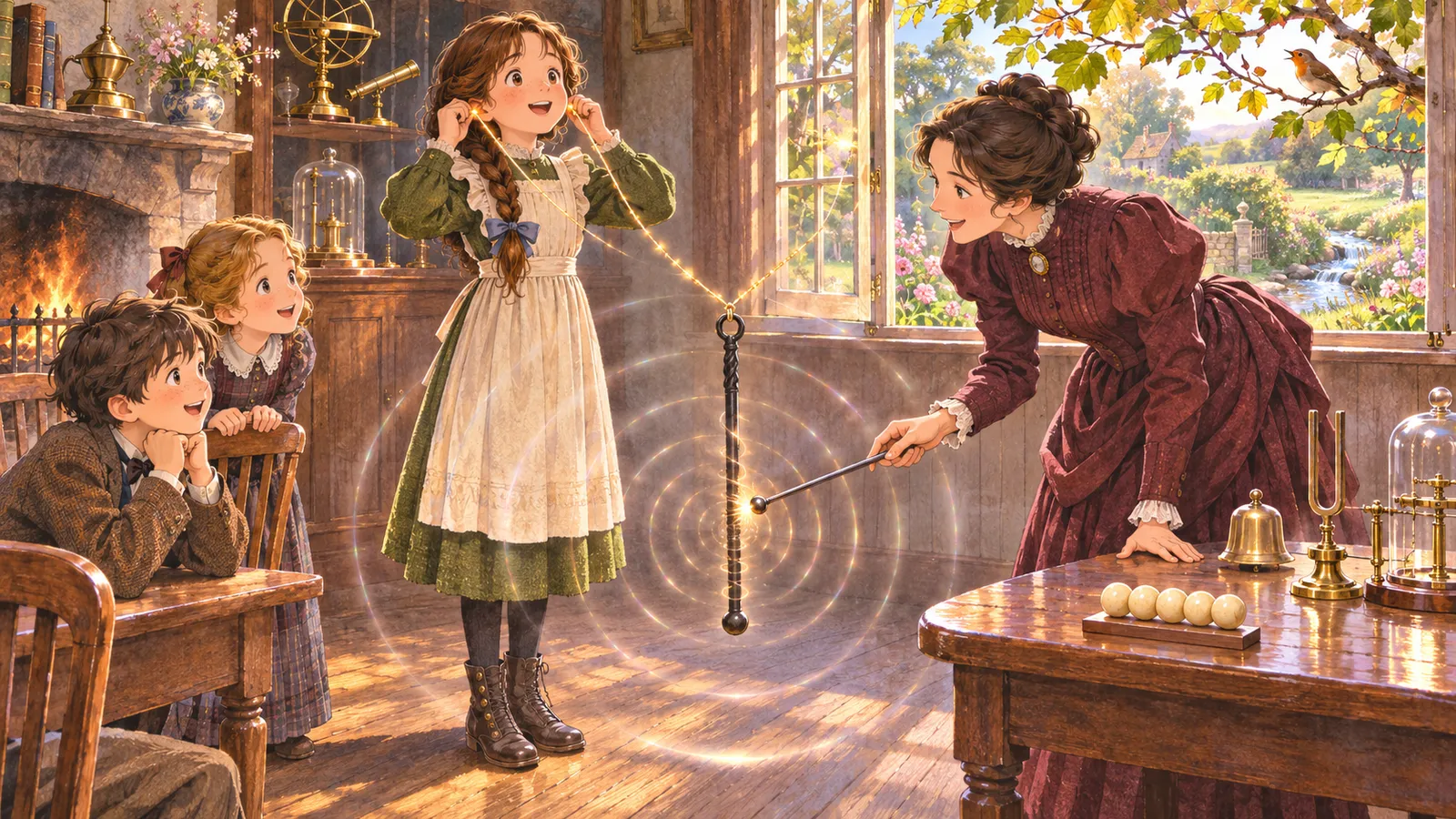
This we shall do most readily by means of an experiment made by Dr. Tyndall in his lectures on Sound.これは、ティンダル博士が音についての講義で行った実験を使うと、いちばんわかりやすいでしょう。 I have here a number of boxwood balls resting in a wooden tray which has a bell hung at the end of it.ここに、ツゲの木の玉がいくつも入った木のおぼんがあります。おぼんのはしにはベルがつるしてあります。 I am going to take the end ball and roll it sharply against the rest, and then I want you to notice carefully what happens.はしの玉を一つとって、ほかの玉にいきおいよくぶつけてみます。何が起こるか、よく注意して見てください。 See! the ball at the other end has flow off and hit the bell, so that you hear it ring.ほら! 反対のはしの玉が飛んでいって、ベルに当たり、ベルが鳴るのが聞こえます。 Yet the other balls remain where they were before.でも、ほかの玉はもとの場所にとどまったままです。 Why is this?これはなぜでしょう。 It is because each of the balls, as it was knocked forwards, had one in front of it to stop it and make it bound back again, but the last one was free to move on.それは、どの玉も、前におされたとき、前にある玉にとめられてはね返されたのに、最後の玉だけは自由に先へ進めたからです。 When I threw this ball from my hand against the others, the one in front of it moved, and hitting the third ball, bounded back again; the third did the same to the fourth, the fourth to the fifth, and so on to the end of the line.わたしが手からこの玉をほかの玉にぶつけると、その前の玉が動いて3番目の玉に当たり、はね返りました。3番目の玉は4番目の玉に同じことをし、4番目は5番目に、というようにして列の最後まで続いたのです。 Each ball thus came back to its place, but it passed the shock on to the last ball, and the ball to the bell.こうしてどの玉ももとの場所にもどりましたが、しょうげきは最後の玉へ、そして最後の玉からベルへと伝えられたのです。 If I now put the balls close up to the bell, and repeat the experiment, you still hear the sound, for the last ball shakes the bell as if it were a ball in front of it.今度は玉をベルにぴったりつけて、同じ実験をくり返しても、やはり音が聞こえます。最後の玉が、まるでベルが前にある玉であるかのようにベルをゆらすからです。
Now imagine these balls to be atoms of air, and the bell your ear.さあ、この玉を空気の原子、ベルをみなさんの耳だと考えてみてください。 If I clap my hands and so hit the air in front of them, each air-atom hits the next just as the balls did, and though it comes back to its place, it passes the shock on along the whole line to the atom touching the drum of your ear, and so you receive a blow.わたしが手をたたいて、手の前の空気を打つと、空気の原子はちょうど玉と同じように次の原子を打ちます。そして自分はもとの場所にもどりますが、しょうげきを列全体にそって、耳のこまくにふれている原子まで伝えていくので、みなさんは一打ちを受けとるのです。 But a curious thing happens in the air which you cannot notice in the balls.でも、空気の中では、玉では気づけないふしぎなことが起こります。 You must remember that air is elastic, just as if there were springs between the atoms as in the diagram, Fig.空気にはだん力があって、まるで原子のあいだにばねがあるようなものだということを思い出してください(図 31, and so when any shock knocks the atoms forward, several of them can be crowded together before they push on those in front.31)。そのため、しょうげきが原子を前におすと、いくつもの原子が、前の原子をおし進める前に、ぎゅっとつめこまれることができるのです。 Then, as soon as they have passed the shock on, they rebound and begin to separate again, and so swing to and fro till they come to rest. meanwhile the second set will go through just the same movements, and will spring apart as soon as they have passed the shock on to a third set, and so you will have one set of crowded atoms and one set of separated atoms alternately all along the line, and the same set will never be crowded two instants together.そして、しょうげきを伝えるとすぐに、原子ははね返ってまたはなれはじめ、行ったり来たりゆれながら、やがて止まります。そのあいだに2番目の組もまったく同じ動きをして、しょうげきを3番目の組に伝えるとすぐにはなれていきます。こうして列全体にそって、ぎゅっとつまった原子の組と、はなれた原子の組がかわるがわるならぶことになり、同じ組が二つのしゅん間続けてつまっていることは決してないのです。