 11分
 朗読 Patricia Oakley
 原文そのまま

 PDFで印刷(A4 9まい)
Who does not love the sunbeams, and feel brighter and merrier as he watches them playing on the wall, sparkling like diamonds on the ripples of the sea, or making bows of coloured light on the waterfall?日の光が好きでない人がいるでしょうか。日の光がかべの上でおどったり、海のさざ波の上でダイヤモンドのようにきらめいたり、たきの上に色のついた光のにじをかけたりするのを見ると、だれでも明るく楽しい気持ちになりますね。 Is not the sunbeam so dear to us that it has become a household word for all that is merry and gay? and when we want to describe the dearest, busiest little sprite amongst us, who wakes a smile on all faces wherever she goes, do we not call her the "sunbeam of the house"?日の光はわたしたちにとってとても大切なものなので、楽しく明るいもののことを言う身近なことばになっているのではありませんか。そして、どこへ行ってもみんなの顔に笑顔をよびおこす、いちばんかわいらしくて、いちばんよく動きまわる小さな子のことを言いたいとき、「家の日の光」とよぶではありませんか。
And yet how little even the wisest among us know about the nature and work of these bright messengers of the sun as they dart across space!それなのに、太陽からのこの明るいお使いたちが宇宙をかけぬけてくるとき、そのせいしつやはたらきについて、いちばんかしこい人たちでさえ、なんと知らないことでしょう。
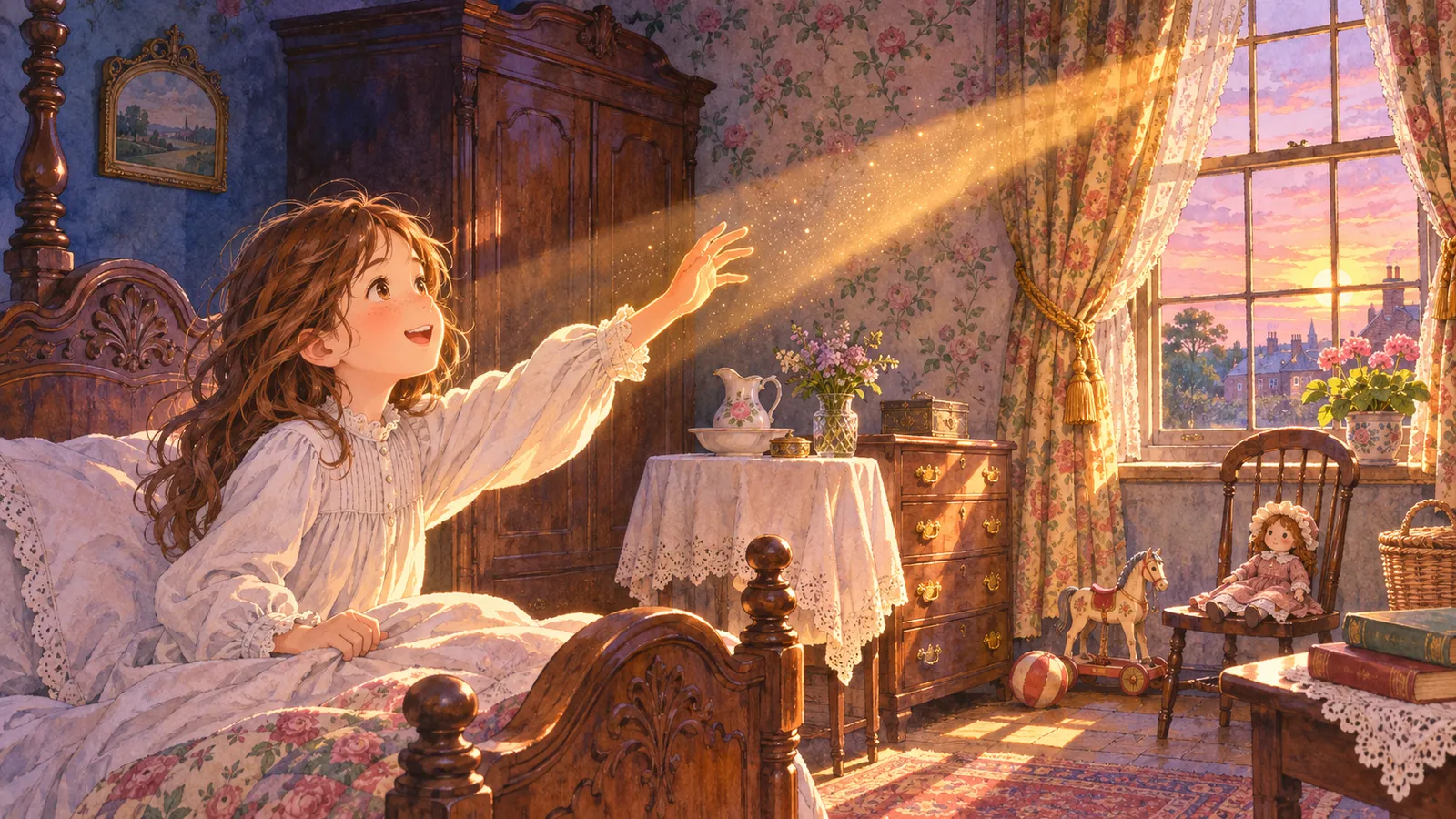
Did you ever wake quite early in the morning, when it was pitch- dark and you could see nothing, not even your own hand; and then lie watching as time went on till the light came gradually creeping in at the window?朝、とても早く目がさめたことはありますか。まっくらで何も見えず、自分の手さえ見えないときです。そして、時間がたつにつれて、光がだんだん窓からしのびこんでくるのを、横になったままながめていたことはありませんか。 If you have done this you will have noticed that you can at first only just distinguish the dim outline of the furniture; then you can tell the difference between the white cloth on the table and the dark wardrobe beside it; then by degrees all the smaller details, the handles of the drawer, the pattern on the wall, and the different colours of all the objects in the room become clearer and clearer till at last you see all distinctly in broad daylight.そうしたことがあれば、気がついたでしょう。はじめは家具のぼんやりした輪かくがやっと見分けられるだけです。それから、テーブルの白い布と、そのそばの黒っぽい洋服だんすのちがいがわかるようになります。それから少しずつ、引き出しのとってや、かべのもようや、部屋の中のいろいろなものの色といった細かいところが、だんだんはっきりしてきて、とうとう明るい昼の光の中で、すべてがくっきりと見えるようになるのです。
What has been happening here? and why have the things in the room become visible by such slow degrees?ここで何が起こっていたのでしょう。そして、なぜ部屋の中のものは、こんなにゆっくりと少しずつ見えるようになったのでしょう。 We say that the sun is rising, but we know very well that it is not the sun which moves, but that our earth has been turning slowly round, and bringing the little spot on which we live face to face with the great fiery ball, so that his beams can fall upon us.わたしたちは「太陽がのぼる」と言いますが、動いているのは太陽ではなく、地球がゆっくり回って、わたしたちの住んでいる小さな場所を、あの大きな火の玉と向かい合わせにし、その光がわたしたちにとどくようにしているのだということを、よく知っています。
Take a small globe, and stick a piece of black plaster over England, then let a lighted lamp represent the sun, and turn the globe slowly, so that the spot creeps round from the dark side away from the lamp, until it catches, first the rays which pass along the side of the globe, then the more direct rays, and at last stands fully in the blaze of the light.小さな地球ぎを用意して、イギリスの上に黒いばんそうこうを一まいはりましょう。それから火をともしたランプを太陽にみたてて、地球ぎをゆっくり回してごらんなさい。すると、黒い点はランプからはなれた暗い側から回ってきて、まず地球ぎのはしをかすめていく光を受け、次にもっとまっすぐな光を受け、最後には光のまっただ中に立つのです。 Just this was happening to our spot of the world as you lay in bed and saw the light appear; and we have to learn today what those beams are which fall upon us and what they do for us.みなさんがベッドに横になって光があらわれるのを見ていたとき、わたしたちの世界の一点では、まさにこれが起こっていたのです。きょうは、わたしたちにふりそそぐその光とは何なのか、それがわたしたちのために何をしてくれるのかを学びましょう。
First we must learn something about the sun itself, since it is the starting-place of all the sunbeams.まず、太陽そのものについて少し学ばなければなりません。太陽は、すべての日の光の出発点なのですから。 If the sun were a dark mass instead of a fiery one we should have none of these bright cheering messengers, and though we were turned face to face with him every day we should remain in one cold eternal night.もし太陽がもえる火の玉ではなく、暗いかたまりだったら、あの明るく元気づけてくれるお使いはひとつもやってこないでしょう。そして、毎日太陽と向かい合わせにされても、わたしたちはいつまでも冷たい永遠の夜の中にいることになるでしょう。 Now you will remember we mentioned in the last lecture that it is heat which shakes apart the little atoms of water and makes them gloat up in the air to fall again as rain; and that if the day is cold they fall as snow, and all the water is turned into ice.さて、前の講義でお話ししたのをおぼえているでしょう。水の小さな原子をゆさぶってばらばらにし、空気の中へうかび上がらせて、また雨としてふらせるのは熱です。そして、寒い日には雪になってふり、水はすっかり氷になってしまうのでした。 But if the sun were altogether dark, think how bitterly cold it would be; far colder than the most wintry weather ever known, because in the bitterest night some warmth comes out of the earth, where it has been stored from the sunlight which fell during the day.でも、もし太陽がまったく暗かったら、どんなにひどく寒いか考えてごらんなさい。これまでに知られたいちばん冬らしい天気より、はるかに寒いでしょう。なぜなら、いちばん寒い夜でも、地面からはいくらかあたたかさが出てくるからです。それは、昼のあいだにふりそそいだ日の光からたくわえられたものなのです。 But if we never received any warmth at all, no water would ever rise up into the sky, no rain ever fall, no rivers flow, and consequently no plants could grow and no animals live.でも、もしあたたかさをまったく受けとらなかったら、水はけっして空へのぼらず、雨はけっしてふらず、川は流れず、したがって植物は育たず、動物も生きられないでしょう。 All water would be in the form of snow and ice, and the earth would be one great frozen mass with nothing moving upon it.水はみな雪と氷の形になり、地球はその上で何ひとつ動くもののない、ひとつの大きなこおったかたまりになってしまうでしょう。
So you see it becomes very interesting for us to learn what the sun is, and how he sends us his beams.ですから、太陽とは何なのか、どうやって光をおくってくるのかを学ぶのは、とてもおもしろいことなのです。 How far away from us do you think he is?太陽は、わたしたちからどのくらい遠くにあると思いますか。 On a fine summer's day when we can see him clearly, it looks as if we had only to get into a balloon and reach him as he sits in the sky, and yet we know roughly that he is more than ninety-one millions of miles distant from our earth.よく晴れた夏の日、太陽がはっきり見えるときには、気球に乗りさえすれば、空にいる太陽にとどきそうに見えます。でも、太陽は地球から9100万マイル以上もはなれていることが、おおよそわかっています。
These figures are so enormous that you cannot really grasp them.この数はあまりに大きくて、ほんとうにはつかめないでしょう。 But imagine yourself in an express train, travelling at the tremendous rate of sixty miles an hour and never stopping.でも、自分が急行列車に乗って、1時間に60マイル(約97キロメートル)というものすごい速さで、一度も止まらずに走っていると想像してごらんなさい。 At that rate, if you wished to arrive at the sun today you would have been obliged to start 171 years ago.その速さだと、きょう太陽に着きたければ、171年前に出発していなければならなかったでしょう。 That is, you must have set off in the early part of the reign of Queen Anne, and you must have gone on, never, never resting, through the reigns of George I, George ii, and the long reign of George III, then through those of George IV, William IV, and Victoria, whirling on day and night at express speed, and at last, today, you would have reached the sun!つまり、アン女王の時代のはじめごろに出発して、ジョージ1世、ジョージ2世、そして長いジョージ3世の時代、それからジョージ4世、ウィリアム4世、ビクトリア女王の時代をずっと、一度も一度も休まずに、昼も夜も急行の速さでつき進み、ようやくきょう、太陽に着くというわけです!
And when you arrived there, how large do you think you would find him to be?そして着いてみたら、太陽はどのくらいの大きさだと思いますか。 Anaxagoras, a learned Greek, was laughed at by all his fellow Greeks because he said that the sun was as large as the Peloponne-sus, that is about the size of Middlesex.学者だったギリシャ人のアナクサゴラスは、太陽はペロポネソス半島くらいの大きさ、つまりミドルセックス州くらいの大きさだと言って、仲間のギリシャ人みんなに笑われました。 How astonished they would have been if they could have known that not only is he bigger than the whole of Greece, but more than a million times bigger than the whole world!もし太陽が、ギリシャ全体より大きいどころか、地球全体の100万倍よりも大きいと知ることができたら、ギリシャの人たちはどんなにおどろいたことでしょう。
Our world itself is a very large place, so large that our own country looks only like a tiny speck upon it, and an express train would take nearly a month to travel round it.わたしたちの世界そのものもとても大きな所で、わたしたちの国はその上ではほんの小さな点のようにしか見えません。急行列車で一周するのに、1か月近くかかるでしょう。 Yet even our whole globe is nothing in size compared to the sun, for it only measures 8000 miles across, while the sun measures more the 852,000.それでも、わたしたちの地球全体は、太陽とくらべれば大きさなど無いも同然です。地球は直径8000マイルしかありませんが、太陽は85万2000マイル以上もあるのですから。
Imagine for a moment that you could cut the sun and the earth each in half as you would cut an apple; then if you were to lay the flat side of the half-earth on the flat side of the half sun it would take 106 such earths to stretch across the face of the sun.ちょっと想像してごらんなさい。太陽と地球を、リンゴを切るようにそれぞれ半分に切ったとします。そして、半分の地球の平らな面を、半分の太陽の平らな面の上にならべていくと、太陽の面をよこぎるのに、そんな地球が106こも要るのです。 One of these 106 round spots on the diagram represents the size which our earth would look if placed on the sun; and they are so tiny compared to him that they look only like a string of minute beads stretched across his face.図の上の106この丸い点のひとつが、地球を太陽の上に置いたときの大きさをあらわしています。太陽とくらべると、とても小さいので、太陽の面にずらりとならべた小さなビーズのひもにしか見えません。 Only think, then, how many of these minute dots would be required to fill the whole of the inside of Fig.では考えてみてください。もし図 4, if it were a globe.4が球だったら、その中身をすっかりうめるのに、この小さな点がいったいいくつ要ることでしょう。
One of the best ways to form an idea of the whole size of the sun is to imagine it to be hollow, like an air-ball, and then see how many earths it would take to fill it.太陽全体の大きさを思いうかべるいちばんよい方法のひとつは、太陽がゴムふうせんのように中がからっぽだと想像して、それをうめるのに地球がいくつ要るかを考えることです。 You would hardly believe that it would take one million, three hundred and thirty-one thousand globes the size of our world squeezed together.それには、わたしたちの世界と同じ大きさの球を、ぎゅうぎゅうにつめて、133万1000こも要るなんて、とても信じられないでしょう。 Just think, if a huge giant could travel all over the universe and gather worlds, all as big as ours, and were to make first a heap of merely ten such worlds, how huge it would be!考えてもごらんなさい。もし大男が宇宙じゅうを旅して、わたしたちの世界と同じ大きさの世界を集め、まずたった10この世界の山をつくったとしたら、どんなに大きな山でしょう。 Then he must have a hundred such heaps of ten to make a thousand world; and then he must collect again a thousand times that thousand to make a million, and when he had stuffed them all into the sun-ball he would still have only filled three-quarters of it!それから、1000この世界にするには、10こずつの山が100こ要ります。そして100万こにするには、その1000この1000倍を、また集めなければなりません。それをみな太陽の玉の中につめこんでも、まだ4分の3しかうまらないのです!
After hearing this you will not be astonished that such a monster should give out an enormous quantity of light and heat; so enormous that it is almost impossible to form any idea of it.これを聞いたら、こんなとほうもないものが、ものすごい量の光と熱を出していても、おどろかないでしょう。それはあまりにもものすごくて、思いうかべることさえほとんどできないほどです。 Sir John Herschel has, indeed, tried to picture it for us.サー・ジョン・ハーシェルが、じっさいにそれをわたしたちのために思いうかべさせようとしました。 He found that a ball of lime with a flame of oxygen and hydrogen playing round it (such as we use in magic lanterns and call oxy- hydrogen light) becomes so violently hot that it gives the most brilliant artificial light we can get - such that you cannot put your eye near it without injury.ハーシェルは、石灰の玉のまわりに酸素と水素のほのおを当てると(げんとう機に使うもので、酸水素光とよばれます)、ものすごく熱くなって、わたしたちが手に入れられるいちばんまぶしい人工の光を出すことを知っていました。あまりにまぶしいので、目を近づけると目をいためてしまうほどです。 Yet if you wanted to have a light as strong as that of our sun, it would not be enough to make such a lime-ball as big as the sun is.それでも、わたしたちの太陽と同じくらい強い光がほしければ、そんな石灰の玉を太陽と同じ大きさにつくるだけでは足りないのです。 No, you must make it as big as 146 suns, or more than 146,000,000 times as big as our earth, in order to get the right amount of light.そうです、正しい量の光を得るには、太陽146こ分、つまり地球の1億4600万倍以上の大きさにしなければなりません。 Then you would have a tolerably good artificial sun; for we know that the body of the sun gives out an intense white light, just as the lime- ball does, and that , like it, it has an atmosphere of glowing gases round it.そうすれば、かなりよくできた人工の太陽ができるでしょう。なぜなら、太陽の本体は石灰の玉と同じように強い白い光を出していて、石灰の玉と同じように、まわりにかがやくガスの大気があることがわかっているからです。
But perhaps we get the best idea of the mighty heat and light of the sun by remembering how few of the rays which dart out on all sides from this fiery ball can reach our tiny globe, and yet how powerful they are.でも、太陽のものすごい熱と光をいちばんよく思いうかべられるのは、この火の玉から四方八方に飛び出す光のうち、わたしたちの小さな地球にとどくのはほんのわずかなのに、それがどれほど強いかを思い出すときかもしれません。 Look at the globe of a lamp in the middle of the room, and see how its light pours out on all sides and into every corner; then take a grain of mustard-seed, which will very well represent the comparative size of our earth, and hold it up at a distance from the lamp.部屋のまん中のランプのほやを見て、その光が四方八方に、すみずみまでそそいでいる様子を見てごらんなさい。それから、わたしたちの地球の大きさをよくあらわしているカラシナのたねを一つぶ持って、ランプからはなれた所でかざしてごらんなさい。 How very few of all those rays which are filling the room fall on the little mustard-seed, and just so few does our earth catch of the rays which dart out from the sun.部屋をいっぱいにしている光のうち、小さなカラシナのたねに当たるのは、なんとほんのわずかでしょう。地球が受けとる、太陽から飛び出す光も、ちょうどそれくらいわずかなのです。 And yet this small quantity (1/2000-millionth part of the whole) does nearly all the work of our world.それなのに、このわずかな量(全体の20億分の1)が、わたしたちの世界のしごとのほとんどすべてをしているのです。 (These and the preceding numerical statements will be found worked out in Sir J. Herschel's 'Familiar Lectures on Scientific Subjects,' 1868, from which many of the facts in the first part of the lecture are taken.)(これらの数や、その前に出てきた数の計算は、ハーシェルの『科学についての親しみやすい講義』(1868年)にのっています。この講義の前半の事実の多くは、この本からとったものです。)