
 9分
 朗読 J. M. Smallheer
 原文そのまま

 PDFで印刷(A4 9まい)
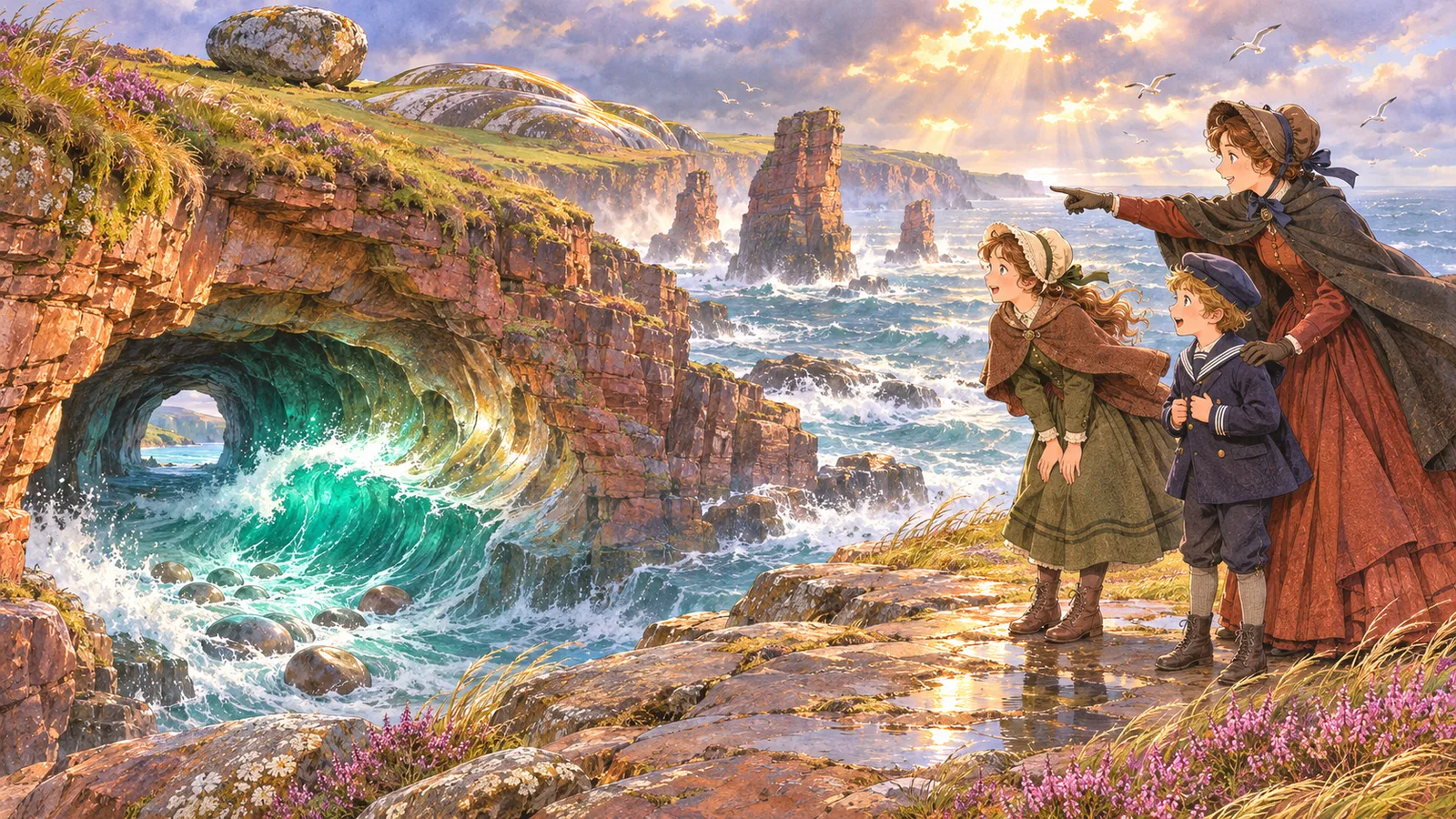
Fig.図 28 is a sketch on the shores of Arbroath which I made some years ago.28は、何年か前に、わたしがアーブロースの海岸でかいたスケッチです。 You will not find it difficult to picture to yourselves how the sea has eaten away these cliffs till some of the strongest pieces which have resisted the waves stand out by themselves in the sea.海がこのがけをけずっていき、波に負けなかったいちばんじょうぶな部分が、海の中にぽつんと立っているようすは、たやすく思いえがけるでしょう。 That cave in the left-hand corner ends in a narrow dark passage from which you come out on the other side of the rocks into another bay.左すみのどうくつは、おくがせまく暗い通路になっていて、そこをぬけると、岩のむこう側の別の入りえに出られます。 Such caves as these are made chiefly by the force of the waves and the air, bringing down pieces of rock from under the cliff and so making a cavity, and then as the waves roll these pieces over and over and grind them against the sides, the hole is made larger.このようなどうくつは、おもに波と空気の力でできます。がけの下から岩のかけらをくずし落として穴をつくり、それから波がそのかけらをごろごろころがして穴の内側にこすりつけるので、穴が大きくなっていくのです。 There are many places on the English coast where large pieces of the road are destroyed by the crumbling down of cliffs when they have been undermined by caverns such as these.イギリスの海岸には、このようなどうくつにえぐられたがけがくずれて、道路の大きな部分がこわされてしまった場所がたくさんあります。
Thus, you see, the whole of the beautiful scenery of the sea - the shores, the steep cliffs, the quiet bays, the creeks and caverns - are all the work of the "sculptor" water; and he works best where the rocks are hardest, for there they offer him a good stout wall to batter, whereas in places where the ground is soft it washes down into a gradual gentle slope, and so the waves come flowing smoothly in and have no power to eat away the shore.このように、海辺の美しい景色――海岸、切り立ったがけ、静かな入りえ、小さな入りえやどうくつ――は、すべて「ちょうこく家」である水の作品なのです。そして、水がいちばんよくはたらくのは岩がいちばんかたい所です。そこでは、打ちつけるのにちょうどよい、がんじょうなかべがあるからです。いっぽう、地面がやわらかい所では、土が洗い流されてゆるやかな坂になるので、波はなめらかに寄せてくるだけで、海岸をけずる力はないのです。
And now, what has Ice got to do with the sculpturing of the land?では、氷は土地のちょうこくに、どんな関係があるのでしょう。 First, we must remember how much the frost does in breaking up the ground.まず思い出さなければならないのは、こおりつく寒さが地面をくだくのに、どれほど役立っているかということです。 The farmers know this, and always plough after a frost, because the moisture, freezing in the ground, has broken up the clods, and done half their work for them.農家の人はこのことを知っていて、いつも寒さのあとで畑をたがやします。地面の中の水分がこおって土のかたまりをくだき、仕事の半分をしてくれているからです。
But this is not the chief work of ice.でも、これは氷のおもな仕事ではありません。 You will remember how we learnt in our last lecture that snow, when it falls on the mountains, gradually slides down into the valleys, and is pressed together by the gathering snow behind until it becomes moulded into a solid river of ice (see Fig.前回のお話で学んだのを覚えているでしょう。山にふった雪は少しずつ谷へすべり下り、うしろに集まってくる雪におされて、ついにはかたい氷の川の形になるのでした(図 29, Frontispiece).29、口絵)。 In Greenland and in Norway there are enormous ice-rivers or glaciers, and even in Switzerland some of them are very large.グリーンランドやノルウェーにはものすごく大きな氷の川、つまり氷河があり、スイスにもとても大きな氷河があります。 The Aletsch glacier, in the Alps, is fifteen miles long, and some are even longer than this.アルプスのアレッチ氷河は長さが15マイル(約24キロメートル)もあり、それより長いものもあります。 They move very slowly - on an average about 20 to 27 inches in the centre, and 13 to 19 inches at the sides every twenty-four hours, in the summer and autumn.氷河はとてもゆっくり動きます。夏や秋には、24時間ごとに、真ん中で平均20〜27インチ、両はしで13〜19インチほどです。 How they move, we cannot stop to discuss now; but if you will take a slab of thin ice and rest it upon its two ends only, you can prove to yourself that ice does bend, for in a few hours you will find that its own weight has drawn it down in the centre, so as to form a curve.氷河がどうやって動くのかを話している時間は今はありません。でも、うすい氷の板を両はしだけでささえておけば、氷が曲がることを自分でたしかめられます。数時間たつと、自分の重さで真ん中が下がって、曲線になっているのがわかるでしょう。 This will help you to picture to yourselves how glaciers can adapt themselves to the windings of the valley, creeping slowly onwards until they come down to a point where the air is warm enough to melt them, and then the ice flows away in a stream of water.このことから、氷河がどのようにして谷の曲がりくねりに合わせて形を変え、空気が氷をとかすほどあたたかい所まで、ゆっくりと進んでいくのかを思いえがけるでしょう。そこで氷は、水の流れとなって流れていくのです。 It is very curious to see the number of little rills running down the great masses of ice at the glacier's mouth, bringing down with them gravel, and every now and then a large stone, which falls splashing into the stream below.氷河の口の大きな氷のかたまりを、たくさんの小さな流れが流れ下り、じゃりや、ときには大きな石もいっしょに運んできて、石がバシャンと下の流れに落ちるのを見るのは、とてもおもしろいものです。 If you look at the glacier in the Frontispiece, you will see that these stones come from those long lines of stones and boulders stretching along the sides and centre of the glacier.口絵の氷河を見ると、こうした石は、氷河の両はしと真ん中にそって長くのびる、石や大岩の列から来ていることがわかるでしょう。 It is easy to understand where the stones at the side come from; for we have seen that damp and frost cause pieces to break off the surface of the rocks, and it is natural that these pieces should roll down the steep sides of the mountains on to the glacier.両はしの石がどこから来るのかは、すぐにわかります。しめり気とこおりつく寒さのために、岩の表面からかけらが折れることは前に見ましたし、そのかけらが山の急なしゃ面をころがって氷河の上に落ちてくるのは当然だからです。 But the middle row requires some explanation.でも、真ん中の列については説明がいります。 Look to the back of the picture, and you will see that this line of stones is made of two side rows, which come from the valleys above.絵のおくのほうを見てください。この石の列は、上の谷からやってくる二つの両はしの列でできているのがわかるでしょう。 Two glaciers, you see, have there joined into one, and so made a heap of stones all along their line of junction.そこで、二つの氷河が一つに合わさったので、そのつなぎ目にそって石の列ができたのです。
These stones are being continually, though slowly, conveyed by the glacier, from all the mountains along its sides, down to the place where it melts.これらの石は、ゆっくりとではありますが、氷河の両側にあるすべての山から、氷河がとける所まで、絶えず運ばれています。 Here it lets them fall, and they are gradually piled up till they form great walls of stone, which are called moraines.氷河はそこで石を落とし、石は少しずつ積み上がって、大きな石のかべをつくります。これを「モレーン(たい石)」とよびます。 Some of the moraines left by the larger glaciers of olden time, in the country near Turin, form high hills, rising up even to 1500 feet.大昔のもっと大きな氷河が残したモレーンの中には、トリノに近い地方で、1500フィート(約460メートル)もの高いおかになっているものもあります。
Therefore, if ice did no more than carry these stone blocks, it would alter the face of the country; but it does much more than this.ですから、もし氷がこうした石のかたまりを運ぶだけだったとしても、土地のすがたは変わるでしょう。でも、氷はそれよりずっと多くのことをするのです。 As the glacier moves along, it often cracks for a considerable way across its surface, and this crack widens and widens, until at last it becomes a great gaping chasm, or crevasse as it is called, so that you can look down it right to the bottom of the glacier.氷河は進んでいくうちに、表面をかなり長く横切るようにひびわれることがよくあります。このわれ目はどんどん広がって、ついには大きく口をあけた深いわれ目、つまり「クレバス」になり、氷河の底まで見下ろせるほどになります。 Into these crevasses large blocks of rock fall, and when the chasm is closed again as the ice presses on, these masses are frozen firmly into the bottom of the glacier, much in the same way as a steel cutter is fixed in the bottom of a plane.このクレバスには大きな岩のかたまりが落ちこみます。氷がおし進んでわれ目がまたとじると、岩のかたまりは氷河の底にしっかりとこおりつきます。ちょうど、かんなの底に、けずるための鋼の板がはめこまれているのとよく似ています。 And they do just the same kind of work; for as the glacier slides down the valley, they scratch and grind the rocks underneath them, rubbing themselves away, it is true, but also scraping away the ground over which they move.このクレバスには大きな岩のかたまりが落ちこみます。氷がおし進んでわれ目がまたとじると、岩のかたまりはひょうがの底にしっかりとこおりつきます。ちょうど、かんなの底に、けずるためのはがねの板がはめこまれているのとよくにています。 In this way the glacier becomes a cutting instrument, and carves out the valleys deeper and deeper as it passes through them.そして、それらの岩はかんなとまったく同じ仕事をします。ひょうがが谷をすべり下りるとき、岩のかたまりは下の岩をひっかいたりけずったりします。たしかに自分たちもすりへっていきますが、自分たちが上を動いていく地面もけずり取るのです。
You may always know where a glacier has been, even if no trace of ice remains; for you will see rocks with scratches along them which have been cut by these stones; and even where the rocks have not been ground away, you will find them rounded like those in the left-hand of the Frontispiece, showing that the glacier- plane has been over them.氷がまったく残っていなくても、氷河がそこにあったことはいつでもわかります。こうした石でつけられた引っかききずのある岩が見られるからです。また、岩がけずられていない所でも、口絵の左側にあるように丸くなった岩が見つかり、氷河のかんながその上を通ったことを示しているのです。 These rounded rocks are called "roches moutonnees," because at the distance they look like sheep lying down.この丸い岩は「ロッシュ・ムトネ(ひつじ岩)」とよばれます。遠くから見ると、ひつじがねそべっているように見えるからです。
You have only to look at the stream flowing from the mouth of a glacier to see what a quantity of soil it has ground off from the bottom of the valley; for the water is thick, and coloured a deep yellow by the mud it carries.氷河の口から流れ出る川を見さえすれば、氷河が谷の底からどれほどたくさんの土をけずり取ったかがわかります。水はにごっていて、運んでいるどろのために、こい黄色になっているのです。 This mud soon reaches the rivers into which the streams run; and such rivers as the Rhone and the Rhine are thick with matter brought down from the Alps.このどろは、流れがそそぐ川にまもなくとどきます。ローヌ川やライン川のような川は、アルプスから運ばれてきた物でにごっています。 The Rhone leaves this mud in the Lake of Geneva, flowing out at the other end quite clear and pure.ローヌ川はこのどろをジュネーブ湖に残し、反対側のはしからは、すっかりすんだきれいな水になって流れ出ていきます。 A mile and a half of land has been formed at the head of the lake since the time of the Romans by the mud thus brought down from the mountains.ローマ時代から、こうして山から運ばれてきたどろによって、湖の上流のはしに1マイル半もの土地ができました。
Thus we see that ice, like water, is always busy carving out the surface of the earth, and sending down material to make new land elsewhere.このように、氷も水と同じように、いつも地球の表面をきざむのにいそがしく、別の場所に新しい土地をつくるための材料を送り出していることがわかります。 We know that in past ages the glaciers were much larger than they are in our time; for we find traces of them over large parts of Switzerland where glaciers do not now exist, and huge blocks which could only have been carried by ice, and which are called "erratic blocks," some of them as big as cottages, have been left scattered over all the northern part of Europe.昔は、氷河が今よりずっと大きかったことがわかっています。今は氷河のないスイスの広い地域で氷河のあとが見つかりますし、氷でしか運べなかったはずのとても大きな岩のかたまり――「迷子石」とよばれ、中には小さな家ほどの大きさのものもあります――が、ヨーロッパの北部全体に散らばって残されているからです。 These blocks were a great puzzle to scientific men till, in 1840, Professor Agassiz showed that they must have been brought by ice all the way from Norway and Russia.この岩のかたまりは、科学者たちにとって大きななぞでしたが、1840年にアガシー教授が、それはノルウェーやロシアからはるばる氷で運ばれてきたにちがいないことを明らかにしました。
In those ancient days, there were even glaciers in England; for in Cumberland and in Wales you may see their work, in scratched and rounded rocks, and the moraines they have left.その大昔には、イングランドにさえ氷河がありました。カンバーランドやウェールズでは、引っかききずのある丸い岩や、氷河が残したモレーンに、そのはたらきのあとを見ることができます。 Llanberis Pass, so famous for its beauty, is covered with ice-scratches, and blocks are scattered all over the sides of the valley.美しさで有名なスランベリスとうげは、氷の引っかききずでおおわれていて、谷の両側じゅうに岩のかたまりが散らばっています。 There is one block high up on the right-hand slope of the valley, as you enter from the Beddgelert side, which is exactly poised upon another block, so that it rocks to and fro.ベズゲレルトの側から入ると、谷の右側の坂の高い所に、別の岩の上にちょうどうまくのっていて、前後にゆらゆらゆれる岩のかたまりが一つあります。 It must have been left thus balanced when the ice melted round it.氷がまわりでとけたとき、そのようにつり合ったまま残されたにちがいありません。 You may easily see that these blocks were carried by ice, and not by water, because their edges are sharp, whereas if they had been rolled in water, they would have been smoothed down.こうした岩のかたまりが水ではなく氷で運ばれたことは、すぐにわかります。かどがとがっているからです。もし水の中でころがされたのなら、かどはすりへってなめらかになっているはずです。
We cannot here go into the history of that great Glacial Period long ago, when large fields of ice covered all the north of England; but when you read it for yourselves and understand the changes on the earth's surface which we can see being made by ice now, then such grand scenery as the rugged valleys of Wales, with large angular stone blocks scattered over them, will tell you a wonderful story of the ice of bygone times.大昔、大きな氷原がイングランド北部全体をおおっていた、あの大きな「氷河時代」の歴史に、ここでふれることはできません。でも、自分でその歴史を読み、今も氷によってつくられている地表の変化を理解すれば、大きな角ばった岩のかたまりが散らばるウェールズのごつごつした谷のような堂々とした景色が、過ぎ去った時代の氷のすばらしい物語を語ってくれるでしょう。
And now we have touched lightly on the chief ways in which water and ice carve out the surface of the earth.さて、水と氷が地球の表面をきざむおもなやり方に、ざっとふれてきました。 We have seen that rain, rivers, springs, the waves of the sea, frost, and glaciers all do their part in chiselling out ravines and valleys, and in producing rugged peaks or undulating plains - here cutting through rocks so as to form precipitous cliffs, there laying down new land to add to the flat country - in one place grinding stones to powder, in others piling them up in gigantic ridges.雨、川、泉、海の波、こおりつく寒さ、氷河が、みなそれぞれ役目をはたして、きょう谷や谷をのみでけずるようにつくり、ごつごつした山頂やなだらかな平野をつくり出していることを見てきました。ある所では岩をけずりぬいて切り立ったがけをつくり、別の所では新しい土地を置いて平らな土地を広げ、ある所では石を粉になるまですりつぶし、別の所では石をとてつもなく大きなおねに積み上げているのです。 We cannot go a step into the country without seeing the work of water around us; every little gully and ravine tells us that the sculpture is going on; every stream, with its burden of visible or invisible matter, reminds us that some earth is being taken away and carried to a new spot.いなかでは、一歩進むごとに、まわりに水の仕事が見えます。小さなみぞや谷の一つ一つが、ちょうこくが今も続いていることを教えてくれます。目に見える物や見えない物を運ぶ流れの一つ一つが、どこかの土が運び去られ、新しい場所へ運ばれていることを思い出させてくれるのです。 In our little lives we see indeed but the very small changes, but by these we learn how greater ones have been brought about, and how we owe the outline of all our beautiful scenery, with its hills and valleys, its mountains and plains, its cliffs and caverns, its quiet nooks and its grand rugged precipices, to the work of the "Two great sculptors, Water and Ice."わたしたちの短い一生のうちでは、ほんの小さな変化しか見られません。でも、その小さな変化から、もっと大きな変化がどのように起こってきたかを学びます。そして、おかや谷、山や平野、がけやどうくつ、静かな小さな一角や切り立った大きながけのある、わたしたちの美しい景色の形はみな、「二人の大ちょうこく家、水と氷」の仕事のおかげなのだと知るのです。