
 11分
 朗読 Patricia Oakley
 原文そのまま

 PDFで印刷(A4 9まい)
Having now learned what air is, the next question which presents itself is, Why does it stay round our earth?空気とは何かがわかったので、次にうかんでくる問いは、「空気はなぜ地球のまわりにとどまっているのか」です。 You will remember we saw in the first lecture, that all the little atoms of a gas are trying to fly away from each other, so that if I turn on this gas-jet the atoms soon leave it, and reach you at the farther end of the room, and you can smell the gas.最初の講義で見たのをおぼえているでしょう。気体の小さな原子は、みなたがいにはなれて飛んでいこうとしています。ですから、このガス口のせんをひねると、原子はすぐにそこからはなれて、部屋の向こうのはしにいるみなさんのところまでとどき、ガスのにおいがするのです。 Why, then, do not all the atoms of oxygen and nitrogen fly away from our earth into space, and leave us without any air?それなら、どうして酸素やちっ素の原子は、みな地球から宇宙へ飛んでいってしまって、わたしたちを空気のない所に置きざりにしないのでしょう。
Ah! here you must look for another of our invisible forces.ああ!ここで、わたしたちの目に見えない力の、もうひとつをさがさなければなりません。 Have you forgotten our giant force, "gravitation," which draws things together from a distance?はなれた所からものどうしを引きよせる、大男の力「引力」をわすれてしまいましたか。 This force draws together the earth and the atoms of oxygen and nitrogen; and as the earth is very big and heavy, and the atoms of air are light and easily moved, they are drawn down to the earth and held there by gravitation.この力が、地球と、酸素やちっ素の原子を引きよせ合っているのです。地球はとても大きくて重く、空気の原子は軽くてかんたんに動くので、原子は引力によって地球へ引きよせられ、そこにつなぎとめられているのです。 But for all that, the atmosphere does not leave off trying to fly away; it is always pressing upwards and outwards with all its might, while the earth is doing its best to hold it down.それでも、大気は飛んでいこうとするのをやめません。大気はいつも全力で上へ、外へとおしているのに、地球のほうはけんめいにそれをおさえつけているのです。
The effect of this is, that near the earth, where the pull downward is very strong, the air-atoms are drawn very closely together, because gravitation gets the best of the struggle.そのけっか、下へ引く力がとても強い地球の近くでは、空気の原子はとてもぎっしりと引きよせられています。この引っぱり合いでは、引力のほうが勝つからです。 But as we get farther and farther from the earth, the pull downward becomes weaker, and then the air-atoms spring farther apart, and the air becomes thinner.でも、地球からだんだん遠ざかるにつれて、下へ引く力は弱くなり、空気の原子はもっとはなれてはねまわり、空気はうすくなります。 Suppose that the lines in this diagram represent layers of air.この図の線が、空気の層をあらわしているとしましょう。 Near the earth we have to represent them as lying closely together, but as they recede from the earth they are also farther apart.地球の近くでは、線をぎっしりつめてかかなければなりませんが、地球から遠ざかるにつれて、線のあいだも広くなります。
But the chief reason why the air is thicker or denser nearer the earth, is because the upper layers press it down.でも、空気が地球の近くほど厚い、つまりこいいちばんのわけは、上の層が下の空気をおしつけているからです。 If you have a heap of papers lying one on the top of the other, you know that those at the bottom of the heap will be more closely pressed together than those above, and just the same is the case with the atoms of the air.紙をたくさん重ねて山にしておくと、山の下のほうの紙は、上のほうの紙よりもぎゅっとおしつけられていることを知っているでしょう。空気の原子でも、まったく同じことが起こっているのです。 Only there is this difference, if the papers have lain for some time, when you take the top ones off, the under ones remain close together.ただひとつちがうのは、紙は、しばらく重ねておいたあとで上の紙をとりのけても、下の紙はぴったり重なったままだということです。 But it is not so with the air, because air is elastic, and the atoms are always trying to fly apart, so that directly you take away the pressure they spring up again as far as they can.でも空気はそうではありません。空気には、おしちぢめられてももとにもどろうとする力(だん力)があって、原子はいつもたがいにはなれて飛んでいこうとしているので、おす力をとりのけたとたんに、できるだけ遠くへまたはなれていくのです。
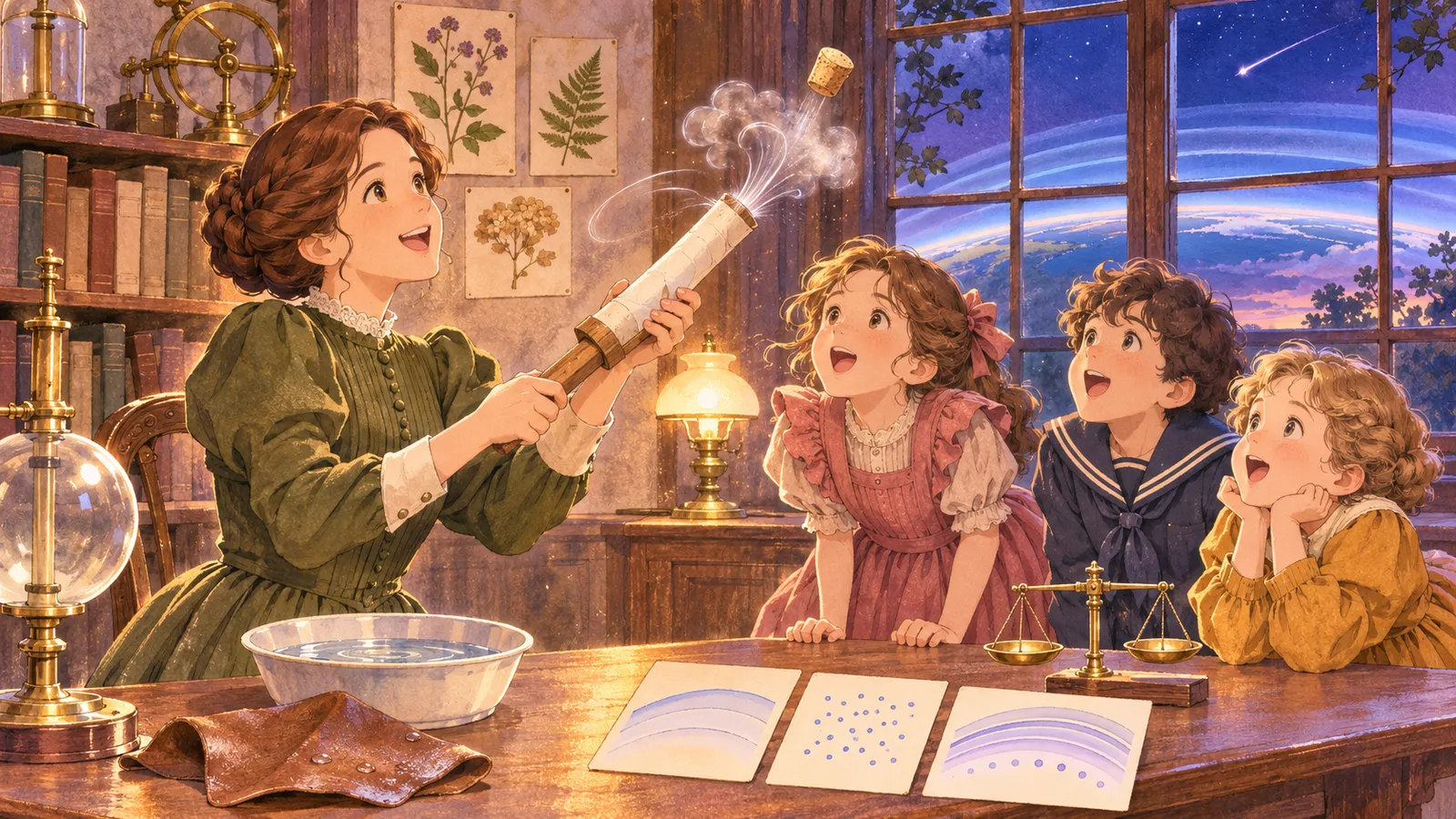
I have here an ordinary pop-gun.ここに、ふつうの紙でっぽう(コルクでっぽう)があります。 If I push the cork in very tight, and then force the piston slowly inwards, I can compress the air a good deal.コルクをとてもきつくおしこんでから、つつのぼうをゆっくりおしこんでいくと、空気をかなりおしちぢめることができます。 Now I am forcing the atoms nearer and nearer together, but at last they rebel so strongly against being more crowded that the cork cannot resist their pressure.今わたしは、原子をどんどん近くへおしこめています。でも、とうとう原子がそれ以上つめこまれるのにはげしくはんこうするので、コルクはそのおす力にたえられなくなります。 Out it flies, and the atoms spread themselves out comfortably again in the air all around them.ポンとコルクが飛び出して、原子はまた、まわりの空気の中にのびのびと広がるのです。 Now, just as I pressed the air together in the pop-gun, so the atmosphere high up above the earth presses on the air below and keeps the atoms closely packed together.さて、わたしが紙でっぽうの中の空気をおしちぢめたのと同じように、地球のはるか上の大気は、下の空気をおしつけて、原子をぎっしりつめこんだままにしています。 And in this case the atoms cannot force back the air above them as they did the cork in the pop-gun; they are obliged to submit to be pressed together.そしてこの場合、原子は、紙でっぽうのコルクをおしもどしたようには、上の空気をおしもどすことができません。おしちぢめられるのにしたがうしかないのです。
Even a short distance from the earth, however, at the top of a high mountain, the air becomes lighter, because it has less weight of atmosphere above it, and people who go up in balloons often have great difficulty in breathing, because the air is so thin and light.けれども、地球からほんの少しはなれただけでも、たとえば高い山のてっぺんでは、上にのっている大気の重さが少ないので、空気は軽くなります。気球に乗って高くのぼった人は、空気がとてもうすくて軽いので、息をするのにたいへん苦しむことがよくあります。 In 1804 a Frenchman, named Gay-Lussac, went up four miles and a half in a balloon, and brought down some air; and he found that it was much less heavy than the same quantity of air taken close down to the earth, showing that it was much thinner, or rarer, as it is called;* and when, in 1862, Mr. Glaisher and Mr. Coxwell went up five miles and a half, Mr. Glaisher's veins began to swell, and his head grew dizzy, and he fainted.1804年に、ゲイ=リュサックというフランス人が気球で4マイル半(約7キロメートル)の高さまでのぼって、空気を持ち帰りました。すると、その空気は地面のすぐ近くでとった同じ量の空気よりずっと軽く、ずっとうすい、つまり「きはく」であることがわかりました。* また1862年には、グレーシャーさんとコックスウェルさんが5マイル半の高さまでのぼったとき、グレーシャーさんの血管がふくらみはじめ、頭がくらくらして、気を失ってしまいました。 The air was too thin for him to breathe enough in at a time, and it did not press heavily enough on the drums of his ears and the veins of his body.空気がうすすぎて、一度に十分な量をすいこむことができず、また、空気が耳のこまくや体の血管を十分強くおさえなかったのです。 He would have died if Mr. Coxwell had not quickly let off some of the gas in the balloon, so that it sank down into denser air. (*100 cubic inches near the earth weighed 31 grains, while the same quantity taken at four and a half miles up in the air weighed only 12 grains, or two- fifths of the weight.)もしコックスウェルさんが気球のガスをすばやく少しぬいて、気球をこい空気のところまで下ろさなかったら、グレーシャーさんは死んでいたでしょう。(*地面の近くの空気100立方インチは31グレインの重さでしたが、4マイル半の上空でとった同じ量の空気は、たった12グレイン、つまり5分の2の重さしかありませんでした。)
And now comes another very interesting question.さて、ここでもうひとつ、とてもおもしろい問いが出てきます。 If the air gets less and less dense as it is farther from the earth, where does it stop altogether?空気が地球から遠くなるほどうすくなるのなら、空気はどこですっかりなくなるのでしょう。 We cannot go up to find out, because we should die long before we reached the limit; and for a long time we had to guess about how high the atmosphere probably was, and it was generally supposed not to be more than fifty miles.たしかめにのぼっていくことはできません。そのはしにつくよりずっと前に死んでしまうからです。それで長いあいだ、大気がどのくらいの高さなのかは、すいそくするしかありませんでした。ふつうは50マイルより高くはないだろうと考えられていました。 But lately, some curious bodies, which we should have never suspected would be useful to us in this way, have let us into the secret of the height of the atmosphere.ところが近ごろ、こんなふうに役に立つとは思いもしなかった、ふしぎな物体が、大気の高さのひみつを教えてくれました。 These bodies are the meteors, or falling stars.その物体とは、流星、つまり流れ星です。
Most people, at one time or another, have seen what looks like a star shoot right across the sky, and disappear.たいていの人は、いつか、星のようなものが空をさっと横切って消えるのを見たことがあるでしょう。 On a clear starlight night you may often see one or more of these bright lights flash through the air; for one falls on an average in every twenty minutes, and on the nights of August 9th and November 13th there are numbers in one part of the sky.よくはれた星の夜には、こうした明るい光が一ついじょう、空気の中をさっと光って走るのが、よく見られます。へいきんして20分に一つはふっていますし、8月9日と11月13日の夜には、空の一か所にたくさん見られます。 These bodies are not really stars; they are simply stones or lumps of metal flying through the air, and taking fire by clashing against the atoms of oxygen in it.この物体は、ほんとうは星ではありません。空気の中を飛んでいく、ただの石や金属のかたまりで、空気中の酸素の原子にぶつかって火がつくのです。 There are great numbers of these masses moving round and round the sun, and when our earth comes across their path, as it does especially in August and November, they dash with such tremendous force through the atmosphere that they grow white-hot, and give out light, and then disappear, melted into vapour.太陽のまわりをぐるぐる回っている、こうしたかたまりはとてもたくさんあります。そして、とくに8月と11月のように、地球がその通り道を横切ると、かたまりはものすごい勢いで大気の中へつっこんでくるので、白く光るほど熱くなって、光を出し、とけて気体になって消えてしまうのです。 Every now and then one falls to the earth before it is all melted away, and thus we learn that these stones contain tin, iron, sulphur, phosphorus, and other substances.ときどき、すっかりとけてしまう前に地面に落ちてくるものがあります。そのおかげで、この石には、すず、鉄、いおう、リンなどの物質がふくまれていることがわかるのです。
It is while these bodies are burning that they look to us like falling stars, and when we see them we know that hey must be dashing against our atmosphere.この物体が流れ星のように見えるのは、もえているあいだのことです。ですから、流れ星を見たら、それがわたしたちの大気にぶつかっているにちがいないとわかるのです。 Now if two people stand a certain known distance, say fifty miles, apart on the earth and observe these meteors and the direction in which they each see them fall, they can calculate (by means of the angle between the two directions) how high they are above them when they first see them, and at that moment they must have struck against the atmosphere, and even travelled some way through it, to become white-hot.さて、二人の人が、たとえば50マイルというように、きょりのわかっている所にはなれて地上に立ち、流星を見て、それぞれが流星のふってくる方向を調べると、(二つの方向のあいだの角度を使って)はじめて見えたときに流星が自分たちの上のどのくらいの高さにあったかを計算できます。そしてその時には、流星はもう大気にぶつかっていて、白く光るほど熱くなるには、大気の中をいくらか進んでいたはずなのです。 In this way we have learnt that meteors burst into light at least 100 miles above the surface of the earth, and so the atmosphere must be more than 100 miles high.こうして、流星は地表から少なくとも100マイル上空で光りはじめることがわかりました。ですから、大気は100マイルより高いはずなのです。
Our next question is as to the weight of our aerial ocean.次の問いは、わたしたちの空気の海の重さについてです。 You will easily understand that all this air weighing down upon the earth must be very heavy, even though it grows lighter as it ascends.地球の上にのしかかっているこの空気がみな、上へ行くほど軽くなるとはいっても、とても重いにちがいないことは、すぐにわかるでしょう。 The atmosphere does, in fact, weigh down upon land at the level of the sea as much as if a 15-pound weight were put upon every square inch of land.じっさい、海面と同じ高さの陸では、大気は、陸の1平方インチごとに15ポンド(約7キログラム)のおもりをのせたのと同じくらいの重さでのしかかっているのです。 This little piece of linen paper, which I am holding up, measures exactly a square inch, and as it lies on the table, it is bearing a weight of 15 lbs. on its surface.わたしが持ち上げているこの小さなあさの紙は、ちょうど1平方インチの大きさです。テーブルの上に置いておくと、その表面には15ポンドの重さがかかっているのです。 But how, then, comes it that I can lift it so easily?それなら、どうしてこんなにかんたんに持ち上げられるのでしょう。 Why am I not conscious of the weight?なぜ、その重さを感じないのでしょう。
To understand this you must give all your attention, for it is important and at first not very easy to grasp. you must remember, in the first place, that the air is heavy because it is attracted to the earth, and in the second place, that since air is elastic all the atoms of it are pushing upwards against this gravitation.これを理解するには、よくよく注意して聞いてください。大切なことで、はじめはなかなかつかみにくいのです。まず第一に、空気が重いのは地球に引きつけられているからだということ、そして第二に、空気にはだん力があるので、空気の原子はみなこの引力にさからって上へおし上げているのだということを、おぼえておいてください。 And so, at any point in air, as for instance the place where the paper now is as I hold it up, I feel no pressure because exactly as much as gravitation is pulling the air down, so much elasticity is resisting and pushing it up.ですから、空気の中のどの点でも、たとえば今わたしが持ち上げている紙のある所でも、わたしはおす力を感じません。引力が空気を下へ引いているのとちょうど同じだけ、だん力がそれにさからって空気を上へおし上げているからです。 So the pressure is equal upwards, downwards, and on all sides, and I can move the paper with equal ease any way.つまり、おす力は上にも下にも横にも同じなので、紙をどの向きにも同じようにかんたんに動かせるのです。
Even if I lay the paper on the table this is still true, because there is always some air under it.紙をテーブルの上に置いても、やはりこのことは同じです。紙の下には、いつもいくらか空気があるからです。 If, however, I could get the air quite away from one side of the paper, then the pressure on the other side would show itself.けれども、もし紙の片側から空気をすっかりとりのぞくことができたら、反対側のおす力があらわれるでしょう。 I can do this by simply wetting the paper and letting it fall on the table, and the water will prevent any air from getting under it.それは、紙をぬらしてテーブルの上に落とすだけでできます。水が、紙の下に空気が入りこむのをふせいでくれるのです。 Now see! if I try to lift it by the thread in the middle, I have great difficulty, because the whole 15 pounds' weight of the atmosphere is pressing it down.さあ見てごらんなさい!まん中の糸を持って持ち上げようとすると、とてもたいへんです。大気の15ポンドの重さが、まるごと紙をおしつけているからです。 A still better way of making the experiment is with a piece of leather, such as the boys often amuse themselves with in the streets.この実験をするもっとよい方法は、男の子たちがよく通りで遊んでいるような、革のきれを使うことです。 This piece of leather has been well soaked.この革のきれは、よく水にひたしてあります。 I drop it on the floor and see! it requires all my strength to pull it up.これをゆかに落とすと――ほら!引きはがすのに、ありったけの力が要ります。 (In fastening the string to the leather the hole must be very small and the know as flat as possible, and it is even well to put a small piece of kid under the knot.(革にひもをつけるときは、穴をとても小さくし、結び目をできるだけ平たくしなければなりません。結び目の下に小さな子ヤギの革をしいておくのもよいでしょう。 When I first made this experiment, not having taken these precautions, it did not succeed well, owing to air getting in through the hole.)わたしがはじめてこの実験をしたときは、こうした用心をしなかったので、穴から空気が入りこんで、うまくいきませんでした。) I now drop it on this stone weight, and so heavily is it pressed down upon it by the atmosphere that I can lift the weight without its breaking away from it.では今度は、この石のおもりの上に革を落としてみます。大気がとても強く革をおもりにおしつけているので、革がはがれずに、おもりを持ち上げることができるのです。