 9分
 朗読 Auntie Em
 原文そのまま

 PDFで印刷(A4 9まい)
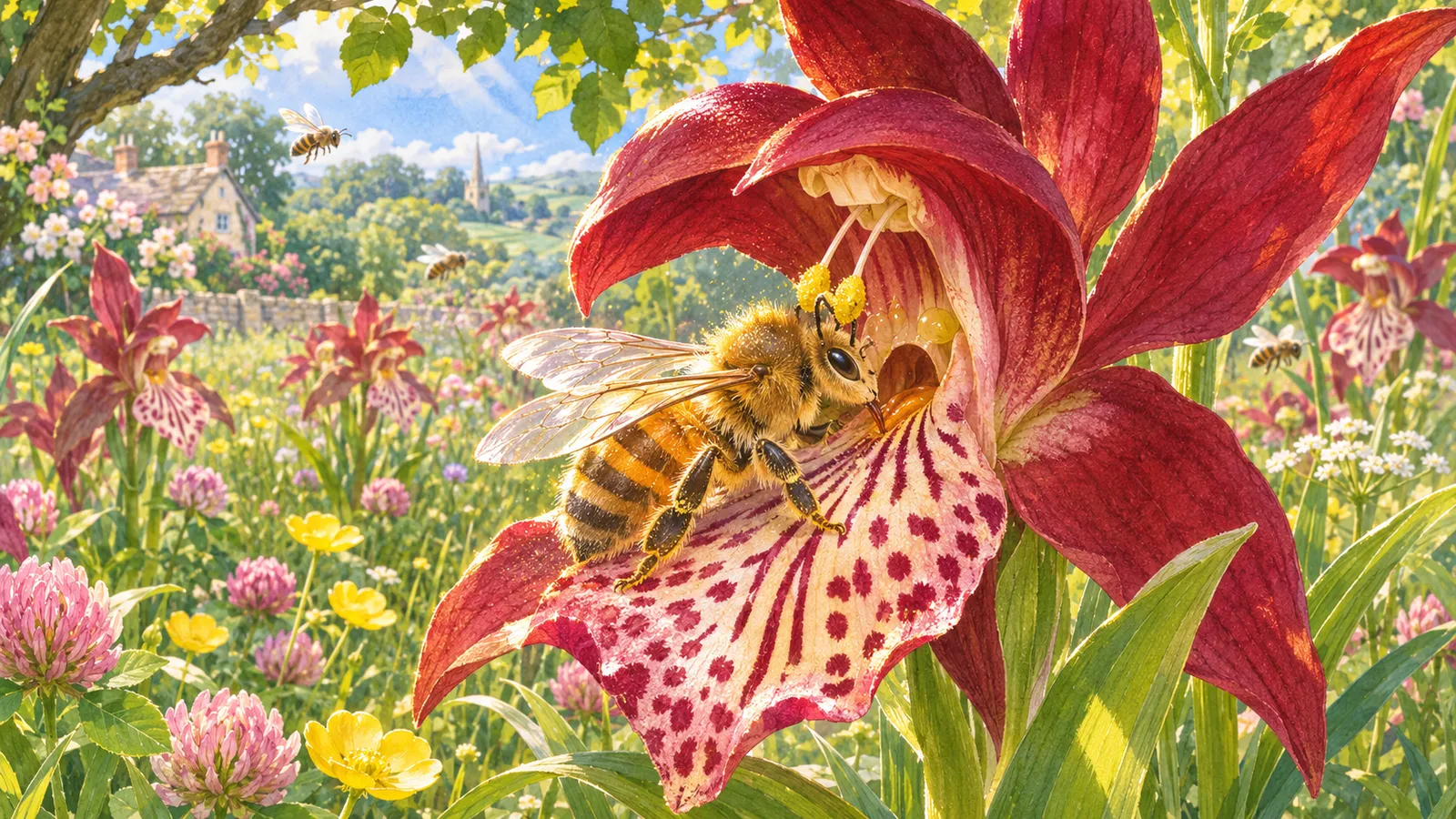
Let us examine it closely.よく調べてみましょう。 It has sic deep-red covering leaves, Fig.この花には、こい赤色のおおいの葉が6まいあります(図 62, three belonging to the calyx or outer cup, and three belonging to the corolla or crown of the flower; but all six are coloured alike, except that the large on in front, called the "lip", has spots and lines upon it which will suggest to you at once that they point to the honey.62)。3まいはがく(外側のカップ)のもの、3まいは花冠(花のかんむり)のものですが、6まいとも同じ色をしています。ただ、前にある大きな1まいは「リップ(くちびる弁)」とよばれ、点やすじがついていて、それがみつのありかを指していることに、すぐ気づくでしょう。
But where are the anthers, and where is the stigma?でも、やくはどこにあり、柱頭はどこにあるのでしょう? Look just under the arch made by those three bending flower-leaves, and there you will see two small slits, and in these some little club-shaped bodies, which you can pick out with the point of a needle.3まいの花びらがつくるアーチのすぐ下を見てごらんなさい。小さなわれ目が2つあり、その中に、こん棒のような形の小さなものがいくつか入っています。ぬい針の先でつまみ出すことができます。 One of these enlarged is shown.そのうちの1つを大きくしたものが、図にあります。 It is composed of sticky grains of pollen held together by fine threads on the top of a thin stalk; and at the bottom of the stalk there is a little round body.それは、細い糸でまとめられたねばねばした花粉のつぶでできていて、細いじくの先についています。じくの根もとには、小さな丸いものがついています。 This is all that you will find to represent the stamens of the flower.この花で、おしべにあたるものは、これだけしかありません。 When these masses of pollen, or pollinia as they are called, are within the flower, the knob at the bottom is covered by a little lid, shutting them in like the lid of a box, and just below this lid you will see two yellowish lumps, which are very sticky.この花粉のかたまり(ポリニアとよばれます)が花の中にあるときは、根もとの丸いものは小さなふたでおおわれていて、箱のふたのようにとじこめています。そして、このふたのすぐ下に、黄色っぽい、とてもねばねばしたかたまりが2つ見えます。 These are the top of the stigma, and they are just above the seed-vessel, which you can see in the lowest flower in the picture.これが柱頭のてっぺんで、種をつくるふくろ(しぼう)のすぐ上にあります。しぼうは、絵の一番下の花で見ることができます。
Now let us see how this flower gives up its pollen.さあ、この花がどのように花粉をわたすのか、見てみましょう。 When a bee comes to look for honey in the orchis, she alights on the lip, and guided by the lines makes straight for the opening just in front of the stigmas.ハチがオルキスにみつをさがしに来ると、リップにとまり、すじにみちびかれて、柱頭のすぐ前の入り口へまっすぐ向かいます。 Putting her head into this opening she pushes down into the spur, where by biting the inside skin she gets some juicy sap.その入り口に頭を入れて、つのの中へおし進み、中の皮をかんで、みずみずしいしるをとります。 Notice that she has to bite, which takes time.ハチは、かまなければならないことに注目してください。それには時間がかかります。
You will see at once that she must touch the stigmas in going in, and so give them any pollen she has on her head. but she also touches the little lid and it flies instantly open, bringing the glands at the end of the pollen-masses against her head.ハチが入っていくとき、柱頭にふれるので、頭についている花粉があれば柱頭にわたすことは、すぐわかるでしょう。でもハチは小さなふたにもふれ、ふたはぱっと開いて、花粉のかたまりのはしにあるねばねばの玉がハチの頭におしつけられます。 These glands are moist and sticky, and while she is gnawing the inside of the spur they dry a little and cling to her head and she brings them out with her.この玉はしめっていてねばねばしているので、ハチがつのの内側をかじっているあいだに少しかわいて、頭にくっつき、ハチはそれを持ったまま出てきます。 Darwin once caught a bee with as many as sixteen of these pollen-masses clinging to her head.ダーウィンは、頭に16個もの花粉のかたまりをくっつけたハチをつかまえたことがあります。
But if the bee went into the next flower with these pollinia sticking upright, she would simply put them into the same slits in the next flower, she would not touch them against the stigma.けれども、もしハチが、花粉のかたまりをまっすぐ立てたまま次の花に入ったら、次の花の同じわれ目にさしこむだけで、柱頭にふれさせることはできません。 Nature, however, has provided against this.でも、自然はちゃんとこれにそなえています。 As the bee flies along, the glands sticking to its head dry more and more, and as they dry they curl up and drag the pollen-masses down, so that instead of standing upright, as in 1, Fig.ハチが飛んでいくうちに、頭にくっついた玉はますますかわき、かわくにつれて丸まって、花粉のかたまりを下へ引っぱります。そのため花粉のかたまりは、図 63, they point forwards, as in 2.63の1のように立っているのではなく、2のように前を向くのです。
And now, when the bee goes into the next flower, she will thrust them right against the sticky stigmas, and as they cling there the fine threads which hold the grains together break away, and the flower is fertilized.そして、ハチが次の花に入ると、花粉のかたまりをねばねばした柱頭にまっすぐおしつけます。花粉のかたまりが柱頭にくっつくと、花粉のつぶをまとめていた細い糸がちぎれて、花は受粉するのです。
If you will gather some of these orchids during your next spring walk in the woods, and will put a pencil down the tube to represent the head of the bee you may see the little box open, and the two pollen-masses cling to the pencil.次の春に森を散歩するとき、このランをいくつかつんで、ハチの頭のかわりにえんぴつをつつの中に入れてみれば、小さな箱が開いて、2つの花粉のかたまりがえんぴつにくっつくのが見られるでしょう。 Then if you draw it out you may see them gradually bend forwards, and by thrusting your pencil into the next flower you may see the grains of pollen bread away, and you will have followed out the work of a bee.それからえんぴつを引きぬくと、花粉のかたまりがだんだん前にかたむいていくのが見られます。そして、えんぴつを次の花にさしこめば、花粉のつぶがちぎれていくのが見えて、ハチの仕事を自分でたどったことになるのです。
Do not such wonderful contrivances as these make us long to know and understand all the hidden work that is going on around us among the flowers, the insects, and all forms of life?こんなにすばらしいしかけを知ると、花や虫や、あらゆる命のあいだで、わたしたちのまわりで起こっているかくれた仕事を、すべて知りたい、わかりたいと思いませんか? I have been able to tell you but very little, but I can promise you that the more you examine, the more you will find marvellous histories such as these in simple field-flowers.わたしがお話しできたのはほんの少しですが、調べれば調べるほど、ありふれた野の花の中に、このようなおどろくべき物語がもっと見つかることはお約束します。
Long as we have known how useful honey was to the bee, and how it could only get it from flowers, yet it was not till quite lately that we have learned to follow out Sprengel's suggestion, and to trace the use which the bee is to the flower.ハチにとってみつがどれほど役に立つか、そしてハチは花からしかみつをとれないことは、ずっと前から知られていましたが、シュプレンゲルの考えにしたがって、ハチが花にとってどんな役に立っているのかをたどるようになったのは、ごく最近のことです。 But now that we have once had our eyes opened, every flower teaches us something new, and we find that each plant adapts itself in a most wonderful way to the insects which visit it, both so as to provide them with honey, and at the same time to make them unconsciously do it good service.でも、一度目が開かれてしまえば、どの花もわたしたちに何か新しいことを教えてくれます。そして、植物はそれぞれ、おとずれる虫にとてもみごとに自分を合わせていて、虫にみつをあたえると同時に、虫が知らないうちに自分のためによくはたらいてくれるようにしていることがわかるのです。
And so we learn that even among insects and flowers, those who do most for others, receive most in return.こうしてわたしたちは、虫と花のあいだでさえ、ほかの者のために一番多くつくす者が、一番多くのお返しを受けとることを学びます。 The bee and the flower do not either of them reason about the matter, they only go on living their little lives as nature guides them, helping and improving each other.ハチも花も、このことを頭で考えているわけではありません。ただ、自然にみちびかれるままに自分の小さな命を生き、おたがいに助け合い、よくし合っているのです。 Think for a moment how it would be, if a plant used up all its sap for its own life, and did not give up any to make the drop of honey in its flower.ちょっと考えてみてください。もしある植物が、しるを全部自分の命のために使ってしまって、花のみつのしずくをつくるために少しも出さなかったら、どうなるでしょう。 The bees would soon find out that these particular flowers were not worth visiting, and the flower would not get its pollen-dust carried, and would have to do its own work and grow weakly and small.ハチはすぐに、その花はおとずれるねうちがないと気づくでしょう。そうなると、花は花粉を運んでもらえず、自分で仕事をしなければならなくなって、弱く小さく育つことになるでしょう。 Or suppose on the other hand that the bee bit a hole in the bottom of the flower, and so got at the honey, as indeed they sometimes do; then she would not carry the pollen-dust, and so would not keep up the healthy strong flowers which make her daily food.あるいはぎゃくに、ハチが花の根もとに穴をかじりあけてみつをとったとしたらどうでしょう。じっさい、ハチはときどきそうすることがあります。そうすると、ハチは花粉を運ばないので、毎日の食べ物となる元気でじょうぶな花をたもつこともできなくなってしまいます。
But this, as you see, is not the rule.でも、ごらんのとおり、それはふつうのことではありません。 On the contrary, the flower feeds the bee, and the bee quite unconsciously helps the flower to make its healthy seed.それどころか、花はハチをやしない、ハチはまったく知らないうちに、花が元気な種をつくるのを助けているのです。 Nay more; when you are able to read all that has been written on this subject, you will find that we have good reason to think that the flowerless plants of the Coal Period have gradually put on the beautiful colours, sweet scent, and graceful shapes of our present flowers, in consequence of the necessity of attracting insects, and thus we owe our lovely flowers to the mutual kindliness of plants and insects.さらに、このテーマについて書かれたものを全部読めるようになったら、石炭紀の花のない植物が、虫を引きよせる必要があったために、だんだんと今の花のような美しい色、あまいかおり、優美な形を身につけてきたと考える十分な理由があることがわかるでしょう。つまり、わたしたちが美しい花を見られるのは、植物と虫がおたがいに親切にし合ってきたおかげなのです。
And is there nothing beyond this?そして、その先には何もないのでしょうか? Surely there is.いいえ、きっとあります。 Flowers and insects, as we have seen, act without thought or knowledge of what they are doing; but the law of mutual help which guides them is the same which bids you and me be kind and good to all those around us, if we would lead useful and happy lives.これまで見てきたように、花も虫も、自分たちが何をしているかを考えたり知ったりせずに行動しています。でも、それらをみちびいている「助け合いのおきて」は、わたしたちが役に立つ幸せな生き方をしたいなら、まわりのすべての人にやさしく親切にしなさいと教えるおきてと、同じものなのです。 And when we see that the Great Power which rules over our universe makes each work for the good of all, even in such humble things as bees and flowers; and that beauty and loveliness come out of the struggle and striving of all living things; then, if our own life be sometimes difficult, and the struggle hard to bear, we learn from the flowers that the best way to meet our troubles is to lay up our little drop of honey for others, sure that when they come to sip it they will, even if unconsciously, give us new vigour and courage in return.宇宙をおさめる大いなる力が、ハチや花のようなささやかなものの中でさえ、それぞれをみんなのためにはたらかせていること、そして美しさや愛らしさが、すべての生き物の苦労やがんばりの中から生まれてくることがわかれば、わたしたちは花から学ぶことができます。もし自分の生活がときにむずかしく、苦しくてたえがたいときがあっても、なやみに向き合う一番よい方法は、ほかの人のために自分の小さなみつのしずくをたくわえておくことだ、と。そうすれば、その人たちがそれをすいに来たとき、たとえ自分では気づかなくても、きっとお返しに新しい元気と勇気をくれるはずです。
And now we have arrived at the end of those subjects which we selected out of the Fairy-land of Science.さて、わたしたちが「科学のおとぎの国」からえらんだテーマも、これで終わりになりました。 You must not for a moment imagine, however, that we have in any way exhausted our fairy domain; on the contrary, we have scarcely explored even the outskirts of it.けれども、わたしたちのおとぎの国をすっかり調べつくしたなどとは、けっして思わないでください。それどころか、そのはずれさえ、ほとんど探検していないのです。 The "History of a Grain of Salt," "A Butterfly's Life," or "The Labours of an Ant," would introduce us to fairies and wonders quite as interesting as those of which we have spoken in these Lectures.「ひとつぶの塩の物語」「チョウの一生」「アリのはたらき」といったお話をすれば、これまでの講義でお話ししたのと同じくらいおもしろい、ようせいやふしぎに出会えるでしょう。 While "A Flash of Lightning," "An Explosion in a Coal-mine," or "The Eruption of a Volcano," would bring us into the presence of terrible giants known and dreaded from time immemorial.また、「いなずま」「炭こうのばく発」「火山のふん火」といったお話をすれば、大昔から知られ、おそれられてきた、おそろしい大男たちの前につれていかれることでしょう。
But at least we have passed through the gates, and have learnt that there is a world of wonder which we may visit if we will; and that it lies quite close to us, hidden in every dewdrop and gust of wind, in every brook and valley, in every little plant or animal.でも少なくとも、わたしたちは門をくぐりぬけて、その気になればおとずれることのできるふしぎの世界があることを知りました。そしてそれは、すぐ近くに、つゆの1しずくや、ひとふきの風の中に、小川や谷の1つ1つに、小さな植物や動物の1つ1つに、かくれているのです。 We have only to stretch out our hand and touch them with the wand of inquiry, and they will answer us and reveal the fairy forces which guide and govern them; and thus pleasant and happy thoughts may be conjured up at any time, wherever we find ourselves, by simply calling upon nature's fairies and asking them to speak to us.わたしたちはただ手をのばして、「たずねてみる」というまほうのつえでそれらにふれればよいのです。そうすれば、それらは答えてくれ、自分たちをみちびき、おさめている、ようせいの力を見せてくれるでしょう。こうして、どこにいても、いつでも、自然のようせいたちをよび出して話しかけてもらうだけで、楽しく幸せな考えをよびおこすことができるのです。 Is it not strange, then, that people should pass them by so often without a thought, and be content to grow up ignorant of all the wonderful powers ever active in the world around them?それなのに、人々がよく何も考えずにそれらの前を通りすぎ、まわりの世界でいつもはたらいている、すばらしい力について何も知らないまま大人になって平気でいるのは、ふしぎではありませんか?
Neither is it pleasure alone which we gain by a study of nature.自然を学んで得られるのは、楽しみだけではありません。 We cannot examine even a tiny sunbeam, and picture the minute waves of which it is composed, travelling incessantly from the sun, without being filled with wonder and awe at the marvellous activity and power displayed in the infinitely small as well as in the infinitely great things of the universe.小さな日光の1すじでも調べて、それをつくっている細かい波が、太陽からたえまなく旅してくるようすを思いうかべれば、宇宙のかぎりなく小さなものにも、かぎりなく大きなものにもあらわれている、おどろくべきはたらきと力に、ふしぎさとおそれの気持ちでいっぱいにならずにはいられません。 We cannot become familiar with the facts of gravitation, cohesion, or crystallization, without realizing that the laws of nature are fixed, orderly, and constant, and will repay us with failure or success according as we act ignorantly or wisely; and thus we shall begin to be afraid of leading careless, useless, and idle lives.引力や、物と物がくっつき合う力(ぎょう集力)、結しょうといった事実をよく知れば、自然の法則は決まっていて、きちんとしていて、変わらないものであり、わたしたちが知らずに行動するか、かしこく行動するかによって、失敗か成功かでむくいてくれる、ということがわかります。こうしてわたしたちは、注意の足りない、役に立たない、なまけた生き方をすることが、こわくなってくるでしょう。 We cannot watch the working of the fairy "life" in the primrose or the bee, without learning that living beings as well as inanimate things are governed by these same laws of nature; nor can we contemplate the mutual adaptation of bees and flowers without acknowledging that it teaches the truth that those succeed best in life who, whether consciously or unconsciously, do their best for others.サクラソウやハチの中にある「命」というようせいのはたらきを見れば、生き物も、命のないものと同じように、この同じ自然の法則にしたがっていることを学ばずにはいられません。また、ハチと花がおたがいに合わせ合っているようすを考えれば、それが、意識してであれ知らずにであれ、ほかの者のために最善をつくす者こそが、人生で一番うまくいくという真実を教えていることを、みとめずにはいられません。
And so our wanderings in the Fairy-land of Science will not be wasted, for we shall learn how to guide our own lives, while we cannot fail to see that the forces of nature, whether they are apparently mechanical, as in gravitation or heat; or intelligent, as in living beings, are one and all the voice of the Great Creator, and speak to us of His Nature and His Will.こうして、わたしたちの「科学のおとぎの国」の旅は、むだにはならないでしょう。自分の生き方をどうみちびけばよいかを学ぶとともに、自然の力が、引力や熱のように機械的に見えるものであっても、生き物のようにちえをもって見えるものであっても、すべて大いなる創り主の声であり、その本性とお考えをわたしたちに語っているのだと、きっとわかるはずだからです。