
 8分
 朗読 J. M. Smallheer
 原文そのまま

 PDFで印刷(A4 9まい)
"No description," says Lieutenant Ives, one of the first explorers of this river, "can convey the idea of the varied and majestic grandeur of this peerless waterway.この川を最初にたんけんした人の一人、軍人のアイブズはこう言っています。「どんな言葉でも、このならぶもののない水の道の、さまざまに変わるおごそかなすばらしさを伝えることはできません。 Wherever the river turns, the entire panorama changes.川が曲がるたびに、見わたす景色ががらりと変わります。 Stately facades, august cathedrals, amphitheatres, rotundas, castellated walls, and rows of time-stained ruins, surmounted by every form of tower, minaret, dome and spire, have been moulded from the cyclopean masses of rock that form the mighty defile."堂々とした建物の正面、おごそかな大聖堂、円形劇場、まるい屋根の建物、城のようなかべ、時の流れにそまってくずれた古い建物の列――そのうえには、あらゆる形のとう、ミナレット(イスラム教の寺院の細長いとう)、まるい屋根、とがった屋根が立っていて、それらがみな、この大きな谷間をつくる、とてつもなく大きな岩のかたまりからけずり出されているのです。」 Who will say, after this, that water is not the grandest of all sculptors, as it cuts through hundreds of miles of rock, forming such magnificent granite groups, not only unsurpassed but unequalled by any of the works of man?これを聞いたあとで、水はあらゆるちょうこく家の中でいちばんすぐれていない、と言う人がいるでしょうか。水は何百マイルもの岩をけずりぬけて、人間のどんな作品もおよばない、いや、くらべるものさえない、すばらしい花こう岩の像の群れをつくっているのですから。
But we must not look upon water only as a cutting instrument, for it does more than merely carve out land in one place, it also carries it away and lays it down elsewhere; and in this it is more like a modeller in clay, who smooths off the material from one part of his figure to put it upon another.でも、水をけずる道具としてだけ見てはいけません。水は、ある場所で土地をきざむだけでなく、それを運んで別の場所に置くこともするのです。この点では、水はねん土で像をつくる人に似ています。ねん土で像をつくる人は、像のある部分から材料をけずり取っては、別の部分につけるのですから。
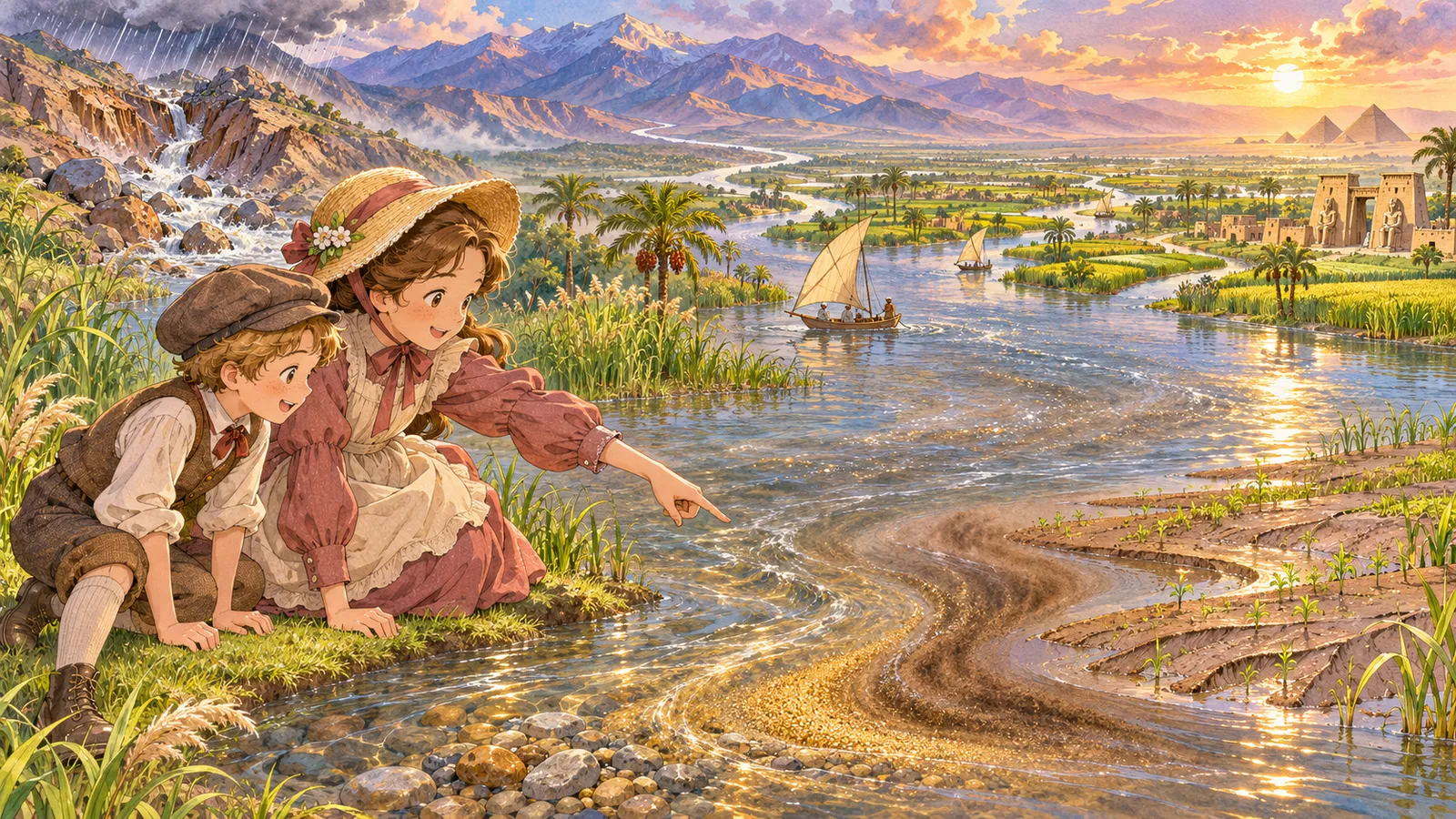
Running water is not only always carrying away mud, but at the same time laying it down here and there wherever it flows.流れる水は、いつもどろを運び去っていますが、同時に、流れていく先のあちこちにそれを置いてもいるのです。 When a torrent brings down stones and gravel from the mountains, it will depend on the size and weight of the pieces how long they will be in falling through the water.急流が山から石やじゃりを運んでくるとき、それが水の中をしずむのにどれくらい時間がかかるかは、かけらの大きさと重さによって決まります。 If you take a handful of gravel and throw it into a glass full of water, you will notice that the stones in it will fall to the bottom at once, the grit and coarse sand will take longer in sinking, and lastly, the fine sand will be an hour or two in settling down, so that the water becomes clear.じゃりを一にぎりとって、水をいっぱいに入れたコップに投げこむと、じゃりの中の石はすぐに底にしずみ、細かいじゃりやあらい砂はしずむのにもう少し時間がかかり、さいごに細かい砂は1、2時間かかってしずみ、水がすむことに気づくでしょう。 Now, suppose that this gravel were sinking in the water of a river.さて、このじゃりが、川の水の中をしずんでいくとしましょう。 The stones would be buoyed up as long as the river was very full and flowed very quickly, but they would drop through sooner than the coarse sand.川の水が多く、とても速く流れているあいだは、石も水にささえられて運ばれますが、あらい砂よりは早くしずむでしょう。 The coarse sand in its turn would begin to sink as the river flowed more slowly, and would reach the bottom while the fine sand was still borne on.次に、あらい砂は、川の流れがゆっくりになるとしずみはじめ、細かい砂がまだ運ばれているあいだに底にとどくでしょう。 Lastly, the fine sand would sink through very, very slowly, and only settle in comparatively still water.最後に、細かい砂は、とてもとてもゆっくりしずみ、わりあい静かな水の中でだけ底におちつくでしょう。
From this it will happen that stones will generally lie near to the bottom of torrents at the foot of the banks from which they fall, while the gravel will be carried on by the stream after it leaves the mountains.このため、石はたいてい、くずれ落ちてきた岸のふもと、急流の底近くにころがっていて、いっぽうじゃりは、流れが山を出たあとも運ばれていくことになります。 This too, however, will be laid down when the river comes into a more level country and runs more slowly.でも、このじゃりも、川がもっと平らな土地に入って、ゆっくり流れるようになると、置いていかれます。 Or it may be left together with the finer mud in a lake, as in the lake of Geneva, into which the Rhone flows laden with mud and comes out at the other end clear and pure.あるいは、細かいどろといっしょに湖に残されることもあります。たとえばジュネーブ湖がそうで、ローヌ川はどろをたっぷりのせて流れこみ、反対側のはしからはすんだきれいな水になって出ていきます。 But if no lake lies in the way the finer earth will still travel on, and the river will take up more and more as it flows, till at last it will leave this too on the plains across which it moves sluggishly along, or will deposit it at its mouth when it joins the sea.でも、とちゅうに湖がなければ、細かい土はさらに旅を続け、川は流れながらますます多くの土を取りこみ、ついには、のろのろと流れていく平野にそれを置いていくか、海に流れこむ河口にためていくのです。
You all know the history of the Nile; how, when the rains fall very heavily in March and April in the mountains of Abyssinia, the river comes rushing down and brings with it a load of mud which it spreads out over the Nile valley in Egypt.ナイルの歴史はみんな知っているでしょう。3月と4月にアビシニア(今のエチオピア)の山々にとても強い雨がふると、川はいきおいよく流れ下り、大量のどろを運んできて、エジプトのナイル川の谷に広げるのです。 This annual layer of mud is so thin that it takes a thousand years for it to become 2 or 3 feet thick; but besides that which falls in the valley a great deal is taken to the mouth of the river and there forms new land, making what is called the "Delta" of the Nile.毎年のどろの層はとてもうすいので、2、3フィートの厚さになるのに千年かかります。でも、谷にしずむどろのほかにも、たくさんのどろが河口まで運ばれて、そこで新しい土地をつくり、ナイル川の「デルタ(三角州)」とよばれるものをつくっています。 Alexandria, Rosetta, and Damietta, are towns which are all built on land made of Nile mud which was carried down ages and ages ago, and which has now become firm and hard like the rest of the country.アレクサンドリア、ロゼッタ、ダミエッタは、みな、大昔に運ばれてきて、今ではまわりの土地と同じようにかたくしっかりしたナイルのどろの土地の上に建てられた町です。 You will easily remember other deltas mentioned in books, and all these are made of the mud carried down from the land to the sea.本に出てくるほかのデルタもすぐに思い出せるでしょう。それらはみな、陸から海へ運ばれたどろでできています。 The delta of the Ganges and Brahmapootra in India, is actually as large as the whole of England and Wales, (58,311 square miles.) and the River Mississippi in America drains such a large tract of country that its delta grows, Mr. Geikie tells us, at the rate of 86 yards in year.インドのガンジス川とブラマプトラ川のデルタは、なんとイングランドとウェールズを合わせたほどの広さ(5万8311平方マイル)がありますし、アメリカのミシシッピ川はとても広い土地の水を集めているので、ギーキーさんによれば、そのデルタは1年に86ヤードの速さでのびているそうです。
All this new land laid down in Egypt, in India, in America, and in other places, is the work of water.エジプトやインドやアメリカ、そのほかの場所に置かれたこの新しい土地は、すべて水の仕事です。 Even on the Thames you may see mud-banks, as at Gravesend, which are made of earth brought from the interior of England.テムズ川でも、グレーブゼンドなどで、イングランドのおく地から運ばれた土でできたどろの州を見ることができます。 But at the mouth of the Thames the sea washes up very strongly every tide, and so it carries most of the mud away and prevents a delta growing up there.でも、テムズ川の河口では、しおが満ちるたびに海がとても強くうち寄せるので、どろの大部分を運び去ってしまい、そこにはデルタが育たないのです。 If you will look about when you are at the seaside, and notice wherever a stream flows down into the sea, you may even see little miniature deltas being formed there, though the sea generally washes them away again in a few hours, unless the place is well sheltered.海辺に行ったとき、小川が海に流れこむ所を見つけて注意して見てみると、小さなミニチュアのデルタができているのを見られるかもしれません。もっとも、よほど守られた場所でなければ、たいてい数時間のうちに海がまた洗い流してしまいますが。
This, then, is what becomes of the earth carried down by rivers.さて、川が運んだ土がどうなるかは、これでわかりました。 Either on plains, or in lakes, or in the sea, it falls down to form new land.平野でも、湖でも、海でも、土はしずんで新しい土地をつくるのです。 But what becomes of the dissolved chalk and other substances?では、とけたチョークやそのほかの物質はどうなるのでしょう。 We have seen that a great deal of it is used by river and sea animals to build their shells and skeletons, and some of it is left on the surface of the ground by springs when the water evaporates.その多くは、川や海の動物がからや骨格をつくるのに使い、また一部は、わき水が蒸発するときに地面の上に残されることを見てきました。 It is this carbonate of lime which forms a hard crust over anything upon which it may happen to be deposited, and then these things are called "petrified."物の上にたまってかたい皮をつくるのは、この炭酸石灰です。そうなった物は「石になった」とよばれます。
But it is in the caves and hollows of the earth that this dissolved matter is built up into the most beautiful forms.でも、このとけた物がいちばん美しい形に組み立てられるのは、地下のどうくつやほら穴の中です。 If you have ever been to Buxton in Derbyshire, you will probably have visited a cavern called Poole's Cavern, not far from there, which when you enter it looks as if it were built up entirely of rods of beautiful transparent white glass, hanging from the ceiling, from the walls, or rising up from the floor.ダービーシャーのバクストンに行ったことがあれば、そこからほど近いプールズ・カバーンというどうくつをおとずれたことがあるでしょう。中に入ると、天井からぶら下がったり、かべから下がったり、ゆかから立ち上がったりする、美しいすきとおった白いガラスの棒だけでできているように見えるどうくつです。 In this cavern, and many others like it,*(See the picture at the head of the lecture.) water comes dripping through the roof, and as it falls carbonate of lime forms itself into a thin, white film on the roof, often making a complete circle, and then, as the water drips from it day by day, it goes on growing and growing till it forms a long needle-shaped or tube-shaped rod, hanging like an icicle.このどうくつや、ほかのよく似た多くのどうくつ*(この回のはじめの絵を見てください。)では、天井から水がしたたり落ちています。水が落ちるとき、炭酸石灰が天井にうすい白いまくをつくり、多くの場合まるい輪になります。そして毎日そこから水がしたたるにつれて、どんどんのびていき、ついには長い針のような、あるいは管のような形の棒になって、つららのようにぶら下がるのです。 These rods are called stalactites, and they are so beautiful, as their minute crystals glisten when a light is taken into the cavern, that one of them near Tenby is called the "Fairy Chamber."この棒は「しょうにゅう石」とよばれます。明かりをどうくつに持ちこむと、その小さな結しょうがきらきらかがやいてとても美しいので、テンビーの近くにあるどうくつの一つは「ようせいの部屋」とよばれています。 Meanwhile, the water which drips on to the floor also leaves some carbonate of lime where it falls, and this forms a pillar, growing up towards the roof, and often the hanging stalactites and the rising pillars (called stalagmites) meet in the middle and form one column.いっぽう、ゆかにしたたり落ちる水も、落ちた所に炭酸石灰を少しずつ残し、それが天井にむかってのびる柱になります。そして、ぶら下がるしょうにゅう石と、立ち上がる柱(「石じゅん」とよばれます)が、真ん中で出会って一本の柱になることもよくあるのです。 And thus we see that underground, as well as aboveground, water moulds beautiful forms in the crust of the earth.こうして、地上と同じように地下でも、水は地球のかたい外がわの部分に美しい形をつくっていることがわかります。 At Adelsberg, near Trieste, there is a magnificent stalactite grotto made of a number of chambers one following another, with a river flowing through them; and the famous Mammoth Cave of Kentucky, more than ten miles long, is another example of these wonderful limestone caverns.トリエステに近いアーデルスベルクには、いくつもの部屋が次々と続き、その中を川が流れている、すばらしいしょうにゅうどうがあります。そして、10マイル以上の長さがある、ケンタッキーの有名なマンモス・ケーブも、こうしたすばらしい石灰岩のどうくつの一つです。
But we have not yet spoken of the sea, and this surely is not idle in altering the shape of the land.でも、まだ海のことを話していません。海はきっと、陸の形を変えるのになまけてなどいないはずです。 Even the waves themselves in a storm wash against the cliffs and bring down stones and pieces of rock on to the shore below.あらしのときには、波そのものががけに打ち寄せて、石や岩のかけらを下の海岸へ落とします。 And they help to make cracks and holes in the cliffs, for as they dash with force against them they compress the air which lies in the joints of the stone and cause it to force the rock apart, and so larger cracks are made and the cliff is ready to crumble.そして波は、がけにひびや穴をつくる手助けもします。波がいきおいよくがけにぶつかると、岩の切れ目の中にある空気をおしちぢめ、その空気が岩をおし広げるので、ひびが大きくなって、がけがくずれやすくなるのです。
It is, however, the stones and sand and pieces of rock lying at the foot of the cliff which are most active in wearing it away.でも、がけをけずるのにいちばん活発なのは、がけのふもとにある石や砂や岩のかけらです。 Have you never watched the waves breaking upon a beach in a heavy storm?はげしいあらしの日に、波が海辺にくだけるのをながめたことはありませんか。 How they catch up the stones and hurl them down again, grinding them against each other!波は石をつかみ上げてはまたたたきつけ、たがいにこすり合わせるでしょう! At high tide in such a storm these stones are thrown against the foot of the cliff, and each blow does something towards knocking away part of the rock, till at last, after many storms, the cliff is undermined and large pieces fall down.そんなあらしの満ちしおのときには、これらの石ががけのふもとに投げつけられ、一打ちごとに岩の一部をけずり取っていきます。そしてたくさんのあらしのあと、ついにがけの下がえぐられて、大きなかたまりがくずれ落ちるのです。 These pieces are in their turn ground down to pebbles which serve to batter against the remaining rock.そのかたまりも、こんどはけずられて小石になり、のこった岩を打ちくだく道具になります。
Professor Geikie tells us that the waves beat in a storm against the Bell Rock Lighthouse with as much force as if you dashed a weight of 3 tons against every square inch of the rock, and Stevenson found stones of 2 tons' weight which had been thrown during storms right over the ledge of the lighthouse.ギーキー教授によれば、あらしのときにベル・ロック灯台に打ち寄せる波は、岩の1平方インチごとに3トンのおもりをたたきつけたほどの力があるそうです。また、スティーブンソンは、あらしのあいだに灯台の岩だなをこえて投げとばされた、2トンもの石を見つけています。 Think what force there must be in waves which can lift up such a rock and throw it, and such force as this beats upon our sea-coasts and eats away the land.そんな岩を持ち上げて投げとばせる波には、どれほどの力があるか考えてみてください。そして、このような力がわたしたちの海岸に打ち寄せて、陸をけずっているのです。