 11分
 朗読 Patricia Oakley
 原文そのまま

 PDFで印刷(A4 9まい)
This is no fancy tale; it is literally true, as we shall see in Lecture VIII, that the warmth of a coal fire could not exist if the plants of long ago had not used the sunbeams to make their leaves, holding them ready to give up their warmth again whenever those crushed leaves are consumed.これは作り話ではありません。第8回の講義で見るように、昔の植物が日の光を使って葉をつくり、その日の光をとっておいて、おしつぶされた葉がもやされるときにはいつでもあたたかさをまた出せるようにしていなかったら、石炭の火のあたたかさはありえなかった、というのは、文字どおりほんとうのことなのです。
Now, do you believe in, and care for, my fairy-land?さて、わたしのおとぎの国を信じて、好きになってくれましたか。 Can you see in your imagination fairy 'Cohesion' ever ready to lock atoms together when they draw very near to each other: or fairy 'Gravitation' dragging rain-drops down to the earth: or the fairy of 'Crystallization' building up the snow-flakes in the clouds?原子どうしがとても近づいたときに、いつでもしっかりむすびつけようと待ちかまえているようせい「ぎょう集力」や、雨のしずくを地面へ引っぱり下ろすようせい「引力」や、雲の中で雪の結しょうをくみ立てる「結しょう」のようせいが、想像の中で見えますか。 Can you picture tiny sunbeam-waves of light and heat travelling from the sun to the earth?光と熱の小さな日の光の波が、太陽から地球へ旅してくるのを心にえがけますか。 Do you care to know how another strange fairy, 'Electricity,' flings the lightning across the sky and causes the rumbling thunder?もうひとりのふしぎなようせい「電気」が、どうやって空にいなずまを投げつけ、ゴロゴロというかみなりを起こすのか、知りたいと思いますか。 Would you like to learn how the sun makes pictures of the world on which he shines, so that we can carry about with us photographs or sun-pictures of all the beautiful scenery of the earth?太陽が、自分の照らしている世界の絵をどうやってえがくのか、学んでみたいですか。そのおかげで、わたしたちは地球の美しいけしきの写真、つまり「太陽の絵」を持ち歩けるのです。 And have you any curiosity about 'Chemical action,' which works such wonders in air, and land, and sea?それから、空気の中でも、陸でも、海でも、すばらしいふしぎを起こしている「化学変化」について、知りたい気持ちはありますか。 If you have any wish to know and make friends of these invisible forces, the next question isもしこの目に見えない力たちを知り、友だちになりたいと思うなら、次の問題は――
How are you to enter the fairy-land of science?科学のおとぎの国に、どうやって入ればよいのか、です。
There is but one way.方法はたったひとつしかありません。 Like the knight or peasant in the fairy tales, you must open you eyes.おとぎ話のきしや農夫のように、目を開かなければならないのです。 There is no lack of objects, everything around you will tell some history if touched with the fairy wand of imagination.見るものにはこと欠きません。想像力というようせいのつえでふれれば、まわりのどんなものでも、何かの物語を話してくれるでしょう。 I have often thought, when seeing some sickly child drawn along the street, lying on its back while other children romp and play, how much happiness might be given to sick children at home or in hospitals, if only they were told the stories which lie hidden in the things around them.病気の子どもが、ほかの子どもたちがはしゃいで遊んでいるあいだに、あおむけにねたまま通りを引かれていくのを見ると、わたしはよく思ったものです。家や病院にいる病気の子どもたちに、身のまわりのものにかくれている物語を話してあげさえすれば、どれほど幸せをあげられることだろう、と。 They need not even move from their beds, for sunbeams can fall on them there, and in a sunbeam there are stories enough to occupy a month.その子たちはベッドから動く必要さえありません。日の光はそこにもさしこみますし、ひとすじの日の光の中には、ひと月かかっても話しきれないほどの物語があるのですから。 The fire in the grate, the lamp by the bedside, the water in the tumbler, the fly on the ceiling above, the flower in the vase on the table, anything, everything, has its history, and can reveal to us nature's invisible fairies.だんろの火、まくらもとのランプ、コップの水、天じょうのハエ、テーブルの花びんの花――どんなものでも、すべてのものに物語があって、自然の目に見えないようせいたちを見せてくれるのです。
Only you must with to see them.ただし、見たいと思わなければなりません。 If you go through the world looking upon everything only as so much to eat, to drink, and to use, you will never see the fairies of science.もし、世の中のものを、ただ食べるもの、飲むもの、使うものとしか見ないで歩きまわるなら、科学のようせいたちはけっして見えないでしょう。 But if you ask yourself why things happen, and how the great God above us has made and governs this world of ours; If you listen to the wind, and care to learn why it blows; if you ask the little flower why it opens in the sunshine and closes in the storm; and if when you find questions you cannot answer, you will take the trouble to hunt out in books, or make experiments to solve your own questions, then you will learn to know and love those fairies.でも、なぜものごとが起こるのか、天におられる大いなる神さまがわたしたちのこの世界をどのようにつくり、おさめておられるのかを自分にたずねるなら――風の音に耳をすまして、なぜふくのかを知りたいと思うなら――小さな花に、なぜ日なたでは開き、あらしではとじるのかとたずねるなら――そして、答えられない問いにぶつかったとき、苦労をいとわずに本でさがしたり、実験をしたりして自分の問いをとこうとするなら、そのときこそ、ようせいたちを知り、好きになれるでしょう。
Mind, I do not advise you to be constantly asking questions of other people; for often a question quickly answered is quickly forgotten, but a difficulty really hunted down is a triumph for ever.よく聞いてください。わたしは、いつもほかの人に質問ばかりしなさい、とすすめているのではありません。すぐに答えてもらった問いは、すぐにわすれてしまうことが多いのですが、ほんとうに自分で追いつめてといたむずかしい問題は、いつまでも勝利として残るのです。 For example, if you ask why the rain dries up from the ground, most likely you will be answered, "that the sun dries it," and you will rest satisfied with the sound of the words.たとえば、なぜ雨が地面からかわいてなくなるのかとたずねれば、たぶん「おひさまがかわかすから」という答えが返ってきて、そのことばのひびきだけでまんぞくしてしまうでしょう。 But if you hold a wet handkerchief before the fire and see the damp rising out of it, then you have some real idea how moisture may be drawn up by heat from the earth.でも、ぬれたハンカチを火の前にかざして、しめりけが立ちのぼるのを見れば、地面のしめりけが熱によってどのように引き上げられるのか、ほんとうにわかったことになるのです。
A little foreign niece of mine, only four years old, who could scarcely speak English plainly, was standing one morning near the bedroom window and she noticed the damp trickling down the window-pane.わたしの外国生まれのめいで、まだ4さいの、英語もほとんどはっきり話せない子が、ある朝、しん室の窓のそばに立っていて、窓ガラスをしずくがつたい落ちているのに気がつきました。 "Auntie," she said, "what for it rain inside?"「おばちゃん、なんでおうちの中に雨ふるの?」とその子は言いました。 It was quite useless to explain to her in words, how our breath had condensed into drops of water upon the cold glass; but I wiped the pane clear, and breathed on it several times.わたしたちの息が冷たいガラスの上で水のしずくになったのだと、ことばで説明しても、まったくむだでした。そこでわたしは窓ガラスをふいてきれいにし、何度か息をふきかけてみせました。 When new drops were formed, I said, "Cissy and auntie have done like this all night in the room."新しいしずくができると、わたしは言いました。「シシーとおばちゃんが、ひと晩じゅうこのお部屋でこうしていたのよ。」 She nodded her little head and amused herself for a long time breathing on the window-pane and watching the tiny drops; and about a month later, when we were travelling back to Italy, I saw her following the drops on the carriage window with her little finger, and heard her say quietly to herself, "Cissy and auntie made you."その子は小さな頭でうなずくと、長いあいだ窓ガラスに息をふきかけては、小さなしずくをながめて遊んでいました。そしてひと月ほどあと、いっしょにイタリアへ帰る旅のとちゅうで、その子が馬車の窓のしずくを小さな指でなぞりながら、「シシーとおばちゃんが、あなたたちをつくったのよ」と、ひとりごとをそっと言っているのが聞こえました。 Had not even this little child some real picture in her mind of invisible water coming from her mouth, and making drops upon the window-pane?こんなに小さな子でさえ、口から出る目に見えない水が窓ガラスの上でしずくになるという、ほんとうの絵が心の中にあったのではないでしょうか。
Then again, you must learn something of the language of science.次に、科学のことばも少しは学ばなければなりません。 If you travel in a country with no knowledge of its language, you can learn very little about it: and in the same way if you are to go to books to find answers to your questions, you must know something of the language they speak.その国のことばを知らずに旅をしても、その国のことはほとんどわかりません。同じように、自分の問いの答えを本にさがしに行くなら、本が話していることばを少しは知っていなければなりません。 You need not learn hard scientific names, for the best books have the fewest of these, but you must really understand what is meant by ordinary words.むずかしい学名をおぼえる必要はありません。いちばんよい本ほど、そういうことばは少ないのです。でも、ふつうのことばが何を意味しているのかは、ほんとうに理解していなければなりません。
For example, how few people can really explain the difference between a solid, such as the wood of the table; a liquid, as water; and a gas, such as I can let off from this gas-jet by turning the tap.たとえば、テーブルの木のような固体と、水のような液体と、このガス口のせんをひねると出てくるような気体のちがいを、ほんとうに説明できる人がどれほど少ないことでしょう。 And yet any child can make a picture of this in his mind if only it has been properly put before him.それなのに、正しく説明してもらいさえすれば、どんな子どもでもこのことを心にえがけるのです。
All matter in the world is made up of minute parts or particles; in a solid these particles are locked together so tightly that you must tear them forcibly apart if you with to alter the shape of the solid piece.世界のすべての物質は、とても小さな部分、つまりつぶでできています。固体では、このつぶがとてもかたくむすびついているので、固体のかたまりの形を変えたければ、力ずくでつぶを引きはなさなければなりません。 If I break or bend this wood I have to force the particles to move round each other, and I have great difficulty doing it.この木を折ったり曲げたりするには、つぶを力ずくでたがいにまわりこませなければならず、それはとてもたいへんです。 But in a liquid, though the particles are still held together, they do not cling so tightly, but are able to roll or glide round each other, so that when you pour water out of a cup on to a table, it loses its cuplike shape and spreads itself out flat.ところが液体では、つぶはまだまとまってはいるものの、それほどかたくくっついてはおらず、たがいのまわりをころがったり、すべったりできます。だから、コップの水をテーブルにこぼすと、水はコップの形をなくして、平たく広がってしまうのです。 Lastly, in a gas the particles are no longer held together at all, but they try to fly away from each other; and unless you shut a gas in tightly and safely, it will soon have spread all over the room.最後に気体では、つぶはもうまったくまとまっておらず、たがいにはなれて飛んでいこうとします。ですから、気体をしっかり安全にとじこめておかないと、すぐに部屋じゅうに広がってしまいます。
A solid, therefore, will retain the same bulk and shape unless you forcibly alter it; a liquid will retain the same bulk, but no the same shape if it be left free; a gas will not retain either the same bulk or the same shape, but will spread over as large a space as it can find wherever it can penetrate.つまり、固体は力ずくで変えないかぎり、同じかさと形をたもちます。液体は、自由にしておくと、同じかさはたもちますが同じ形はたもちません。気体は、同じかさも同じ形もたもたず、入りこめる所ならどこへでも、できるだけ広い空間に広がっていくのです。 Such simple things as these you must learn from books and by experiment.こんなかんたんなことは、本と実験で学ばなければなりません。
Then you must understand what is meant by chemical attraction; and though I can explain this roughly here, you will have to make many interesting experiments before you will really learn to know this wonderful fairy power.それから、化学的な引き合う力とは何のことかを理解しなければなりません。ここでおおまかに説明することはできますが、このすばらしいようせいの力をほんとうに知るには、おもしろい実験をたくさんしなければならないでしょう。 If I dissolve sugar in water, though it disappears it still remains sugar, and does not join itself to the water.さとうを水にとかすと、見えなくなっても、さとうはさとうのままで、水とむすびついたりはしません。 I have only to let the cup stand till the water dries, and the sugar will remain at the bottom.コップを置いておいて水がかわくのを待つだけで、さとうは底に残ります。 There has been no chemical attraction here.ここでは化学的な引き合う力ははたらいていません。
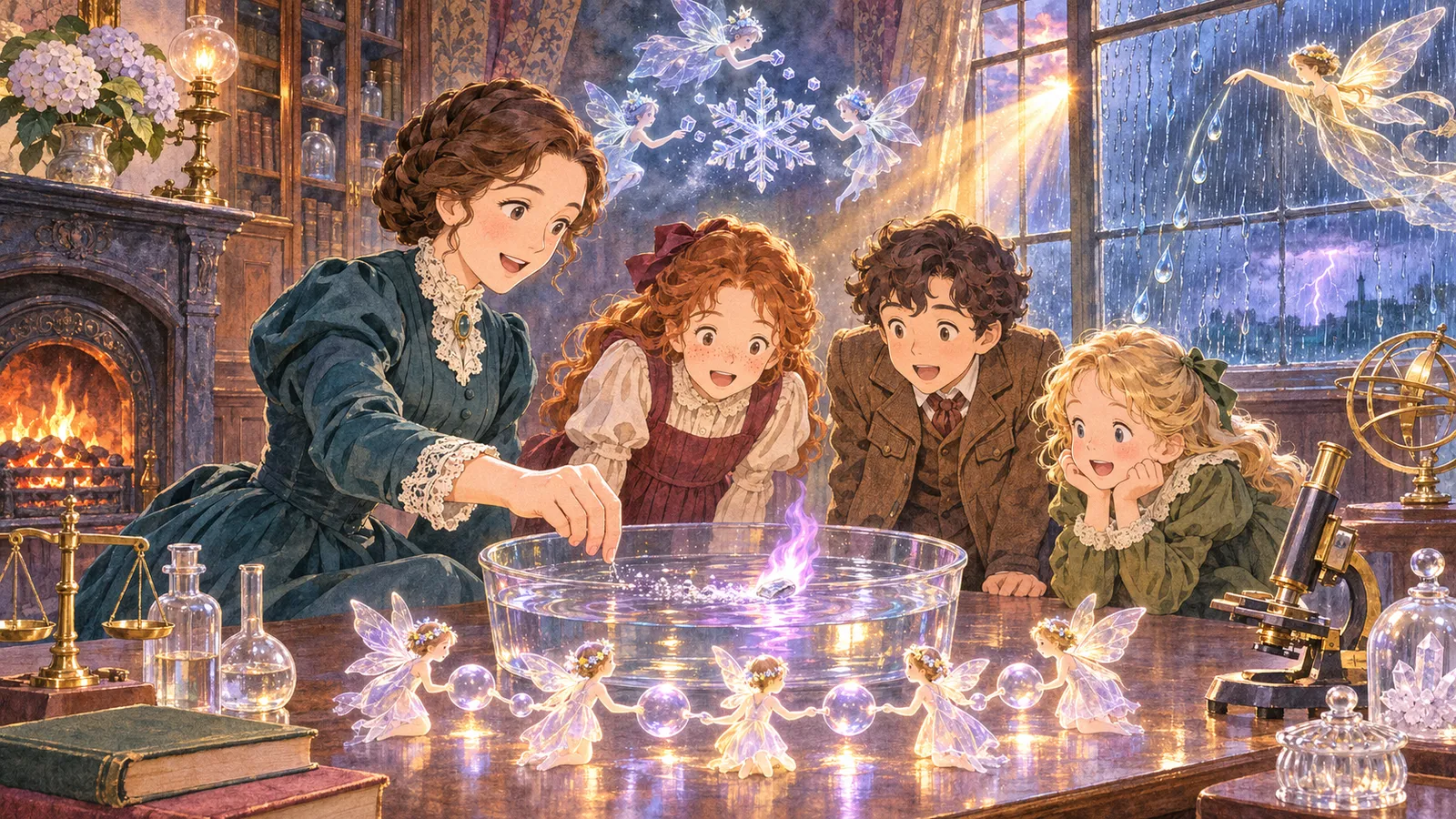
But now I will put something else in water which will call up the fairy power.では今度は、水の中にべつのものを入れて、ようせいの力をよび出してみましょう。 Here is a little piece of the metal potassium, one of the simple substances of the earth; that is to say, we cannot split it up into other substances, wherever we find it, it is always the same.ここにあるのは、カリウムという金属の小さなかけらです。これは地球の単純な物質(元素)のひとつです。つまり、ほかの物質に分けることができず、どこで見つけても、いつも同じものなのです。 Now if I put this piece of potassium on the water it does not disappear quietly like the sugar.さて、このカリウムのかけらを水の上に置くと、さとうのように静かに消えたりはしません。 See how it rolls round and round, fizzing violently with a blue flame burning round it, and at last goes off with a pop.ほら、ぐるぐるころがりまわって、青いほのおにつつまれてはげしくシューシューいい、最後にポンと音を立てて消えてしまいます。
What has been happening here?ここで何が起こっていたのでしょう。
You must first know that water is made of two substances, hydrogen and oxygen, and these are not merely held together, but are joined to completely that they have lost themselves and have become water; and each atom of water is made of two atoms of hydrogen and one of oxygen.まず知っておかなければならないのは、水は水素と酸素という二つの物質でできていて、それがただまとまっているのではなく、すっかりむすびついて、もとのすがたをなくして水になっている、ということです。そして水の原子ひとつは、水素の原子二つと酸素の原子一つでできています。
Now the metal potassium is devotedly fond of oxygen, and the moment I threw it on the water it called the fairy "chemical attraction' to help it, and dragged the atoms of oxygen out of the water and joined them to itself.さて、金属のカリウムは酸素が大好きで、わたしが水に投げこんだとたん、ようせい「化学的な引き合う力」に助けをもとめ、水から酸素の原子を引っぱり出して、自分にくっつけてしまいました。 In doing this it also caught part of the hydrogen, but only half, and so the rest was left out in the cold.そのとき、水素もいくらかつかまえましたが、半分だけだったので、のこりは寒い外へ放り出されてしまいました。 No, not in the cold! for the potassium and oxygen made such a great heat in clashing together that the rest of the hydrogen became very hot indeed, and sprang into the air to find some other companion to make up for what it had lost.いいえ、寒くはありません!カリウムと酸素がぶつかり合って、ものすごい熱を出したので、のこりの水素はとても熱くなり、なくしたものをうめ合わせるために、ほかの相手をさがしに空気の中へ飛び出していったのです。 Here it found some free oxygen floating about, and it seized upon it so violently, that they made a burning flame, while the potassium with its newly found oxygen and hydrogen sank down quietly into the water as potash.そこで水素は、ただよっている自由な酸素を見つけると、はげしくそれにとびついたので、もえるほのおになりました。いっぽうカリウムは、新しく見つけた酸素と水素をつれて、カリ(かせいカリ)になって静かに水の中へしずんでいきました。 And so you see we have got quite a new substance potash in the basin; made with a great deal of fuss by chemical attraction drawing different atoms together.こうして、はちの中には、まったく新しい物質、カリができたのです。化学的な引き合う力がいろいろな原子を引き合わせ、大さわぎしてつくったものです。