 8分
 朗読 Patricia Oakley
 原文そのまま

 PDFで印刷(A4 7まい)
But how come they to find any empty space to receive them?でも、空気の原子は、どうやって自分たちが入りこめる空いた場所を見つけるのでしょう。 To answer this we must go back again to our little active invisible fairies the sunbeams.これに答えるには、もう一度、あの小さくて元気な目に見えないようせいたち、日光のところへもどらなければなりません。 When the sun-waves come pouring down upon the earth they pass through the air almost without heating it.太陽の波が地球にふりそそぐとき、波は空気をほとんどあたためずに通りぬけます。 But not so with the ground; there they pass down only a short distance and then are thrown back again.ところが、地面ではそうはいきません。波は地面の中に少しだけ入ると、またはね返されます。 And when these sun- waves come quivering back they force the atoms of the air near the earth apart and make it lighter; so that the air close to the surface of the heated ground becomes less heavy than the air above it, and rises just as a cork rises in water.そして、この太陽の波がふるえながらはね返ってくると、地面近くの空気の原子をおし広げて、空気を軽くします。そのため、熱くなった地面のすぐ上の空気は、その上の空気より軽くなり、コルクが水の中でうき上がるように上がっていくのです。 You know that hot air rises in the chimney; for if you put a piece of lighted paper on the fire it is carried up by the draught of air, often even before it can ignite.熱い空気がえんとつの中を上っていくことは知っていますね。火の上に火のついた紙きれをおくと、燃え上がる前に、空気の流れで上へ運ばれていくことがよくあります。 Now just as the hot air rises from the fire, so it rises from the heated ground up into higher parts of the atmosphere. and as it rises it leaves only thin air behind it, and this cannot resist the strong cold air whose atoms are struggling and trying to get free, and they rush in and fill the space.さて、火から熱い空気が上るのと同じように、熱くなった地面からも、空気が大気の高い所へ上っていきます。上っていくとき、あとにはうすい空気しか残りません。うすい空気は、原子が自由になろうともがいている強くて冷たい空気をおしとどめることができず、冷たい空気がなだれこんでその場所をうめるのです。
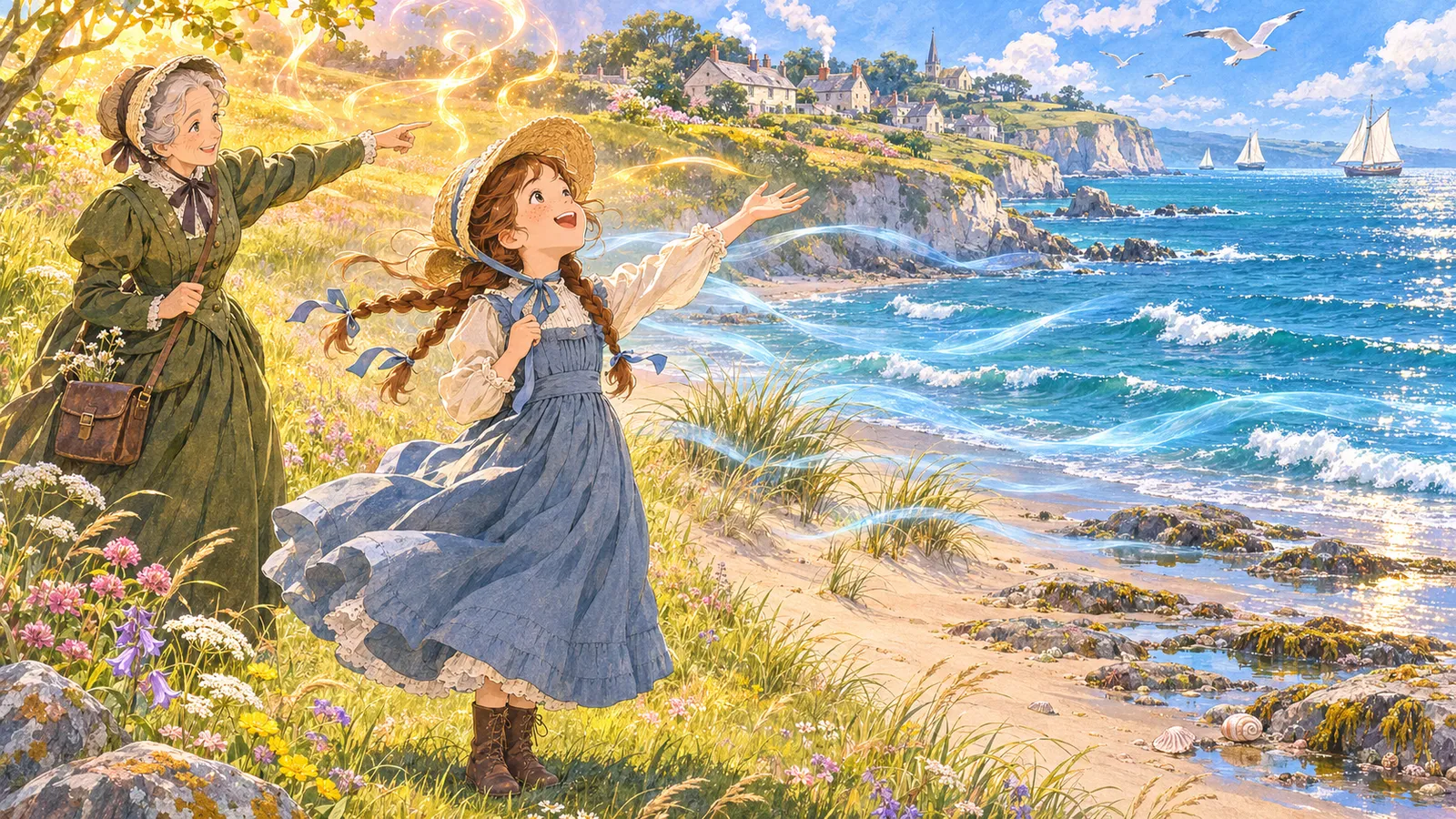
One of the simplest examples of wind is to be found at the seaside. there in the daytime the land gets hot under the sunshine, and heats the air, making it grow light and rise.風のいちばんかんたんな例の一つは、海辺で見られます。昼のあいだ、陸は日光で熱くなり、空気をあたためて、軽くして上らせます。 Meanwhile the sunshine on the water goes down deeper, and so does not send back so many heat-waves into the air; consequently the air on the top of the water is cooler and heavier, and it rushes in from over the sea to fill up the space on the shore left by the warm air as it rises.いっぽう、水面にさす日光は深くまでしみこむので、空気へそれほど多くの熱の波を返しません。そのため、水の上の空気はすずしくて重く、あたたかい空気が上ったあとの海岸の空いた場所をうめようと、海の上からおしよせてくるのです。 This is why the seaside is so pleasant in hot weather.暑い日に海辺がとても気持ちよいのは、このためです。 During the daytime a light sea-breeze nearly always sets in from the sea to the land.昼のあいだは、たいてい海から陸へ、軽い海風がふきます。
When night comes, however, then the land loses its heat very quickly, because it has not stored it up and the land-air grows cold; but the sea, which has been hoarding the sun-waves down in its depths, now gives them up to the atmosphere above it, and the sea-air becomes warm and rises.ところが夜になると、陸は熱をためこんでいないので、すぐに熱を失い、陸の空気は冷えてしまいます。いっぽう海は、太陽の波を深い所にたくわえていたので、今度はそれを上の大気へわたし、海の上の空気があたたまって上っていきます。 For this reason it is now the turn of the cold air from the land to spread over the sea, and you have a land-breeze blowing off the shore.そのため、今度は陸の冷たい空気が海の上へ広がる番になり、岸から海へむかって陸風がふくのです。
Again, the reason why there are such steady winds, called the trade winds, blowing towards the equator, is that the sun is very hot at the equator, and hot air is always rising there and making room for colder air to rush in.また、赤道にむかって「ぼうえき風」とよばれる、いつも同じむきの風がふいているのは、赤道では日ざしがとても強く、あつい空気がいつも上っていて、冷たい空気がなだれこむ場所をつくっているからです。 We have not time to travel farther with the moving air, though its journeys are extremely interesting; but if, when you read about the trade and other winds, you will always picture to yourselves warm air made light by the heat rising up into space and cold air expanding and rushing in to fill its place, I can promise you that you will not find the study of aerial currents so dry as many people imagine it to be.動く空気について、これ以上旅を続ける時間はありません。その旅はとてもおもしろいのですが。でも、貿易風やそのほかの風について本で読むとき、熱で軽くなったあたたかい空気が空へ上り、冷たい空気が広がってそのあとをうめにいくようすを、いつも思いえがくようにすれば、空気の流れの勉強は、多くの人が思っているほどつまらないものではないとわかるはずです。
We are now able to form some picture of our aerial ocean.さあ、これでわたしたちの空気の海を、少し思いえがけるようになりました。 We can imagine the active atoms of oxygen floating in the sluggish nitrogen, and being used up in every candle-flame, gas-jet and fire, and in the breath of all living beings; and coming out again tied fast to atoms of carbon and making carbonic acid.活発な酸素の原子が、のんびりしたちっ素の中にただよっていて、ろうそくのほのおやガスの火、たき火の中で、そしてすべての生き物の息の中で使われ、炭素の原子としっかり結びついて「炭酸ガス」(今でいう二酸化炭素)になって、また出てくるようすを想像できます。 Then we can turn to trees and plants, and see them tearing these two apart again, holding the carbon fast and sending the invisible atoms of oxygen bounding back again into the air, ready to recommence work.それから木や草に目をむけると、植物がこの二つをまた引きはなし、炭素をしっかりつかまえて、目に見えない酸素の原子を空気の中へはずむように送り返し、ふたたびはたらけるようにしているのが見えます。 We can picture all these air-atoms, whether of oxygen or nitrogen, packed close together on the surface of the earth, and lying gradually farther and farther apart, as they have less weight above them, till they become so scattered that we can only detect them as they rub against the flying meteors which flash into light.さんそでもちっそでも、空気の原子はみな、地面の近くではぎゅっとつまっていて、上にある重さが少なくなるにつれてだんだんはなれていきます。そして、ついにはとてもまばらになり、飛んでくる流れ星とこすれ合って流れ星を光らせるときにしか、そこにあるとわからなくなります。そんなようすを思いうかべることができます。 We can feel this great weight of air pressing the limpet on to the rock; and we can see it pressing up the mercury in the barometer and so enabling us to measure its weight.この大きな空気の重さが、カサガイを岩におしつけているのを感じることができますし、それが気圧計の水銀をおし上げ、重さを量らせてくれるのを見ることもできます。 Lastly, every breath of wind that blows past us tells us how this aerial ocean is always moving to and fro on the face of the earth; and if we think for a moment how much bad air and bad matter it must carry away, as it goes from crowded cities to be purified in the country, we can see how, in even this one way alone, it is a great blessing to us.最後に、わたしたちのそばをふきすぎる風の一つ一つが、この空気の海がいつも地球の表面を行ったり来たりしていることを教えてくれます。空気が人の多い町から、きれいにしてもらいにいなかへと進みながら、どれほど多くのよごれた空気やよごれた物を運び去ってくれるかを少し考えてみれば、このことだけでも、空気がわたしたちにとって大きなめぐみであることがわかるでしょう。
Yet even now we have not mentioned many of the beauties of our atmosphere.それでもまだ、大気のすばらしさの多くについては話していません。 It is the tiny particles floating in the air which scatter the light of the sun so that it spreads over the whole country and into shady places.太陽の光を散らして、国じゅうに、そして日かげにまで広げてくれるのは、空気の中にういている小さなつぶなのです。 The sun's rays always travel straight forward; and in the moon, where there is no atmosphere, there is no light anywhere except just where the rays fall.太陽の光はいつもまっすぐに進みます。大気のない月では、光が当たっているところ以外は、どこにも光がありません。 But on our earth the sun-waves hit against the myriads of particles in the air and glide off them into the corners of the room or the recesses of a shady lane, and so we have light spread before us wherever we walk in the daytime, instead of those deep black shadows which we can see through a telescope on the face of the moon.けれども地球では、太陽の波が空気の中の数えきれないつぶにぶつかり、そこからすべるようにして部屋のすみや、木かげの小道のおくまで入っていきます。だから昼間は、どこを歩いても目の前に光が広がっていて、望遠鏡で月の表面に見えるような、まっ黒なかげはないのです。
Again, it is electricity playing in the air-atoms which gives us the beautiful lightning and the grand aurora borealis, and even the twinkling of the starts is produced entirely by minute changes in the air.また、美しいいなずまや、すばらしいオーロラ(北極光)を見せてくれるのは、空気の原子の中ではたらく電気ですし、星がまたたくのでさえ、すべて空気の中の小さな変化によって起こるのです。 If it were not for our aerial ocean, the stars would stare at us sternly, instead of smiling with the pleasant twinkle-twinkle which we have all learned to love as little children.もし空気の海がなかったら、星はわたしたちをきびしくじっと見つめるだけで、小さいころから大好きな、あのきらきら星のようにやさしくほほえみかけてはくれないでしょう。
All these questions, however, we must leave for the present; only I hope you will be eager to read about them wherever you can, and open your eyes to learn their secrets.でも、こうした問題はみな、今はおいておかなければなりません。ただ、みなさんが読めるところではどこででも進んでそれについて読み、目を大きく開いて、そのひみつを学んでくれることを願っています。 For the present we must be content if we can even picture this wonderful ocean of gas spread round our earth, and some of the work it does for us.今のところは、地球のまわりに広がるこのすばらしい気体の海と、それがわたしたちのためにしてくれる仕事のいくつかを、思いえがけるだけでじゅうぶんだとしましょう。
We said in the last lecture that without the sunbeams the earth would be cold, dark, and frost-ridden.前回のお話で、日光がなければ地球は冷たく、暗く、こおりついてしまうだろうと言いました。 With sunbeams, but without air, it would indeed have burning heat, side by side with darkness and ice, but it could have no soft light. our planet might look beautiful to others, as the moon does to us, but it could have comparatively few beauties of its own.日光があっても空気がなければ、地球にはたしかに焼けつくような暑さがありますが、そのすぐとなりに暗やみと氷があり、やわらかな光はまったくないでしょう。わたしたちの星は、月がわたしたちに美しく見えるように、ほかの星からは美しく見えるかもしれませんが、自分自身の美しさはずっと少ないでしょう。 With the sunbeams and the air, we see it has much to make it beautiful.日光と空気があれば、ごらんのとおり、地球を美しくするものがたくさんあります。 But a third worker is wanted before our planet can revel in activity and life.でも、わたしたちの星が活動と命にあふれるには、三番目のはたらき手が必要です。 This worker is water; and in the next lecture we shall learn something of the beauty and the usefulness of the "drops of water" on their travels.そのはたらき手とは水です。次のお話では、旅をする「水のしずく」の美しさと役に立つことについて学びましょう。