 10分
 朗読 Patricia Oakley
 原文そのまま

 PDFで印刷(A4 9まい)
And now how large do you think they turn out to be? so very, very tiny that about fifty thousand waves are contained in a single inch of space!さて、その波はどのくらいの大きさだとわかったと思いますか。それはとてもとても小さくて、たった1インチ(約2.5センチメートル)の中に、およそ5万もの波が入ってしまうのです! I have drawn on the board the length of an inch, and now I will measure the same space in the air between my finger and thumb.黒板に1インチの長さをかきました。では、同じ長さを、空中でわたしの親指と人さし指のあいだにはかってみましょう。 Within this space at this moment there are fifty thousand tiny waves moving up and down.このすき間の中に、今この時にも、5万の小さな波が上下に動いているのです。 I promised you we would find in science things as wonderful as in fairy tales.科学の中には、おとぎ話と同じくらいすばらしいものが見つかると、わたしは約束しましたね。 Are not these tiny invisible messengers coming incessantly from the sun as wonderful as any fairies? and still more so when, as we shall see presently, they are doing nearly all the work of our world.太陽からたえまなくやってくる、この小さな目に見えないお使いたちは、どんなようせいにも負けないくらいすばらしいではありませんか。それに、このあとすぐ見るように、わたしたちの世界のしごとのほとんどすべてをしているのですから、なおさらです。
We must next try to realize how fast these waves travel.次に、この波がどのくらい速く進むのかを、つかんでみましょう。 You will remember that an express train would take 171 years to reach us from the sun; and even a cannon-ball would take from ten to thirteen years to come that distance.おぼえているでしょうが、急行列車なら太陽からここまで171年かかります。大ほうのたまでさえ、そのきょりを来るのに10年から13年かかるでしょう。 Well, these tiny waves take only seven minutes and a half to come the whole 91 millions of miles.ところが、この小さな波は、9100万マイルの道のりをすっかり来るのに、たった7分半しかかからないのです。 The waves which are hitting your eye at this moment are caused by a movement which began at the sun only 7 1/2 minutes ago.今この時にみなさんの目に当たっている波は、ほんの7分半前に太陽で始まった動きによって生まれたものなのです。 And remember, this movement is going on incessantly, and these waves are always following one after the other so rapidly that they keep up a perpetual cannonade upon the pupil of your eye.そしておぼえておいてください。この動きはたえまなくつづいていて、波はいつもつぎつぎにとても速く追いかけてくるので、みなさんのひとみにたえまなく大ほうをうちこんでいるのです。 So fast do they come that about 608 billion waves enter your eye in one single second.* I do not ask you to remember these figures; I only ask you to try and picture to yourselves these infinitely tiny and active invisible messengers from the sun, and to acknowledge that light is a fairy thing. (*Light travels at the rate of 190,000 miles, or 12,165,120,000 inches in a second.波はとても速くやってくるので、たった1秒のあいだに、およそ608兆もの波がみなさんの目に入ります。* この数をおぼえてくださいとは言いません。ただ、このかぎりなく小さくて活発な、太陽からの目に見えないお使いたちを心にえがいてみて、光とはようせいのようなものだと、みとめてほしいのです。(*光は1秒に19万マイル、つまり121億6512万インチの速さで進みます。 Taking the average number of wave-lengths in an inch at 50,000, then 12,165,120,000 X 50,000 = 608,256,000,000,000.)1インチの中の波の数を平均5万とすると、12,165,120,000 × 50,000 = 608,256,000,000,000 になります。)
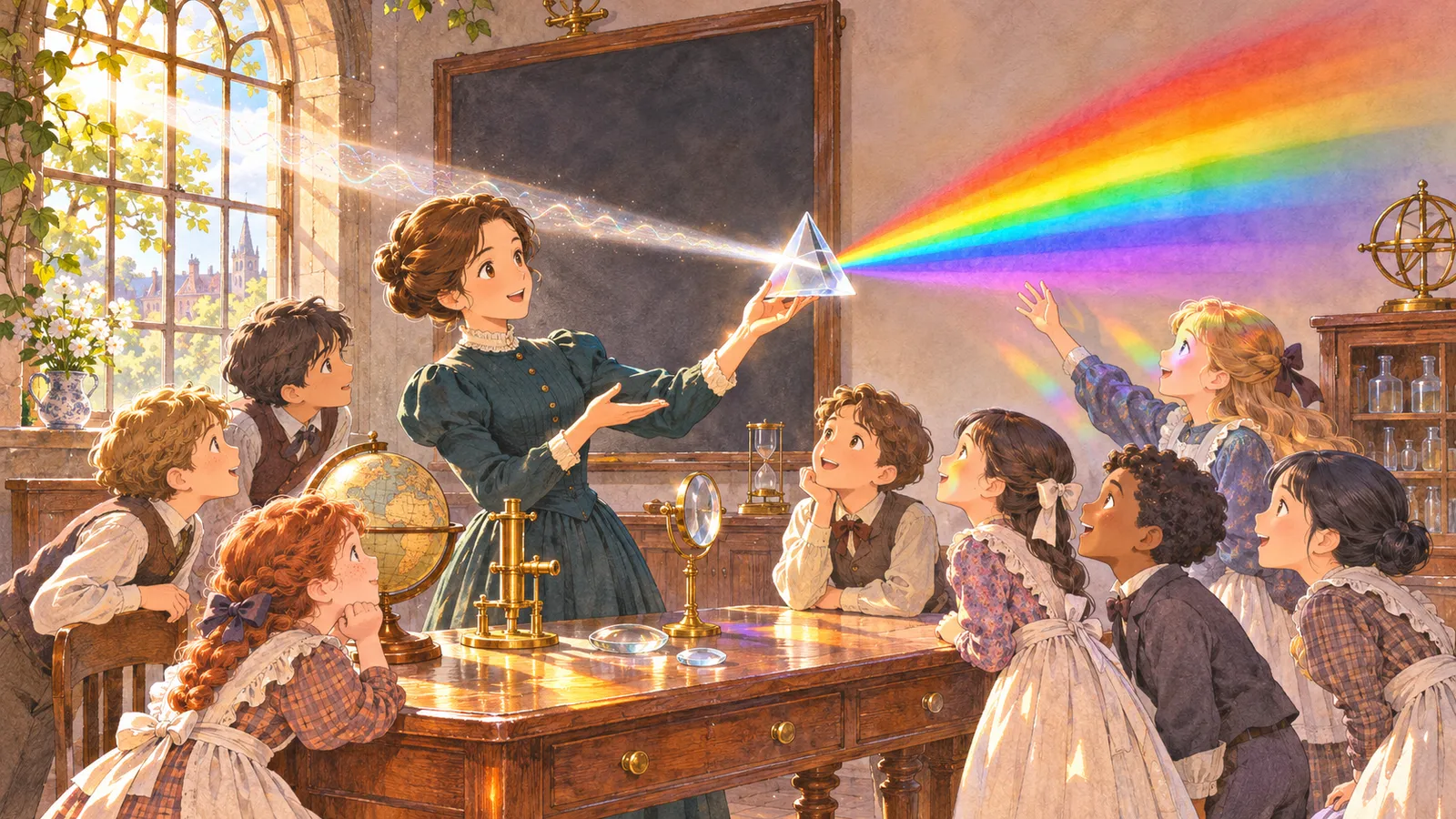
But we do not yet know all about our sunbeams.でも、わたしたちはまだ日の光のことをすっかり知ったわけではありません。 See, I have here a piece of glass with three sides, called a prism.ほら、ここに三つの面をもつガラスがあります。プリズムといいます。 If I put it in the sunlight which is streaming through the window, what happens?これを、窓からさしこんでいる日の光の中に入れると、どうなるでしょう。 Look! on the table there is a line of beautiful colours.見てごらんなさい!テーブルの上に、美しい色の帯ができました。 I can make it long or short, as I turn the prism, but the colours always remain arranged in the same way.プリズムを回すと、帯を長くしたり短くしたりできますが、色はいつも同じ順にならんでいます。 Here at my left hand is the red, beyond it orange, then yellow, green, blue, indigo or deep blue, and violet, shading one into the other all along the line.わたしの左手のほうが赤、その先がだいだい、それから黄色、緑、青、あい色(こい青)、そしてすみれ色で、帯にそってずっと、となりの色へとなめらかにうつり変わっています。 We have all seen these colours dancing on the wall when the sun has been shining brightly on the cut-glass pendants of the chandelier, and you may see them still more distinctly if you let a ray of light into a darkened room, and pass it through the prism as in the diagram (Fig.シャンデリアのカットガラスのかざりに、日の光が明るく当たっているとき、かべの上でこの色たちがおどっているのを、だれでも見たことがあるでしょう。暗くした部屋に光を一すじ入れて、図(図 7).7)のようにプリズムに通すと、もっとはっきり見ることができます。 What are these colours?この色たちは何なのでしょう。 Do they come from the glass?ガラスから出てくるのでしょうか。 No; for you will remember to have seen them in the rainbow, and in the soap- bubble, and even in a drop of dew or the scum on the top of a pond.いいえ。なぜなら、にじの中にも、シャボン玉の中にも、つゆのしずくの中や池の水面にうかぶまくの上にさえ、この色を見たことがあるでしょうから。 This beautiful coloured line is only our sunbeam again, which has been split up into many colours by passing through the glass, as it is in the rain-drops of the rainbow and the bubbles of the scum of the pond.この美しい色の帯は、じつはやはりわたしたちの日の光なのです。にじの雨つぶの中や、池の水面のまくのあわの中と同じように、ガラスを通りぬけるあいだに、たくさんの色に分けられたのです。
Till now we have talked of the sunbeam as if it were made of only one set of waves of different sizes, all travelling along together from the sun.これまでは、日の光を、いろいろな大きさの波がひとそろいになって、みないっしょに太陽から進んでくるだけのもののように話してきました。 These various waves have been measured, and we know that the waves which make up red light are larger and more lazy than those which make violet light, so that there are only thirty-nine thousand red waves in an inch, while there are fifty-seven thousand violet waves in the same space.このいろいろな波ははかられていて、赤い光をつくる波は、すみれ色の光をつくる波より大きくて、ゆったりしていることがわかっています。それで、1インチの中に赤い波は3万9000しかないのに、同じ長さの中にすみれ色の波は5万7000もあるのです。
How is it then, that if all these different waves making different colours, hit on our eye, they do not always make us see coloured light?では、ちがう色をつくるこのいろいろな波がみな目に当たっているのに、どうしていつも色のついた光が見えるわけではないのでしょう。 Because, unless they are interfered with, they all travel along together, and you know that all colours, mixed together in proper proportion, make white.それは、じゃまされないかぎり、波はみないっしょに進んでくるからです。そして、すべての色をちょうどよいわりあいでまぜると白になることは、知っているでしょう。
I have here a round piece of cardboard, painted with the seven colours in succession several times over.ここに、七つの色を何度もじゅんにぬった丸い厚紙があります。 When it is still you can distinguish them all apart, but when I whirl it quickly round - see! - the cardboard looks quite white, because we see them all so instantaneously that they are mingled together.止まっているときは、色を一つ一つ見分けられます。でも、すばやく回すと――ほら!――厚紙はすっかり白く見えます。すべての色が一しゅんのうちに目に入るので、まざり合ってしまうからです。 In the same way light looks white to you, because all the different coloured waves strike on your eye at once.同じように、光が白く見えるのは、色のちがう波がみな一度に目に当たるからなのです。 You can easily make on of these card for yourselves only the white will always look dirty, because you cannot get the colours pure.この厚紙は自分でもかんたんにつくれます。ただ、色をまじりけなくぬることはできないので、白はいつもうすよごれて見えるでしょう。
Now, when the light passes through the three-sided glass or prism, the waves are spread out, and the slow, heavy, red waves lag behind and remain at the lower end R of the coloured line on the wall (Fig.さて、光が三つの面のあるガラス、つまりプリズムを通りぬけるとき、波はばらばらに広げられます。ゆっくりした重い赤い波はおくれて、かべの色の帯の下のはしのRの所にとどまり(図 7), while the rapid little violet waves are bent more out of their road and run to V at the farther end of the line; and the orange, yellow, green, blue, and indigo arrange themselves between, according to the size of their waves.7)、いっぽう、すばやい小さなすみれ色の波は、道から大きく曲げられて、帯の向こうのはしのVまで走っていきます。そして、だいだい、黄色、緑、青、あい色は、それぞれの波の大きさにしたがって、そのあいだにならぶのです。
And now you are very likely eager to ask why the quick waves should make us see one colour, and the slow waves another.さて、みなさんはきっと、なぜ速い波だとある色が見え、ゆっくりした波だとべつの色が見えるのか、聞きたくてたまらないでしょう。 This is a very difficult question, for we have a great deal still to learn about the effect of light on the eye.これはとてもむずかしい問題です。光が目にどうはたらくかについては、まだまだ学ばなければならないことがたくさんあるからです。 But you can easily imagine that colour is to our eye much the same as music is to our ear.でも、色が目にとってもつ意味は、音楽が耳にとってもつ意味とだいたい同じだと考えれば、わかりやすいでしょう。 You know we can distinguish different notes when the air-waves play slowly or quickly upon the drum of the ear (as we shall see in Lecture VI) and somewhat in the same way the tiny waves of the ether play on the retina or curtain at the back of our eye, and make the nerves carry different messages to the brain: and the colour we see depends upon the number of waves which play upon the retina in a second.知ってのとおり、空気の波が耳のこまくをゆっくり、または速くたたくと、わたしたちはちがう音の高さを聞き分けられます(第6回の講義で見ます)。それと少しにたやり方で、エーテルの小さな波が目のおくにあるまく、つまり、もうまくをたたき、神経に、ちがう知らせを脳へ運ばせるのです。そして、わたしたちに見える色は、1秒間にもうまくをたたく波の数によって決まるのです。
Do you think we have now rightly answered the question - What is a sunbeam?これで「日の光とは何か」という問いに、正しく答えられたと思いますか。 We have seen that it is really a succession of tiny rapid waves, travelling from the sun to us across the invisible substance we call "ether", and keeping up a constant cannonade upon everything which comes in their way.日の光とは、じつは小さくて速い波のつらなりで、わたしたちが「エーテル」とよぶ目に見えない物質をわたって太陽からわたしたちのところまで進み、とちゅうでぶつかるあらゆるものに、たえまなく大ほうをうちこみつづけているのだ、ということを見てきました。 We have also seen that, tiny as these waves are, they can still vary in size, so that one single sunbeam is made up of myriads of different-sized waves, which travel all together and make us see white light; unless for some reason they are scattered apart, so that we see them separately as red, green, blue, or yellow.また、この波はとても小さいけれども、大きさにはちがいがあり、たった一すじの日の光が、大きさのちがう数えきれないほどの波でできていることも見てきました。その波はみないっしょに進んできて、白い光に見えるのです。ただし、何かのわけで波がばらばらに分けられると、赤、緑、青、黄色とべつべつに見えるのです。 How they are scattered, and many other secrets of the sun-waves, we cannot stop to consider not, but must pass on to ask -波がどのようにして分けられるのか、そのほか太陽の波のたくさんのひみつについては、今は立ち止まって考えることはできません。先へ進んで、こうたずねなければなりません――
What work do the sunbeams do for us?日の光は、わたしたちのためにどんなしごとをしてくれるのでしょう。
They do two things - they give us light and heat.日の光は二つのことをしてくれます――光と熱をくれるのです。 It is by means of them alone that we see anything.わたしたちがものを見ることができるのは、ただ日の光のおかげなのです。 When the room was dark you could not distinguish the table, the chairs, or even the walls of the room.部屋が暗かったときは、テーブルもいすも、部屋のかべさえ見分けられませんでしたね。 Why?なぜでしょう。 Because they had no light-waves to send to your eye.それは、それらのものには、みなさんの目におくる光の波がなかったからです。 But as the sunbeams began to pour in at the window, the waves played upon the things in the room, and when they hit them they bounded off them back to your eye, as a wave of the sea bounds back from a rock and strikes against a passing boat.でも、日の光が窓からさしこみはじめると、波は部屋の中のものの上をおどり、ものに当たると、はね返ってみなさんの目にもどってきたのです。ちょうど海の波が岩にはね返って、通りかかったボートにぶつかるように。 Then, when they fell upon your eye, they entered it and excited the retina and the nerves, and the image of the chair or the table was carried to your brain.そして、波がみなさんの目に入ると、もうまくと神経をしげきして、いすやテーブルの形が脳へ運ばれたのです。 Look around at all the things in this room.この部屋の中のすべてのものを見まわしてごらんなさい。 Is it not strange to think that each one of them is sending these invisible messengers straight to your eye as you look at it; and that you see me, and distinguish me from the table, entirely by the kind of waves we each send to you?ふしぎだと思いませんか。みなさんが見るとき、そのひとつひとつが、この目に見えないお使いをまっすぐみなさんの目におくっていること、そして、みなさんがわたしを見て、わたしとテーブルを見分けられるのは、ひとえに、わたしとテーブルがそれぞれおくってくる波のしゅるいによるのだということが。
Some substances send back hardly any waves of light, but let them all pass through them, and thus we cannot see them.中には、光の波をほとんどはね返さず、みな通してしまう物質があります。それで、わたしたちにはそれが見えないのです。 A pane of clear glass, for instance, lets nearly all the light-waves pass through it, and therefore you often cannot see that the glass is there, because no light-messengers come back to you from it.たとえば、すきとおった窓ガラスは光の波をほとんどみな通してしまいます。ですから、そこにガラスがあることがよくわからないことがあるのです。ガラスからは光のお使いがひとつももどってこないからです。 Thus people have sometimes walked up against a glass door and broken it, not seeing it was there.それで、ガラスのドアがあることに気づかずに歩いていってぶつかり、こわしてしまう人がときどきいるのです。 Those substances are transparent which, for some reason unknown to us, allow the ether waves to pass through them without shaking the atoms of which the substance is made.とうめいな物質とは、わたしたちにはまだわからない何かのわけで、物質をつくっている原子をゆさぶらずに、エーテルの波を通してしまう物質のことです。 In clear glass, for example, all the light- waves pass through without affecting the substance of the glass; while in a white wall the larger part of the rays are reflected back to your eye, and those which pass into the wall, by giving motion to its atoms lose their own vibrations.たとえば、すきとおったガラスでは、光の波はみなガラスの物質にえいきょうをあたえずに通りぬけます。いっぽう白いかべでは、光の大部分がみなさんの目にはね返され、かべの中に入った光は、かべの原子を動かすことで、自分のしんどう(振動)をなくしてしまうのです。