
 8分
 朗読 J. M. Smallheer
 原文そのまま

 PDFで印刷(A4 9まい)
But besides earthly matter, which we can see, there is much matter dissolved in the water of rivers (as we mentioned in the last lecture), and this we cannot see.でも、目に見える土のほかにも、川の水には(前回のお話で言ったように)たくさんの物がとけていて、それは目に見えません。
If you use water which comes out of a chalk country you will find that after a time the kettle in which you have been in the habit of boiling this water has a hard crust on its bottom and sides, and this crust is made of chalk or carbonate of lime, which the water took out of the rocks when it was passing through them.チョークの多い地方の水を使っていると、しばらくして、いつもその水をわかしているやかんの底や横に、かたい「湯あか」ができているのに気づくでしょう。この湯あかはチョーク、つまり炭酸石灰でできていて、水が岩の中を通るときに岩から取り出してきたものです。 Professor Bischoff has calculated that the river Rhine carries past Bonn every year enough carbonate of lime dissolved in its water to make 332,000 million oyster-shells, and that if all these shells were built into a cube it would measure 560 feet.ビショフ教授の計算では、ライン川は毎年、3320億このカキのからをつくれるほどの炭酸石灰を、水にとかしてボンの町の前を運んでいます。このからをすべて立方体に積み上げたら、一辺が560フィート(約170メートル)にもなるそうです。
Imagine to yourselves the whole of St. Paul's churchyard filled with oyster-shells, built up in a large square till they reached half as high again as the top of the cathedral, then you will have some idea of the amount of chalk carried invisibly past Bonn in the water of the Rhine every year.セント・ポール大聖堂のまわりの土地全体にカキのからをつめこみ、大きな四角に積み上げていって、大聖堂のてっぺんのさらに半分の高さまでとどいたところを想像してみてください。そうすれば、毎年ライン川の水にとけて、目に見えないままボンの前を運ばれていくチョークの量が、少しはわかるでしょう。
Since all this matter, whether brought down as mud or dissolved, comes from one part of the land to be carried elsewhere or out to sea, it is clear that some gaps and hollows must be left in the places from which it is taken.どろとして運ばれるにせよ、とけて運ばれるにせよ、この物はすべて、土地のある場所から別の場所へ、あるいは海へと運ばれていくのですから、取られた場所には、すき間やくぼみが残るにちがいありません。 Let us see how these gaps are made.そのすき間がどのようにできるのか、見てみましょう。 Have you ever clambered up the mountainside, or even up one of those small ravines in the hillside, which have generally a little stream trickling through them?山の中腹や、おかのしゃ面にある、たいていは小さな流れがちょろちょろと流れている小さな谷を、よじ登ったことはありますか。 If so, you must have noticed the number of pebbles, large and small, lying in patches here and there in the stream, and many pieces of broken rock, which are often scattered along the sides of the ravine; and how, as you climb, the path grows steeper, and the rocks become rugged and stick out in strange shapes.もしあれば、流れのあちこちに大小の小石が集まっていたり、谷の両側にくだけた岩がたくさん散らばっていたりするのに気づいたはずです。そして登るにつれて道が急になり、岩がごつごつして、ふしぎな形につき出してくることにも。
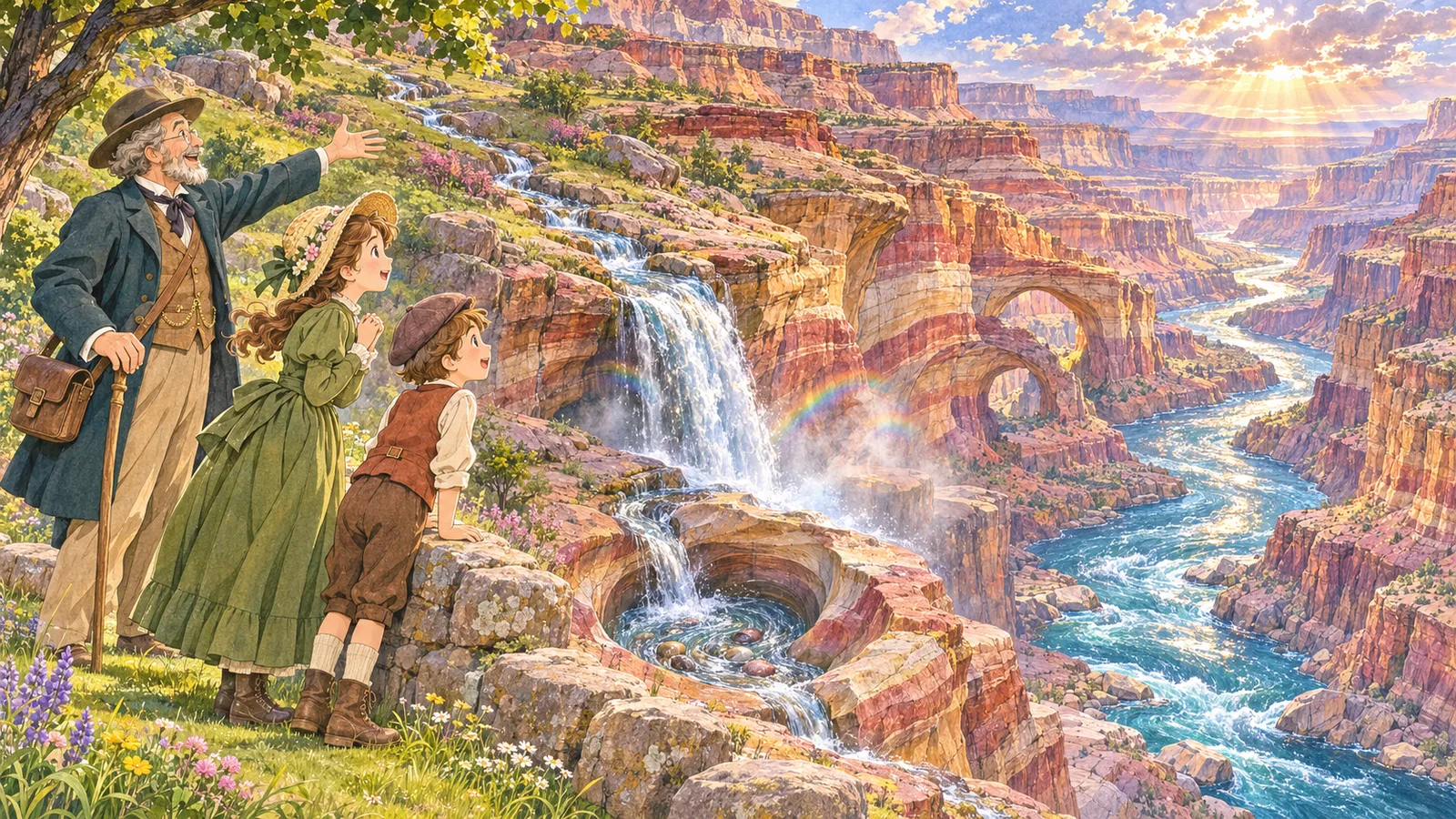
The history of this ravine will tell us a great deal about the carving of water.この谷の歴史は、水がどのようにきざむのかを、たくさん教えてくれます。 Once it was nothing more than a little furrow in the hillside down which the rain found its way in a thin thread-like stream.はじめ、ここはおかのしゃ面の小さなみぞにすぎず、雨が糸のように細い流れになってそこを流れ下っていました。 But by and by, as the stream carried down some of the earth, and the furrow grew deeper and wider, the sides began to crumble when the sun dried up the rain which had soaked in.でも、やがて流れが土をいくらか運び去り、みぞが深く広くなると、しみこんだ雨を太陽がかわかすときに、両側がくずれはじめました。 Then in winter, when the sides of the hill were moist with the autumn rains, frost came and turned the water to ice, and so made the cracks still larger, and the swollen steam rushing down, caught the loose pieces of rock and washed them down into its bed.それから冬になって、秋の雨でおかの両側がしめっていると、こおりつく寒さがやってきて水を氷に変え、ひびをさらに大きくしました。そして水かさのました流れがいきおいよくかけ下りて、ゆるんだ岩のかけらをつかまえ、川底へと洗い流しました。 Here they were rolled over and over, and grated against each other, and were ground away till they became rounded pebbles, such as lie in the foreground of the picture (Fig.岩のかけらはそこでごろごろところがされ、たがいにこすれ合い、けずられて、ついには、絵(図 25); while the grit which was rubbed off them was carried farther down by the stream.25)の手前にあるような丸い小石になりました。そして、けずり取られた細かい砂は、流れにのってさらに下へ運ばれていきました。 And so in time this became a little valley, and as the stream cut it deeper and deeper, there was room to clamber along the sides of it, and ferns and mosses began to cover the naked stone, and small trees rooted themselves along the banks, and this beautiful little nook sprang up on the hill-side entirely by the sculpturing of water.こうしてやがて、ここは小さな谷になりました。流れが谷をどんどん深くけずっていくと、両側をよじ登れるだけの場所ができ、シダやコケがむき出しの石をおおいはじめ、小さな木々が岸にそって根を下ろしました。こうして、おかのしゃ面のこの美しい小さな一角は、すべて水のちょうこくによって生まれたのです。
Shall you not feel a fresh interest in all the little valleys, ravines, and gorges you meet with in the country, if you can picture them being formed in this way year by year?いなかで出会う小さな谷やきょう谷が、こうして年ごとにできてきたのだと思いえがけたら、どれにも新しい興味がわいてくるのではありませんか。 There are many curious differences in them which you can study for yourselves.谷には、自分で調べられるふしぎなちがいがたくさんあります。 Some will be smooth, broad valleys and here the rocks have been soft and easily worn, and water trickling down the sides of the first valley has cut other channels so as to make smaller valleys running across it.なめらかで広い谷もあります。そこは岩がやわらかくてけずられやすく、最初の谷の両側を流れ下る水がほかのみぞをきざんで、その谷を横切る小さな谷をつくったのです。 In other places there will be narrow ravines, and here the rocks have been hard, so that they did not wear away gradually, but broke off and fell in blocks, leaving high cliffs on each side.また別の所には、せまいきょう谷があります。そこは岩がかたかったので、少しずつけずられるのではなく、大きなかたまりになって折れて落ち、両側に高いがけを残したのです。 In some places you will come to a beautiful waterfall, where the water has tumbled over a steep cliff, and then eaten its way back, just like a saw cutting through a piece of wood.ある所では、美しいたきに出会うでしょう。水が急ながけを流れ落ち、それから、のこぎりが木を切っていくように、がけを後ろへとけずり進んでいったのです。
There are two things in particular to notice in a waterfall like this.このようなたきでは、とくに注意してほしいことが二つあります。 First, how the water and spray dash against the bottom of the cliff down which it falls, and grind the small pebbles against the rock.一つ目は、水としぶきが、流れ落ちるがけのふもとにどうぶつかり、小石を岩にこすりつけてけずるか、ということです。 In this way the bottom of the cliff is undermined, and so great pieces tumble down from time to time, and keep the fall upright instead of its being sloped away at the top, and becoming a mere steam.こうして、がけの下のほうがけずられてえぐられるので、ときどき大きなかたまりがくずれ落ちます。そのおかげで、たきは上のほうがけずられてなだらかになり、ただの流れになってしまうことなく、まっすぐに切り立っていられるのです。 Secondly, you may often see curious cup-shaped holes, called "pot-holes," in the rocks on the sides of a waterfall, and these also are concerned in its formation.二つ目は、たきの横の岩に、「ポットホール(おう穴)」とよばれる、カップのような形のふしぎな穴がよく見られることで、これもたきができることに関係しています。 In these holes you will generally find two or three small pebbles, and you have here a beautiful example of how water uses stones to grind away the face of the earth.この穴の中には、たいてい小石が二つか三つ見つかります。ここには、水が石を使って地面の表面をけずっていく、すばらしい例があるのです。 These holes are made entirely by the falling water eddying round and round in a small hollow of the rock, and grinding the pebbles which it has brought down, against the bottom and sides of this hollow, just as you grind round a pestle in a mortar.この穴は、すべて、落ちる水が岩の小さなくぼみの中でぐるぐるうずをまき、運んできた小石を、くぼみの底や横にこすりつけてできたものです。ちょうど、すりばちの中ですりこぎをぐるぐる回すのと同じです。 By degrees the hole grows deeper and deeper and though the first pebbles are probably ground down to powder, others fall in, and so in time there is a great hole perforated right through, helping to make the rock break and fall away.少しずつ穴は深くなり、最初の小石はたぶん粉になるまですりへってしまいますが、ほかの小石が落ちてきます。こうしてやがて、岩をつきぬける大きな穴があき、岩がくずれて落ちるのを助けるのです。
In this and other ways the water works its way back in a surprising manner.このように、またほかのやり方でも、水はおどろくようなやり方で、後ろへとけずり進んでいくのです。 The Isle of Wight gives us some good instances of this; Alum Bay Chine and the celebrated Blackgang Chine have been entirely cut out by waterfalls.ワイト島には、そのよい例があります。アラム湾のチャイン(海へ流れこむ深い谷)や、有名なブラックギャング・チャインは、すべてたきによってけずり出されました。 But the best know and most remarkable example is the Niagara Falls, in America.でも、いちばんよく知られていて、いちばんすばらしい例は、アメリカのナイアガラのたきです。 Here, the River Niagara first wanders through a flat country, and then reaches the great Lake Erie in a hollow of the plain.ここでは、ナイアガラ川はまず平らな土地をゆっくり流れ、それから平野のくぼみにある大きなエリー湖にたどり着きます。 After that, it flows gently down for about fifteen miles, and then the slope becomes greater and it rushes on to the Falls of Niagara.そのあと、川は15マイルほどゆるやかに流れ下り、それから坂が急になって、ナイアガラのたきへとかけこんでいきます。 These falls are not nearly so high as many people imagine, being only 165 feet, or about half the height of St. Paul's Cathedral, but they are 2700 feet or nearly half-a-mile wide, and no less than 670,000 tons of water fall over them every minute, making magnificent clouds of spray.このたきは、多くの人が想像するほど高くはなく、高さはわずか165フィート(約50メートル)、セント・ポール大聖堂の半分くらいです。でも、はばは2700フィート、つまり半マイル近くもあり、毎分なんと67万トンもの水が流れ落ちて、すばらしいしぶきの雲をつくっています。
Sir Charles Lyell, when he was at Niagara, came to the conclusion that, taking one year with another, these falls eat back the cliff at the rate of about one foot a year, as you can easily imagine they would do, when you think with what force the water must dash against the bottom of the falls.サー・チャールズ・ライエルはナイアガラをおとずれたとき、年によってちがいはあっても、平均すると、このたきは1年に約1フィートの速さでがけを後ろへけずっている、という結論を出しました。たきの下に水がどれほどの力でぶつかるかを考えれば、そうなることはたやすく想像できるでしょう。 In this way a deep cleft has been cut right back from Queenstown for a distance of seven miles, to the place where the falls are now.こうして、クイーンズタウンから今たきがある場所まで、7マイルもの深いわれ目が後ろへとけずられてきたのです。 This helps us a little to understand how very slowly and gradually water cuts its way; for if a foot a year is about the average of the waste of the rock, it will have taken more than thirty-five thousand years for that channel of seven miles to be made.このことから、水がどれほどゆっくりと少しずつ道をけずっていくかが、少しわかります。もし岩がけずられるのが平均して1年に1フィートなら、7マイルのその水路ができるには、3万5千年以上かかったことになるのです。
But even this chasm cut by the falls of Niagara is nothing compared with the canyons of Colarado.でも、ナイアガラのたきがけずったこの深いわれ目でさえ、コロラドのキャニオンにくらべれば何でもありません。 Canyon is a Spanish word for a rocky gorge, and these gorges are indeed so grand, that if we had not seen in other places what water can do, we should never have been able to believe that it could have cut out these gigantic chasms.「キャニオン」とは、岩だらけのきょう谷を表すスペイン語です。このきょう谷はほんとうに堂々としていて、もしほかの場所で水に何ができるかを見ていなかったら、水がこんなとてつもなく大きなわれ目をけずり出せたとは、とても信じられなかったでしょう。 For more than three hundred miles the River Colorado, coming down from the Rocky Mountains, has eaten its way through a country made of granite and hard beds of limestone and sandstone, and it has cut down straight through these rocks, leaving walls from half-a-mile to a mile high, standing straight up from it.300マイル以上にわたって、ロッキー山脈から流れ下るコロラド川は、花こう岩やかたい石灰岩、砂岩の層でできた土地をけずり進んできました。川はこれらの岩をまっすぐ下へと切りこみ、川から半マイルから1マイルもの高さで切り立つかべを残したのです。 The cliffs of the Great Canyon, as it is called, stretch up for more than a mile above the river which flows in the gorge below!「グランド・キャニオン」とよばれる所のがけは、下のきょう谷を流れる川から1マイル(約1.6キロメートル)以上も上へのびています! Fancy yourselves for a moment in a boat on this river, as shown in Figure 27, and looking up at these gigantic walls of rock towering above you.ちょっと想像してみてください。図27のように、この川でボートに乗って、頭の上にそびえ立つとてつもなく大きな岩のかべを見上げているところを。 Even half-way up them, a man, if he could get there, would be so small you could not see him without a telescope; while the opening at the top between the two walls would seem so narrow at such an immense distance that the sky above would have the appearance of nothing more than a narrow streak of blue.そのかべの半分の高さでさえ、もし人がそこにいられたとしても、とても小さくて望遠鏡なしでは見えないでしょう。そして、二つのかべのあいだの上の開いた所は、あまりに遠いのでとてもせまく見え、その上の空は、細い青い線のようにしか見えないでしょう。 Yet these huge chasms have not been made by any violent breaking apart of the rocks or convulsion of an earthquake.けれども、このとてつもなく大きなわれ目は、岩がはげしくさけたり、地しんで大地がゆれ動いたりしてできたのではありません。 No, they have been gradually, silently, and steadily cut through by the river which now glides quietly in the wider chasms, or rushes rapidly through the narrow gorges at their feet.そう、今は広いわれ目の中を静かに流れ、せまいきょう谷ではそのふもとをいきおいよくかけぬけているこの川によって、少しずつ、静かに、着実にけずられてきたのです。