 15分
 朗読 Jude Somers
 原文そのまま

 PDFで印刷(A4 11まい)
Lightfoot the Deer was the first one on hand the next morning.つぎの朝、いちばん乗りはシカのライトフットでした。 In fact, he arrived before sun-up and, lying down in a little thicket close at hand, made himself very comfortable to wait for the opening of school.じつは、日の出前にやってきて、すぐ近くの小さなしげみに横になり、すっかりくつろいで、学校がはじまるのをまっていたのです。 You see, not for anything would he have missed that lesson about his big cousins.だって、大きないとこたちについての授業を、何があってものがしたくなかったのですから。 There the others found him when they arrived.ほかのみんなが来たとき、ライトフットはそこにいました。
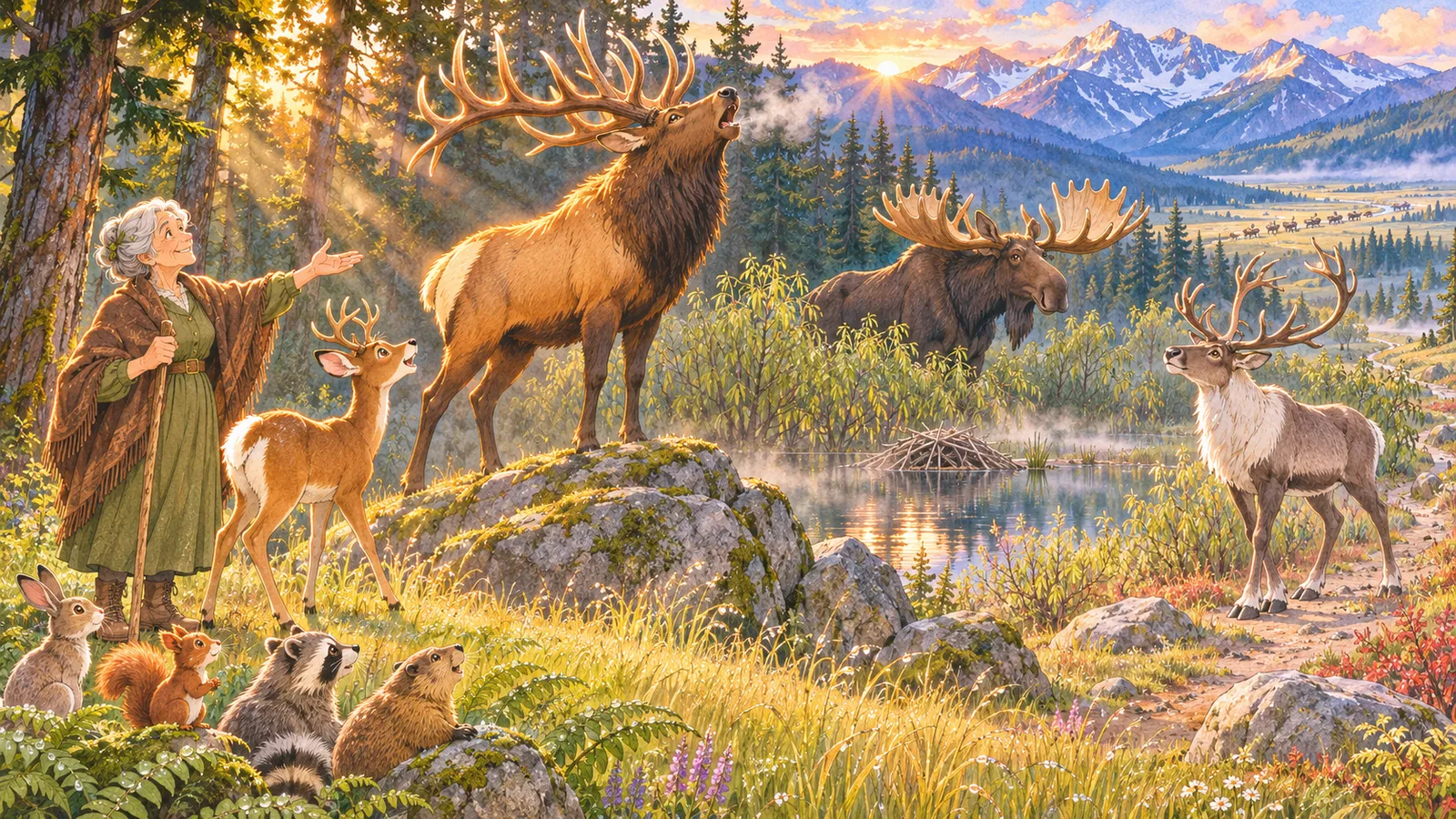
“The Deer family,” began Old Mother Nature, “is divided into two branches—the round-horned and the flat-horned.「シカのなかまは」と、しぜんのおかあさんは話しはじめました。「二つのグループに分かれます。丸い角のグループと、平たい角のグループです。 I have told you about the round-horned Deer with the exception of the largest and noblest, Bugler the Elk.丸い角のシカについては、いちばん大きくていちばん気高い、エルクのビューグラーのほかは、もう話しましたね。 He is commonly called Elk, but his right name is Wapiti.ふつうはエルクとよばれていますが、正しい名前はワピチです。
“Bugler is found only in the great mountains of the Far West, but once, before hunters with terrible guns came, Elk were found in nearly all parts of this country excepting the Far South and the Far North—even on the great plains.「ビューグラーは、遠い西部の大きな山にしかいません。でもむかし、おそろしい鉄ぽうをもったハンターたちが来る前は、エルクはこの国の、遠い南と遠い北をのぞくほとんどどこにでもいました。大平原にさえいたのです。 Now Bugler lives only in the forests of the great mountains.”今では、ビューグラーは大きな山の森にしかすんでいません。」
“How big is he?” asked Lightfoot.「どのくらい大きいの?」とライトフットがききました。
“So big that beside him you would look very small,” replied Old Mother Nature.「とても大きくて、となりにならぶと、あなたがとても小さく見えるくらいよ」と、しぜんのおかあさんは答えました。 “Have you ever seen Farmer Brown's Horse?”「ブラウンさんの馬を見たことがある?」
Lightfoot nodded.ライトフットはうなずきました。 “Well, Bugler stands as high as that Horse,” replied Old Mother Nature.「それなら、ビューグラーはあの馬と同じくらいの背の高さよ」と、しぜんのおかあさんは答えました。 “He isn't as heavy, for his body is of different shape, not so big around, but at that he weighs three times as much as you do.「体の形がちがっていて、あまり太くないから、馬ほど重くはないけれど、それでも、あなたの三倍もの重さがあるのよ。 In summer his coat is a light yellowish-brown, becoming very dark on his neck and underneath.夏の毛皮は明るい黄色っぽい茶色で、首とおなかがわは、とてもこい色になります。 His legs are dark brown.足はこげ茶色です。 The hair on his neck is long and coarse.首の毛は長くて、ごわごわしています。 His tail is very small, and around it is a large patch so light in color as to be almost whitish.しっぽはとても小さく、そのまわりに、ほとんど白に近いうすい色の大きなもようがあります。 In winter his coat becomes dark gray.冬には、毛皮がこい灰色になります。
“Bugler's crowning glory are his antlers.「ビューグラーのいちばんの自まんは、枝角です。 They are very large and wide-spreading, sweeping backward and upward, the long prongs, or tines, curving upward from the front instead of from the back, as in the case of Lightfoot's antlers.とても大きく、はばも広く、後ろへ、そして上へとのびていて、長い枝、つまりとがった先は、ライトフットの枝角のように後ろからではなく、前から上へと曲がっています。 Above each eye is a long sharp prong.両方の目の上には、長くするどい枝が一本ずつあります。 So big are these antlers that Bugler looks almost as if he were carrying a small, bare tree on his head.この枝角があまりに大きいので、ビューグラーはまるで、葉のない小さな木を頭にのせて歩いているように見えます。
“Big as these antlers are, they are grown in a few months for Bugler is like his small cousins in that he loses his antlers at the end of every winter and must grow a new pair.「こんなに大きな枝角なのに、たった数か月で育つのです。ビューグラーも小さないとこたちと同じように、毎年冬のおわりに枝角を落として、新しい一組をはやさなければならないからです。 While they are growing, he hides in the wildest places he can find, high up on the mountains.枝角が育っているあいだ、ビューグラーは山の高いところの、見つかるかぎりいちばん人の来ない場所にかくれています。 Mrs. Bugler is at that time down in a valley with her baby or babies.そのころ、ビューグラーのおくさんは、谷で赤ちゃんといっしょにいます。 Usually she has one, but sometimes twins.ふつう赤ちゃんは一頭ですが、ふたごのこともあります。 She has no antlers.おくさんには枝角がありません。
“In the fall, when his antlers have hardened, Bugler moves down to join his family.「秋になって枝角がかたくなると、ビューグラーは家族のところへおりていきます。 The bigger and stronger he is, the bigger his family is, for he has a number of wives and they all live together in a herd or band of which Bugler is lord and master.体が大きくて強いほど、家族も大きくなります。ビューグラーにはおくさんが何頭もいて、みんなでむれをつくってくらし、そのむれのかしらがビューグラーなのです。 He is ready and eager to fight for them, and terrible battles take place when another disputes his leadership.ビューグラーは、家族のためなら、いつでもよろこんでたたかいます。ほかのものがかしらの地位をうばおうとすると、すさまじいたたかいになります。 At this season he has a habit of stretching his neck out and emitting a far-reaching trumpet-like sound from which he gets the name of Bugler.この季節、ビューグラーは首をのばして、遠くまでひびく、らっぱのような声を出すくせがあります。それで、ビューグラー(らっぱをふく者)という名前がついたのです。 It is a warning that he is ready to fight.それは、たたかう用意ができているぞ、という知らせです。
“When the snows of winter come, many families get together and form great bands.「冬の雪がふると、たくさんの家族が集まって、大きなむれをつくります。 Then they move down from the mountains in search of shelter and food.それから、風や雪をよけられる場所と食べ物をさがして、山からおりてきます。 When a winter is very bad, many starve to death, for man has fenced in and made into farms much of the land where the elk once found ample food for winter.とてもきびしい冬には、たくさんのエルクがうえ死にしてしまいます。エルクがかつて冬に食べ物をたっぷり見つけていた土地の多くを、人間がさくでかこって畑にしてしまったからです。
“But big as is Bugler the Elk, there is a cousin who is bigger, the biggest of all the Deer family.「でも、エルクのビューグラーがどんなに大きくても、もっと大きないとこがいます。シカのなかまでいちばん大きなシカです。 It is Flathorns the Moose.それは、ヘラジカ(ムース)のフラットホーンズです。 As you must guess by his name he is a member of the flat-horned branch of the family.名前(平たい角)でわかるとおり、シカのなかまの平たい角のグループに入っています。 His antlers spread widely and are flattened instead of being round.枝角は大きく広がっていて、丸くなく、平たくなっています。 From the edges of the flattened part many sharp points spring out.平たいところのふちから、するどい先がたくさんつき出ています。
“Flathorns, wearing his crown of great spreading antlers, is a noble appearing animal because of his great size, but when his antlers have dropped he is a homely fellow.「大きく広がった枝角のかんむりをかぶったフラットホーンズは、体がとても大きいので気高く見えますが、枝角が落ちてしまうと、みっともないやつになります。 Mrs. Flathorns, who has no antlers, is very homely.枝角のないおくさんは、とてもみっともないすがたです。 As I have said, Flathorns is the biggest member of the Deer family.前にも言ったように、フラットホーンズはシカのなかまでいちばん大きいのです。 He is quite as big as Farmer Brown's Horse and stands much higher at the shoulders.ブラウンさんの馬にまけないくらい大きく、かたのところはずっと高くなっています。 Indeed, his shoulders are so high that he has a decided hump there, for they are well above the line of his back.じっさい、かたがとても高いので、背中の線よりずっと上にとび出して、はっきりしたこぶになっています。 His neck is very short, large and thick, and his head is not at all like the heads of other members of the Deer family.首はとても短く、太くてがっしりしていて、頭はほかのシカのなかまの頭とは、ぜんぜんちがいます。 Instead of the narrow, pointed face of other members of the Deer family, he has a broad, long face, rather more like that of a Horse.ほかのシカのような細くてとがった顔ではなく、はばが広くて長い顔で、どちらかというと馬の顔ににています。 Towards the nose it humps up, and the great thick upper lip overhangs the lower one.鼻のほうへいくと、もり上がっていて、大きくぶあつい上くちびるが、下くちびるにかぶさっています。 His nose is very broad, and for his size his eyes are small.鼻はとても広く、体の大きさのわりに目は小さいのです。 His ears are large.耳は大きいです。
“From his throat hangs a hairy fold of skin called a bell.「のどからは、毛のはえた皮がたれ下がっていて、ベル(すず)とよばれます。 He has a very short tail, so short that it is hardly noticeable.しっぽはとても短く、あまりに短いので、ほとんど目立ちません。 His legs are very long and rather large.足はとても長くて、わりあい太いのです。 His hoofs are large and rounded, more like those of Bossy the Cow than like those of Lightfoot the Deer.ひづめは大きくて丸く、シカのライトフットのひづめより、めうしのボッシーのひづめににています。 Seen at a little distance in the woods, he looks to be almost black, but really is for the most part dark brown.森の中で少しはなれて見ると、ほとんど黒に見えますが、じつは大部分がこげ茶色です。 His legs are gray on the inside.足の内がわは灰色です。
“Flathorns lives in the great northern forests clear across the country, and is especially fond of swampy places.「フラットホーンズは、この国を横切るように広がる北の大森林にすんでいて、とくにじめじめしたぬまのような場所が好きです。 He is fond of the water and is a good swimmer.水が好きで、泳ぎがじょうずです。 In summer he delights to feed on the pads, stems and roots of water lilies, and his long legs enable him to wade out to get them.夏には、スイレンの葉やくきや根を食べるのが大好きで、長い足のおかげで、それをとりに水の中へ歩いていけるのです。 For the most part his food consists of leaves and tender twigs of young trees, such as striped maple, aspen, birch, hemlock, alder and willow.食べ物の大部分は、若い木の葉ややわらかい小えだです。たとえば、シマカエデ、アスペン(ポプラのなかま)、カバノキ、ツガ、ハンノキ、ヤナギなどです。 His great height enables him to reach the upper branches of young trees.背がとても高いので、若い木の上のほうの枝にも口がとどきます。 When they are too tall for this, he straddles them and bends or breaks them down to get at the upper branches.木が高すぎてとどかないときは、木をまたいで、おし曲げたり、おったりして、上の枝を食べるのです。 His front teeth are big, broad and sharp-edged.前歯は大きく、はばが広くて、ふちがするどくなっています。 With these he strips the bark from the larger branches.この前歯で、太い枝の皮をはぎとります。 He also eats grass and moss.草やコケも食べます。 Because of his long legs and short neck he finds it easiest to kneel when feeding on the ground.足が長くて首が短いので、地面のものを食べるときは、ひざをつくのがいちばんらくなのです。
“Big as he is, he can steal through thick growth without making a sound.「あんなに大きいのに、しげったやぶの中を、音ひとつたてずに、そっと通りぬけることができます。 He does not jump like other Deer, but travels at an awkward trot which takes him over the ground very fast.ほかのシカのようにとびはねず、ぎこちない早足で進みますが、それでとても速く地面をかけぬけます。 In the winter when snow is deep, the Moose family lives in a yard such as I told you Lightfoot makes.冬、雪が深くなると、ヘラジカの家族は、ライトフットがつくると話したのと同じようなヤードでくらします。 The greatest enemy of Flathorns is the hunter, and from being much hunted Flathorns has learned to make the most of his ears, eyes and nose.フラットホーンズのいちばんの敵はハンターで、さんざんかられたので、耳と目と鼻をめいっぱい使うことをおぼえました。 He is very smart and not easily surprised.とてもかしこくて、ふいをつかれることはめったにありません。 When wounded he will sometimes attack man, and occasionally when not wounded.けがをしたとき、人間におそいかかることもあり、けがをしていなくても、ときにはおそいかかります。 Then he strikes with his sharp-edged front hoofs, and they are terrible weapons.そのときは、ふちのするどい前足のひづめで打ちかかります。それはおそろしい武器です。 Altogether he is a wonderful animal, and it is a matter for sorrow that man persists in hunting him merely to get his wonderful head.まったくすばらしい動物なのに、人間がそのみごとな頭をほしいというだけで、かりつづけているのは、悲しいことです。
“In parts of these same northern forests lives another big member of the Deer family, Wanderhoof the Woodland Caribou.「この同じ北の森のところどころに、もう一頭の大きなシカのなかま、森林カリブーのワンダーフーフがすんでいます。 He is bigger than Lightfoot the Deer, but smaller than Bugler the Elk, rather an awkward-looking fellow.シカのライトフットよりは大きく、エルクのビューグラーよりは小さくて、少しぶかっこうなやつです。 His legs are quite long but stout.足はかなり長いけれど、がっしりしています。 His neck is rather short, and instead of carrying his head proudly as does Lightfoot, he carries it stretched out before him or hanging low.首はわりあい短く、ライトフットのようにほこらしげに頭をあげるのではなく、前へつき出したり、低くたらしたりしています。 The hair on the lower part of his neck is long.首の下のほうの毛は長いのです。
“Wanderhoof wears a coat of brown.「ワンダーフーフは茶色の毛皮を着ています。 His neck being much lighter or almost gray.首はずっと色がうすく、ほとんど灰色です。 He has an undercoat which is very thick and woolly.毛皮の下には、羊毛のような、とても厚い下毛がはえています。 In winter his whole coat becomes grayish and his neck white.冬には、毛皮全体が灰色っぽくなり、首は白くなります。 Above each hoof is a band of white.ひづめの上には、それぞれ白い帯があります。 His tail is very short, and white on the under side.しっぽはとても短く、うらがわが白いのです。 His antlers are wonderful, being very long and both round and flat.枝角はすばらしく、とても長く、丸くもあり平たくもあります。 That is, parts of them are round and parts flattened.つまり、丸いところと平たいところがあるのです。 They have more prongs than those of any other Deer.ほかのどのシカよりも、枝の先の数が多いのです。
“His hoofs are very large, deeply slit, and cup-shaped.「ひづめはとても大きく、深い切れこみがあって、おわんのような形をしています。 When he walks they make a snapping or clicking sound.歩くと、パチン、カチッという音がします。 These big feet were given him for a purpose.この大きな足には、ちゃんとわけがあるのです。 He is very fond of boggy ground, and because of these big feet and the fact that the hoofs spread when he steps, he can walk safely where others would sink in.ワンダーフーフはぬかるんだ土地がとても好きで、大きな足と、ふみ出すとひづめが広がるおかげで、ほかの動物ならしずんでしまうところでも、安心して歩けるのです。 This is equally true in snow, when they serve as snowshoes.雪の上でも同じで、ひづめがかんじきの役をはたします。 As a result he is not forced to live in yards as are Lightfoot and Flathorns when the snow is deep, but goes where he pleases.そのため、雪が深くなっても、ライトフットやフラットホーンズのようにヤードでくらさなくてもよく、好きなところへ行けるのです。
“He is very fond of the water and delights to splash about in it, and is a splendid swimmer.「水がとても好きで、水の中でばしゃばしゃするのが大好きです。泳ぎもとてもじょうずです。 His hair floats him so that when swimming he is higher out of water than any other member of the family.毛のおかげで体がうくので、泳ぐとき、シカのなかまのだれよりも、水の上に体が高く出ています。 In winter he lives in the thickest parts of the forest among the hemlocks and spruces, and feeds on the mosses and lichens which grow on the trees.冬には、ツガやトウヒの木がいちばんしげった森の中でくらし、木にはえるコケや地衣類(コケににた生きもの)を食べます。 In summer he moves to the open, boggy ground around shallow lakes where moss covers the ground, and on this he lives.夏には、浅い湖のまわりの、コケが地面をおおうひらけたぬかるみにうつり、そのコケを食べてくらします。
“He is a great wanderer, hence his name Wanderhoof.「ワンダーフーフはたいへんな旅好きで、それでワンダーフーフ(さすらいのひづめ)という名前なのです。 Mrs. Caribou has antlers, wherein she differs from Mrs. Lightfoot, Mrs. Flathorns and Mrs. Bugler.カリブーのおくさんには枝角があります。そこが、ライトフットやフラットホーンズやビューグラーのおくさんとちがうところです。 Wanderhoof is fond of company and usually is found with many companions of his own kind.ワンダーフーフはなかまといるのが好きで、たいてい同じなかまがたくさんいっしょにいます。 When they are moving from their summer home to their winter home, or back again, they often travel in very large bands.夏のすみかから冬のすみかへ、またその反対へうつるときには、よく、とても大きなむれで旅をします。
“In the Far North beyond the great forests Wanderhoof has a cousin who looks very much like him, called the Barren Ground Caribou.「大森林をこえた遠い北の国には、ワンダーフーフにとてもよくにたいとこがいて、バーレングラウンドカリブー(あれ地のカリブー)とよばれています。 The name comes from the fact that way up there little excepting moss grows, and on this the Caribou lives.その名前は、ずっと北のそのあたりではコケくらいしか育たず、カリブーはそれを食べてくらしていることからきています。 In summer this Caribou is found almost up to the Arctic Ocean, moving southward in great herds as the cold weather approaches.夏、このカリブーは北極海のすぐ近くまで行き、寒くなってくると、大きなむれになって南へうつっていきます。 No other animals of to-day get together in such great numbers.今の時代の動物で、これほどたくさん集まるものは、ほかにいません。 In the extreme North is another Caribou, called Peary's Caribou, whose coat is wholly white.いちばん北には、毛皮がまっ白な、ピアリーカリブーという、べつのカリブーもいます。 The Caribou are close cousins of the Reindeer and look much like them.カリブーはトナカイの近い親類で、トナカイによくにています。
“All male members of the smaller Deer are called bucks, the female members are called does, and the young are called fawns.「小さいシカのオスはバック、メスはドウ、子どもはフォーンとよばれます。 All male members of the big Deer, such as Bugler the Elk, Flathorns the Moose and Wanderhoof the Caribou, are called bulls.エルクのビューグラーやヘラジカのフラットホーンズやカリブーのワンダーフーフのような、大きいシカのオスは、みんなブル(おうし)とよばれます。 The females are called cows and the young are called calves.メスはカウ(めうし)、子どもはカーフ(子牛)とよばれます。 All members of the Deer family, with the exception of the Barren Ground Caribou, are forest-loving animals and are seldom seen far from the sheltering woods.シカのなかまは、バーレングラウンドカリブーをのぞいて、みんな森が大好きな動物で、守ってくれる森から遠くはなれたところでは、めったに見られません。
“This, I think, will do for the Deer family.「シカのなかまについては、これくらいにしておきましょう。 To-morrow I shall tell you about Thunderfoot the Bison, Fleetfoot the Antelope, and Longcoat the Musk Ox.”あしたは、バイソンのサンダーフット、アンテロープのフリートフット、ジャコウウシのロングコートについてお話しします。」