

 ワークシート
 ぬりえ
 迷路
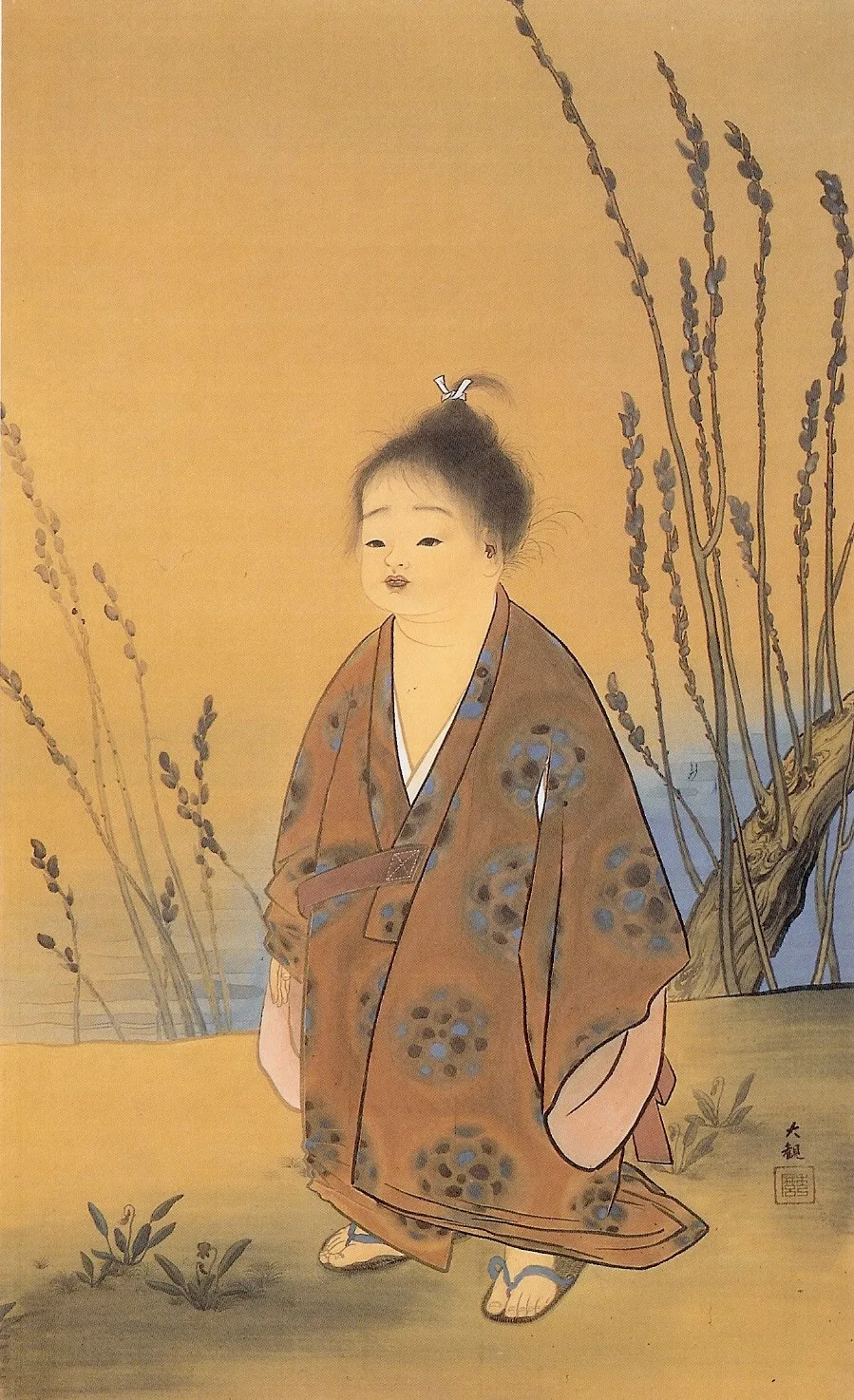
ぶかぶかの着物で、ぼんやり。この子が「悟り」の姿!?A boy in a baggy kimono with a blank, innocent look. Is this what enlightenment looks like!?
 美術館アンテナ:横山大観の作品に会える展覧会
全国の展覧会をさがす →この作品のお話
Story春の川辺に、ぶかぶかの着物を着た小さな男の子が、ぽつんと立っています。まわりには芽をふくらませた猫柳、足もとには小さな草花。男の子はどこを見るでもなく、ぼんやりした顔をしています。描いたのは横山大観。1897年(明治30年)、20代の終わりに描いた、大観の出世作のひとつです。
A small boy in a baggy kimono stands alone by a river in spring. Around him are pussy willows with swelling buds, and little plants grow at his feet. He is not looking at anything in particular, and his face looks dreamy. Yokoyama Taikan painted it in 1897, when he was in his late twenties. It was one of the works that made him famous.
題名の「無我」は仏教の言葉で、とくに禅でも大切にされる考えです。自分へのこだわりから離れた、悟りに通じる心をさします。ふつう悟りは、仏や位の高いお坊さんの姿で表しますが、大観は何も考えていないような無邪気な子どもで表しました。大観は東京美術学校の1期生で、岡倉天心のもとで「新しい日本画」を目指していました。
'Muga' is a Buddhist word, and it is especially important in Zen. It means a state of mind free from attachment to the self, close to enlightenment. Artists usually showed enlightenment with Buddhas or great monks. Taikan showed it with an innocent child who seems to think of nothing. Taikan was in the first class of the Tokyo School of Fine Arts. He was working toward a new Japanese painting under Okakura Tenshin.
翌1898年、天心が東京美術学校を去ると、大観は菱田春草らとともに学校を辞め、天心と日本美術院をつくりました。1903年にはインド、翌年にはアメリカへ春草と旅し、海外でも作品を発表します。大観はやがて日本画の第一人者となり、1937年には第1回の文化勲章を受けました。
In 1898, Okakura left the Tokyo School of Fine Arts. Taikan, Hishida Shunsō and others quit with him and started the Japan Art Institute. In 1903, Taikan traveled to India, and the next year to America with Shunsō, showing his work abroad. He became the leading Japanese-style painter of his time. In 1937, he was among the first people to receive the Order of Culture.
春の川のそばに、小さな男の子が立っています。着物は彼には大きすぎます。男の子はおだやかで、何も考えていないようです。題名の「無我」は「自分がない」という意味です。この素朴な男の子が、仏教の大きな考えを表しているのです!
A little boy stands by a river in spring. His kimono is too big for him. He looks calm and does not think about anything. The title 'Muga' means 'no self.' This simple boy shows a big idea from Buddhism!
英語のレベルは上の「やさしい/ふつう」で切りかえられます。
えっ!?な裏ネタ
Secrets大観は同じ1897年に、「無我」という題の絵を別にも描いています。たとえば島根県の足立美術館にも、別の「無我」があります。見くらべると、子どものポーズや構図のちがいがわかります。
In the same year, 1897, Taikan painted another picture called 'Muga.' For example, the Adachi Museum of Art in Shimane has another version. If you compare them, you can see differences in the boy's pose and the layout.
大観と春草は、輪郭線を使わずに色のぼかしで空気を表す画法を試しました。ところが当時の批評家は、ぼんやりしてはっきりしないと批判し、「朦朧体」と呼んでからかいました。今ではその名前が、ふたりの新しさを表す言葉になっています。
Taikan and Shunsō tried painting without outlines, using soft shading to show air. Critics of the time said the pictures were vague, and they mocked the style as 'mōrō-tai,' or the 'hazy style.' Today, that name stands for how new their art was.
大観は富士山を愛し、生涯に描いた富士の絵は1500点をこえるとも言われます。若いころのこの「無我」はやさしい子どもの絵ですが、のちの大観といえば、堂々とした富士山の絵で知られるようになりました。
Taikan loved Mount Fuji. It is said that he painted it more than 1,500 times in his life. 'Muga' is a gentle picture of a child from his young days, but later Taikan became famous for his grand paintings of Mount Fuji.
大観は大のお酒好きで、広島の酒蔵「醉心」のお酒を長年愛飲しました。晩年は、ごはんをあまり食べずにお酒を主食のようにしていたと言われます。それでも89歳まで長生きしました。
Taikan loved sake and drank sake from the Suishin brewery in Hiroshima for many years. It is said that in his later years he ate little rice and lived mostly on sake. Even so, he lived to be 89.
ここを見て!
Look Closer1ぼんやりした顔A dreamy face
ふっくらしたほおに、ぽかんと少し開いた口。何も考えていないような表情が「無我」の心を表しています。頭のてっぺんでは、髪を小さく結んでいます。
Round cheeks and a slightly open mouth. His blank expression shows the idea of 'selflessness.' His hair is tied in a small knot on top.
2ぶかぶかの着物Baggy kimono
体に合わない大きな着物で、そでから手が出ていません。足もとはわらじをはいています。
The kimono is much too big, and his hands do not come out of the sleeves. He is wearing straw sandals.
3猫柳Pussy willows
ふわふわの芽をつけた猫柳が、春風にゆれています。季節が春の始まりだとわかります。
Pussy willows with fluffy buds sway in the spring wind. They tell us it is early spring.
4足もとの草花Little plants
地面には小さな草花が芽を出しています。子どもと同じく、小さな命が静かに描かれています。
Little plants are coming up from the ground. Like the child, they are small lives painted quietly.
英語で名画を語ろう
Talk about Art in EnglishThe kimono is too big for the little boy.
その着物は、小さな男の子には大きすぎます。
💡 too +形容詞+for 人で「人にとって〜すぎる」。服の様子を言うときに便利です。
英語で説明すると… Describe it
これは川のそばにいる小さな男の子の絵です。男の子はまん中に立ち、大きな茶色の着物を着ています。右には猫柳があります。足もとには小さな草花があります。
This is a picture of a little boy by a river. He is standing in the middle and wearing a big brown kimono. On the right, there are pussy willows. At his feet, there are some small plants.
考えてみよう Think & Talk
- 大観はなぜ、「無我」を子どもの姿で表したと思いますか?Why do you think Taikan used a child to show 'selflessness'?
- あなたは、この男の子のように自分のことを忘れてしまうのはどんなときですか?When do you forget about yourself, like this boy?
この作品の英単語
WordsThe boy has an innocent face.
男の子は無邪気な顔をしています。
Taikan showed enlightenment with a child.
大観は子どもの姿で悟りを表しました。
His hands are hidden in his long sleeves.
彼の手は長いそでにかくれています。
The willows sway in the spring wind.
柳が春風にゆれています。
ミニクイズ
QuizQ. 題名の「無我」と深く結びつく考えはどれ?Which tradition is the idea of 'muga' closely connected with?
「無我」は仏教の言葉で、自分へのこだわりから離れた心の境地をさします。禅でも大切にされる考えです。
'Muga' is a Buddhist word for a mind free from attachment to the self. It is also important in Zen.
ウソ?ホント? 「無我」という題の大観の絵は、この1点だけではない。This is not the only painting by Taikan called 'Muga.'
ホントです。たとえば足立美術館にも、同じ1897年の「無我」があります。
True. For example, the Adachi Museum of Art also has a 'Muga' from 1897.
ウソ?ホント? この絵は、大観が80歳をすぎてから描いた晩年の作品だ。Taikan painted this when he was over 80 years old.
ウソです。1897年、まだ20代の終わりごろに描いた、若いころの出世作です。
False. He painted it in 1897, in his late twenties. It helped make him famous.
 画像の出典とライセンス / Image credit
- PDYokoyama Muga.jpg(Wikimedia Commons)
ライセンス:Public domain(パブリックドメイン)/作者・撮影者の表記:Yokoyama Taikan/提供元:Catalogue
この作品は、作者の死後長い年月がたち著作権の保護期間が終わった「パブリックドメイン」の作品です。画像は平面の作品を忠実に写したもので、新しい著作権は生じません(Wikimedia Commons の PD-Art の考え方)。 所蔵:東京国立博物館(Tokyo National Museum)。画像は表示のために縮小・WebP 形式に変換しています。
