 ワークシート
 ぬりえ
 迷路
線がほとんどないのに、霧の林の奥行きが見える!春草の名作屏風。Almost no lines, yet you can see deep into a misty forest! Shunsō's famous screen.
 美術館アンテナ:菱田春草の作品に会える展覧会
全国の展覧会をさがす →この作品のお話
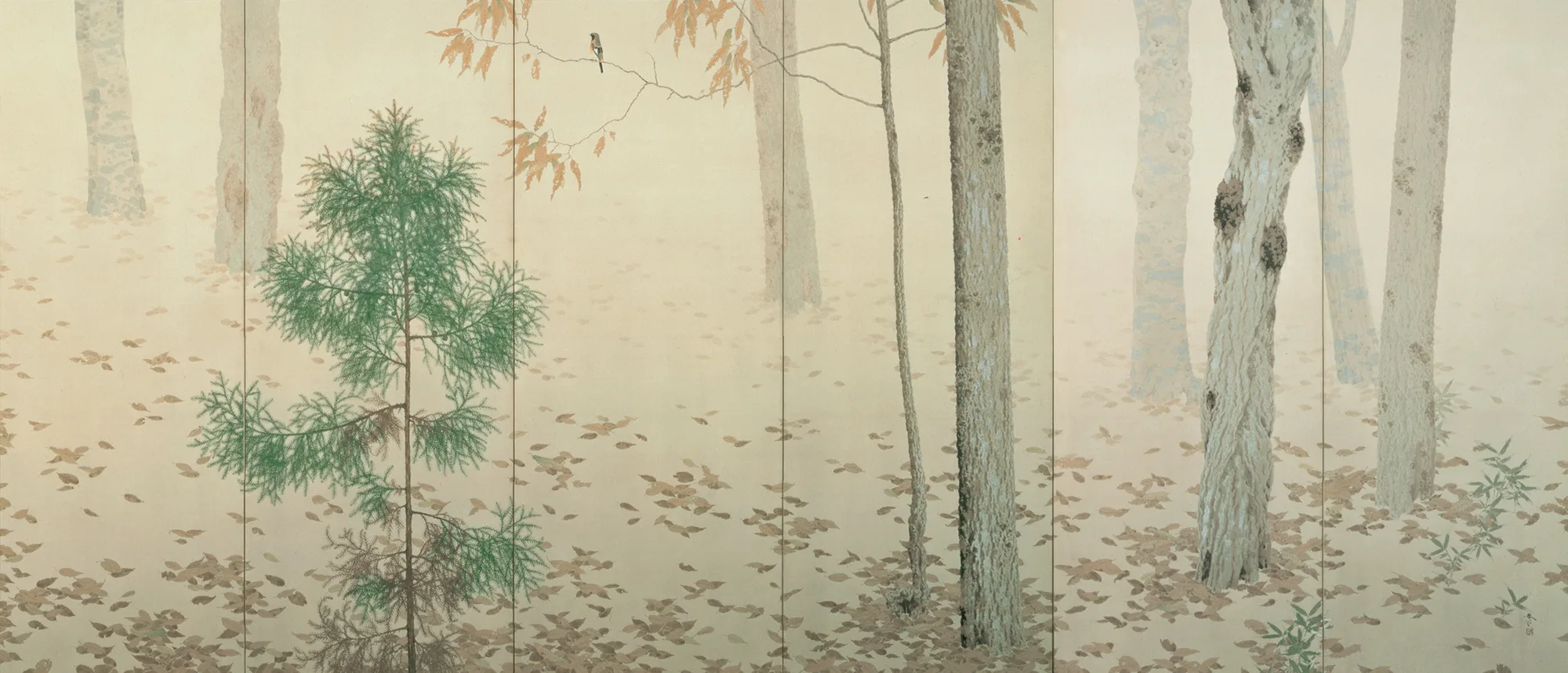
Story秋の終わりの雑木林。地面には茶色い落ち葉が散りしき、木々の幹が霧の中に立ち並んでいます。手前の木ははっきりと、奥の木ほど淡くかすんで描かれ、空と地面の境目もありません。これは菱田春草の六曲一双の屏風「落葉」の片方です。1909年(明治42年)の第3回文展で、事実上の最高賞にあたる二等賞第一席を受けました。
This is a woodland in late autumn. Brown leaves cover the ground, and tree trunks stand in the mist. The trees in front are clear, but the ones farther back become paler and paler. There is no line between the sky and the ground. This is one of a pair of six-panel screens called 'Fallen Leaves' by Hishida Shunsō. At the third Bunten exhibition in 1909, it won first place among the second prizes. No first prize was given, so this was really the top award.
春草は1908年、目の病気の療養もかねて、当時は雑木林が多く残っていた東京の代々木に移り住みました。この屏風は、その林を歩いて観察した体験から生まれたといわれます。輪郭線をほとんど使わず、色の濃さだけで遠近を表す描き方は、かつて「朦朧体」と批判された画風を、さらにみがき上げたものです。
In 1908, Shunsō moved to Yoyogi in Tokyo, partly to rest his sick eyes. At that time, Yoyogi still had many woods. This screen is said to have grown from his walks and careful observation in those woods. He used almost no outlines and showed distance only with lighter and darker colors. It was a more polished form of the 'hazy style' that critics had once attacked.
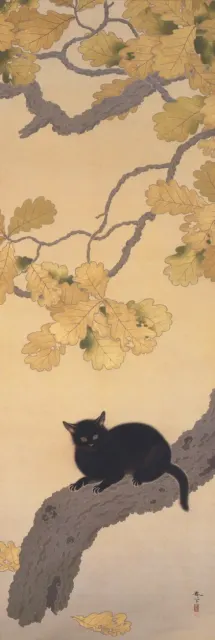
春草はこの2年後の1911年、36歳で亡くなりました。「落葉」と題した作品は、未完成のものも含めて5点が知られていますが、文展に出したのはこの永青文庫の屏風で、国の重要文化財です。永青文庫には「黒き猫」もあり、細川家の当主・細川護立は20点をこえる春草の作品を集めました。
Two years later, in 1911, Shunsō died at 36. Five works called 'Fallen Leaves' are known, including unfinished ones. The one shown at the Bunten is this pair of screens owned by the Eisei Bunko. It is an Important Cultural Property. The Eisei Bunko also owns his 'Black Cat,' and Hosokawa Moritatsu, head of the Hosokawa family, collected more than 20 of Shunsō's works.
これは秋の終わりの林です。茶色い葉が地面をおおっています。遠くの木は、霧の中のようにうすく見えます。画家は線をほとんど使いませんでした。枝の上の小さな鳥を見つけられますか?
This is a forest in late autumn. Brown leaves cover the ground. The trees far away look pale, like in fog. The painter used almost no lines. Can you find the small bird on a branch?
英語のレベルは上の「やさしい/ふつう」で切りかえられます。
えっ!?な裏ネタ
Secrets春草は「落葉」という題の作品を、未完成のものも含めて5点描いています。完成した六曲一双の大きな屏風は、この永青文庫のものと、福井県立美術館のものの2点です。春草にとって特別なテーマだったのです。
Shunsō made five works called 'Fallen Leaves,' including unfinished ones. Two of them are finished pairs of large six-panel screens: this one owned by the Eisei Bunko and one at the Fukui Fine Arts Museum. It was clearly a very special subject for him.
永青文庫と福井県立美術館の「落葉」のどちらが先かは、長いあいだ議論されてきました。ところが春草のふるさと長野県飯田市で、注文を書きとめた「製作控帖」が見つかり、福井の作品があとの注文だとわかったのです。
For a long time, experts argued about which 'Fallen Leaves' came first, the Eisei Bunko screens or the Fukui ones. Then a notebook of Shunsō's orders was found in Iida, Nagano, his hometown. It showed that the Fukui work was ordered later.
この絵には、地平線も空も描かれていません。地面も空気も同じやわらかな色で、木々が霧の中に浮かんでいるようです。何も描かない部分が、かえって林の広がりと静けさを感じさせます。
There is no horizon and no sky in this picture. The ground and the air are the same soft color, so the trees seem to float in the mist. The empty space makes the forest feel wide and quiet.
左上の細い枝を探してみてください。オレンジ色のおなかの小さな鳥が1羽、ぽつんととまっています。大きな画面の中の小さな命が、林の静けさをいっそう引き立てています。
Look for the thin branch in the upper left. A small bird with an orange belly sits there alone. This tiny life in a huge picture makes the forest feel even quieter.
ここを見て!
Look Closer1若い針葉樹Young evergreen tree
画面の中で、ここだけがあざやかな緑。茶色の林の中で、まだ若い木が目を引きます。
This is the only bright green in the picture. The young tree stands out in the brown forest.
2枝にとまる小鳥A bird on a branch
紅葉した枝に、小さな鳥が1羽。見つけられたかな?
A small bird sits on a branch with autumn leaves. Can you find it?
3はっきりした幹A clear tree trunk
手前の幹は、木の皮の模様まではっきり。そのまわりの奥の木々はうっすらとかすみ、距離のちがいが感じられます。
The front trunk shows even the pattern of the bark. The trees behind it are faint, so you can feel the distance.
4散りしく落ち葉Fallen leaves
地面いっぱいの落ち葉。奥へ行くほど小さく、うすくなり、地面が遠くまで続いて見えます。
Leaves cover the ground. They get smaller and paler toward the back, so the ground seems to go on and on.
英語で名画を語ろう
Talk about Art in EnglishIn the distance, pale trees fade into the mist.
遠くでは、うすい色の木々が霧の中にかすんでいます。
💡 風景画で「遠くに見える」ものを言う定番の表現。in the background とあわせて覚えよう。
英語で説明すると… Describe it
これは秋の終わりの林を描いた横長の絵です。左には、小さな緑の木があります。まん中と右には、背の高い木の幹が並んでいます。茶色い葉が地面をおおい、遠くの木々はうすく見えます。
This is a wide picture of a forest in late autumn. On the left, there is a small green tree. In the middle and on the right, there are tall tree trunks. Brown leaves cover the ground, and the trees in the distance look pale.
考えてみよう Think & Talk
- 春草は、遠くにある木をどうやって表しましたか?How did Shunsō show that some trees are far away?
- もしこの林に入っていったら、どんな音が聞こえると思いますか?If you walked into this forest, what sounds would you hear?
この作品の英単語
WordsFallen leaves cover the ground.
落ち葉が地面をおおっています。
The trees stand in the mist.
木々が霧の中に立っています。
The trees in the back fade into the mist.
奥の木々は霧の中にかすんでいきます。
This picture is painted on a folding screen.
この絵は屏風に描かれています。
ミニクイズ
QuizQ. 春草が「落葉」を描くもとになった林があったのはどこ?Where were the woods that inspired 'Fallen Leaves'?
目の病気の療養もかねて移り住んだ、東京・代々木の雑木林がもとになったといわれます。
It is said to come from the woods in Yoyogi, Tokyo, where he moved partly to rest his eyes.
ウソ?ホント? 春草は、木の一本一本に黒い輪郭線をはっきり描いた。Shunsō drew a clear black outline around every tree.
ウソです。輪郭線をほとんど使わず、色の濃さで遠い・近いを表しています。
False. He used almost no outlines and showed near and far with lighter and darker colors.
ウソ?ホント? 「落葉」という題の春草の作品は、ほかにもある。Shunsō made other works called 'Fallen Leaves.'
ホントです。未完成のものも含めて5点が知られています。
True. Five are known, including unfinished ones.
 画像の出典とライセンス / Image credit
- PDHishida Shunsō - Fallen Leaves (Eisei Bunko Museum) 2.jpg(Wikimedia Commons)
ライセンス:Public domain(パブリックドメイン)/作者・撮影者の表記:Hishida Shunsō
この作品は、作者の死後長い年月がたち著作権の保護期間が終わった「パブリックドメイン」の作品です。画像は平面の作品を忠実に写したもので、新しい著作権は生じません(Wikimedia Commons の PD-Art の考え方)。 所蔵:熊本県立美術館(永青文庫蔵・寄託)(Kumamoto Prefectural Museum of Art (Eisei Bunko collection, on deposit))。画像は表示のために縮小・WebP 形式に変換しています。