

 PDF をダウンロード
Let's Look at Art!
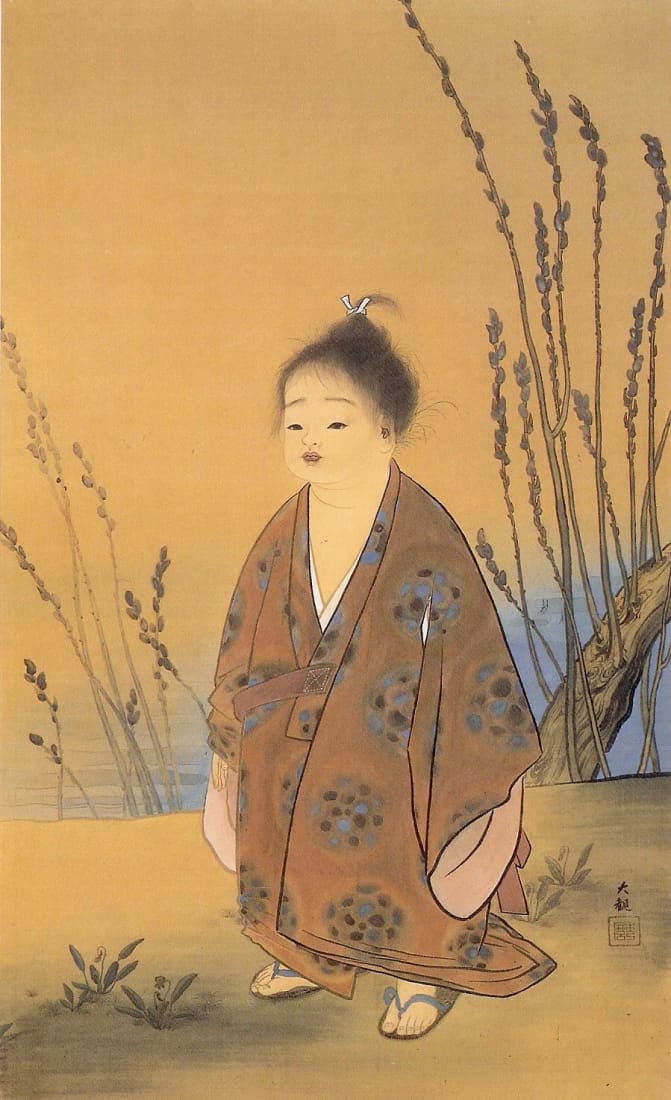
Title: Selflessness
Artist: Yokoyama Taikan (1868–1958)
Year: 1897
Medium: Color on silk
Museum: Tokyo National Museum, Tokyo
1 Find it! 絵の中から見つけて、○でかこもう。
- ☐ A dreamy face
- ☐ Baggy kimono
- ☐ Pussy willows
- ☐ Little plants
2 First look 最初に見たときの感想を書こう。
When I first saw this painting, I felt ______________ because ______________________.
Three colors I can see: ①__________ ②__________ ③__________
3 Words — Match them. 英語と日本語を線で結ぼう。
- innocent ●
- enlightenment ●
- sleeve ●
- sway ●
- ● そで
- ● 無邪気な
- ● ゆれる
- ● 悟り
Selflessness
4 Fill in the blanks. 下の箱から選んで、( )に入れよう。形を変えるものもあります。
- The boy has an face.
- Taikan showed with a child.
- His hands are hidden in his long .
- The willows in the spring wind.
5 Read and answer — True or False? 英文を読んで、正しければ T、ちがえば F。
A little boy stands by a river in spring. His kimono is too big for him. He looks calm and does not think about anything. The title 'Muga' means 'no self.' This simple boy shows a big idea from Buddhism!
A small boy in a baggy kimono stands alone by a river in spring. Around him are pussy willows with swelling buds, and little plants grow at his feet. He is not looking at anything in particular, and his face looks dreamy. Yokoyama Taikan painted it in 1897, when he was in his late twenties. It was one of the works that made him famous.
- This is not the only painting by Taikan called 'Muga.' T / F
- Taikan painted this when he was over 80 years old. T / F
6 Quiz — Choose the best answer. 正しいものを選ぼう。
Which tradition is the idea of 'muga' closely connected with?
- Waka poetry
- Noh theater
- Kabuki
- Buddhism
Selflessness
7 Put the words in order. 語を正しく並べかえて、文を書こう。
- boy / too / little / is / kimono / big / for / the / The .
- little / a / boy / of / a / by / is / picture / a / river / This .
8 Complete the description. 箱の語を(1)〜(4)に入れて、絵の説明を完成させよう。
This is a picture of a (1) boy by a river. He is standing in the middle and (2) a big (3) kimono. On the right, there are (4) willows. At his feet, there are some small plants.
9 Describe the painting in English. この絵を英語で説明しよう(3文以上)。
10 Think & Talk 考えて、ペアやグループで話し合おう。
Why do you think Taikan used a child to show 'selflessness'?
When do you forget about yourself, like this boy?
11 My favorite part いちばん好きなところを英語で。
I like the ____________ because ____________________________.
Answers & Notes
1 Find it!
A dreamy face=ぼんやりした顔/Baggy kimono=ぶかぶかの着物/Pussy willows=猫柳/Little plants=足もとの草花
2 First look
自由に書けたら正解。I felt calm / surprised / happy … などの形容詞を使おう。
3 Words
1–b(innocent=無邪気な) 2–d(enlightenment=悟り) 3–a(sleeve=そで) 4–c(sway=ゆれる)
4 Fill in the blanks
- innocent The boy has an innocent face.
男の子は無邪気な顔をしています。 - enlightenment Taikan showed enlightenment with a child.
大観は子どもの姿で悟りを表しました。 - sleeves His hands are hidden in his long sleeves.
彼の手は長いそでにかくれています。 - sway The willows sway in the spring wind.
柳が春風にゆれています。
5 Read — T / F
【本文の訳】春の川のそばに、小さな男の子が立っています。着物は彼には大きすぎます。男の子はおだやかで、何も考えていないようです。題名の「無我」は「自分がない」という意味です。この素朴な男の子が、仏教の大きな考えを表しているのです!
【本文の訳】春の川辺に、ぶかぶかの着物を着た小さな男の子が、ぽつんと立っています。まわりには芽をふくらませた猫柳、足もとには小さな草花。男の子はどこを見るでもなく、ぼんやりした顔をしています。描いたのは横山大観。1897年(明治30年)、20代の終わりに描いた、大観の出世作のひとつです。
- T 「無我」という題の大観の絵は、この1点だけではない。
解説:ホントです。たとえば足立美術館にも、同じ1897年の「無我」があります。 - F この絵は、大観が80歳をすぎてから描いた晩年の作品だ。
解説:ウソです。1897年、まだ20代の終わりごろに描いた、若いころの出世作です。
6 Quiz
D 問:題名の「無我」と深く結びつく考えはどれ?
選択肢:A 和歌/B 能/C 歌舞伎/D 仏教
解説:「無我」は仏教の言葉で、自分へのこだわりから離れた心の境地をさします。禅でも大切にされる考えです。
7 Put the words in order
- The kimono is too big for the little boy.
その着物は、小さな男の子には大きすぎます。 - This is a picture of a little boy by a river.
これは川のそばにいる小さな男の子の絵です。
💡 too big for ~(〜には大きすぎる):too +形容詞+for 人で「人にとって〜すぎる」。服の様子を言うときに便利です。
8 Complete the description
(1) little (2) wearing (3) brown (4) pussy
9 Describe(模範解答)
This is a picture of a little boy by a river. He is standing in the middle and wearing a big brown kimono. On the right, there are pussy willows. At his feet, there are some small plants.
これは川のそばにいる小さな男の子の絵です。男の子はまん中に立ち、大きな茶色の着物を着ています。右には猫柳があります。足もとには小さな草花があります。
10 Think & Talk(問いの訳)
- Why do you think Taikan used a child to show 'selflessness'?
大観はなぜ、「無我」を子どもの姿で表したと思いますか? - When do you forget about yourself, like this boy?
あなたは、この男の子のように自分のことを忘れてしまうのはどんなときですか?
正解のない問いです。理由をつけて話せたら◎。
Fun Fact(訳)
「無我」は1枚だけじゃない 大観は同じ1897年に、「無我」という題の絵を別にも描いています。たとえば島根県の足立美術館にも、別の「無我」があります。見くらべると、子どものポーズや構図のちがいがわかります。
