Tuesday, November 10 (archive)
Today in Japan
What day is it?
-
1979年制定Elevator Dayエレベーターの日
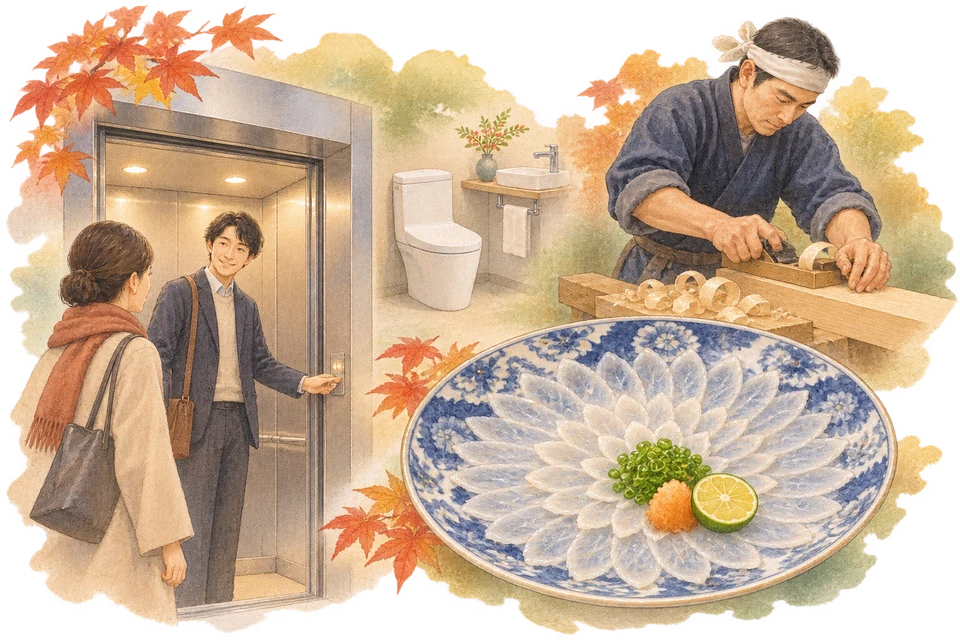
On November 10th, 1890, Japan's first electric elevator was installed in Ryounkaku, a 12-story tower in Asakusa, Tokyo. The Japan Elevator Association made this date Elevator Day in 1979. Every year around now, it runs a campaign to teach people how to use elevators and escalators safely.
Read more › -
1986年制定Toilet Dayトイレの日
Today is also Toilet Day in Japan. It's a pun: 11 can be read "ii," meaning good, and 10 can be read "to," so the date sounds like "good toilet." The Japan Toilet Association set it up in 1986. Don't mix it up with World Toilet Day, which the United Nations marks on November 19th.
Read more › -
Skills Day技能の日
In November 1970, Tokyo hosted the international skills competition now known as WorldSkills, the first time it was held in Asia. Young workers competed in trades like welding, carpentry and dressmaking. The opening ceremony was on November 10th, so Japan's labor ministry made this date Skills Day, and the whole month is used to honor skilled workers. The event is coming back to Japan, in Aichi, in 2028.
Read more ›
If someone asks you
Why do Japanese elevators have a button that keeps the door open, and why do people hold it for others?
Most elevators everywhere have an open button, but in Japan people actually use it a lot. The person standing near the buttons often takes the job of holding the door and pressing floors for everyone. It's a small way of not making others wait or rush. In offices, junior staff often do it for their bosses or for guests. You don't have to do it, but saying "Thank you" when someone does is always nice.
Phrase of the day
Could you hold the door, please?
Sentence of the day
Japan's first electric elevator ran in 1890 in a 12-story tower in Asakusa. Today's other date, Toilet Day, is a pun on 11 and 10, and it's a good excuse to talk about Japan's famously clean public restrooms.
Related topics
- MannersAdvanced erebeta no sahoエレベーターの作法who stands where and who presses the buttons
- PlacesEssential Asakusa浅草the old temple district in eastern Tokyo
- Modern JapanEssential kokyo no toire公共のトイレclean public toilets, free to use
- Modern JapanStandard woshurettoウォシュレットthe Japanese high-tech toilet
- CraftsStandard shokunin職人the craftsman, as an identity