Sunday, November 8 (archive)
Today in Japan
What day is it?
-
1993年制定Good Teeth Dayいい歯の日
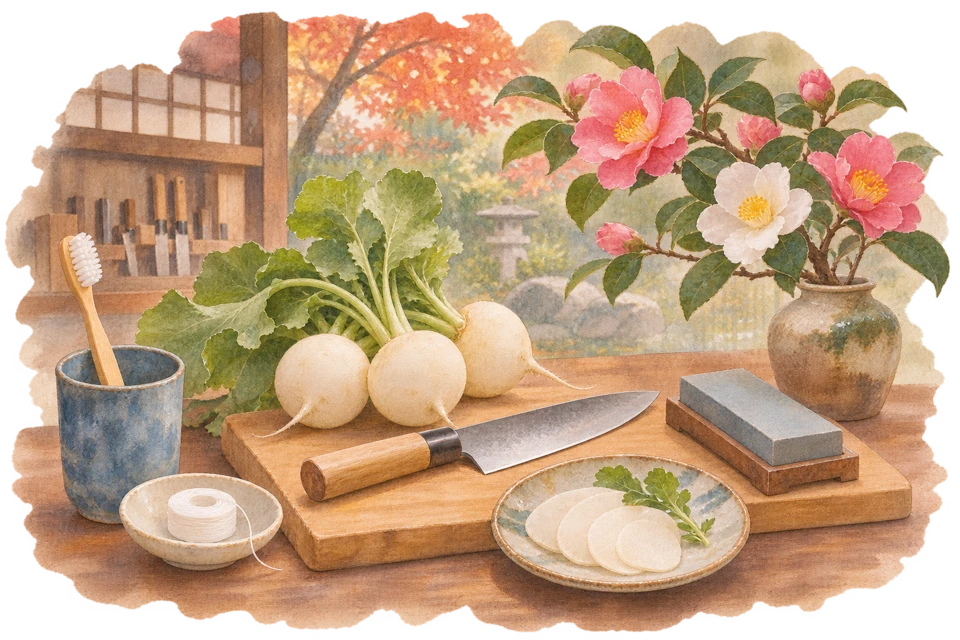
November 8th is Good Teeth Day, set up in 1993 by the Japan Dental Association. It's a pun: 11 can be read "ii," meaning good, and 8 can be read "ha," meaning teeth. The day promotes the 8020 campaign, which encourages people to keep at least 20 of their own teeth at age 80. In a 2024 national survey, about 61.5% of people had reached that goal.
-
Blade Day刃物の日
Today is also Blade Day, set by groups in Japan's knife-making industry. Besides the "ii-ha-mono" pun, it's linked to Fuigo Matsuri, an old festival where blacksmiths thank the gods of their trade. A fuigo is the bellows that keeps a forge fire hot. In Seki, Gifu, a famous knife-making town, people bring old knives and scissors to be honored in a memorial service before they are put to rest.
Read more › -
Sasanqua camellias begin to bloom七十二候「山茶始開(つばきはじめてひらく)」
In the old calendar of 72 microseasons, November 7th to 11th is called "tsubaki hajimete hiraku." The kanji literally mean camellias, but the flower meant here is the sasanqua, or sazanka, which blooms in late autumn when most other flowers are gone. You'll see its pink and white flowers in hedges and gardens all over town.
If someone asks you
Why do people in Japan hold memorial services for old knives and needles?
It's a way of saying thank you to a tool that worked hard for you. Many Japanese people feel uneasy just throwing away something they used every day, like a kitchen knife or a sewing needle. So some shrines and temples hold events where you can bring them and have them honored before they're disposed of. Not everyone does it, but the feeling behind it is pretty common.
Phrase of the day
I need to get my kitchen knife sharpened.
Sentence of the day
November 8th is both Good Teeth Day and Blade Day in Japan, thanks to a pun on the numbers 11 and 8. On days like this, people think about taking care of their teeth and thank the knives they've used for years.
Related topics
- CraftsStandard wabocho和包丁Japanese kitchen knives, many of them sharpened on one side only
- Annual EventsAdvanced hari kuyo針供養a memorial service for broken needles
- CraftsAdvanced katana kaji刀鍛冶the swordsmiths who still forge Japanese blades by hand
- Annual EventsStandard ritto立冬the start of winter in the traditional calendar, around November 7th
- CraftsStandard toishi砥石a Japanese whetstone for sharpening knives and tools