kushikatsu
skewered, breaded and deep-fried food
串カツ(くしかつ)
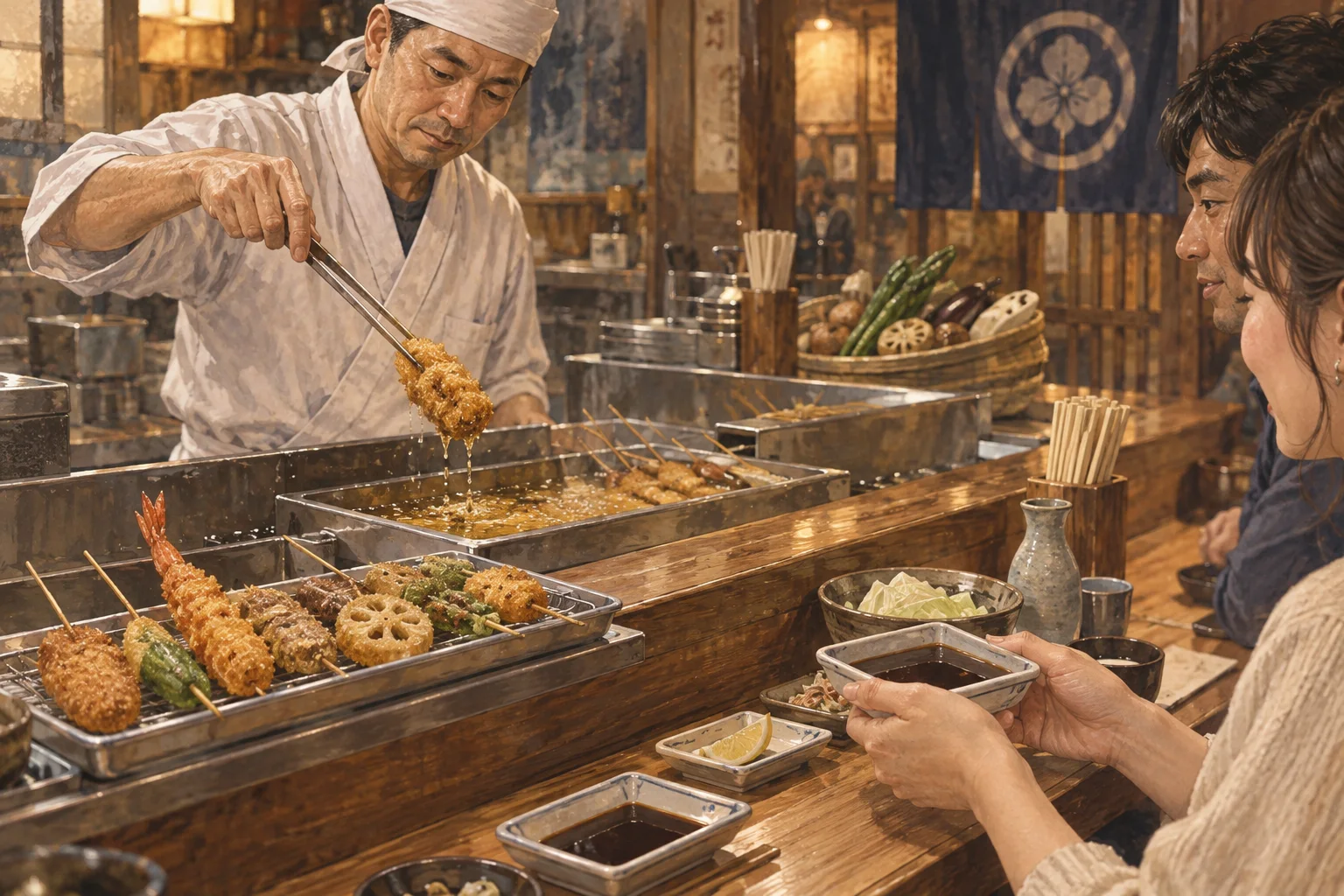
In one line
The shortest answer that works
Kushikatsu is bite-sized food on a skewer, breaded and deep-fried, dipped once in a shared sauce that cannot be double-dipped.
串カツとは、串に刺した具材に衣をつけて揚げたもので、共用のソースには一度しかつけられません。
In 30 seconds
The standard explanation
Kushikatsu is meat, seafood or vegetables cut into bite-sized pieces, skewered, coated in breadcrumbs and deep-fried, closely associated with the Shinsekai district of Osaka. The defining rule at casual kushikatsu counters is that the sauce sits in a shared container, and everyone dips their skewer only once before eating, since dipping a second time after biting means putting other people's food back into a pot everyone shares.
串カツは、肉や魚介、野菜を一口大に切って串に刺し、パン粉をつけて揚げたもので、大阪の新世界という地区と強く結びついています。カジュアルな串カツの店で絶対の決まりとされているのは、ソースが共用の容器に入っていることです。串を一度しかソースにつけてはいけません。一口かじったあとにもう一度つけると、皆が使うソースの中に、自分がかじったものを戻すことになるからです。
As a short speech
A full paragraph you can read aloud
Kushikatsu is skewered food, breaded and deep-fried, and while it sounds close to tonkatsu, the pork cutlet, it is really its own category: almost anything can go on the stick, from meat and shrimp to cheese, mushrooms and quail eggs, each piece small enough for one or two bites. It is most strongly associated with Shinsekai, a working-class district of Osaka near the Tsutenkaku tower, where it is said to have started in the late 1920s as cheap, fast food for laborers.
The rule every visitor learns quickly is nido-zuke kinshi, no double-dipping: the tonkatsu-style sauce sits in a communal container at the counter, so you dip your skewer once, before taking the first bite, and never again after you've already put it in your mouth, because the same pot serves the whole counter. Restaurants post the rule in several languages for tourists, and shredded cabbage is usually provided free at the counter, both as a palate cleanser and, in some shops, as an all-you-can-eat side to fill up on between skewers.
串カツは、具材を串に刺して衣をつけ、油で揚げた料理で、豚肉のカツであるとんかつに近く聞こえますが、実際は別の系統の料理です。肉やえびだけでなく、チーズ、きのこ、うずらの卵まで、一口か二口で食べられる大きさに切ったものがほとんど何でも串に刺さります。
大阪の新世界、通天閣のそばにある庶民的な地区と強く結びついており、昭和の初めごろ、働く人々のための安くて早い食事として始まったとされます。旅行者がすぐに覚える決まりが「二度づけ禁止」です。とんかつソースに似たソースがカウンターの共用容器に入っているため、串は一度、最初のひと口を食べる前にだけつけてよく、口に入れたあとに再びつけることは決してしてはいけません。
同じ容器をカウンター全員が使うからです。店は観光客向けに複数の言語でこの決まりを掲示していることが多く、カウンターには刻みキャベツが無料で置かれ、口直しにも、店によっては串の合間に食べ放題の付け合わせにもなります。
Questions people actually ask
And how to answer them.
What happens if I double-dip by accident?
Staff will usually just remind you firmly not to, since it's the one rule every regular follows without exception. It's about shared hygiene, not manners for their own sake, so a quick apology is enough.
たいていは、お店の人がはっきりと注意してくれるだけです。常連が例外なく守っている唯一の決まりだからで、形式的な礼儀というより衛生の問題なので、軽く謝れば十分です。
Is kushikatsu the same as tonkatsu?
No. Tonkatsu is a whole breaded pork cutlet eaten with a knife and fork or chopsticks off a plate; kushikatsu is small pieces of many possible ingredients on a skewer, eaten by hand at a casual counter.
違います。とんかつは、皿にのった衣付きの豚肉の切り身をナイフとフォークや箸で食べるものです。串カツは、さまざまな具材を小さく切って串に刺し、カジュアルなカウンターで手に持って食べるものです。
Why is it so linked to Osaka specifically?
It is said to have started in Shinsekai, an Osaka working-class district, as an affordable, quick meal for laborers, and the area still has a dense concentration of kushikatsu shops that draw both locals and tourists.
大阪の庶民的な地区である新世界で、働く人々のための安くて早い食事として始まったとされ、今もこの地区には串カツの店が密集し、地元の人にも観光客にも親しまれています。
Phrases you can use
- No double-dipping in the sauce.ソースの二度づけは禁止です。
- The cabbage is free, help yourself.キャベツは無料なので、ご自由にどうぞ。
- This is Osaka's soul food.これは大阪のソウルフードです。
- Everything on a stick is fried the same way.串に刺さったものは、どれも同じように揚げます。
- Order a few at a time and see how it goes.少しずつ注文して、様子を見てください。
Words you need
- skewer串
- no double-dipping二度づけ禁止
- communal dipping sauce共用ソース
- working-class district in Osaka新世界
- breadcrumbsパン粉
Watch
From YouTubeBackground (Japanese)
串カツは大正末期から昭和初期にかけて、大阪の新世界で労働者向けの安価な食事として広まったとされる。「二度づけ禁止」の習わしは、共用のソース入れを衛生的に使うための店独自のルールから始まり、新世界の多くの店で受け継がれているとされる。とんかつソースに似た甘辛いソースを使うが、串に刺す具材は肉に限らず、野菜、魚介、チーズなど店によって幅広い。カウンターに置かれた刻みキャベツを無料または食べ放題で提供する店が多く、口直しの役割を兼ねている。