Kaguya-hime
the girl found in a bamboo stalk who returns to the moon
かぐや姫(かぐやひめ)
In one line
The shortest answer that works
Kaguya-hime is a girl found inside a bamboo stalk who refuses every suitor and returns to the moon.
かぐや姫は竹の中から見つかった娘で、すべての求婚を退け、月へ帰る話です。
In 30 seconds
The standard explanation
An old bamboo cutter finds a tiny girl inside a glowing stalk. She grows into a beauty, and five noblemen court her. She sets each an impossible task; all fail, some dishonestly. The emperor himself is refused. Then she tells her parents she is from the moon and must go back, and an escort descends to take her.
竹取の翁が、光る竹の中に小さな娘を見つけます。美しく育ち、五人の貴公子が求婚します。姫はそれぞれに手に入らない品を求め、全員が失敗し、偽物を持ってくる者もいます。帝の求婚も断ります。やがて自分は月の者で帰らねばならないと告げ、迎えが降りてきます。
As a short speech
A full paragraph you can read aloud
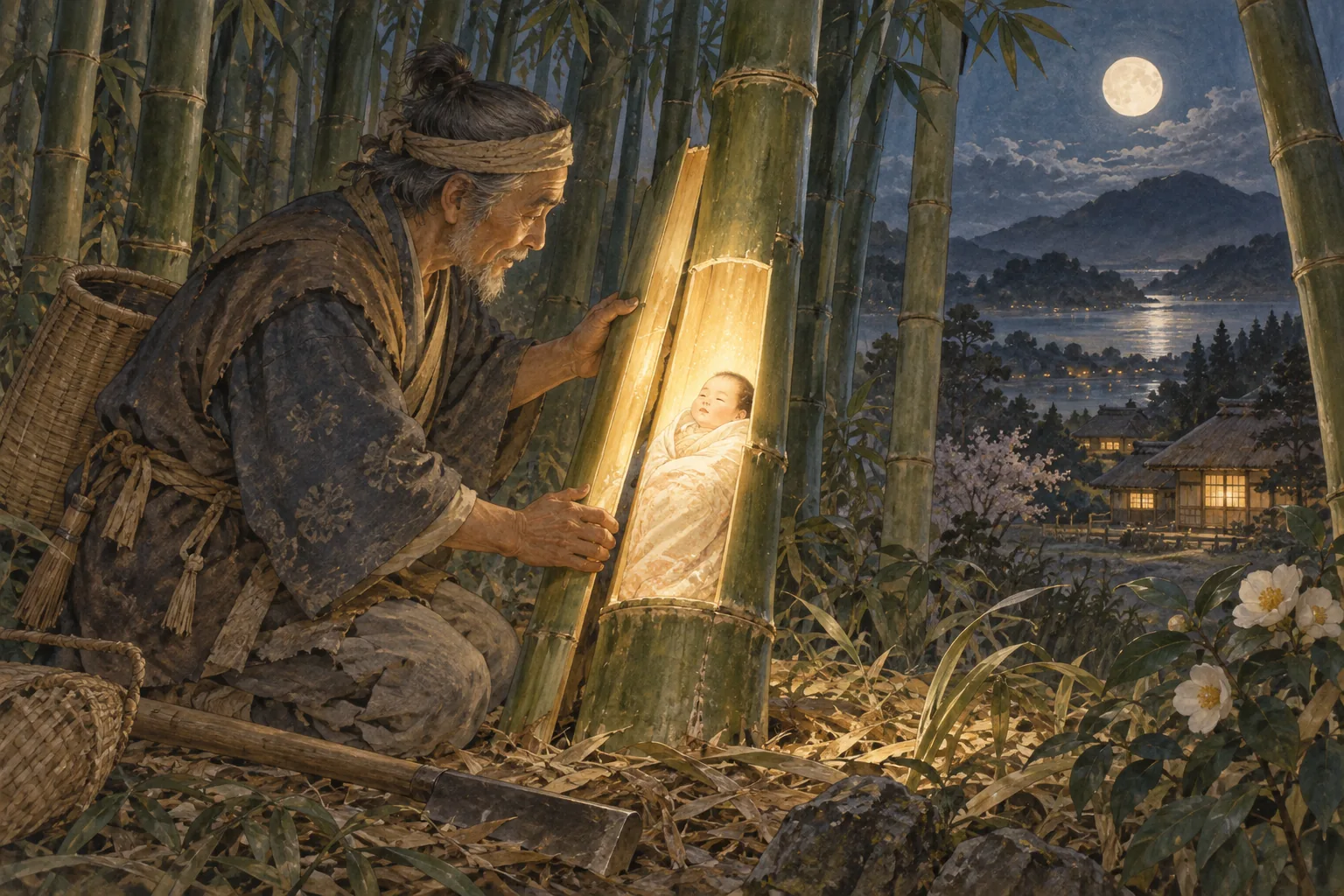
Kaguya-hime comes from the Tale of the Bamboo Cutter, which survives from around the tenth century and is the oldest work of prose fiction in Japanese. An old man who cuts bamboo for a living finds a stalk shining from within, and inside is a girl the size of his hand. She grows in three months into a woman so beautiful that five noblemen lay siege to the house.
She gives each an impossible errand: the Buddha's stone begging bowl, a jeweled branch from a mountain in the eastern sea, a robe made from the fur of a fire-rat, a dragon's neck jewel, and a shell said to be born from a swallow. All five fail, and two try to cheat. Even the emperor is refused.
Then she weeps at the full moon and tells her parents she is from there and must return. Soldiers are posted, and they are useless: the escort descends and she puts on a feathered robe that takes away her human feelings. What stays with Japanese readers is not the wonder but the parents left behind.
かぐや姫は『竹取物語』の話で、10世紀ごろから伝わり、日本語で書かれた最も古い物語文学です。竹を採って暮らす翁が、内側から光る竹を見つけます。中には手のひらほどの娘。三か月で女に育ち、その美しさに五人の貴公子が家を囲みます。
姫はそれぞれに手に入らない品を言いつけます。仏の御石の鉢、東の海の山にある玉の枝、火鼠の裘、竜の首の玉、燕の子安貝。五人とも失敗し、二人は偽物でごまかそうとします。帝の求婚さえ断ります。
やがて満月に泣き、自分は月の者で帰らねばならないと両親に告げます。兵が配されますが、何の役にも立ちません。迎えが降り、姫は人の心を失わせる天の羽衣をまといます。日本の読者の胸に残るのは、不思議さではなく、残された親のほうです。
Questions people actually ask
And how to answer them.
Why is it considered important?
It is the oldest surviving prose tale in Japanese, from around the tenth century. The Tale of Genji calls it the ancestor of all tales, so later literature is measured from it.
日本語で書かれた現存最古の物語だからです。10世紀ごろのもので、『源氏物語』はこれを「物語の出で来はじめの祖」と呼んでいます。後の文学は、ここから測られます。
What are the five impossible tasks?
The Buddha's stone bowl, a jeweled branch from a legendary mountain, a robe of fire-rat fur that does not burn, a jewel from a dragon's neck, and a cowrie shell said to be born from a swallow. None exists.
仏の御石の鉢、蓬莱の玉の枝、燃えない火鼠の裘、竜の首の玉、燕の子安貝です。どれも存在しません。
Is it read in school?
Yes. The opening lines are often memorized in classical Japanese in junior high, so most adults can still recite the first sentence. Studio Ghibli also made a film of it in 2013.
読みます。冒頭は中学で古文として暗唱することが多いので、多くの大人がいまも最初の一文を言えます。2013年にはスタジオジブリが映画にしました。
Phrases you can use
- She was found inside a glowing bamboo stalk.光る竹の中から見つかりました。
- Five noblemen were given impossible tasks.五人の貴公子に難題が出されました。
- Even the emperor was refused.帝の求婚さえ断りました。
- She returned to the moon.月へ帰りました。
- It's the oldest prose tale in Japanese.日本語で最も古い物語です。
Words you need
- bamboo cutter竹取の翁
- suitor求婚者
- impossible task難題
- robe of feathers羽衣
- classical Japanese古文
Watch
From YouTubeBackground (Japanese)
『竹取物語』は9世紀末から10世紀初めの成立とされ、作者も成立年も分かっていない。『源氏物語』の「絵合」の巻に「物語の出で来はじめの祖なる竹取の翁」とある。五つの難題のうち、仏の御石の鉢と蓬莱の玉の枝は偽物で切り抜けようとして露見し、火鼠の裘は買い求めた品が火に燃えてしまい、竜の首の玉を求めた大納言は嵐に遭う。富士山の名の由来を、姫が残した不死の薬を燃やした山とする場面が末尾にあるが、これは語源としては後づけと考えられている。