 11分
 朗読 Ruth Golding
 原文そのまま

 PDFで印刷(A4 9まい)
Have you ever seen the little club moss or Lycopodium which grows all over England, but chiefly in the north, on heaths and mountains?イングランドじゅう、とくに北のほうのあれ地や山に生えている、小さなヒカゲノカズラ(リコポディウム)を見たことがありますか? At the end of each of its branches it bears a cone made of scaly leaves; and fixed to the inside of each of these leaves is a case called a sporangium, full of little spores or moss-seeds, as we may call them, though they are not exactly like true seeds.それぞれの枝の先には、うろこのような葉でできた、まつかさのようなほがついています。その葉の一まい一まいの内側には「ほう子のう」とよばれるふくろがついていて、中には小さなほう子がいっぱいつまっています。コケのたねとよんでもよいのですが、本当のたねとまったく同じではありません。 In one of these club-mosses called Selaginella, the cases near the bottom of the cone contain large spores, while those near the top contain a powdery dust.ヒカゲノカズラの仲間のセラギネラ(イワヒバの仲間)では、ほの下のほうのふくろには大きなほう子が、上のほうのふくろには粉のようなちりが入っています。 These spores are full of resin, and they are collected on the Continent for making artificial lightning in the theatres, because they flare when lighted.このほう子には、やにがいっぱいつまっていて、火をつけるとぱっともえ上がるので、ヨーロッパ大陸では、劇場でにせのいなずまを作るために集められています。
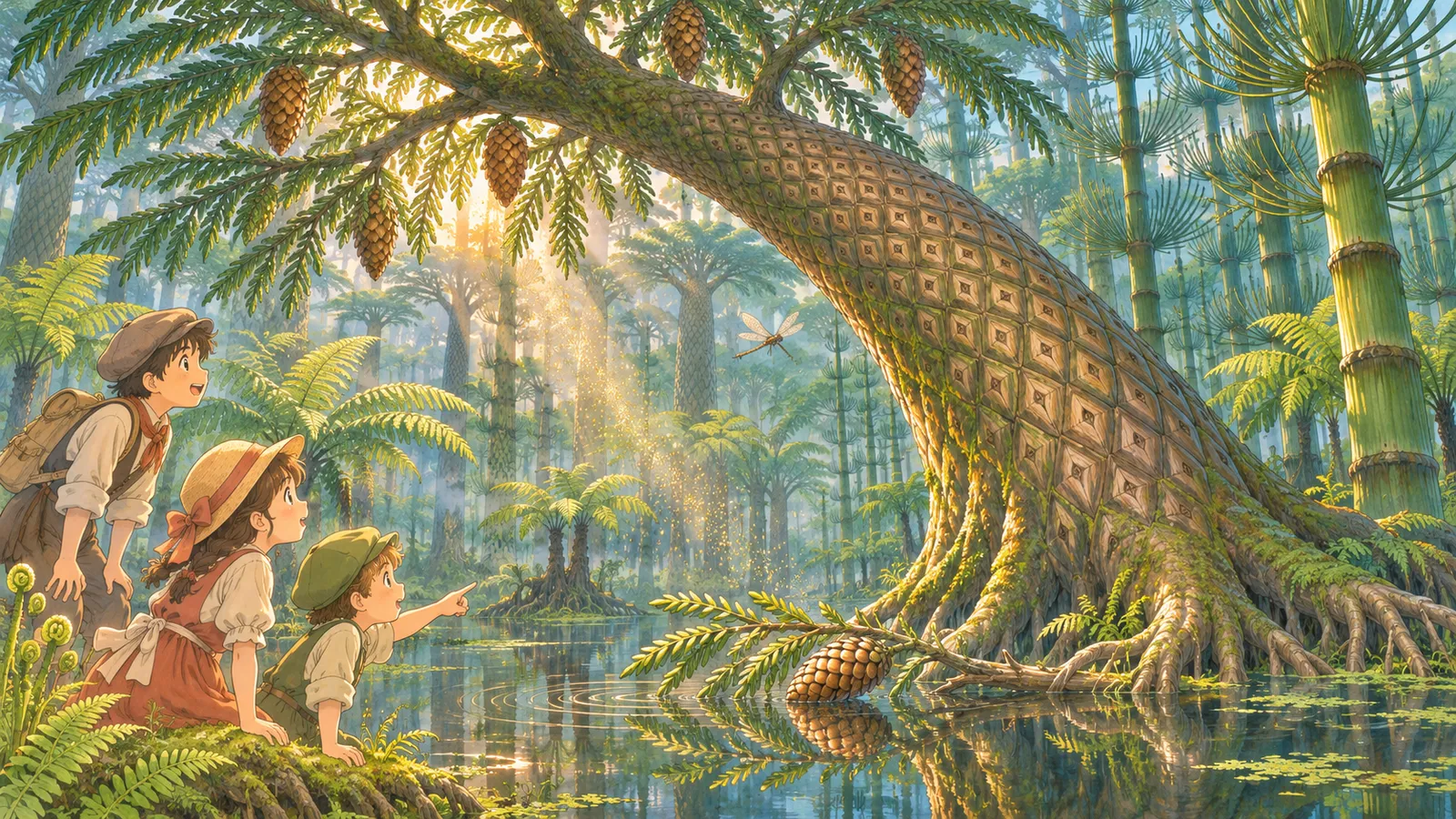
Now this little Selaginella is of all living plants the one most like some of the gigantic trees of the coal-forests.さて、この小さなセラギネラこそ、今生きているすべての植物の中で、石炭の森にあったとても大きな木のいくつかにいちばんよく似ているのです。 If you look at this picture of a coal-forest (Fig.この石炭の森の絵(図 51), you will find it difficult perhaps to believe that those great trees, with diamond markings all up the trunk, hanging over from the right to the left of the picture, and covering all the top with their boughs, could be in any way relations of the little Selaginella; yet we find branches of them in the beds above the coal, bearing cones larger but just like Selaginella cones; and what is most curious, the spores in these cones are of exactly the same kind and not any larger than those of the club-mosses.51)を見ると、絵の右から左へとおおいかぶさり、枝で上のほうをすっかりおおっている、幹のてっぺんまでひし形のもようのついた大きな木が、小さなセラギネラの親せきだなんて、信じにくいかもしれません。でも、石炭の上の層からは、この木の枝が見つかっていて、セラギネラのほより大きいけれどそっくりなほをつけています。そして何よりふしぎなことに、そのほの中のほう子は、ヒカゲノカズラのほう子とまったく同じ種類で、大きさも少しも大きくないのです。
These trees are called by botanists Lepidodendrons, or scaly trees; there are numbers of them in all coal-mines, and one trunk has been found 49 feet long.この木は、植物学者たちにレピドデンドロン、つまり「うろこの木」とよばれています。どの炭こうにもたくさんあり、49フィート(約15メートル)もの長さの幹が見つかったこともあります。 Their branches were divided in a curious forked manner and bore cones at the ends.枝は、ふしぎなふたまたの形に分かれていて、先にほをつけていました。 The spores which fell from these cones are found flattened in the coal, and they may be seen scattered about in the coal-ball.このほから落ちたほう子は、石炭の中にぺしゃんこになって見つかり、炭球の中にもちらばっているのが見られます。
Another famous tree which grew in the coal-forests was the one whose roots we found in the floor or underclay of the coal.石炭の森に生えていたもう1つの有名な木は、石炭のゆか、つまり下ばんねん土で根が見つかった、あの木です。 It has been called Sigillaria, because it has marks like seals (sigillum, a seal) all up the trunk, due to the scars left by the leaves when they fell from the tree.この木はシギラリアとよばれています。幹のてっぺんまで、はんこ(ラテン語でシギルム)のようなあとがついているからです。これは、葉が木から落ちたときに残ったあとなのです。 You will see the Sigillarias on the left-hand side of the coal-forest picture, having those curious tufts of leaves springing out of them at the top.石炭の森の絵の左側に、てっぺんからふしぎな葉のふさが出ているシギラリアが見えるでしょう。 Their stems make up a great deal of the coal, and the bark of their trunks is often found in the clays above, squeezed flat in lengths of 30, 60, or 70 feet.シギラリアのくきは石炭のかなりの部分をしめていて、幹の皮は、上のねん土の中で、30、60、70フィートもの長さのまま、ぺしゃんこにおしつぶされて見つかることがよくあります。 Sometimes, instead of being flat the bark is still in the shape of a trunk, and the interior is filled with sane; and then the trunk is very heavy, and if the miners do not prop the roof up well it falls down and kills those beneath it.ときには、皮がぺしゃんこにならずに幹の形のまま残り、中に砂がつまっていることがあります。そうなると幹はとても重く、こう夫たちが天井をしっかり支えておかないと、落ちてきて下にいる人を死なせてしまいます。 Stigmaria is the root of the Sigillaria, and is found in the clays below the coal.スティグマリアはシギラリアの根で、石炭の下のねん土の中に見つかります。 Botanists are not yet quite certain about the seed-cases of this tree, but Mr. Carruthers believes that they grew inside the base of the leaves, as they do in the quillwort, a small plant which grows at the bottom of our mountain lakes.植物学者たちは、この木のたねのふくろについてまだはっきりとはわかっていません。でもカラザーズさんは、それが葉のつけ根の内側にできていたのだろうと考えています。わたしたちの国の山の湖の底に生える小さな植物、ミズニラと同じようにです。
But what is that curious reed-like stem we found in the piece of shale (see Fig.では、けつ岩のかけらに見つけた、あのふしぎなアシのようなくきは何でしょう(図 47)?47を見てください)? That stem is very important, for it belonged to a plant called a Calamite, which, as we shall see presently, helped to sift the earth away from the coal and keep it pure.このくきはとても大切です。カラミテスという植物のもので、あとで見るように、石炭から土をこし分けて、石炭を純すいに保つ手助けをしたのです。 This plant was a near relation of the "horsetail," or Equisetum, which grows in our marshes; only, just as in the case of the other trees, it was enormously larger, being often 20 feet high, whereas the little Equisetum, Fig.この植物は、わたしたちの国のぬま地に生える「トクサ」(エクイセタム)の近い親せきでした。ただ、ほかの木と同じように、とてつもなく大きく、高さ20フィート(約6メートル)になることもよくありました。小さなトクサ(図 52, is seldom more than a foot, and never more than 4 feet high in England, though in tropical South America they are much higher.52)は、イングランドでは1フィート(約30センチ)をこえることはめったになく、4フィートより高くなることはけっしてありません。もっとも、熱帯の南アメリカでは、ずっと高くなりますが。 Still, if you have ever gathered "horsetails," you will see at once that those trees in the foreground of the picture (Fig.それでも、「トクサ」をつんだことがあれば、絵の手前にある、枝のまわりに葉が星の形に並んだ木(図 51), with leaves arranged in stars round the branches, are only larger copies of the little marsh-plants; and the seed-vessels of the two plants are almost exactly the same.51)は、小さなぬま地の草を大きくしただけのものだと、すぐにわかるでしょう。そして2つの植物のたねの入れ物は、ほとんどまったく同じなのです。
These great trees, the Lepidodendrons, the Sigillarias, and the Calamites, together with large tree-ferns, are the chief plants that we know of in the coal-forests.こうした大きな木、レピドデンドロン、シギラリア、カラミテスと、大きな木生シダが、石炭の森にあったとわかっているおもな植物です。 It seems very strange at first that they should have been so large when their descendants are now so small, but if you look at our chief plants and trees now, you will find that nearly all of them bear flowers, and this is a great advantage to them, because it tempts the insects to bring them the pollen-dust, as we saw in the last lecture.子孫が今ではこんなに小さいのに、むかしはあれほど大きかったというのは、はじめはとてもふしぎに思えます。でも、今のおもな草や木を見てみると、そのほとんどが花をさかせることがわかるでしょう。これは植物にとって大きな強みです。前回のお話で見たように、虫をさそって花粉を運んできてもらえるからです。
Now the Lipidodendrons and their companions had no true flowers, but only these seed-cases which we have mentioned; but as there were no flowering plants in their time, and they had the ground all to themselves, they grew fine and large.ところが、レピドデンドロンとその仲間には本当の花がなく、さっき話したようなたねのふくろしかありませんでした。でも、その時代には花をさかせる植物がなく、地面をひとりじめしていたので、りっぱに大きく育ったのです。 By-and-by, however, when the flowering plants came in, these began to crowd out the old giants of the coal-forests, so that they dwindled and dwindled from century to century till their great-great- grandchildren, thousands of generations after, only lift up their tiny heads in marshes and on heaths, and tell us that they were big once upon a time.ところがやがて、花をさかせる植物が出てくると、それが石炭の森の古い大木たちをおしのけはじめました。そのため大木たちは、何百年、何千年とたつうちにどんどん小さくなり、何千代もあとのひいひい孫たちは、ぬま地やあれ地で小さな頭をもたげて、むかしむかしは自分たちも大きかったんだよ、と教えてくれるだけになってしまったのです。
And indeed they must have been magnificent in those olden days, when they grew thick and tall in the lonely marshes where plants and trees were the chief inhabitants.そして本当に、そのむかし、草や木がおもな住人だった人けのないぬま地で、こうした木がしげり、高くそびえていたころは、さぞかしすばらしいながめだったにちがいありません。 We find no traces in the clay-beds of the coal to lead us to suppose that men lived in those days, nor lions, nor tigers, nor even birds to fly among the trees; but these grand forests were almost silent, except when a huge animal something like a gigantic newt or frog went croaking through the marsh, or a kind of grasshopper chirruped on the land.石炭のねん土の層には、そのころ人間が住んでいたと思わせるあとは見つかりません。ライオンもトラも、木々のあいだを飛ぶ鳥さえもいませんでした。この大きな森は、イモリやカエルをとても大きくしたような大きな動物がぬま地をゲロゲロ鳴きながら歩いたり、バッタの仲間が陸でチッチッと鳴いたりするほかは、ほとんど静まりかえっていたのです。 But these forms of life were few and far between, compared to the huge trees and tangled masses of ferns and reeds which covered the whole ground, or were reflected in the bosom of the large pools and lakes round about which they grew.でも、こうした生き物はほんの少ししかいませんでした。地面いっぱいをおおい、あるいはまわりに生えていた大きな池や湖の水面に、すがたをうつしていたとても大きな木々や、からみ合ったシダやアシにくらべれば、ほんのわずかだったのです。
And now, if you have some idea of the plants and trees of the coal, it is time to ask how these plants became buried in the earth and made pure coal, instead of decaying away and leaving behind only a mixture of earth and leaves?でも、こうした生き物はほんの少ししかいませんでした。地面いっぱいをおおう、とても大きな木々や、からみ合ったシダやアシにくらべれば、ほんのわずかだったのです。そうした植物は、大きな池や湖のまわりにも生え、その水面にすがたをうつしていました。
To answer this question, I must ask you to take another journey with me across the Atlantic to the shores of America, and to land at Norfolk in Virginia, because there we can see a state of things something like the marshes of the coal-forests.この問いに答えるために、もう一度わたしといっしょに、大西洋をこえてアメリカの岸辺へ旅をし、バージニア州のノーフォークに上陸してもらわなければなりません。そこでは、石炭の森のぬま地に少し似た様子が見られるからです。 All round about Norfolk the land is low, flat, and marshy, and to the south of the town, stretching far away into North Carolina, is a large, desolate swamp, no less than forty miles long and twenty-five broad.ノーフォークのまわりは、どこも土地が低く、平らで、じめじめしています。町の南には、ノースカロライナ州まで遠く広がる、長さ40マイル、はば25マイルにもなる、大きくてさびしいぬま地があります。 The whole place is one enormous quagmire, overgrown with water-plants and trees.そこ全体が、水草や木におおわれた、一つのとても大きなぬかるみなのです。 The soil is as black as ink from the old, dead leaves, grasses, roots, and stems which lie in it; and so soft, that everything would sink into it, if it were not for the matted roots of the mosses, ferns, and other plants which bind it together.土は、古いかれ葉や草や根やくきがうまっているせいで、インクのようにまっ黒です。そして、コケやシダなどの植物の根がからみ合ってしっかりつなぎとめていなければ、何もかもしずんでしまうほどやわらかいのです。 You may dig down for ten or fifteen feet, and find nothing but peat made of the remains of plants which have lived and died there in succession for ages and ages, while the black trunks of the fallen trees lie here and there, gradually being covered up by the dead plants.10〜15フィートほり下げても、何代も何代もそこで生きては死んできた植物のなごりでできた、ピート(でい炭)しか見つかりません。そして、たおれた木の黒い幹があちこちに横たわり、かれた植物にだんだんうめられていっています。
The whole place is so still, gloomy, and desolate, that it goes by the name of the "Great Dismal Swamp," and you see we have here what might well be the beginning of a bed of coal; for we know that peat when dried becomes firm and makes an excellent fire, and that if it were pressed till it was hard and solid it would not be unlike coal.あたり全体がとても静かで、うす暗く、さびしいので、ここは「グレート・ディズマル・スワンプ(大いなるいんきなぬま)」という名でよばれています。ここには、石炭の層の始まりといってもよいものがあるのです。ピートはかわかすとかたくなり、とてもよい燃料になりますし、かたく固まるまでおしつけたら、石炭に似たものになるはずだとわかっているからです。 If, then, we can explain how this peaty bed has been kept pure from earth, we shall be able to understand how a coal-bed may have been formed, even though the plants and trees which grow in this swamp are different from those which grew in the coal-forests.ですから、このピートの層がどうやって土からきれいに保たれてきたのかを説明できれば、このぬまに生えている草や木は石炭の森のものとはちがっていても、石炭の層がどうやってできたのかがわかるはずです。
The explanation is not difficult; streams flow constantly, or rather ooze into the Great Dismal Swamp from the land that lies to the west, but instead of bringing mud in with them as rivers bring to the sea, they bring only clear, pure water, because, as they filter for miles through the dense jungle of reeds, ferns, and shrubs which grow round the marsh, all the earth is sifted out and left behind.その説明はむずかしくありません。西の土地から、ぬまへはいつも小川が流れこんでいます。というより、しみこんでいます。でも、川が海へどろを運ぶのとちがって、この小川はすんだきれいな水しか運んできません。ぬまのまわりに生えているアシやシダや低い木の深いしげみの中を、何マイルもかけてこされてくるうちに、土はすっかりこし分けられて、あとに残されるからです。 In this way the spongy mass of dead plants remains free from earthy grains, while the water and the shade of the thick forest of trees prevent the leaves, stems, etc., from being decomposed by the air and sun.こうして、スポンジのようなかれ草のかたまりは土のつぶがまざらないままになり、いっぽう、水としげった木々のかげが、葉やくきなどが空気や日の光でくさるのをふせいでいるのです。 And so year after year as the plants die they leave their remains for other plants to take root in, and the peaty mass grows thicker and thicker, while tall cedar trees and evergreens live and die in these vast, swampy forests, and being in loose ground are easily blown down by the wind, and leave their trunks to be covered up by the growing moss and weeds.こうして、毎年毎年、植物はかれてはなごりを残し、そこにほかの植物が根をはります。ピートのかたまりはどんどん厚くなり、いっぽうで、背の高いシーダーの木や常緑樹が、この広いぬま地の森で生きては死んでいきます。こうした木は、やわらかい地面に立っているので風でかんたんにたおされ、幹を残して、のびていくコケや草におおわれていくのです。