
 11分
 朗読 Ruth Golding
 原文そのまま

 PDFで印刷(A4 9まい)
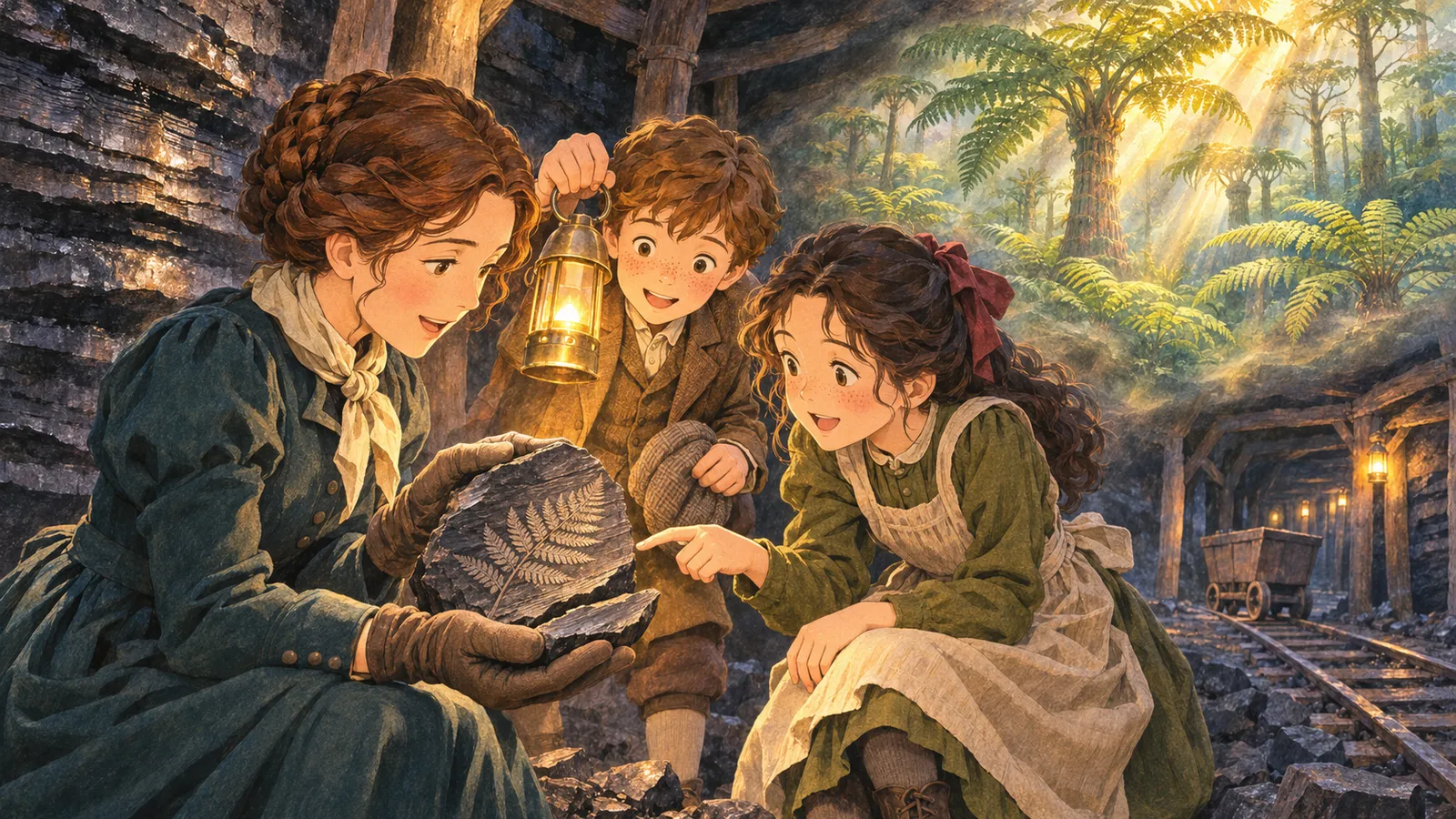
I have here a piece of coal (Fig.ここに石炭のかけらがあります(図 45), which, though it has been cut with some care so as to have a smooth face, is really in no other way different from any ordinary lump which you can pick for yourself out of the coal-scuttle.45)。表面がなめらかになるように少していねいに切ってありますが、そのほかは、石炭入れから自分でつまみ出せるふつうのかたまりと、まったく変わりません。 Our work to-day is to relate the history of this black lump; to learn what it is, what it has been, and what it will be.今日のわたしたちの仕事は、この黒いかたまりの歴史を語ること、つまり、これが何なのか、むかしは何だったのか、これから何になるのかを学ぶことです。
It looks uninteresting enough at first sight, and yet if we examine it closely we shall find some questions to ask even about its appearance.ひと目見たところでは、おもしろくもなさそうに見えます。でも、よく調べてみると、その見かけについてさえ、たずねてみたいことがいくつか見つかります。 Look at the smooth face of this specimen and see if you can explain those fine lines which run across so close together as to look like the edges of the leaves of a book.この見本のなめらかな面を見て、本のページのはしのように見えるほど、ぎっしり並んで横切っている細い線を、説明できるかどうか考えてみてください。 Try to break a piece of coal, and you will find that it will split much more easily along those lines than across the other way of the lump; and if you wish to light a fire quickly you should always put this lined face downwards so that the heat can force its way up through these cracks and gradually split up the block.石炭のかけらを割ろうとしてみると、かたまりの別の向きに割るより、この線にそってのほうが、ずっとかんたんに割れることがわかるでしょう。だから、火を早くおこしたいときは、この線のある面をいつも下に向けておくとよいのです。そうすると、熱がこのわれ目を通って上へおし進み、だんだんかたまりを割っていくからです。 Then again if you break the coal carefully along one of these lines you will find a fine film of charcoal lying in the crack, and you will begin to suspect that this black coal must have been built up in very thin layers, with a kind of black dust between them.また、この線の1本にそって石炭をていねいに割ると、われ目に木炭のうすいまくがはさまっているのが見つかるでしょう。そして、この黒い石炭は、とてもうすい層が何まいも重なってできていて、そのあいだに黒い粉のようなものがはさまっているにちがいない、と思いはじめるでしょう。
The next thing you will call to mind is that this coal burns and gives flame and heat, and that this means that in some way sunbeams are imprisoned in it; lastly, this will lead you to think of plants, and how they work up the strength of the sunbeams into their leaves, and hide black carbon in even the purest and whitest substance they contain.次に思い出すのは、この石炭がもえてほのおと熱を出すということ、そしてそれは、なんらかの形で日の光がその中に閉じこめられているということです。そして最後に、植物のことを思いうかべるでしょう。植物が日の光の力を葉の中に作りかえてたくわえ、いちばん純すいでまっ白な物質の中にさえ黒い炭素をかくしていたことを。
Is coal made of burnt plants, then?次に思い出すのは、この石炭がもえてほのおと熱を出すということ、そしてそれは、なんらかの形で日の光がその中に閉じこめられているということです。そして最後に、植物のことを思いうかべるでしょう。植物が日の光の力を葉の中に作りかえてたくわえ、いちばん純すいでまっ白な物質の中にさえ黒い炭素をかくしていることを。 Not burnt ones, for if so it would not burn again; but you may have read how the makers of charcoal take wood and bake it without letting it burn, and then it turns black and will afterwards make a very good fire; and so you will see that it is probable that our piece of coal is made of plants which have been baked and altered, but which have still much sunbeam strength bottled up in them, which can be set free as they burn.もえた植物ではありません。もしそうなら、もう一度もえることはないからです。でも、炭焼きの人たちが、木をもやさずにむし焼きにすると、木が黒くなって、あとでとてもよい火になることを、本で読んだことがあるかもしれません。ですから、この石炭のかけらは、むし焼きにされて変化した植物でできていて、その中にはまだ日の光の力がたくさんびんづめのように閉じこめられていて、もえるときに自由になるのだろう、と考えられるのです。
If you will take an imaginary journey with me to a coal-pit near Newcastle, which I visited many years ago, you will see that we have very good evidence that coal is made of plants, for in all coal-mines we find remains of them at every step we take.わたしがずっと前におとずれた、ニューカッスルの近くの炭こうへ、いっしょに想像の旅をしてみましょう。そうすれば、石炭が植物でできているという、とてもよい証こがあることがわかります。どの炭こうでも、一歩進むごとに植物のなごりが見つかるからです。
Let us imagine that we have put on old clothes which will not spoil, and have stepped into the iron basket (see Fig.よごれてもかまわない古い服を着て、鉄のかご(図 46) called by the miners a cage, and are being let down the shaft to the gallery where the miners are at work.46を見てください)に乗りこんだと想像しましょう。これは炭こうではたらく人たちが「ケージ」とよぶもので、わたしたちは、たて穴をおろされて、こう夫たちがはたらいているこう道へ向かっています。 Most of them will probably be in the gallery b, because a great deal of the coal in a has been already taken out.こう夫たちのほとんどは、たぶんこう道bにいるでしょう。こう道aの石炭は、もうたくさんほり出されてしまっているからです。 But we will stop in a because there we can see a great deal of the roof and the floor.でも、わたしたちはこう道aでおりることにします。そこでは天井とゆかをたくさん見ることができるからです。 When we land on the floor of the gallery we shall find ourselves in a kind of tunnel with railway lines laid along it and trucks laden with coal coming towards the cage to be drawn up, while empty ones are running back to be loaded where the miners are at work.こう道のゆかにおり立つと、そこはトンネルのようになっていて、線路がしかれています。石炭を山づみにしたトロッコが、引き上げてもらうためにケージのほうへやって来て、からのトロッコは、こう夫たちがはたらいているところで石炭をつむために走ってもどっていきます。 Taking lamps in our hands and keeping out of the way of the trucks, we will first throw the light on the roof, which is made of shale or hardened clay.ランプを手に持ってトロッコをよけながら、まず天井に明かりを向けてみましょう。天井は、けつ岩、つまりかたまったねん土でできています。 We shall not have gone many yards before we see impressions of plants in the shale, like those in this specimen (Fig.何ヤードも進まないうちに、けつ岩の中に植物のあとが見えてきます。この見本(図 47), which was taken out of a coal-mine at Neath in Glamorganshire, a few days ago, and sent up for this lecture.47)にあるようなものです。これはグラモーガンシャーのニースの炭こうから数日前にほり出され、このお話のために送られてきたものです。 You will recognize at once the marks of ferns (a), for they look like those you gather in the hedges of an ordinary country lane, and that long striped branch (b) does not look unlike a reed, and indeed it is something of this kind, as we shall see by-and-by.シダのあと(a)は、すぐにわかるでしょう。ふつうのいなか道の生けがきでつむシダとそっくりだからです。そして、あの細長いしまもようのある枝(b)は、アシに似ていなくもありません。じっさい、あとで見るように、これはアシの仲間のようなものなのです。 You will find plenty of these impressions of plants as you go along the gallery and look up at the roof, and with them there will be others with spotted stems, or with stems having a curious diamond pattern upon them, and many ferns of various kinds.こう道を進みながら天井を見上げると、こうした植物のあとがたくさん見つかります。そのなかには、くきに点々のもようがあるものや、ひし形のふしぎなもようがあるもの、それにいろいろな種類のシダもたくさんあります。
Next look down at your feet and examine the floor.次は足もとを見て、ゆかを調べてみましょう。 You will not have to search long before you will almost certainly find a piece of stone like that represented in Fig.それほど長くさがさないうちに、ほぼまちがいなく、図 48, which has also come from Neath Colliery.48にかいてあるような石のかけらが見つかるでしょう。これもニース炭こうから来たものです。 This fossil, which is the cast of a piece of a plant, puzzled those who found it for a very long time.この化石は、植物のかけらの型をとったようなもので、見つけた人たちを長いあいだなやませてきました。 At last, however, Mr. Binney found the specimen growing to the bottom of the trunk of one of the fossil trees with spotted stems, called Sigillaria; and so proved that this curious pitted stone is a piece of fossil root, or rather underground stem, like that which we found in the primrose, and that the little pits or dents in it are scars where the rootlets once were given off.でもとうとう、ビニーさんが、シギラリアとよばれる、くきに点々のもようのある化石の木の幹の下のほうに、この見本がくっついて生えているのを見つけました。こうして、このあなぼこだらけのふしぎな石は、化石になった根、というより、サクラソウで見つけたような地下のくきのかけらで、小さなあなやくぼみは、かつて細い根が出ていたあとなのだと証明されたのです。
Whole masses of these root-stems, with ribbon-like roots lying scattered near them, are found buried in the layer of clay called the underclay which makes the floor of the coal, and they prove to us that this underclay must have been once the ground in which the roots of the coal-plants grew.こうした根のくきが、リボンのような根をまわりにちらばらせて、かたまりになってたくさん見つかるのは、石炭のゆかになっている「下ばんねん土」とよばれるねん土の層の中です。このことから、下ばんねん土はかつて、石炭になった植物の根がはっていた地面だったにちがいないとわかるのです。 You will feel still more sure of this when you find that there is not only one straight gallery of coal, but that galleries branch out right and left, and that everywhere you find the coal lying like a sandwich between the floor and the roof, showing that quite a large piece of country must be covered by these remains of plants all rooted in the underclay.石炭のこう道がまっすぐな1本だけでなく、右へ左へと枝分かれしていて、どこでも石炭がゆかと天井のあいだにサンドイッチのようにはさまっているのを見れば、さらにそう確信するでしょう。かなり広い土地が、下ばんねん土に根をはった植物のなごりでおおわれているにちがいない、ということになるからです。
But how about the coal itself?でも、石炭そのものはどうでしょう? It seems likely, when we find roots below and leaves and stems above, that the middle is made of plants, but can we prove it?下には根があり、上には葉やくきがあるのですから、まん中も植物でできていそうですが、それを証明できるでしょうか? We shall see presently that it has been so crushed and altered by being buried deep in the ground that the traces of leaves have almost been destroyed, though people who are used to examining with the microscope, can see the crushed remains of plants in thin slices of coal.あとで見るように、石炭は地中深くうめられて、とてもおしつぶされ、変化しているので、葉のあとはほとんどこわれてしまっています。でも、けんび鏡で調べることになれた人には、石炭をうすく切ったものの中に、おしつぶされた植物のなごりが見えるのです。
But fortunately for us, perfect pieces of plants have been preserved even in the coal-bed itself.でも、ありがたいことに、石炭の層そのものの中にさえ、植物の完全なかけらが残されていることがあります。 Do you remember our learning in Lecture IV, that water with lime in it petrifies things, that is, leaves carbonate of lime to fill up grain by grain the fibres of an animal or plant as the living matter decays, and so keeps an exact representation of the object?第4回のお話で、石灰をふくんだ水はものを石にすること、つまり、生き物の体がくさっていくにつれて、動物や植物のせんいを炭酸カルシウムが一つぶ一つぶうめていき、もとのものの形を正確に残すことを学んだのをおぼえていますか?
Now, it so happens that in a coal-bed at South Ouram, near Halifax, as well as in some other places, carbonate of lime trickled in before the plants were turned into coal, and made some round nodules in the plant-bed, which look like cannon- balls.さて、ちょうどハリファックスの近くのサウス・オーラムの石炭層などでは、植物が石炭に変わる前に炭酸カルシウムがしみこんで、植物の層の中に、大ほうのたまのような丸いかたまりを作りました。 Afterwards, when all the rest of the bed was turned into coal, these round balls remained crystallized, and by cutting thin transparent slices across the nodule we can distinctly see the leaves and stems and curious little round bodies which make up the coal.そのあと、層の残りの部分がすべて石炭に変わっても、この丸いかたまりは結しょうのまま残りました。そこで、かたまりをすき通るほどうすく切ると、石炭を作っている葉やくきや、ふしぎな小さな丸いつぶが、はっきりと見えるのです。 Several such sections may be seen at the British Museum, and when we compare these fragments of plants with those which we find above and below the coal-bed, we find that they agree, thus proving that coal is made of plants, and of those plants whose roots grew in the clay floor, while their heads reached up far above where the roof now is.こうした切り口のいくつかは大英博物館で見ることができます。この植物のかけらを、石炭層の上や下で見つかるものとくらべると、一ちすることがわかります。こうして、石炭は植物でできていること、それも、ねん土のゆかに根をはり、頭は今の天井よりはるか上までのびていた植物でできていることが、証明されるのです。
The next question is, what kind of plants were these?次の問いは、それがどんな種類の植物だったか、です。 Have we anything like them living in the world now?今の世界に、それに似た植物は生きているでしょうか? You might perhaps think that it would be impossible to decide this question from mere petrified pieces of plants.石になった植物のかけらだけで、この問いに答えるのはむりだと思うかもしれません。 But many men have spent their whole lives in deciphering all the fragments that could be found, and though the section given in Fig.でも、多くの人が、見つかるかぎりのかけらを読み解くのに一生をささげてきました。図 49 may look to you quite incomprehensible, yet a botanist can reed it as we read a book.49の切り口は、あなたにはまったくわけがわからないように見えるかもしれませんが、植物学者は、わたしたちが本を読むように、それを読むことができるのです。 For example, at S and L, where stems are cut across, he can learn exactly how they were build up inside, and compare them with the stems of living plants, while the fruits cc and the little round spores lying near them, tell him their history as well as if he had gathered them from the tree.たとえば、SとLのところではくきが横に切られているので、くきの中がどんなふうにできていたかを正確に知り、今生きている植物のくきとくらべることができます。また、実(cc)とそのそばにある小さな丸いほう子は、木からつんできたのと同じくらい、その植物の歴史を教えてくれるのです。 In this way we have learnt to know very fairly what the plants of the coal were like, and you will be surprised when I tell you that the huge trees of the coal-forests, of which we sometimes find trunks in the coal-mines from ten to fifty feet long, are only represented on the earth now by small insignificant plants, scarcely ever more than two feet, and often not many inches high.こうしてわたしたちは、石炭の植物がどんなものだったかを、かなりよく知るようになりました。そして、聞いたらおどろくでしょうが、炭こうで10〜50フィート(約3〜15メートル)もの長さの幹が見つかることもある石炭の森のとても大きな木は、今の地球では、2フィート(約60センチ)をこえることはまずなく、数インチの高さしかないことも多い、小さくて目立たない植物しか、その仲間として残っていないのです。